The National University of Singapore (NUS) and Sunway University in Malaysia are ranked ASEAN's No. 1 public and private universities respectively in the AppliedEdu University Rankings 2027 for ASEAN*.
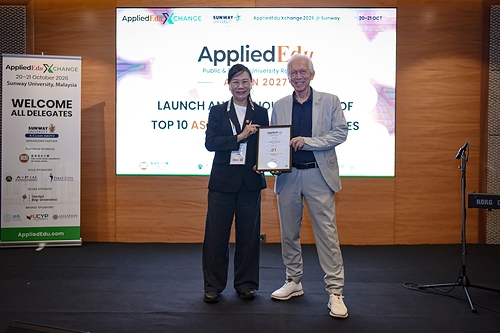 |
| Source: Sunway University. Mandy Mok, Founder and CEO of AppliedEdu (left) and Professor Sibrandes Poppema, President and Vice-Chancellor of Sunway University (right). |
NUS leads the public university rankings for the 3rd consecutive year, while Sunway University retains the top private university spot for the 4th consecutive year.
A total of 316 universities across nine ASEAN countries have been ranked, up by a third from 237 last year. More than 100,000 validated student survey responses inform the results, alongside academic peer nominations and verified institutional data.
Malaysia claims seven of the top 10 private university positions and half of the top 10 public university positions. It also has more institutions in the top 50 of each category than any other country, with 21 private and 16 public universities.
"Being named ASEAN's No. 1 private university for the fourth consecutive year is a proud moment for Sunway University and for Malaysia. Our ambition is for every graduate to leave with the knowledge, confidence and experience to build a meaningful career and contribute positively to society. That is what being a mission-driven 5th Generation University means to us. This recognition drives us to keep raising the standard of the education we offer," said Professor Sibrandes Poppema, President and Vice-Chancellor of Sunway University.
The AppliedEdu ranking approach gives the greatest weight to teaching and learning, which accounts for 40% of the assessment. Employability contributes a further 20% for private universities and 15% for public universities. Together, these measures represent 60% and 55% of the respective scores, making the quality of education and graduate student outcomes central to the results.
Students directly inform the assessment through their views on teaching, facilities and campus life. Public and private universities are ranked separately, using different weightings to reflect their missions. Research, institutional reputation, community engagement and internationalisation complete the assessment, recognising a range of contributions that universities make to students and society.
"Rankings should do more than recognise achievement; they should drive improvement," said Mandy Mok, Founder and CEO of AppliedEdu. "They should help universities build on their strengths, identify where change is needed, and make informed decisions that deliver better outcomes for students and the communities they serve."
Across ASEAN:
Singapore
The National University of Singapore retains ASEAN's No. 1 public university position for the 3rd consecutive year, followed by Nanyang Technological University, Singapore, in 2nd place. Four of the country's five ranked universities feature in the top 50.
Malaysia
Universiti Kebangsaan Malaysia is the country's highest-ranked public university, placing third in ASEAN. Among private universities, Sunway University retains its regional No. 1 position, while Asia Pacific University of Technology & Innovation has climbed from 5th to 2nd. Taylor's University and Universiti Teknologi PETRONAS rank 3rd and 4th respectively.
Indonesia
With 102 institutions, Indonesia has the largest representation in the rankings. Universitas Airlangga leads the country's public universities at 10th in ASEAN, while Syarif Hidayatullah State Islamic University Jakarta jumped 22 places to 61st. Among private universities, Bina Nusantara University (BINUS) leads the country, rising from 8th to 5th regionally. Universitas Muhammadiyah Malang records the largest rise across both categories, rising 53 places to 57th. The Muhammadiyah University of Sidoarjo advanced 39 places to 37th, while Institut Teknologi Nasional Bandung is up 27 places. Both are in the private university rankings.
The Philippines
With 79 ranked institutions, the Philippines has the second-largest national representation. The University of the Philippines leads the country's public universities at 25th in ASEAN. Among private universities, the University of Santo Tomas leads the country, climbing six places from 14th to eighth regionally. First City Providential College also advances 27 places in the private university rankings.
Thailand. Thailand has 43 institutions in the rankings. Chulalongkorn University leads the country's public universities at ninth in ASEAN, with 11 Thai institutions featuring in the public top 50. Krirk University is the country's highest-ranked private university, placing seventh regionally.
Vietnam. Vietnam's public universities record strong gains. The University of Economics Ho Chi Minh City leads the country's public universities at 33rd in ASEAN after climbing 23 places. Ton Duc Thang University advances 27 places to 34th, while Vietnam National University Ho Chi Minh City rises 22 places to 44th. Among private universities, Duy Tan University leads the country at 14th regionally, while Nguyen Tat Thanh University climbs 30 places to 26th.
Brunei. Universiti Brunei Darussalam remains the country's highest-ranked public university and returns to ASEAN's public university top ten, climbing from 12th to eighth.
Cambodia. The University of Puthisastra is the country's highest-ranked private university, placing 28th in ASEAN.
Myanmar. The University of Yangon is the country's highest-ranked public university, placing in the 101–110 band in ASEAN.
Across the region, 23 universities enter the top 100 for the first time. They include Indonesia's Universitas Brawijaya at 36th among public universities, Thailand's Shinawatra University at 21st among private universities and Malaysia's IMU University at 25th among private universities.
The AppliedEdu University Rankings 2027 for ALL ASIA will follow on 30 November 2026. Full ASEAN results are available at appliededu.com/rankings.
The top 10 public universities, ASEAN 2027
1 (2026: 1) National University of Singapore (NUS), Singapore
2 (2026: 2) Nanyang Technological University, Singapore (NTU Singapore), Singapore
3 (2026: 3) Universiti Kebangsaan Malaysia (UKM), Malaysia
4 (2026: 4) Universiti Malaya (UM), Malaysia
5 (2026: 5) Universiti Putra Malaysia (UPM), Malaysia
6
Universiti Sains Malaysia (USM)
Malaysia
6
7
Universiti Teknologi Malaysia (UTM)
Malaysia
9
8
Universiti Brunei Darussalam (UBD)
Brunei
12
9 (2026: 10) Chulalongkorn University, Thailand
10 (2026: 11) Universitas Airlangg, Indonesia
The top 10 private universities, ASEAN 2027
1 (2026: 1) Sunway University, Malaysia
2 (2026: 5) Asia Pacific University of Technology & Innovation (APU), Malaysia
3 (2026: 3) Taylor's University, Malaysia
4 (2026: 4) Universiti Teknologi Petronas (UTP), Malaysia
5 (2026: 8) Bina Nusantara University (BINUS), Indonesia
6 (2026: 2) UCSI University, Malaysia
7 (2026: 6) Krirk University, Thailand
8
University of Santo Tomas
Philippines
14
9
INTI International University
Malaysia
11
10
Management and Science University (MSU)
Malaysia
10
Leading universities by country
Singapore: National University of Singapore (1st, public)
Malaysia:
Universiti Kebangsaan Malaysia (3rd, public)
Sunway University (1st, private)
Brunei: Universiti Brunei Darussalam (8th, public)
Thailand:
Chulalongkorn University (9th, public)
Krirk University (7th, private)
Indonesia
Universitas Airlangga (10th, public)
Bina Nusantara University (5th, private)
Philippines
University of the Philippines (25th, public)
University of Santo Tomas (8th, private)
Vietnam
University of Economics Ho Chi Minh City (33rd)
Duy Tan University (14th), Cambodia
—
University of Puthisastra (28th),
Myanmar
University of Yangon (101–110 band)
*The ASEAN rankings weigh six criteria: Teaching & Learning (40%), Employability (15% public, 20% private), Research (15% public, 10% private), Institutional Reputation, Community Engagement and Internationalisation (10% each). Public and private universities are never ranked together: each category has its own methodology and weights, reflecting the different missions they serve.
Two surveys sit at the heart of the method. The AppliedEdu Student Survey 2026 gathered the views of students on their teaching, facilities and campus life, with more than 100,000 responses validated and counted across the universities that took part. The AppliedEdu Peer-Nomination Survey asks academics which universities they hold in the highest regard, with every university's academics weighted equally and nominations of one's own institution excluded.
A record number of universities submitted a full set of verified institutional data through the AppliedEdu VAULT and took part in both surveys, the highest level of participation in the rankings' history. The rankings are overseen by the independent AppliedEdu Ranking Advisory Board and have been published since 2021.
The first 100 places in each table are ranked individually; places from 101 are listed in bands of ten, alphabetically. The full tables are at appliededu.com/rankings and the methodology at appliededu.com/rankings/methodology
