Showing posts with label Kickstarter. Show all posts

19 July 2017

Place a finger to your ear for your next conference call

Source: Origami Labs. The ORII smart ring is splashproof.

Move over, smart watches. The world’s first voice-powered smart ring, ORII, has launched on Kickstarter. The Bluetooth-enabled ring turns the hand into a smartphone using cutting-edge bone conduction technology to transmit sound.

ORII has dual noise-cancelling microphones that lets wearers make calls, send messages and access Siri or Google Assistant without needing to take out their phones, all by placing a fingertip to the ear. With the ORII app, users can also set custom alerts using the four LED lights on the wearable, or have it vibrate.

Beta users' rings (US$399) will ship in November 2017, and the first batch of rings (US$149) will be delivered in February 2018.

ORII is the first product from Origami Labs, a maker of voice-enabled connected hardware. The company was founded by four Hong Kong-born university friends.

Source: Origami Labs. Make discreet calls wherever you are.
Kevin Johan Wong, CEO and Co-Founder of Origami Labs said, “Our inspiration came from my dad who has been visually impaired from a young age. He set out to develop a voice and text-based technology to help others like him and is a pioneer in his field with eight patents under his name. Integrating the same technology used in hearing aids, ORII uses bone conduction to send sound discreetly to your ear, creating a device which allows freedom from screen-based interaction.”

According to a CCS Insight report, 2020 will see a wearables market worth close to US$34 billion.


Interested?

The splash-proof ORII comes in three colours - matte black, sandblasted silver and metallic dark grey

It is estimated to be good for an hour of talk time, and will require an hour of charging

Visit the Kickstarter page for ORII. At the time of writing ORII has already surpassed its Kickstarter target, but early bird rings are still available for US$99

9 June 2014

Kickstarter focus: Solar power for the rest of us

Spor Solar Charges promises portable solar battery chargers for the rest of us. According to the company, Spor is a self-regenerating battery charger for USB devices. It can be charged with AC power, or via the sun. "It can charge multiple devices at once, and can charge your phone practically as fast as a wall outlet," says the company on the Kickstarter page.

Source: Kickstarter. Spor Solar Chargers hope that the compact solar chargers will be the start of bigger things.

For US$50, a backer can get a 3D printed limited edition Spor charger, with an additional US$10 required to ship overseas.

The funding campaign ends on June 30. View the associated video here.

3 June 2014

Kickstarter focus: iFind, powered by ambient electromagnetic radiation

WeTag's iFind tags communicate with iOS or Android devices using Bluetooth and do not need to be charged. As with other locator systems, a tag is placed on the item and tracked through the phone. 

If the item moves out of range, the owner is alerted through the 'Rope' feature, and nearby phones can help detect the object through Bluetooth via the 'UHelp' feature. A fascinating feature for iFind is that shaking the iFind tags will cause the phone to vibrate, WeTag said.

Source: Kickstarter.

The difference is that the iFind tag does not contain a battery and is powered by ambient electromagnetic radiation, WeTag says. "It recycles electromagnetic energy and stores it in a unique power bank. This exciting feature frees you from the trouble of charging batteries or replacing them through the manufacturer," say the makers on the Kickstarter page.

For US$16, a backer is entitled to one locator in one of a dozen colours. Overseas shipping costs US$10.

The funding campaign ends June 30. View the associated video here.

This blog has posted on two other location-based projects: Tile, and Phone Finder.

28 May 2014

Kickstarter focus: Sit cross-legged on a CrossChair

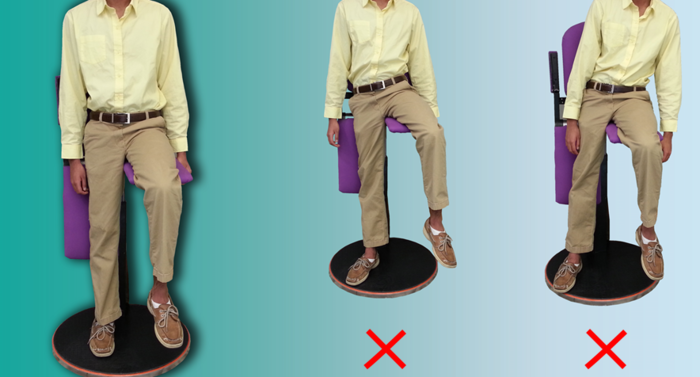
Want to sit with your legs up on your office chair? Dave McClintock has created one which allows this. The chair is so versatile, he says it can allow yoga practitioners to perform the sukhasana pose while sitting on it.

"We made this chair for the millions of workers who sit for hours per day and suffer the consequences of fatigue, back pain and stiff muscles," he said. "Sitting cross-legged would help immensely, but it is a difficult or impossible position for many of us – especially in a conventional office chair. The CrossChair makes this new option accessible to all, and allows frequent posture changes to avoid fatigue and reduce back pain."

Source: CrossChair.
Called the CrossChair, McClintock's invention allows both conventional sitting positions and cross-legged seating. The CrossChair seat has various sections which can be swung into place to accommodate different sitting arrangements. See how the chair adjusts on the Kickstarter campaign page.

CrossChairs are available for the early bird price of US$499. A shipping fee of US$100 applies for international orders.

View the associated video here. The Kickstarter campaign ends June 6.

21 May 2014

Kickstarter focus: the quick Phone Finder

The Phone Finder does just that, and with any lost smartphone, even one that is on silent mode, and will continue to do so in a no-fuss way for the next three years. Once the Phone Finder device is clicked within a 15 metre radius, the missing phone will ring, vibrate and flash even if it is on silent mode, so that the owner can find it. If the phone is out of range, the Phone Finder website will show where it is on a map.
 
Source: Kickstarter

Entrepreneur Gabsow Tom chose Bluetooth 2.1 as the underlying technology for a reason. He says on the Kickstarter page: "Bluetooth v2.1 is the only Bluetooth version to have both forward and backward compatibility, which allows Phone Finder to work on every Smartphone. It is not limited to an iOS or Android version. In comparison, Bluetooth v4.0* based products only support a very limited number of smartphone models."

Tom also promises that a Phone Finder used approximately five times a week should last up to three years. "We had to design it to consume energy only when pressed, and only for the necessary amount of time. This was a huge technical challenge...We manipulated Bluetooth to activate, transmit and communicate with the phone and then shut off automatically in order to drastically conserve energy. This way we guaranteed that if you own a Phone Finder you never have to think about charging it or maintaining it in any way," states Tom on the Kickstarter page.

A pledge of US$25 will provide the backer with a single Phone Finder and the choice of either a keychain, magnet or a sticker to use it with. The funding request expires on June 2. The associated video can be viewed here.

*A post about Tile, which uses Bluetooth 4 to locate objects, is here.

14 May 2014

Kickstarter focus: A USB cable that charges smartphones twice as fast

Minsoo and Emily Seo have come up with a USB charging cable that charges iPhones and Samsung Galaxy phones roughly twice as fast as ordinary charging cables. 

As they explain on their Kickstarter page, USB cables automatically try to communicate with the attached device while providing limited electric energy, whereas their DouBBleTime USB charging cable has a switch that limits the cable to charging only, shortening charging times substantially.


Source: Kickstarter.
"A simple yet ingenious special chip inside the switch talks to your computer saying, ‘I’m not a phone; I’m not going to sync, so give me maximum charging energy.’ This message allows the cable to bypass the capped out maximum power a USB can output and connect straight to the mainboard. The special chip also provides over current protection (OCP) and short circuit protection, which guarantees the safety of both your computer and device while charging," say the Seos on their Kickstarter page.

The second wave of backers can get their choice of a Lightning or Micro USB cable for US$18, with US$5 more for international shipping.
 
View the associated video here. The Kickstarter campaign ends May 23, and is already heavily oversubscribed.

7 May 2014

Kickstarter focus: The standing desk

Need a desk that you can stand comfortably at, but still stay productive? Steven Yu may have the answer. The StandDesk is height-adjustable from 71cm to 114cm and has various design features that allow for the fact that the desk will be adjusted quite often. 
 
Source: Kickstarter. The all-black StandDesk version.

"StandDesk is more than just a product: it is a step in the right direction to change the lives of people everywhere, for the better," said Yu on his Kickstarter page.
 
A nifty 'up/down' control button automatically raises or lowers the desk to a desired height, stopping just by tapping the button again. A customised motor balances reliability, power, and price. 

There is an optional integrated cable management tray for power cords, for example, that moves up or down as the desk moves so the wires don't get dislodged.

Yu has thought of everything, and offers the desks in black or white as well as desk surfaces in three colours and various levels of customisation. A pledge of US$399 will get a backer a StandDesk in either gloss grey or matte black with the standard two-button control, plus a laminate top in either midnight black or frosty white, for example. For US$499 backers have the privilege of joining a hackathon where they may design or create new features for the StandDesk, with prizes for the top three designs. Shipping is extra, however.
 
The funding request ends May 17. View the associated video here.

30 April 2014

Kickstarter focus: Instant reusable tailored clothing

SiDi Huang of ZipSeam has hit upon a quick and clever way of creating professional-looking, secure and temporary seams in loose clothing so that they fit the wearer better, with no need for sewing machines or tailors. 

Think the modelling industry, hand-me-downs, or just buying something you love but which doesn't fit properly, and you can see why this project has been over-subscribed so much.

Source: Kickstarter. Huang demonstrates 'before' and 'after'.
"Traditional tailoring is often expensive/cost ineffective, time consuming, and commonly permanent. If you were to take needle and thread to cloth, tailoring one shirt would take the average person well upwards of an hour to possibly result in a questionable result. A whole wardrobe? The thought of tailoring my entire closet is horrifyingly daunting," says Huang on his Kickstarter page.

If you know how the bag clips that fold into each other work, then you know the principle of the ZipSeam. While the wearer can feel the seams in place, Huang notes that they are comfortable and flexible enough to allow the wearer to move naturally.

Huang has turned to Kickstarter to help him mass produce the ZipSeam and turn out a polished product. "The tooling will be quite costly," he explains.
 
US$8 will get a backer a set of two ZipSeams, enough to fold in the two sides of one item of clothing. The first wave of delivery for single, duo and triple packs of ZipSeams are sold out. Huang is now on his second and third wave delivery requests depending on the funding terms.

The request for funding ends on May 18. View the associated video here.

24 April 2014

Kickstarter focus: A better chair that eliminates back pain

Simon Hong, a neuroscientist, wants to get funding for the Chairbot, a robot that suggests a new position for the user based on his or her existing posture.

Source: Kickstarter page
The ChairBot does away with back pain with a split seat that basically means the user 'sits' by being supported on one side and standing on the other. 

"The basic design of frequent alternation prevents trauma to the spine caused by maintaining a single posture for an extended period of time. In addition, the chair encourages the proper degree of extension of the spine, as in a standing posture. That is because you are practically standing, while half of your body weight is supported," says Hong on the Kickstarter page. "It's 2014, and we still suffer from sitting-related back pain; that's not acceptable!"

US$2,700 will get a backer a Chairbot. The funding request ends May 4.
 
View the associated video here.

17 April 2014

Kickstarter focus: Mouse Glove to replace mice

One entrepreneur hopes a "Mouse Glove" on Kickstarter will be a new way to interact with technology, possibly doing away with the need for touch screens. 

Source: Kickstarter website
"We combined a commonly used wireless computer mouse with a wearable design that allows the user to have a more comfortable and natural experience when working with their electronic devices. It puts the hand in a more comfortable position than a traditional mouse, which minimises risk of wrist injuries such as carpal tunnel syndrome," explains the Mouse Glove Kickstarter page. 

The product has the same features as a mouse like the left and right click commands, scrolling ability, and cursor control. "Along with these features we hope to also add a pinch to zoom interface and a lock button to allow the user to disable the mouse while typing," says In-Tech, the company behind the Mouse Glove. 

The initial funding will allow In-Tech to begin production and finish the development of the pinch to zoom capability. Backers who pledge US$50 will receive a mouse glove which ships only within the US. The request for funding ends on May 10.

View the associated video here.

11 April 2014

Kickstarter focus: record direct from your phone to the computer

Recap S2 is a little device that attaches to a smartphone and saves a call to a computer or voice recorder, and its inventor hopes the world will fund its manufacture. 

Source: Kickstarter website

According to inventor Igor Ramos, Recap is easy to use as it works on any device with a combo port* and outputs into any with a standard stereo MIC port. 

"(A) Recap recording will be as good as the phone call quality," said Ramos on the Kickstarter page.

View the associated video here

*A combo port inputs sound from a mike and outputs audio. It is where the earphones with mike connects to mobile phones.

5 April 2014

Kickstarter focus: TwistVolt, the designer power strip

Most power strips are just that - strips that accept traditional power plugs. The TwistVolt is a power strip that has integrated USB outlets and is able to twist and fold so as to meet power needs as required. 

Source: Kickstarter website
"Our vision was to re-imagine the power strip, to be energy efficient and give access to all outlets. The result, is industry leading energy efficiency, enough USB power to charge all of your devices - fast, in a unique patent pending non-blocking outlet design that you would want to show ON your desk, kitchen counter, living room, conference room, or anywhere where it can be seen, used, and enjoyed," says inventor Michael Schroeder. 
 
US$49 gets backers a standard TwistVolt, with no USB ports, and US$89 a TwistVolt that has two USB ports. The request for funding expires May 5.

View the associated video here.

24 March 2014

Crowdfunding takes off for some businesses

Crowdfunding has been highly successful for some entrepreneurs, with websites like Kickstarter leading the pack. The basic project puts together a concept, some pictures of the work in progress, and asks for backers to fund the product. The entrepreneur can be anywhere in the world, and the backers can come from anywhere in the world as well.

Funding is typically requested through an escalating tier of pledges, with larger backing eligible for a product with more features. The whole process can be gamified with stretch goals, with growing backing for the project 'unlocking' a new reward for everyone at selected milestones. 

While anyone can try crowdfunding, the Internet recognises those who have clearly put a lot of effort into their proposals. The more intriguing the story, the slicker the packaging and the more sophisticated the pledging plans, the more likely it is to be successful. It also helps to have something tangible which can be mailed to the backers; crowdfunding for a service is less likely to be successful, especially one that is tied to geographic location like a mobile food truck.

Most projects on Kickstarter are US-based but there are some from the Asia Pacific. Zelos Helmsman, a watch that can be made of bronze or stainless steel, is the most successful active Singapore-related project on Kickstarter at the moment, with Yahoo Singapore reporting that the project was fully funded within two days of its launch on Kickstarter. The Helmsman is over 200% subscribed at the time of writing.


CDN$1 gets name recognition on the website, and CDN$420 a Helmsman watch. "We wanted to create the Helmsman to be a modern sports watch, functional yet sleek enough to take with to the office. Its automatic movement powers the watch by your kinetic energy so no batteries will ever be needed... Each variant of the Helmsman will be limited to only 50 pieces and will be individually numbered," states Zelos Watches on the Kickstarter project page. 

Pawda, a GPS-based tracking system that works with iOS and Android mobile phones, is a project from Sydney, Australia. According to maker Ross Lambert on the Kickstarter project page, Pawda is a small lightweight GPS tracking device which fastens securely to a pet's collar. Once the pet leaves a virtual perimeter or 'safe zone', the Pawda user receives an alert on the Pawda smartphone app. A map shows exactly where the pet is. The device can track the pet using the same network as your mobile phone, in real time, in the same way that Google Maps adjusts your location as you move.

While the device is marketed for pets, it could just as well be fastened to a toddler's backpack, or to a suitcase full of money; it's up to the imagination. 

A pledge of A$45 gets a Pawda t-shirt, and A$99 the device itself. View the associated video here.

*All images from the Kickstarter website.

*All percentages correct at the time of writing.