Showing posts with label Panasonic. Show all posts

25 September 2018

Panasonic demonstrates how air quality can be improved

Panasonic stands for quality air.

"Every day we take in 18kg of air a day but nobody is talking about the air we breathe," Philip Chua, Director, Domestic Business Division, Panasonic Singapore said. Panasonic has studied how to improve air quality in addition to controlling temperature and humidity for more than half a century - 2018 is the 60th anniversary for Panasonic air-conditioners, he said.

Panasonic's Nanoe air-purification and filtering system is one technology that helps to improve air quality. Using nanotechnology, 480 billion OH radicals are released by the system per second to deactivate 99% of airborne bacteria and viruses in the filter’s indoor unit. It also neutralises odours. In a demonstration at MCE Asia, Nanoe completely removed the smell of durian from test swatches in 90 seconds. Nanoe is already in use in Toyota and Lexus cars.

The CO2 demo lab, showing how CO2 concentration levels can build up rapidly. Executive Director, Malaysia at Panasonic Ichiri Suganuma explained that Panasonic has a solution to CO2 concentrations building up rapidly in closed environments. Energy Recovery Ventilator (ERV) technology from Panasonic can remove CO2 and pipe in cool air that is free of PM 2. 5 particles. PM 2.5 refers to particulate matter which are smaller than 2.5 micrometres in size.

CO2 management is particularly important for small office-home office (SOHO) environments, which are often poorly ventilated and air-conditioned for eight hours a day, he said.

A booth representative discusses SOHO air quality.

Air quality is equally important for hotels. A survey by Expedia showed that 40% of respondents actually say indoor air quality (IAQ) is an important criterion when they book a hotel, Chua said. High CO2 levels affect productivity and performance. In a 2012 study, CO2 at 1,000 ppm caused statistically significant decrements in performance in six of nine scales of decision-making performance.

Energy Recovery Ventilator (ERV) technology from Panasonic can change CO2 levels quickly, helping people become more productive. ERV removes the polluted air and replaces it with outside air that has been filtered with Nanoe.

An energy management system for rooms makes use of various IoT sensors.

An Internet of Things (IoT) solution for hotels also keeps air quality high while managing energy in conjunction with Schneider technology.

The solution can activate or deactivate the ventilation, lighting and blinds intelligently with the help of sensors supporting the Zigbee standard. The sensors monitor room temperature, humidity and CO2, can tell whether doors are opened or closed, and detect if there are people inside.

For example, Panasonic Nanoe technology minimises odours and inhibits viruses, while door sensors will ensure that the air-conditioning is switched off if the door to the balcony has been opened. Motion and CO2 sensors can work together to determine if there are people in a room, and then switch off the lights if the room is empty.

Explaining how Aerowings  work.
Explaining how Aerowings
work.
Panasonic's energy management systems customers include Patra Jasa Hotels in Indonesia, the Travelodge Hobart in Australia, and the Gapurna Group in Malaysia.
Panasonic also demonstrated air-conditioning innovations at MCE Asia.

The Aerowings design has two independent blades that provide more control over the direction of the airflow. Traditionally, air-conditioners can only direct airflow to specific parts of the room, creating spots which can get too cold.

Aerowings can direct airflow to more parts of the room, and with the Shower Cooling capability, can direct air towards the ceiling for more even cooling in an area.

Explore:

Read the WorkSmart Asia blog posts about Singapore Green Building Week , super low energy buildings, and the TechTrade Asia blog posts about Surbana Jurong’s City of ____ and on Panasonic's device interconnectivity.

8 March 2016

Panasonic to broadcast solar eclipse live from Ternate, Indonesia

Source: Panasonic blog post. Map showing Ternate Island and path of the solar eclipse.

Panasonic will conduct a live broadcast of the 9 March 2016 solar eclipse from Ternate island in Indonesia. A solar eclipse occurs when the moon comes in between the sun and the planet Earth.

Panasonic will leverage its portable Power Supply Container for the broadcast. The container can generate approximately 3kW of electricity and store it in 24 built-in lead-acid storage batteries. The stored energy will be supplied to a Panasonic LUMIX GH4 camera attached to a telescope to capture the astronomical phenomenon. Solar energy will also power the mobile computers, production and editing equipment, Internet connection and other supporting technology used.

Interested?

This year’s live broadcast will be available on Ustream, YouTube Live and Periscope. The international live broadcast timings are (Indonesia time on March 9, UTC + 7):

Live broadcast begins (tentative) 03:00
Partial eclipse begins 06:36 
Total eclipse begins 07:50
Maximum eclipse 07:53
Total eclipse Ends 07:56
Partial eclipse ends 09:20
Live broadcast ends (tentative) 10:00

Hashtag: #PanasonicSolarEclipse

3 June 2015

Panasonic launches rugged tablet for industrial applications

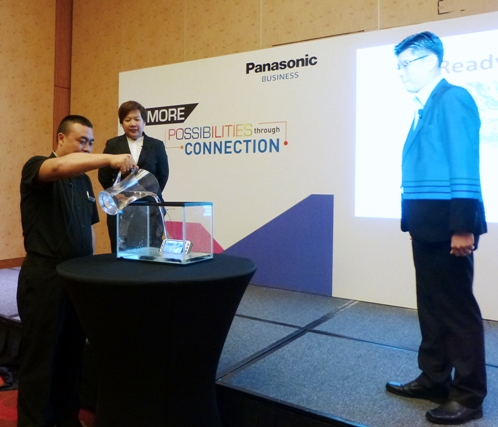
The submersion test. Staff at the Marina Bay Sands pour cold water onto the Toughpad FZ-X1, which remained operational during the entire process. Sudapa Chamod, Senior VP of Home Pro (middle) and Soh Peng Kiat, General Manager, Toughbook Solutions Team, Panasonic System Solutions Asia Pacific (right), look on.

Panasonic, which is well known for its ruggedised mobile products, has launched a rugged, 5" enterprise-class Android tablet in Asia at CommunicAsia2015. The Toughpad FZ-X1, with voice and data connectivity, is designed for mission-critical mobile workers.

“With the expanding mobile workforce and growing infrastructure investments across Asia, organisations of all sizes are evaluating their enterprise mobility strategy to ensure their mobile workers are equipped with the right devices to consistently get connected to secured data,” said Soh Peng Kiat, General Manager, Toughbook Solutions Team, Panasonic System Solutions Asia Pacific.

“Building on our legacy of nearly two decades of rugged devices, Panasonic designed the Toughpad FZ-X1 to withstand the harshest conditions, keeping workers connected to the data they need to do their jobs, to one another and to the customers they are supporting.”

Sudapa Chamod, Senior VP of Home Pro, Speaks about Home Pro's adoption of Toughpads.

Invited speaker Sudapa Chamod, Senior VP of Home Pro, a home improvement chainstore with 70 branches in Thailand and one in Malaysia, shared that the company had been looking for new mobile devices to replace an ageing handheld platform. Rather than simply replacing the handhelds, the company hoped to create more value with its investment.

"Panasonic has a good product. We did a study (and) saw that we could get cost savings, could do a lot more that would bring benefits to customers and to our business," she said. 

Home Pro uses Toughpad JT-B1 devices to serve customers, for example for price checks. "We can serve customers better, we can serve them on the spot. That's the best thing," she said. 

Panasonic’s Toughpad tablets are engineered to deliver performance, security and reliability in extreme operating conditions where consumer devices would fail. With 14-hour hot-swappable batteries, a built-in barcode scanner and sunlight-readable HD touchscreens that work even during rain, the Toughpad FZ-X1 is purpose-built to improve efficiency and productivity for mobile professionals in logistics, warehousing, utilities, retail, telecommunications and defence industries. 

The Toughpad FZ-X1 is submersible in up to 1.5 m of water for up to 30 minutes.

Resistance to drops of up to three metres show how the Toughpad FZ-X1 can go beyond MIL-STD-810G specifications to assure in-field reliability. The device is fully sealed against dust and is submersible in up to 1.5 m of water for up to 30 minutes, meeting IP68 certification requirements. It boasts an operating temperature range of -20°C to +60°C and is also tested for resistance to impact, shock, vibration, altitude and extreme humidity.

The device’s enterprise-grade features include a sunlight-readable, anti-reflective HD (1,280x720) 10-point capacitive multi-touchscreen that works even with heavy gloves, with a rain-sensing feature that allows for single touch use even in pouring rain. In addition to 8.0MP (rear) and 1.3MP (front) cameras, configuration options such as an integrated 1D/2D barcode reader and attachable magnetic stripe reader allow enterprises to customise the tablet for their needs.

The Toughpad FZ-X1 is the first device in the Toughpad line to offer optional voice connectivity. To ensure clear voice communication above engine or construction noise, the device is equipped with intelligent noise cancelling and dual front speakers reaching a maximum volume of 100 decibels — about as loud as the average home stereo system.

A major requirement for enterprise mobile solutions is full-shift battery performance. With a 6,200mAh battery providing up to 14 hours of continuous use based on Panasonic test conditions*, the Toughpad FZ-X1 is purpose-built to enable workforce productivity. A quick-charging feature allows for a 50% charge in just 1 hour and Hot Swap functionality allows a depleted battery to be swapped out for a fresh one without powering down the device, providing virtually unlimited use.

The Toughpad FZ-X1 with WiFi or mobile broadband data connectivity is available from 3 June in Singapore, Malaysia, Thailand and Indonesia at a list price of US$1,499 (WiFi-only) or US$1,699 (mobile broadband data). All Toughpad devices can be purchased through authorised Panasonic resellers.

*Battery life measurement conditions: Wireless LAN connection enabled; continuous access to the server while browsing; swipe every 1 second; page change every 30 seconds, communication every 30 seconds.

13 April 2015

Panasonic opens showrooms in Jakarta, Yangon

Source: Panasonic.

Panasonic has officially opened showrooms in Indonesia and Myanmar in quick succession, with the showroom in Jakarta launched in early April and in Yangon in late March.

The Panasonic Business Showroom in Jakarta is 230m2, located within the premises of Panasonic Gobel Indonesia. It has five experiential zones, for security, business, retail, energy and climate control. Panasonic said the facility is the first showcase of the company’s full suite of B2B solutions available in Indonesia.

A video on what is available featuring Panasonic's President Director of Panasonic Gobel Indonesia, Hiroyoshi Suga, can be viewed here.

Panasonic's first integrated showroom and service centre in Yangon showcases the full lineup of B2C and B2B offerings available for Myanmar. 
 The B2B solutions include retail, security, hotel, office, eco and solar technologies. The showroom also incorporates after-sales support services.

Corporates can also gain a deeper understanding of Panasonic’s suite of technology and solutions developed to support business growth. With a strong network of local engineering channel partners, Panasonic is capable of tailoring solutions to meet requirements across different sectors.


A second integrated showroom will open in Mandalay in April 2015, in Mahar Aung Myae Township, Haymamarlar North Quarter, Mandalay.

View the associated video here.