Showing posts with label m-commerce. Show all posts

28 April 2017

Criteo quantifies the Singaporean love of travel

+Mobile travel purchase increased 35% from 2011 to 2016, and is expected to continue growing fast

+Respondents browsed travel products online because of accessibility (74%) and convenience (69%)

+Eight in 10 (78%) choose to browse on smartphones instead of desktops/laptops because they can do so on-the-go

Criteo, the performance marketing technology company, has found that mobile travel sales will continue to grow and present the biggest growth opportunity. The findings are from a Criteo-commissioned study* by Euromonitor International, which surveyed 150 Singaporeans to analyse the online travel landscape, as well as browsing and purchase behaviours in Singapore to help travel businesses and online travel agents (OTAs) identify and adopt digital strategies to engage travellers throughout their purchase journey.

The research revealed that travel remains an area that Singaporeans are devoted to – in 2016, Singaporeans took 21.9 million outbound trips, and expenditure on leisure and recreation is expected to have a CAGR of 3.2% from 2017 to 2020. Online travel sales have grown at 7.1% CAGR in the period 2011 to 2016, and totalled S$6 billion in 2016. Mobile travel sales have accelerated, outpacing the growth of online travel sales and will see 19.6% CAGR from 2017 to 2020.

“Singaporeans are tech savvy travellers who are browsing seamlessly across multiple devices to find the best deal before making their purchase. Travel websites and OTAs need to focus on providing a mobile experience that is user-friendly, easy to navigate, has add-on features and secure payment methods. To drive transactions, they need to engage with shoppers during the discovery, search and booking phases,” said Alban Villani, GM, Criteo Southeast Asia, Hong Kong and Taiwan.

While browsing online, all shoppers used a combination of OTAs, the vendors’ own website or app and online travel price aggregators. Across all age groups, laptops are the most preferred device for online browsing of travel products and services with this method chosen by 42%, of respondents, followed by smartphones at 33% and desktops at 18%. Of those who choose to browse with their smartphones instead of laptops/desktops, over half say it is more convenient, and 78% said it was because smartphones allowed them to do so on-the-go. Other key online booking habits include:

Laptops are also the preferred device used for booking, with half of all online travel sales made on laptops, compared with 21% on smartphones and 23% on desktops.

Most shoppers still choose to book with laptops as they “prefer to use a larger screen when making purchases” (57%) and “typing a lot of personal information is difficult on a small screen” (43%).

The key drivers for booking via smartphones is being able to book anywhere (58%) and being more convenient than laptops/desktops (33%).

According to Criteo’s commissioned research, Singaporeans took an average of 5.2 trips in the last 12 months, with 63% taking five trips or fewer; almost half were mid-length stays of between three to six days. Over half (52%) of Singaporeans booked their trip between one and four months before departure, and are most likely to do so while at home (79%) on a weekend, although they would already have browsed on weekdays (56%). Other key findings on factors that affect their purchase include:

The biggest driver for online booking is convenience - 88% chose a combination of factors such as time-saving (54%) and being more convenient than a phone or physical booking (54%).

Price also plays a big part in the shift towards online travel purchases, with 44% of respondents believing that online travel providers and OTAs offer a better deal.

Half of all online travel purchases are for accommodation and air travel.
When purchasing online, Singaporeans are most likely to directly book via websites or apps of the airlines and/or lodging (52%) as it would be easier to change or cancel their booking (47%).
They also make direct purchases through OTAs (37%), as they say the website is easy to use (45%).

Online and mobile strategies are crucial for retailers and OTAs to engage with shoppers while they browse and book travel and ancillaries – 85% of shoppers have seen retargeted ads and 52% have clicked on them.

“As online and mobile purchases become more commonplace, travel businesses and OTAs need to invest more in personalised marketing. This means showing shoppers ads that are based on what they have been looking at and displaying recommendations that may complement what they have already purchased. This adds another element of discovery and up to 70% of online shoppers who are served ads in this way go on to view products they had not looked at previously. Retailers who get this right will be able to drive online conversions very effectively,” added Villani.

Interested?

Read the WorkSmart Asia blog post on travel preferences in the Asia Pacific region

*The research process for this study utilises a top-down central research model with bottom-up intelligence to present a comprehensive and accurate picture of the macro-economic landscape and travel industry in Australia, mainland China, India, Indonesia, Japan, Singapore, South Korea, Taiwan and Vietnam. Both secondary research and primary research are employed in this study. The former includes desk research on publicly available information (such as official statistics, trade press); whilst the latter includes online consumer survey and trade interview discussions with stakeholders in the industry (such as travel agencies, trade associations). Trade data and information collected, where applicable, is validated and cross-checked through both primary and secondary research, with no reliance on any single source to ensure reliability and eliminate bias. The consumer survey was conducted in February 2017 across all 9 markets.

posted from Bloggeroid

14 March 2017

Shopee Malaysia celebrates women entrepreneurs

Shopee, the mobile-first marketplace in Southeast Asia and Taiwan, has celebrated women for their contributions in conjunction with International Women’s Day on 8 March 2017.

International Women’s Day this year focuses on empowering women across the globe and encouraging them to take groundbreaking actions. Shopee Malaysia celebrates the theme by sharing stories of women entrepreneurs who have left their comfort zone to start their own businesses. By providing the fuss-free platform for buyers and sellers, plus free shipping nationwide and zero commissions as incentives, Shopee wants to encourage more women out there to nurture the hidden leadership and entrepreneurial skills within them.

One Shopee merchant who embodies #BeBoldForChange is 20-year-old Erin Ong, who is bed-bound. She started her business selling fashion items (Shopee ID: Little Flower Closet) a year ago after her father succumbed to cancer, leaving her mother widowed.

“I need to fight for my life and my mother,” she said. Despite her physical constraints, Erin and her mother work hand in hand to manage orders and packaging for their customers, earning enough for medical expenses and to support them both.
Source: Shopee. Tee Mei Hong.
Source: Shopee. Tee.

“I constantly want to improve myself to become a better person in any way possible,” she said.

Another Shopee seller (Shopee ID: Cathy Shop) is Tee Mei Hong, a 47-year old mother who came from Medan, Indonesia to work for a better life for herself and her family.

“When I first came here in 2003, I have no friends at all. Everybody I knew was in Indonesia, but I wanted to build my family and career here,” she said.

Conducting business online has tripled her sales and her a better role model for her children. “I’ve been asked by other online platforms to join them, but I’m more than happy with Shopee, so I’ll hang around”.

Behind Shopee ID SisterGojes is Rajinawati Rethuan, who started her retail career selling scarves at a physical store. After the beta launch of Shopee, she decided to become a seller and found that e-commerce tripled her profits. Happy with the results, she has been encouraging her friends to sign up as Shopee sellers as well.  

Source: Shopee. Rajinawati.
According to UN Women, women have been contributing directly to a country’s growth. Studies have also shown that when women participate in contributing to the household income, the imprudent in earning benefit children as well. In June 2016, TalentCorp has announced an increase of Malaysia’s female labour participation rate has increased to 54.1% in 2015 compared to 46.8% in 2010, and Shopee is part of the success story.

Last year, Shopee Malaysia organised the Mighty Moms Challenge to empower mompreneurs who are interested to establish their own business for additional income. More than 200 mothers applied for the opportunity to attend Shopee University with Shopee’s Top Sellers.

Shopee University is a specially tailored set of courses that enables the sellers to leverage on mobile features and optimise online marketing to increase business. In May 2017, Shopee will organise another round of the Mighty Moms Challenge following the success of the 2016’s edition, and aims to get more participation from mothers across the nation.

Shopee will also continue to play its part in empowering women through various community engagement programmes in the future. Plans have anyway been made to explore East Malaysia and to reach out to women entrepreneur associations with Shopee University sessions. Shopee University has penetrated 10 states in Malaysia to date.

Hashtag: #BeBoldForChange
posted from Bloggeroid

10 March 2017

Deep discounts on gadgets galore at the Shopee Online IT Fair

The Shopee Online IT Fair lets consumers score IT deals while avoiding the crowds till 19 March 2017. There is something for everyone on the mobile-first marketplace:

15 March: Everything at $5 Sale

Buy selected products such as the Xplorer 3300 Mouse & Keyboard bundle at S$5.

16 March: Everything at $3 Sale

Selected products such as the Toshiba 8GB Thumbdrive week be available at S$3.

17 March: Everything at $1 Sale

Selected products such as Google Virtual Reality Glasses are to be had at S$1.

17 – 19 March: Bye 2G Phone Mega Sale

Affected by the discontinuation of 2G phones in 1 April 2017 in Singapore? There is a curated list of 3G smartphones such as Xiaomi Redmi Note 4X selling at major discounts at the Shopee Online IT Fair.

Shoppers should also keep their eyes peeled for limited time offers:

11 – 12 March

Source: Shopee. The GoPro Hero 5.
GoPro Hero 5

Original price: S$550
Sale price: S$459 (save 17%)

Capture smooth video in 4K resolution. Designed to withstand rugged conditions, this device can be used underwater too.

15 – 16 March

Source: Shopee. The Xbox One.
Xbox One 500GB Console Bundle

Original price: S$300
Sale price: S$250 (save 17%)

With advanced features like Game DVR and in-home streaming, take gameplay to another level with the Xbox One Bundle. Five games are included, such as theUFC, Dragon Age and Pro Evolution Soccer.

17 – 19 March

Source: Shopee. The Razer Firefly.
Source: Shopee. The Razer Firefly (left), and the Razer Diamondback (right).
Razer Bundle: Razer Diamondback Gaming Mouse and Razer Firefly Gaming Mouse Mat

Original price: S$239
Sale price: S$119 (save 50%)

Featuring the world’s first optical gaming sensor, the Razer Diamondback now supports ambidextrous use to deliver even better accuracy and speed. The Razer Firefly’s micro-textured finish is designed to complement the Diamondback even through the most action-packed gaming showdown.

Xiaomi Redmi Note 4X LTE Dual Sim

Original price: S$240
Sale price: S$199 (save 17%)

Source: Shopee. The Xiaomi Redmi Note 4X LTE Dual Sim.
Boasting a 13-megapixel primary camera on the rear and 5 megapixels upfront, the Xiaomi Redmi Note 4X ensures that there’s no compromise on photo quality. This device also comes with a 5.5” touchscreen display for improved user experience and clarity.

LG G6

As part of the Bye 2G Phone Mega Sale campaign, the LG G6 will be exclusive to Shopee with a sale price lower than the current retail prices in Korea. The highly anticipated phone is not available in Singapore yet.

This mobile phone employs a Hi-Fi Quad DAC for a spectacular audio experience. Control the phone with Google Assistant – the LG G6 is the first non-Pixel device to support the voice activated technology.

One lucky winner will also take home the latest game console, the Nintendo Switch. As part of the campaign, Shopee is giving away a Nintendo Switch and two games, Legend of Zelda and 1-2 Switch, worth S$669 in total.

Interested?

The free Shopee app is available for download on the App Store and Google Play store in Singapore, Malaysia, Indonesia, Thailand, Vietnam, the Philippines and Taiwan.

Browse through discounted products by clicking on the in-app Online IT Fair banner.

All sales start at 12am Singapore time on the stipulated dates

Contest giveaway details will be posted on Shopee’s Facebook page. Participants have to ‘Like’ and ‘Share’ the post, and post a wefie in the comments section. Everyone in the wefie must have the Shopee app visible on their devices. The more people you have in your photo, the higher the chances of winning!

posted from Bloggeroid

29 November 2016

Criteo study uncovers evolving shopping practices in Singapore

· Singapore consumers are using multiple devices in the retail journey

· Brick-and-mortar retailers must respond to the local showrooming phenomenon and invest in multichannel integration

· Improving last-mile fulfilment will help local retailers compete more effectively with international e-commerce players


Criteo, the performance marketing technology company, has found that shopping patterns are changing among consumers in Singapore. Singaporeans now own or have access to an average of 4.72 devices, the research by Edelman Intelligence has found.

Source: Criteo. Profiling the mobile shopper in Singapore.

With three-quarters using these devices to purchase online at least once a month, cross-device usage, ‘showrooming’ and last-mile fulfilment are the three critical areas retailers must address. Showrooming refers to consumers treating a physical store as a showroom, trying on clothing or checking how an item looks and works in real life, before ordering the same item online.

Retailers which can successfully integrate the mobile web, apps and in-app targeting into their business operations and engagement strategies will set the stage for the seamless adoption of newer mobile technologies or add-ons, when required, Criteo said.
The research found:

· Six in 10 Singaporeans consider mobile devices to be their favourite shopping companion, with 95% having used their smartphones or tablets to browse online catalogues in the past month.

· More than half (54%) of consumers indicated that having the option to shop on their mobile devices has caused them to spend more than ever before, with four in five admitting to purchasing online on impulse.

· Travel-related products and apparel are the most popular online purchases, with each shopper purchasing across an average of 5.43 product categories.

· With nearly half of Singaporeans shopping on branded mobile apps at least once a week, and mobile shoppers likely to be heavy social media users in general, retailers must also become familiar with application-based advertising and messaging.

“Singapore is a truly cross-device market, where most consumers – especially Millennials – are using a combination of devices to shop. While a number still rely on PCs to make payments, mobile devices are always by our side as the one consistent factor in all elements of online and offline shopping,” said Alban Villani, Commercial Director, Southeast Asia, Criteo. “This reinforces what we’ve been telling retailers for some time – they can no longer target individuals on just one device. Rather, they will need to embrace technologies that deliver contextual creative experiences and messaging, to respond to individuals’ needs and desires in the moment, wherever they are and however they’re feeling.”

In Singapore, the high incidence of showrooming reinforces the importance of multichannel integration:

· To avoid crowds and queues, almost two-thirds of Singaporeans prefer to shop online during periods like the Great Singapore Sale.

· Half of local consumers also believe online deals during the Great Singapore Sale are better than in-store promotions.

· Even when visiting a physical store, six in 10 local shoppers are browsing similar products online and comparing prices to ensure they get the best deals.

· Seven in 10 (69%) consumers end up purchasing the same product or service online rather than offline.

· Physical stores still have an edge in engaging consumers who desire to touch or trial a product prior to purchase. However, this advantage is eroding as seven in 10 Singaporeans agree that augmented reality also allows them to ‘try’ an item and online players respond by adopting the technology to simulate real-world experiences.

“A few established online players are already using physical pop-up stores with exclusive collections and discounts to create a seamless online-to-offline customer experience. Conversely, physical retailers looking to retain and convert customers must start integrating online channels, especially mobile optimised sites or branded apps, and consider customer relationship management (CRM) data optimisation, to better engage customers before, during and after store visits,” said Villani.

To compete more effectively against international retailers, same-day or next-day order fulfilment should be a big focus for local retailers, who can work with specialised local last-mile delivery service providers.

· Singaporeans shop on both local and international sites. Seventy-eight percent buy from local sites because of delivery considerations – faster or cheaper domestic shipping and easier pickup of a locally-purchased product.

· Six in 10 would rather have their purchases delivered than collect them from a physical store.

“The research findings are pointing us to a future where offline and online shopping are no longer two separate business models. There will just be ‘shopping’ and it will be an integrated experience. If retailers turn to mobile as the chief enabler and successfully deliver such experiences, they will inevitably demand smaller stores as fulfilment gets facilitated directly from warehouses. Be it by offering better connectivity or relooking how retail space is allocated, local malls must also adjust to this new wave of change,” said Villani.

Interested?

Browse the full Criteo-commissioned Edelman Intelligence 2H16 research findings and analysis (PDF)

10 November 2016

November is great for e-commerce in Southeast Asia

Source: Criteo infographic. Mobile plays a significant part in the purchase journey.

Criteo, the performance marketing technology company, has revealed that Southeast Asian consumers are shopping more on Singles Day, which falls annually on 11 November, and browsing up to two days earlier.

Based on an analysis of 21 million online transactions made in Southeast Asia last year (25 October to 30 November 2015), Singles Day saw an upsurge in average visitors on key Southeast Asian retailers’ websites.

“Singles Day is becoming more popular across this region. Most Southeast Asian countries are also ‘mobile-first’, so it’s unsurprising that mobile has become the preferred device for online shopping during this season. To drive increased sales, retailers must respond and leverage technologies like dynamic retargeting and exact matching to deliver personalised and seamless consumer engagement across multiple platforms,” said Alban Villani, Commercial Director, Criteo, Southeast Asia, Hong Kong and Taiwan.

Other findings include:

Traffic to key retailers’ websites started rising from 9 November onwards
Between 9 and 12 November, there was a rise of 44% in average online traffic on key retail companies’ websites and an increase of 167% in overall sales, with traffic and sales both spiking on 11 November.

Multiple devices are used
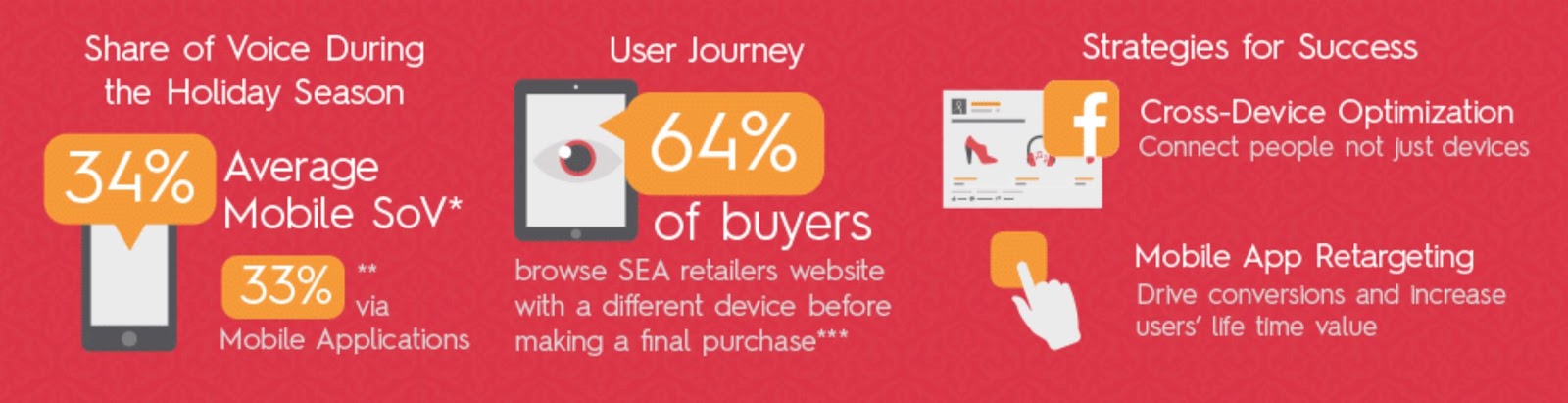
For six in 10 users (64%), the final purchase was made on a different device than the one they initially browsed with.

Criteo predicts that mobile commerce (m-commerce) will dominate e-commerce in driving sales this year - 34% of online transactions at major retail companies was generated by mobile phones, and a further 33% via mobile applications, in November.

While technological enhancements have facilitated shopping on mobile, marketers are challenged with targeting consumers across every environment along the path to purchase. Brands can no longer ignore mobile platforms as a primary means to drive e-commerce sales. To boost revenue, retailers must combine a strong mobile web and app presence with personalised mobile targeting strategies to engage with shoppers wherever and whenever they browse and purchase.

Interested?

View the infographic of Criteo’s analysis of shopping behaviour during Singles Day

26 September 2016

The Shopee Malaysia MyCyberSale offers discounts of up to 90%

Source: Shopee. Part of a banner for MyCyberSale.
Shop on Shopee Malaysia during the MyCyberSale period - ending September 30 - and stand to win* an iPhone 7 and other prizes. Shipping is free*.

Some of the items on sale include:

. Jabra SPORT CORDED Stereo Headset

This waterproof headset in black is targeted at sports lovers. From Jabra Malaysia, there is two years' warranty.
Shopee offer: 69% off*.

2. April Skin Magic Cushion

Part of the 'Hallyu' phenomenon, this magic cushion now costs RM57.9, down from RM100*.
Limit: maximum of three per customer.

3.  Xiaomi Piston Earphones

Available in several pastel colours plus white or black to complete fashion statements.
Shopee offer: RM18, was RM40*.

4. Shake and Take Juice Blender

Make a juice and take it with you. Available in four colours,
Shopee's MyCyberSale price is RM49, down from RM98*.

5. DVR Vehicle Camera Video Recorder

This recorder features a 2.7" 16:9 TFT LCD and a resolution of 1,920 x 1,080. The view angle is 170°.
Shopee offer: RM20, was RM54*.


Interested?

Shop the e-mall at or download the Shopee app. There are additional discount codes for individual shops as well as an overall sale discount on the website*

Hashtag: #MyCyberSale


*Terms and conditions apply

31 August 2016

Shopee introduces 9.9 Mobile Shopping Day this September

Source: Shopee website. The countdown begins 1 September.
Shopee, the mobile-first social marketplace by Garena Interactive Holding, has announced its inaugural 9.9 Mobile Shopping Day, a one-day mobile shopping extravaganza happening on 9 September.

Slated to be the biggest mobile shopping sale in the region, consumers in Singapore can expect 24 hours of non-stop deals and promotions, including discounts of up to 90%, selected picks under S$0.99 and a chance to win Samsung Galaxy phones.

Chris Feng, Chief Executive Officer of Shopee, said, “Among all the markets that we are present in, Singapore has truly proven to be mobile-first, ranking No. 1 globally for smartphone adoption. Shopee 9.9 Mobile Shopping Day signifies the start of a new era for shopping, where everybody is free to shop online anywhere and anytime on mobile, and we’d like to invite everyone to celebrate this day with us.”

Since officially launching across Southeast Asia and Taiwan in December 2015, Shopee has experienced significant growth in all countries. Across all markets, Shopee has over 20 million installs, 250,000 daily orders and an annualised gross merchandise value of US$1.3 billion, making it the fastest-growing marketplace in the region. To date, Shopee Singapore alone has amassed over 1 million installs.

According to a Google study, Singapore has the highest smartphone penetration in the world at 85%*. While e-commerce is expected to grow 13% year on year, expected growth for m-commerce is at 15%**. Based on a report by MasterCard in 2015, 49% of Singaporeans have made a purchase using their mobile phones and this number continues to grow***.

Feng explained, “It is clear that Singapore, much like other countries in the region, is undergoing a mobile transformation. Our mobile-first approach has helped Shopee become one of the leading marketplaces in the region, and we would like to mark September 9 as a milestone to celebrate this.”

He added, “One interesting effect of the mobile revolution is that buyers and sellers are increasingly dealing over live chat. Buyers prefer to chat directly with sellers for multiple reasons, such as to find out more about the products, or seek after-sales support. Shopee has since facilitated 430 million chats across the region, with 30 new chats every second.”

Source: Shopee infographic. Shopee averages 30 chats and four new product listings per second.
Source: Shopee infographic. Shopee averages 30 chats and four new product listings per second. 

Featured deals on 9.9 Mobile Shopping Day include:

● Everything under S$0.99, S$9 and S$19
● Shopee Steals at 90% off

Featured products available on 9.9 Mobile Shopping Day:
Item
Original Price (S$)
Sale Price on 9.9 (S$)
Kat Von D Liquid Lipstick
$32.90
$9.90
SK-II Facial Treatment Cleanser 120ml
$69.00
$9.90
Superga sneakers
$59.90
$37.90
Lancome BB Cushion
$49.90
9.90
Herschel bag
$100
$39.90

Interested?

Shopee 9.9 Mobile Shopping Day will kick off on 1 September with a nine-day countdown featuring deals under $9.99 and daily giveaways. On 9 September, shoppers can enjoy many promotions, including selected products at up to 90% off. Shopee has also enlisted OCBC as a partner for FRANK Credit Card holders to enjoy further discounts.

The app for Shopee Singapore can be downloaded for free on all mobile platforms via Apple App Store and Google Play Store. 

Hashtags: #fashiontrends, #giftforgirls, #freeshipping, #streetstyle, #supportlocal 

*Singapore is No. 1 for smartphone adoption: Google, 2014 figures. As of 2015, Google places Singapore as No. 2 in the world for smartphone adoption, and No. 1 in Asia, with the UAE in No. 1 position.
**Morgan McKinley: The Spending Habits of Southeast Asia eCommerce Consumers, quoting Paypal figures for Q414. 

20 November 2015

Singtel invites subscribers to pay with their phones at the supermarket

A Dash reader at FairPrice.

From 17 November, users of Singtel’s Dash mobile payment app have been able to make payments with Dash at over 200 NTUC FairPrice retail outlets*, comprising FairPrice supermarkets, FairPrice Xtra hypermarkets and standalone Cheers outlets.

Gan Siok Hoon, VP of mCommerce, Consumer Singapore, Singtel, said, “As a leading fintech solutions provider, Singtel is delighted to partner with FairPrice, Singapore’s largest retailer. There are more than half a million customers who shop at FairPrice stores daily, and we are excited to offer them the choice of swift and secure payments with Dash.”

A new feature called Dash Tap and Pay** is available exclusively at Fairprice and Cheers retail stores, allowing customers with NFC Android phones and Dash installed to pay by simply tapping their phones on a reader at the checkout. Customers can also choose to pay by entering the counter code on the Dash reader at checkout counters.

Gan added, “Ultimately, when it comes to mobile payments, convenience and security matter the most to customers. To address this, we worked to improve the experience with the new Dash Tap and Pay feature, to better fulfil our customers’ mobile payment needs.”

Gerry Lee, Deputy CEO (Operations), NTUC FairPrice, said, “FairPrice continues to innovate and leverage technology to cater to the changing lifestyles of our customers and enhance their shopping experience. Dash is another step forward in our ongoing initiatives to introduce greater flexibility through additional payment options to make it more convenient for customers.”

Today, Dash has the largest mobile payment merchant network in Singapore with over 20,000 acceptance points, including Watsons, Food Republic, KOI, 7-Eleven and Topshop. Dash can also be used to pay for ComfortDelGro taxi rides without the usual administrative fees levied by other cashless payment methods. Singtel has been working to diversify payment modes for the use of Dash both in the shops and online. In October Dash partnered with online retailer Lazada.SG to support e-commerce payments.

Interested?

Read the TechTrade Asia blog post about Singtel's partnership with Lazada

Read the TechTrade Asia blog post about Etihad's cash collection methods for online purchases

The app is free to download on the Apple App Store and Google Play.
Shoppers who pay with Dash at FairPrice and Cheers outlets will enjoy 5% cashback with no minimum spend required until 31 December 2015***.

To celebrate its tie-up with FairPrice, Dash has S$12,000 worth of FairPrice gift vouchers up for grabs till 13 December. Ten winners stand to win S$300 FairPrice gift vouchers in a weekly lucky draw. Shoppers only need to pay with Dash at FairPrice and Cheers to qualify****.

*Dash is only accepted at FairPrice supermarkets, FairPrice Xtra hypermarkets and standalone Cheers and FairPrice Xpress outlets. FairPrice Finest, Warehouse Club and all Cheers and FairPrice Xpress located within Esso Service Stations are excluded.
**The Dash Tap and Pay feature is further supported with new enhancements for added security and convenience so as to provide a better user experience. Available on Android devices with the latest app version 3.2. 
***The 5% cashback promotion is capped at one redemption per customer per day. Cashback is in the form of mobile cash credited to customers’ Dash account. Promotion ends on 31 December 2015.
****S$10 minimum spend is required to qualify for the lucky draw.

20 October 2015

Brands optimising apps for mobile see more sales

Source: Criteo website, Q3 2015 State Of Mobile Commerce report

Criteo, the performance marketing technology company, has released its Q3 2015 State of Mobile Commerce report. This quarterly analysis of industry-wide trends arms marketers with essential mobile commerce intelligence for engaging consumers and boosting sales. Criteo’s comprehensive analysis of 1.4 billion online transactions reveals that 50% of purchases worldwide, now involve multiple devices throughout the consumer buying journey.

Southeast Asia also ranked high on the list, with a 45% conversion rate to sales from their mobile devices, up from 27% in the previous quarter. More than half (54%) of the traffic was also generated from mobile devices. Indonesia topped the list in Southeast Asia, with a 56% conversion to sales.

Criteo’s research shows that early investment in apps is also generating significant payback for e-commerce companies that prioritised this platform. In the retail category, brands that make their app experience a priority generate nearly 60% of mobile revenue from the app, up from 50% in Q2, and heavily outperforming desktops. For travel brands that make their apps a priority, about 50% of mobile revenue comes from the app.

“We continue to see the rise of mobile commerce in a cross-device world. Advertising strategies now need to include mobile at the centre if companies want to engage today’s savvy consumer. Marketers need to pay close attention to the consumer’s purchasing journey if they want to attract buyers and maximise sales,” said Jonathan Wolf, Chief Product Officer, Criteo.

“Southeast Asia continues to be one of our fastest growing regions for e- and m-commerce,” said Yuko Saito, Managing Director, Criteo Southeast Asia. “Southeast Asia now ranks much higher above the global average of 35%, and sits in the same company as advanced mobile countries like Japan and the UK.”

“It is clear that customers are now extremely savvy and are open to browsing and buying on their mobile devices, and this is not just limited to mature markets. Mobile optimisation is now a must-have, not nice-to-have for brands, and we see apps as the next growth driver and a key area of focus for marketers,” said Saito.

Consumers are browsing and buying on all devices—laptops, tablets and smartphones. For brands to succeed, they need to invest in mobile and allocate digital spend strategically:

· For purchases completed on laptops and desktops, 39% of buyers use at least one additional device during the shopping process.

· On mobile, 43% of smartphone buyers and 47% of tablet buyers use an additional device.

· Cross-device purchasers are 20% more likely to use their mobile device to complete a transaction.

Ensuring that the app experience is seamless, intuitive and engaging is central to boosting engagement and conversions:

· For retailers who have prioritised their app experience, 58% of all mobile revenue is generated through the app; travel is at 49%.

· Apps convert at a rate of 3.7 times higher than mobile browsers and two times more than desktop in terms of adding to basket and buying.

Consumers are choosing smartphones as the preferred shopping device more frequently. While all devices and channels should be optimised, smartphones are a key vehicle for brands:

· Smartphones generate 56% of mobile transactions and drive 64% of mobile purchases for top quartile retailers.


· Smartphone conversion rate is two times better for top quartile retailers than average retailers.

Mobile commerce activity is growing worldwide with Japan and South Korea seeing some of the highest volumes of e-commerce transactions. Global brands need to be tuned into how different consumer segments behave in order to deliver the best cross-device and mobile experiences:

· Mobile commerce now represents 35% of e-commerce transactions globally. Mobile transactions in Southeast Asia now account for 45% of all e-commerce transactions (up from 27% in the previous quarter), with Indonesia at 56%, and Taiwan at 38%. 

· Cross-device purchasing is represented by 50% of e-commerce transactions worldwide.

Interested?

Read the TechTrade Asia blog post on the Criteo Q2 2015 State of Mobile Commerce report

2 October 2015

Singtel's Dash runs flash campaign with mystery cashback for Lazada.SG purchases

Source: Android Play Store.
Singtel's mobile payment app Dash is running a flash campaign with online retailer Lazada.SG from 2 to 9 October 2015 that offers a mystery cashback of 15% to 50%*.

During the campaign, there will be a daily Dash Happy Hour where customers have a window of up to two hours to pay on Lazada.SG using Dash as a payment mode. The exact cashback percentage will only be revealed at the end of each campaign day and will be credited to customers’ accounts within three working days.

The promotion commemorates Singtel's partnership with helloPay, the fintech platform of the Lazada Group.

“It has been an exciting year for Dash as we continue to grow our merchant network with home-grown partners and collaborating with transit operators," said Gan Siok Hoon, VP, mCommerce, Consumer Singapore, Singtel.

One of Singapore’s most popular online shopping sites, Lazada.SG offers more than 1 million products that range from household appliances, consumer electronics to apparel and jewellery. Dash customers will also receive a 5% cashback on all of their Lazada purchases until 31 December, 2015.

To make fast and secure payments on Lazada.SG, customers only need to select the helloPay option upon checkout, choose the Dash payment mode, and log in with their mobile number and PIN.

Dash has the largest mobile payment merchant network in Singapore with over 20,000 acceptance points, including Watsons, Food Republic, KOI, 7-Eleven and Topshop. Dash can also be used to pay for ComfortDelGro taxi rides without the usual administrative fees levied by other cashless payment methods.

The Dash app has been enhanced with new features including Samsung Fingerprint Scanner and Apple Touch ID authentication to provide an even more user-friendly payment experience.

Interested?

The app is free to download on the Apple App Store and Google Play. 

2 April 2015

Make advertisements mobile to capture a growing opportunity

Source: Criteo.

Criteo, the performance marketing technology company, has released its Q1 2015 State of Mobile Commerce Report, highlighting that mobile devices are now responsible for more than one third of all e-commerce transactions globally. Smartphones are becoming the dominant mobile device replacing tablets. As a result, advertisers’ future success now depends on their ability to offer a compelling mobile site.

“Mobile commerce is growing like a weed,” said Jonathan Wolf, Chief Product Officer, Criteo. “Smartphones are now (accounting for) the majority of mobile transactions, and the growth of larger screen sizes and better mobile sites is only going to accelerate this trend.”

These trends are the result of Criteo’s analysis of individual transaction-level data from more than US$160 billion of sales globally. Key takeaways include:

• By the end of 2015, mobile share of e-commerce transactions will reach 40% globally.

• Asia leads the way in smartphone purchases with close to 50% of e-commerce transactions happening on smartphones. Mobile conversion rates in Japan are more than 3.5x higher than the US.

• Increased comfort level with purchasing and larger screen sizes are credited for the increase.

• The mobile conversion funnel has arrived. Consumers now view the same number of products on both desktops and smartphones, but with lower add-to-basket and purchase rates on smartphones.

“The huge growth in mobile transactions over the past quarter shows that consumers are now very comfortable purchasing on smartphones across all categories,” said Wolf. “There really is no limit to this growth – mobile is now more than half of all e-commerce transactions in advanced markets like Japan and South Korea.”

Download Criteo’s Q1 2015 State Of Mobile Commerce report here.

15 December 2014

Genesys explains how Asian businesses can do e-commerce better

Source: Genesys.
Thomassain.
Many businesses fall short of their e-commerce promises or fail to keep up with the rapidly evolving expectations of their customers, says Genesys, which provides businesses with a customer experience platform that enables them to leverage customer information and data from their contact centre interactions for a seamless customer experience.

"According to a Forrester report, the estimated total of annual abandoned shopping cart revenue will reach US$31 billion dollars in the next few years," said Erwann Thomassain, Head of Marketing, Asia Pacific, Genesys. "Forrester’s 2013 study, CX online, revealed that 52% of customers will abandon online purchases if they can’t find a quick answer." 

One reason is an attention span that is growing shorter, says Thomassain. "It’s estimated that 55% of people spend fewer than 15 seconds actively on a page and 38% who visited a page closed it immediately after it loads. When moving online, businesses have to get it right. As statistics show customers can be unforgiving, so creating a unique customer experience is pivotal to retention and repeat sales," he said.

Another reason is logistics, he said. "Customers are increasingly demanding shorter lead times and reliable logistics providers," he noted. 

Another hurdle businesses in the region have to overcome is the underdeveloped banking services, Thomassain added. "Low banking and credit card penetration rate is an obstacle to businesses looking to offer fast and convenient online payment to complement their e-commerce offerings. Across the region, markets like Indonesia, Malaysia, Vietnam and Philippines said less than 5% of e-commerce shoppers paid online last year."

Genesys believes that live multi-channel interaction along with detailed profiles and catering to the buying behaviours of customers is what will help convert the remaining 80% of ‘wanderers’ during the browsing stage of the buying cycle. "With the competition for customer loyalty heating up, understanding that customers expect an effortless yet engaging service is crucial and must be considered in the customer experience journey provided," he said. "Businesses ignoring this trend are simply missing out of potential sales and giving away market share to their competitors."

To establish a successful presence in e-commerce, Thomassain advises businesses to: 

- Make it as easy and hassle-free as possible. "With the average attention span on a website at 15 seconds (that is, if they stay pass the page has completely loaded), customers can get easily frustrated when maneuvring through sites, so it’s important to simplify the process and ensure they don’t switch elsewhere else in one swift click," he said.

- Think about security. "Nothing ruins a customer’s confidence in a retailer than having all their personal and financial information leaked to hackers due to vulnerable firewalls," he pointed out.

- Use multi-channel platforms to fully identify and understand the context of each customer interaction. "With a holistic view into the customer journey, businesses will then be able to power great customer experiences," he explained. 

Read what Genesys thinks about e-commerce potential in Asia Pacific here.

8 December 2014

Asian businesses need more e-commerce smarts: Genesys

Source: Genesys.
Thomassain.
Asia Pacific overtook Europe as the largest consumer for online shopping for the first time this year, says Genesys, and the only way forward is up. 

"Driven by the potential of the Chinese market, increasing Internet access and the growing adoption of smartphones and tablet computers, Asia is experiencing an e-commerce explosion. By end of 2014, business to consumer e-commerce sales will hit US$525 billion in Asia, that’s half of the world’s online sales," noted Erwann Thomassain, Head of Marketing, Asia Pacific, Genesys, which provides businesses with a customer experience platform that enables them to leverage customer information and data from their contact centre interactions.

Thomassain also pointed to the e-commerce potential of much of Southeast Asia countries. "With the fastest growing Internet population in the world, with recent statistics estimating 530% growth over the past five years, alongside favourable age demographics, Philippines is well-placed to reap benefits of online retail. Indonesia is not far behind with an estimated 430% Internet growth," he said.

Thomassain noted that today's consumers are 'always on' and able to consume, purchase, share content from their mobile devices wherever they are. "It’s up to businesses to push the content they want directly to them," he said. "In South Korea, 49% of consumers use their smartphones to research online purchases. As consumers seek faster and more convenient ways to shop, we can expect e-commerce to continue to rise as new trends and technologies emerge, vying for the attention of today’s 'always-on' consumer."

This year's 'Singles Day' online shopping festival, driven by Alibaba, shows how consumers have embraced mobile and online shopping. The November 11 sale saw a record number of 278 million orders placed during the 24 hours with 42.6% of the gross merchandise volume generated on mobile devices, Thomassain said, quoting Forbes data. "Being aware of the limitations of a mobile screen and so not to affect the customer experience, merchandise recommendations were precisely customised to allow for a more efficient and effective cross- and up-sell process. This is customer experience at its best," he commented.

It follows that businesses will need to customise their outreach for the online and mobile spaces if they are to be successful in the long term, Thomassain said. 

"It is no longer the brick-and-mortar store days where it’s all about attracting customers into the shops. Control is now with the customer, demanding companies to be where they are, be it on social media or user generated content sites, and they want an individually tailored customer experience," he said. "More and more businesses are expanding their presence into the online space and existing businesses are continuously modifying the online experience to stay ahead of the curve."

Thomassain shared two shopping trends that show how e-commerce and physical retail are converging. One challenge for physical retailers is 'showrooming', the practice of browsing merchandise in physical stores but buying it online at better prices. "We can only expect this trend to take hold as e-commerce adoption continues," he noted.

At the same time there is an emerging, competing trend for 'reverse showrooming', where research for products is conducted online and the purchase is completed in a physical store. "According to the Google Marketing Shopping Council, 84% of smartphone shoppers use their phones to assist their store shopping experience," Thomassain said. 

Thomassain advised retailers to embrace the latest customer behaviour to grow, for example by offering incentives that entice online traffic into physical stores.

5 December 2014

Seven in 10 Singapore mobile users click intentionally on mobile ads

Source: Yahoo, Mindshare.


Yahoo and Mindshare have announced that brands have a good opportunity to connect with target audiences when they use mobile devices. The findings are part of a joint study titled Creating Brand Connections across Devices for the Singapore market.

David Jeffs, Head of Insights, India & South-East Asia, Yahoo said, “Singaporeans are among the most gadget-savvy people in the world, with an average user spending a whopping 3.7 hours a day on mobile devices for personal use. Yahoo and Mindshare conducted this study to gain deeper insights into user behaviour, and the findings show that the mobile platform presents a clear opportunity for brands to educate and engage the connected consumer. The mobile is playing an increasingly important role in building meaningful brand experiences with consumers.”

Deepika Nikhilender, Leader, Business Planning, Mindshare Asia Pacific said, “Today brands need to optimise their campaigns keeping in view mobility and cross-device engagement. Users want mobile advertising to be relevant to the way they use the devices. The smart device is playing a key role in the path to purchase in a consumer journey. Brands need to evolve creative and innovative strategies to leverage this phenomenon and change behaviour, as this device grows in its influence in the last mile.”

This year’s study covers Malaysia, Singapore and Taiwan, building upon learnings garnered last year from the same study conducted in India, Indonesia and China. In this year’s study there is increased focus on the role mobile plays in the consumer’s path to purchase.

Key findings include:

1. The top 5 needs from Singapore users that are fulfilled by mobile devices:

a) Leisure activity: 72%
b) Catch up on news: 62%
c) Stay in touch: 61%
d) Morning Ritual: 60%
e) Entertainment: 38%

2. Communication and content consumption followed by entertainment and gaming are the top daily activities for Singaporean smartphone and tablet users.

3. Users in Singapore are avid readers of local news followed by breaking/international news. Female users tend to prefer content on celebrity gossip and beauty, whereas male users' preferences skew towards sports and business news.

4. On average a Singapore smartphone user reads or watches more than six genres of content throughout the day.

5. Video content consumption is hugely popular on mobile devices:

a) Bite-sized videos of three to five minutes in length are popular for users in the mornings, while long form video content is preferred later in the day.
b) Almost a third (35%) of users, have watched at least one video on their smartphones of over 20 minutes in duration.
c) Women users prefer to watch TV shows and comedy videos while men consume more sports and local news.

6. Gaming, chatting/IM and creating alarms, notes and reminders are most popular smartphone activity via apps amongst Singaporean users.

7. While smartphone usage remains consistent through the day, the primetime slot of 8 to 11 pm is device-stacked with PCs and tablets also being used. This offers brands with opportunities to integrate their campaigns across multiple screens. During this period, users were: 

a) Sending instant messages
b) Social networking
c) Playing games
d) Reading content

8. A phenomenal 87% of the surveyed users use their mobile devices for conducting pre-purchase research. This implies a paradigm shift in terms of information flow, showing that users are actively engaging with brands on their mobile devices even before buying the product. Eight in ten (81%) of the surveyed users in Singapore did pre-purchase research on their mobile devices on consumer electronics 
followed by research on fashion (clothes and shoes) at 74% and 67% on financial services.

9. Mobile devices are increasingly being used in the entire consumer journey of the brand especially in the path to purchase i.e. from pre-purchase to post-purchase.

a) 81% users conducted research on consumer electronics before the actual purchase.
b) 74% carried out activities 
in-store like comparing prices, and checking the availability of the consumer electronics product.
c) 46% continue to engage with a brand after the purchase, with activities like sharing photos/ video of the product they bought, recommendations, writing a review etc.

10. M-commerce seems on the rise with 72% using mobile devices for banking transactions and 74% for making some form of online purchase. Mobile advertising is also seeing positive engagement with 70% of the users intentionally clicking on the mobile ads.

11. A mobile user in Singapore says the ‘ideal’ mobile advertisement is about:

a) Promotions/ discount coupons: 61%
b) Rewards via ad interactions: 36%
c) Teaching something new: 29%
d) Keeping him or her up to date: 28%
e) Fun/ providing a short break: 23%

*The report is based on research about user behaviour across devices - smart phones, tablets and PCs and highlights cross-device usage, time spent on mobile devices, top daily activities, genres of content consumed, and emerging trends on mobile video, gaming and entertainment. 

26 June 2014

Criteo uncovers global love affair with m-commerce

Criteo, which specialises in digital performance advertising, has shared new consumer e-commerce insights in its Q1 2014 Mobile Flash report. 

Source: Criteo Mobile Flash Report.
The report, which represents the Internet browsing and shopping behaviour of the more than 920 million unique global Internet users* that Criteo’s advertisements reach, has found that mobile plays an increasingly critical role in effectively reaching consumers:

  • Mobile delivers higher click-through rates (CTRs) than PCs across most industry verticals.
  • Android tablets and smartphones account for 66% of total e-commerce sales globally.
  • Average CTRs on Android devices are nearly two times that of PCs.
  • Android devices generate more sales globally, but iOS leads in the US and Europe.
  • Retail, travel, automotive and classified ads account for more than 70% of mobile clicks.
  • Mobile not only substitutes, but also complements desktop usage and brings additional sales. For example, purchases coming from an iPad are 16% more likely to happen on a Sunday, while sales from a desktop drop by 10% on Sundays.
  • Hotel bookings, car rentals and apparel account for the highest average purchase value on mobile devices (US$364.80, US$209.10 and US$105.30, respectively).

“Every quarter we’re analysing robust mobile data from close to a billion Internet users that we leverage to offer advertisers deeper insights that can help better shape their campaigns,” said Jason Morse, VP Mobile Product at Criteo. “We’re seeing some very exciting opportunities start to emerge for advertisers in mobile right now. The fact that mobile devices are responsible for a rapidly growing share of e-commerce sales, representing millions of dollars, makes it hard for advertisers to ignore the possibilities with mobile campaigns.”

Read Criteo’s Q1 2014 Mobile Flash report here.

*comScore, March 2014