28 February 2019

Winners for MRM Business Award and MRM Business Innovation Award announced

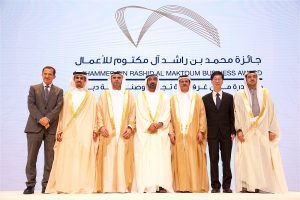
Source: Dubai Chamber. HH Sheikh Ahmed Al Maktoum  honoured winners of the 10th MRM Awards.
Source: Dubai Chamber. HH Sheikh Ahmed Al Maktoum
honoured winners of the 10th MRM Awards.
HH Sheikh Ahmed bin Saeed Al Maktoum, President of Dubai Civil Aviation Authority, who is also Chairman & Chief Executive of the Emirates Airline & Group, has honoured the winners of the 10th Mohammed Bin Rashid Al Maktoum (MRM) Business Award and the 2nd MRM Business Innovation Award in Dubai, UAE.

The awards ceremony, held under the patronage of H.H. Sheikh Mohammed bin Rashid Al Maktoum, Vice-President and Prime Minister of the UAE and Ruler of Dubai, was organised by Dubai Chamber of Commerce and Industry.

The MRM Business Award, which is part of Mohammed Bin Rashid Al Maktoum Global Initiatives, was presented to:

Abu Dhabi Islamic Bank (ADIB);
Abu Dhabi National Insurance Company (ADNIC);
Al Khaleej Sugar Company;
All Food For Food Stuff;
Apparel Group;
Arabian Automobiles Company;
ASGC Construction;
British Orchard Nursery;
China State Construction Engineering Corporation (Middle East);
Doka Gulf;
Gulf Extrusions;
Gulf Petrochemical Industries Company (GPIC);
Jindal Shadeed Iron & Steel;
Network International;
RAK Hospital;
Tablix Technology;
TASC Outsourcing; and
Transguard Group.

The MRM Business Innovation Award was presented to:

Al Ansari Exchange;
ALEC Engineering and Contracting;
Almajdouie Logistics Company;
ASGC Construction;
Aster Pharmacy Group;
DuBox;
ENOC Retail;
Gulf Petrochemical Industries Company (GPIC);
Jebel Ali Free Zone;
Network International;
Samsotech;
Sharjah Islamic Bank; and
Transguard Group.

Gulf Petrochemicals Industries Co. (GPIC) was presented with the Outstanding Award for Business Excellence, while the Outstanding Award for Business Innovation went to ENOC Retail.

HE Sultan bin Saeed Al Mansoori, UAE Minister of Economy and Chairman of judging panel for the MRM Business Award and MRM Business Innovation Award, said the MRM Business Awards have fostered a culture of excellence within business communities in the UAE and GCC, facilitated the adoption of best practices and raised industry standards. He noted that the MRM Business Innovation Award, which was launched in 2015 by Dubai Chamber and the UAE Ministry of Economy during the Year of Innovation, reflects the vision of the UAE’s leadership to encourage companies to make innovation a major part of their organisational cultures.

HE Al Mansoori said the second cycle of the MRM Business Innovation Award registered a 21% increase in the number of participants, reflecting the growing importance that companies in the region attach to innovation excellence.

Source: Dubai Chamber. HE Majid Al Ghurair.
Source: Dubai Chamber. HE Al Ghurair.
In welcome remarks, HE Majid Saif Al Ghurair, Chairman of Dubai Chamber of Commerce and Industry said: “Since the establishment of the MRM Business Awards, we have worked to develop and improve the award programme in line with the changing needs of maturing business communities in the UAE and GCC. I am very proud at the progress that has been achieved by the outstanding companies that have participated in the programme to date.”

Dubai Chamber’s Chairman explained that the awards have served as a catalyst for enhancing business performance and boosting innovation activity on a regional level. He revealed that more than 1,800 companies have benefitted from the award programme since its establishment while 181 winning companies have been recognised for their outstanding achievements.

During the ceremony, HE Al Ghurair launched the Mohammed Bin Rashid Al Maktoum Customer Excellence Award, a new award under the MRM Business Awards platform. The award aims to recognise the efforts of outstanding companies and organisations in the UAE and GCC that are adopting innovative strategies to improve customer experiences.

“The MRM Customer Excellence Award will provide companies with another incentive to apply and participate in the MRM Business Award programme, enhance their customer approach and adopt best practices in line with international standards. The launch of this award stems from our strong belief that customer experience is among the most crucial factors impacting business performance,” said HE Al Ghurair.

HE Hamad Buamim, President & CEO of Dubai Chamber and Chairman of the Steering Committee for the MRM Business Award said: “Over the years, the MRM Business Awards have become benchmarks for business and innovation excellence and they remain the highest level of recognition in these areas within the GCC. With UAE Innovation Month upon us, it is an opportune time to put the spotlight on the outstanding companies we are recognising today that are driving innovation in a wide range of economic sectors.”

HE Buamim noted Dubai Chamber had received an overwhelming number of strong applications for both awards, with a 46% increase in the number of applications. He added that the awards support Dubai Chamber’s efforts to fulfill the vision of HH Sheikh Mohammed Bin Rashid Al Maktoum, VP and PM of the UAE and Ruler of Dubai, and lead the business community to a brighter future.

25 February 2019

Sustainable Business Awards Singapore 2019 open for registration

The Sustainable Business Awards (SBA) Singapore 2019 is open for registration.

In its 8th year, the SBA recognises and rewards companies for their sustainability performance. The awards aim to increase awareness of sustainable business best practices and demonstrate how sustainable business benefits companies, the environment and all stakeholders. The platform guides companies through the process – and rewards them along the way to becoming truly sustainable businesses.  

SBA is organised by Global Initiatives in partnership with PwC Singapore, Control Union, ACCA and BCSD. There are awards for Indonesia and Malaysia as well.

Details:

Check eligibility

Microsoft launches HoloLens 2 at MWC 2019

Source: Microsoft website. Lady wearing the HoloLens 2.
At Mobile World Congress (MWC), Microsoft announced the HoloLens 2 intelligent edge device in addition to making several other launches.

HoloLens 2 is more immersive and comfortable than the previous model, and is built to accelerate time-to-value.

The new visual display system still runs on low power while doubling the field of view; there is a more balanced centre of gravity, with light carbon-fibre material incorporated. A new dial-in fit system makes it comfortable to wear for hours, and those who wear glasses can keep them on because the HoloLens 2 will slide over them. Thermal management has also been improved.

Dynamics 365 Guides is a new mixed-reality app that empowers employees to learn by doing. Guides provides step-by-step instructions that direct employees to the tools and parts they need and how to use them in real work situations. A Guides PC app makes it easy to create interactive content, attach photos and videos, import 3D models and customise training.

"This is a tremendously exciting time for Microsoft, our partners, our customers, the computing industry and indeed the world. The virtually limitless computing power and capability of the cloud combined with increasingly intelligent and perceptive edge devices embedded throughout the physical world create experiences we could only imagine a few short years ago," said Julia White, Corporate VP, Microsoft Azure in a blog post.

Details:

HoloLens 2 will be available this year at a price of US$3,500. Bundles including Dynamics 365 Remote Assist start at US$125/month.

In Asia Pacific, HoloLens 2 will be initially available in Japan, China, Australia and New Zealand. Customers can preorder HoloLens 2 now

Hashtag: #MWC19

22 February 2019

Plantronics introduces the Polycom Studio video bar

Source: Plantronics. The Polycom Studio in action beneath the screen.

Plantronics, an audio pioneer and unified communications technology company, has announced its first entry into the huddle room video market with its new plug-and-play video bar, Polycom Studio. Available as a portable USB device, the video bar immerses small meeting groups in an upgraded collaboration experience with Polycom’s HD audio and video quality, and is compatible with PCs or Macs for video collaboration on popular video-as-a-service (VaaS) platforms.

According to Plantronics, today’s open office spaces have resulted in an explosion of smaller meeting spaces, or “huddle rooms,” where groups of two to six can escape the noise to collaborate, often with coworkers in other locations. But of an estimated 32 million huddle rooms globally, only 2% of those spaces include equipment for videoconferencing*, which is becoming increasingly important for the mobile workforce.

In the Asia Pacific region, a recent Growing Big Ideas from Small Spaces study by Polycom found 96% of workers in the region (including Singapore) agreed that collaboration technologies such as videoconferencing help them to be more productive and to work smarter, but only 41% of huddle rooms in Singapore are video-enabled. This adoption lags behind India and China.

“With an increasingly mobile workforce, workers are no longer bound by physical limitations when it comes to having meetings and collaborating. There is a growing need for companies to equip their workspaces to enable workers to work smarter, collaborate more and achieve greater productivity. With the HD audio and video clarity that Polycom Studio provides, even the smallest of spaces can have boardroom capability,” said Low Mei Lin, Director, APAC solutions marketing at Polycom.

With a USB connection, any PC or Mac can leverage the power of Polycom Studio to elevate audio and video meeting experiences. Its patented NoiseBlock and Acoustic Fence technologies reduce or eliminate distracting noise from office environments for professional-sounding communications. Automatic speaker tracking focuses on whoever is speaking within an ultra-wide 120-degree field of view. With 4K resolution and 5x electronic zoom, Polycom Studio provides TV studio-like quality and experiences in a meeting.

“Enterprises around the world have come to understand the strategic importance of their smaller meeting spaces. In fact, we expect the number of AV-enabled huddle rooms to increase by 15% in the next 12-24 months,” explains Ira M. Weinstein, Managing Partner at analyst firm Recon Research.

“With the release of Polycom Studio, Polycom can finally bring its decades of experience in high quality video and audio to smaller rooms with lower budgets. And based on our initial testing, we think Polycom Studio will meet the expectations of even the most discerning huddle room users.”

Unlike most USB devices that give IT little or no visibility into what is being used or any means for management and updating, Polycom Studio wirelessly connects to a corporate network to allow IT professionals a “no touch” means to manage Polycom Studio units installed anywhere in the world. Customers can easily manage their Polycom Studio video bars along with their other Polycom devices through the cloud with the Polycom Device Management Service for Enterprise or on premises with Polycom RealPresence Resource Manager.

Details:

Polycom Studio will be available in Singapore from February 28, 2019 through channel partners and distributors at a recommended retail price of US$949. VaaS platforms supported include Zoom, Microsoft Teams, Skype for Business, Google Meet, Cisco Webex, and Amazon Chime.

*Research and Markets, Global Video Conferencing in Huddle Rooms Market 2018-2022 – Looking Beyond the Hype

Enterprise-friendly Budget 2019 for Singapore

To support industry transformation, Singapore plans to build deep enterprise capabilities, deep worker capabilities and encourage strong partnerships, within the country and across the world.

In his Budget 2019 speech, Singapore Finance Minister Heng Swee Keat shared new ways that Singapore would help the more than 200,000 enterprises in the country thrive, beginning with helping startups scale.

Deep enterprise capabilities

Startups received a boost two years back with Startup SG to provide holistic support for startups and entrepreneurs, from co-investments and proof-of-concept grants, to mentorship and physical space.

"Our startup ecosystem is flourishing," Heng said. "There are now over 220 venture capital deals per year in Singapore, worth close to US$4.2 billion1. This is a significant rise from the 80 deals worth US$136 million in 2012.

"Today, more than 150 global venture capital funds, incubators, and accelerators are based in Singapore, supporting startups here and in the region."

To help startups scale up and venture into new markets, Singapore will now provide support in three areas: customised assistance, better financing options, and supporting technology adoption.
"Customised support can enable firms to identify and overcome the unique challenges they face, and scale up quickly," Heng said.

"Enterprise Singapore will launch a Scale-up SG programme in partnership with the private and public sectors. Scale-up SG will work with aspiring, high-growth local firms to identify and build new capabilities, to innovate, grow, and internationalise," Heng revealed.

To further support innovation, the government is launching a two-year pilot Innovation Agents programme, where firms can tap on experienced industry professionals to advise them on opportunities to innovate and commercialise technology. Such experts or innovation agents will have both technology expertise and business experience.

Enterprise Singapore will identify individuals with deep expertise in technology, strong track record in growing businesses, and access to global industry networks. These Innovation Agents will be matched with enterprises that aspire to use technology to improve existing businesses or build new ones.

Innovation Agents will provide mentorship to enterprises to identify innovation opportunities, and facilitate connections to valuable technology and business partners. Depending on enterprises’ needs, Innovation Agents may provide consultation on a one-to-one basis, or on a group basis to groups of enterprises or consortia looking to capture new market opportunities through innovation. The duration of an engagement may vary from a few months to a year, depending on its scope.

More support for companies

While the the Monetary Authority of Singapore (MAS) has simplified the regulatory regime for venture capital managers and launched a US$5 billion private markets programme to encourage global private equity players to deepen their presence here, the pool of "smart, patient" capital (editor's note: capital that is invested for the long term, and which brings with it knowhow) will be grown further.

Since 2010, Singapore has invested S$400 million through two rounds of fund injections for the Co-Investment Programme (CIP) to invest in small and medium sized enterprises (SMEs) alongside the private sector. This has catalysed about S$1.3 billion of additional funding for SMEs, Heng said.

This year, an additional S$100 million is earmarked to establish the SME Co-Investment Fund III. "As part of the CIP, it will catalyse investment in Singapore-based SMEs that are ready to scale up. We expect that this will bring in at least S$200 million of additional funding," Heng said.

Temasek Holdings will participate as a co-investor in SME Co-Investment Fund III. Qualifying investee companies must have their key management functions and headquarter activities based in Singapore, and have revenues of up to S$500 million. The fund will be managed by Heliconia Capital Management, which can be reached at enquiries at heliconiacapital.com.

When it comes to loans, local banks have been supportive. DBS provides a Business Capabilities Loan for innovative SME projects; UOB has financial support for technology investments and overseas ventures, and OCBC finances new SMEs which lack the track record typically required for credit assessment. "To catalyse these further, we will enhance the accessibility of loans," Heng said.

Existing financing schemes offered by Enterprise Singapore will be streamlined into a single Enterprise Financing Scheme that will cover trade, working capital, fixed assets, venture debt, mergers and acquisitions, and project financing. This will be launched in October this year, with businesses able to apply for it via participating financial institutions.

The same Enterprise Financing Scheme will provide stronger support for companies that have been incorporated for under five years. "The government will take on up to 70% of the risk for bank loans to these young companies, compared to the current 50% under most existing loan schemes2," Heng said.

The SME Working Capital Loan scheme is to be extended till March 2021. "Since its launch in June 2016, the scheme has catalysed more than S$2.5 billion of loans. We expect the extension to catalyse a further S$1.8 billion. Support for working capital will be folded under the Enterprise Financing Scheme from October," Heng said.

Helping SMEs adopt digital technologies

The SMEs Go Digital programme, announced in Budget 2017 and benefiting some 4,000 SMEs to date, will be expanded.

Its key components* are IDPs, pre-approved digital solutions and digital sector projects. Sector-specific IDPs developed by IMDA serve as a guide for SMEs on the digital technologies and skills training programmes that are relevant to them at different stages of growth. As of end-2018, IDPs have been developed for seven sectors: environmental services, retail, food services, wholesale trade, logistics, security and media.

The accountancy, sea transport, and construction sectors will get their own Industry Digital Plans (IDPs), with more sectors to be added later, Heng said. "These will guide SMEs on relevant digital technologies and skills training programmes," he elaborated.

The government will also expand the number and range of cost-effective, pre-approved digital solutions that will be supported under SMEs Go Digital to boost technology adoption among SMEs. Pre-approved digital solutions are identified by IMDA and sector lead agencies and accessible on the whole-of-government (WOG) Business Grants Portal. This year, the solutions are to include artificial intelligence (AI)-infused solutions and cybersecurity solutions. SMEs can apply for the Productivity Solutions Grant (PSG) for funding support of up to 70% of qualifying costs to adopt these solutions.

IMDA also works with key industry leaders to pilot new digital solutions (including platforms) that have the potential to scale and uplift sectors. These are called digital sector projects.

MAS and the Info-communications Media Development Authority (IMDA) will also jointly pilot a cross-border innovation platform for SMEs, known as Business sans Borders, with an artificial intelligence (AI)-enabled marketplace to help SMEs match with buyers and vendors globally.

To help companies in the services sector capture opportunities from digitalisation, the Ministry of Communications and Information launched a three-year pilot of the Digital Services Lab (DSL) in November 2018. The DSL brings together industry and the research community to codevelop digital solutions with sectorwide impact in services sectors, such as logistics, retail and media. Companies participating as demand users and technology solutions providers may apply for funding support of up to 70% of qualifying costs.

This year, the Singapore government will extend the Automation Support Package (ASP) by two years. Introduced in Budget 2016, the ASP supports firms to deploy impactful, large-scale automation, such as robotics, Internet of Things solutions, and other Industry 4.0 technologies. Since its launch, the ASP has helped more than 300 companies to automate their operations and raise productivity.

Originally set to expire 31 March 2019, the ASP encourages companies to embark on large-scale automation projects to achieve significant productivity gains. The support package comprises grant, tax and loan components.
The Agency for Science, Technology and Research (A*STAR) will also extend its operations and technology roadmapping efforts to more companies and sectors.

Additionally, the Ministry of Trade and Industry and relevant agencies are developing a one-stop portal, with a pilot to be launched for the food services sector by Q319. "Businesses will deal with only one point of contact, instead of up to the 14 different ones today," Heng said.

"Learning from these pilots, government agencies will continue to innovate, and improve the ease of doing business."

Enabling people to enjoy good jobs and opportunities

"On the part of the government, we will continue to invest in our people across all stages of their lives, from preschool, to work," Heng said.

There are currently over 100 Professional Conversion Programmes (PCPs) in about 30 sectors. This year, new PCPs relating to Blockchain, embedded software, and prefabrication will be launched to prepare Singaporeans to move into new growth areas.

The Career Support Programme, begun in 2015, will be extended for another two years. The programme provides wage support for employers to hire eligible Singaporeans who are mature and retrenched, or are in long-term unemployment.

Heng said the current rise in foreign workers for the services sector is unsustainable. "We need to act decisively to manage the manpower growth in services, and encourage our companies to revamp work processes, redesign jobs, and reskill our workers. Our workforce growth is tapering, and if we do not use this narrow window to double down on restructuring, our companies will find this even harder in the future.

"Relying on more and more foreign workers is not the long-term solution – other economies are developing too. What we need is to have a sustainable inflow of foreign workers to complement our workforce, while we upgrade our Singaporean workers and build deep enterprise capabilities in these sectors. We must enhance the complementarities of our local and foreign workers," he said.

The workforce quota is thus to be adjusted for the services sector in January 2020. For the sector, the Dependency Ratio Ceiling (DRC) will be cut in two steps, from 40% to 38% on 1 January 2020, and to 35% on 1 January 2021. The S Pass sub-DRC requirements for the services sector will also be reduced in 2020 and 2021.

The DRC is the maximum permitted ratio of foreign workers to the total workforce that a company in the stipulated sector is allowed to hire. At the time of writing, the DRC for the Manufacturing sector is 60%. This translates to 60% of a manufacturing company’s total workforce - the sum of local workers, S Pass and Work Permit holders - may consist of S Pass and Work Permit holders.

To support firms as they adjust to these changes, the 70% funding support level for the Enterprise Development Grant, slated to expire 31 March 2020, is now extended to 31 March 2023.
The Productivity Solutions Grant is likewise extended, and its scope expanded to support up to 70% of the out-of-pocket cost for training.

"Transitional manpower flexibilities can be considered if firms need more resources in the short term to transit to new operating models," Heng clarified.

He also said that firms can bring in foreign workers with specialised skills that are in demand globally, on a case-by-case basis, provided that they still face a shortage after having given fair consideration to Singaporeans.

An earlier-announced increase in foreign worker levy rates for the Marine Shipyard and Process sectors will be deferred for another year.

Digitising trade

To draw greater value from existing trade networks, the government will streamline and digitise  trade processes further to enable easier access to overseas markets, and help firms make better use of free trade agreements, including the recent EU-Singapore Free Trade Agreement (EUSFTA).

"We will also be working with partners to facilitate the secure exchange of electronic trade documents, to unlock further productivity gains," Heng said.

Singapore as the Global-Asia Node of Technology, Innovation and Enterprise

"With the centre of economic gravity shifting to Asia, and with the technological depth of our partnerships with the G3 economies, we should position Singapore as 'Asia 101' for global MNCs looking to expand into Asia’s growing markets, and as 'Global 101' for Asian companies ready to go global," Heng suggested. The G3 economies refer to the US, Europe and Japan.

As with the macro strategy, the plan to become the Global-Asia node will focus on investments in research and innovation by Singapore universities, research institutes, and Singapore firms; investments in people; and building global partnerships.

"First, we will continue to invest in R&D to support the push to make innovation pervasive. We have set aside S$19 billion as part of our five-year Research, Innovation, and Enterprise 2020 plan. Our investments in R&D in our universities and research institutes are bearing fruit," Heng said.

"The construction sector, seen as low-tech and labour-intensive, is now using integrated digital delivery3. This makes use of building information modelling (BIM) and other digital technologies, connecting different players working on the same construction projects. This has raised productivity and created new high-value jobs such as 3D modellers. Site productivity has improved by about 15% over the last eight years."

BIM is the DevOps of construction, shortening process cycles by bringing together siloed teams on a digital platform earlier in the process, so everyone can visualise building components even before they are physically created.

Much has been done in research and development, and more activity is expected. "The government will continue to invest in Centres of Innovation at our institutes of higher learning (IHLs) and research institutes, and to support companies in innovation," Heng said.

Enterprise Singapore, for instance, will launch a Centre of Innovation in Energy at NTU, building on earlier investments at the Energy Research Institute at NTU (ERI@N). The centre will collaborate with the Sustainable Energy Association of Singapore to drive industry-led innovation in areas such as energy efficiency, renewable energy, and electric mobility.

The current local and overseas internship programmes at IHLs will be combined into a single Global Ready Talent Programme with have enhanced funding support for students interning overseas with Singapore firms. Additionally the programme will support high-growth Singapore firms to send Singaporeans with up to three years of working experience for postings in key markets such as Southeast Asia, China, and India.

"Singapore as a Global-Asia node will bring new opportunities for our people, in new frontiers. The second thrust is to prepare and develop our people to make full use of this node. We are partnering firms to invest in our people, including young Singaporeans, to provide them with opportunities to gain working experience abroad," Heng added.

"To summarise, our economic transformation is progressing well. But, we must persist with our industry transformation efforts. At the same time, the pace of technological innovation is rapid, and global economic weight is shifting towards Asia. We will position Singapore as a Global-Asia node of technology, innovation and enterprise," Heng concluded.

"By giving young Singaporeans overseas exposure, they can develop new skills to better support our firms’ overseas expansion," Heng observed.

The third thrust is to build global partnerships. In Budget 2017, the Global Innovation Alliance (GIA) was launched. There are now nine nodes in global startup hotspots, such as Bangkok, Thailand; Beijing, China; Berlin, Germany; Jakarta, Indonesia, and San Francisco in the US.

"Last year, we held the third edition of the Singapore FinTech Festival. This is now the world’s largest fintech event4. As part of this festival, the Global Investor Summit brought together investors on our Meet ASEAN’s Talents and Champions (MATCH) platform. These investors expressed an interest to invest up to US$12 billion in ASEAN enterprises in fintech, infocommunications technology, and medtech over the next three years," Heng said.

Last year, the Singapore Week of Innovation and Technology (SWITCH) brought together more than 350 exhibitors, and 1,000 promising startups and financiers from 75 countries, Heng said. This year, SWITCH and the Singapore FinTech Festival will be held in the same week in mid-November in 2019 for more impact.

"We can draw in even more entrepreneurs, investors, innovators, from around the world, to explore and collaborate in technology innovation in this fourth industrial revolution," Heng said.

Supplementing worker incomes on the low end

The Workfare Income Supplement (WIS) scheme, which provides cash payouts and CPF top-ups for workers whose earnings are in the bottom 20%, will be enhanced.

From January 2020, the qualifying income cap will be raised from the current S$2,000 to S$2,300 per month. The maximum annual payouts will also be increased by up to S$400. Older workers will see higher increases in payouts. Heng gave the example of workers aged 60 and earning S$1,200 a month today. Under the revised WIS, they will receive S$4,000 per year from WIS, or almost 30% of their wages.

The enhanced WIS is expected to benefit almost 440,000 Singaporeans. The changes will apply for work done from 1 January 2020 onwards.

The older workforce

In response to the greying workforce, with about 25% of the workforce aged 55 or more, Singapore has set up a Tripartite Workgroup to study the concerns of older workers. The committee reviews policies such as the retirement and re-employment age, and the CPF contribution rates of older workers. Recommendations are expected later in 2019.

To support employers in hiring older Singaporean workers, the government had introduced the Special Employment Credit (SEC) scheme in 2011, and later an Additional SEC (ASEC) scheme.

"I am happy that companies have responded by hiring older workers, tapping on their experiences, and supporting them in upgrading their skills," Heng shared. "With a tighter labour market, and more Singaporeans choosing to work longer, more companies will be hiring older workers.

"The government will study better forms of support to continue to help workers to remain productive, earn more, and save more for retirement."

The SEC and ASEC are to be extended to 31 December 2020. "Our aim is to help Singaporeans fulfil their potential at each stage of life," said Heng.

Comments from industry players were generally positive.

Source: PwC. Chris Woo.
Source: PwC. Woo.
"The Singapore government is willing to make a longer term investment to further compel business to improve productivity. The reduction to the DRC is the necessary medicine in the medium term. It will force enterprises to further invest in new technology, reskill their existing workforce, and reduce the reliance on cheaper foreign labour," said Chris Woo, Tax Leader, PwC Singapore.

"The re-calibration of foreign manpower policy is a timely wake-up call to the services sector that industry re-design transformation is central; undue reliance on cheap foreign labour will soon be a thing of the past. Businesses will need to accelerate industry transformation with a focus on automation, redesigning worker skillsets and employing older Singapore workers," added Girish Vikas Naik, Global Mobility Director, PwC International Assignment Services.

Benjamin Low, VP (Asia Pacific), Milestone Systems, commented: “The measures announced in this year’s Budget address two key issues for businesses – the ability to adopt new technologies and ability of people to work with them. For instance, the expansion of the PSG will allow businesses to adopt new technologies which can give them a competitive edge, or reinvigorate struggling sectors such as brick-and-mortar retail."

Low added that the new PCP will also help more people get crucial upgrades to their skills. "In the security industry, for instance, the traditional role of a security guard has been to patrol a site and watch security surveillance feeds. But video analytics can help optimise the work of security guards, meaning our security workforce must start gaining higher value skills, such as the ability to operate more technical surveillance systems, in order to stay relevant,” he explained.

"Local firms are at different phases of growth and competencies. Customised support programmes such as Scale-up SG and Innovation Agents programmes introduced in this Budget will help high growth local firms in deepening their capabilities, strategising how they should venture in new growth markets and introduce innovative products and services so that they can compete globally," stated Lennon Lee, Entrepreneurial & Private Clients Tax Leader, PwC Singapore.

Alex Lim, ASEAN Director, BMC Software noted, “In today’s digital era we are facing profound and far-reaching changes in the way digital technology is created, managed, analysed, and consumed. In an age of 'more'— more people, using more technology, from more locations, on more devices, for more of the time – businesses are having to adapt in dramatic ways. This can be a challenge for businesses of any size, so we therefore support the important initiatives announced in (February 18's) Budget, which will help more of Singapore’s businesses make the crucial changes required to successfully adopt new technologies and remain competitive in the long-term.” 

Source: Tableau. Ong.
Source: Tableau.
Ong.
Leslie Ong, Country Manager, Southeast Asia, Tableau Software said, “Singapore is entering a digital future where the adoption of new technologies is becoming vitally important for businesses of all sizes. This kind of digital transformation can be daunting for many businesses, who often think technologies such as data analytics and automation are out of their reach. For instance, many organisations are sitting on mountains of valuable data that could give them an edge over competitors, but don’t have the readily available technology or literacy to harness it. 

"Time is running out for businesses who haven’t started their digital transformation journey but the measures announced in this year’s Budget will help more businesses embrace new technologies and help workers upgrade their skillsets to match the needs of the new digital economy. We look forward to seeing more of Singapore’s businesses upgrade their competitiveness as a result.”

Said Lim Fang How, Regional Director for Southeast Asia, Zebra Technologies: "We laud the Singapore government’s efforts to help local businesses gain competitive edge to contest abroad. The next critical step will be in ensuring that local businesses have the confidence and knowledge needed to execute their digital transformation, and to know what the right technological solutions are to adopt.

"We are excited to see how the Singapore government will be working with various technology leaders and industry associations to equip local businesses with the knowledge and confidence in choosing the right technological solutions to propel them to the next level."

Source: Trend Micro. Nilesh Jain.
Source: Trend Micro.
Jain.
"In an age when the volume of cyberthreats is becoming overwhelming for any IT team, automation can help relieve some pressure, such as dealing with problems at a greater scale and with superior accuracy. However, automation cannot replace cybersecurity professionals still. Another challenge companies are facing is the increasing complexity of cyberthreats. Many are becoming stealthier and more evasive than before. And spotting them requires deep human analysis.

"Therefore, developing threat-hunting and investigation capabilities, and training talents who can perform these tasks would be the top priority. The Singapore government’s role should be to help companies develop such skills, either in-house or via an external service provider who offers managed detection and response (MDR) services,” said Nilesh Jain, VP, Southeast Asia and India, Trend Micro.

Details:

Browse Budget 2019

Hashtag: #SGBudget2019

*Companies can also benefit from other forms of support under the SMEs Go Digital programme, including consultancy services and project management services. 

1 Inclusive of spikes in venture capital investments arising from large deals.

2 The enhanced support for young companies will be reviewed by 31 March 2021.

3 Integrated digital delivery taps on building information modelling (BIM) to allow architects, engineers, contractors, and facility managers to share information and collaborate. It raises productivity, and creates new, high value jobs such as 3D digital modellers, data analysts, and computational specialists.

4 In 2018, the festival had over 500 exhibitors, 250 speakers, and 45,000 delegates from over 127 countries.
Cross-country 5G video calls with augmented reality shown to work

Source: Singtel. An Optus engineer at Optus’ live 5G site in Sydney, Australia uses a OPPO 5G test device during a 5G AR video call to Singtel engineers in Singapore.

Singtel, Optus and Ericsson have shown the shape of things to come after completing a successful end-to-end 5G video call with augmented reality (AR) between Singapore and Australia.

Made with OPPO 5G test devices equipped with Qualcomm 5G modems on 5G networks in both countries, this call shows that AR can be successfully used on a real-time 5G video call using Ericsson’s networks. Engineers made instant on-screen annotations to exchange views on their respective live 5G sites.

 AR provides users with a more inclusive form of communication, opening up new possibilities for enterprises, ranging from mobile collaboration between experts in different locations, on-the-job training to remote assistance. Examples of consumer use cases will include immersive gaming, virtual tactile shopping and holographic calls.

Allen Lew, CEO, Optus said, “Once again Optus has proven our 5G agility, working collaboratively with our colleagues in Singapore to successfully land a ground-breaking 5G inter-country AR video call. Just last month we achieved another first, with the launch of our plans for our 5G Home Broadband product for Australian consumers and today’s announcement is another step in our commitment to lead 5G delivery in Australia.”

Mark Chong, Group CTO, Singtel, said: “This call is a significant marker in our journey to 5G as we develop a robust 5G ecosystem to ensure that our enterprise and consumer customers will enjoy an enhanced connectivity experience. 5G is a key enabler that will bring the future of AR, autonomous vehicles and smart cities closer to reality.”

Martin Wiktorin, Country Head, Singapore, Brunei and the Philippines, Ericsson added: "The success of this video call using 5G test devices and AR in a multiparty environment, brings us a step closer to having our mobile broadband experience transformed with a mere click. With the establishment of 5G connectivity on smartphones soon becoming a reality, consumers and enterprises will be able to unleash the full potential of 5G by integrating this new technology into their daily lives and operations.”

Peter Huang, President of OPPO APAC added: “Once again, OPPO has pushed the boundaries of what is possible in a smartphone. The call is another 5G first for OPPO, and demonstrates our commitment to become one of, if not the first manufacturer to commercialise a 5G smartphone.”

According to Ericsson’s Towards a 5G consumer future – Consumer and Industry Insight report 2018, the idea of 5G services appeals to 76% of smartphone users consulted for the survey. In fact, over one-third of users expect 5G to offer capabilities beyond speed and network coverage. This refers to improvements such as better battery life for devices, reliability, guaranteed quality of service as well as the ability to extend connectivity beyond devices to include the Internet of Things (IoT).

21 February 2019

InterContinental Hotels & Resorts brings art installation celebrating 200 properties globally to Singapore

Video of Hall with the bottles shaping the number '200'.
Luxury hotel brand InterContinental Hotels & Resorts has partnered with UK-based contemporary artist Alexander Hall, also known under the alias Haut de Gamme, to create an art installation commemorating 200 InterContinentals - 200 InterContinental hotels and resorts around the world.

The art installation is made from 200 champagne bottles handpainted by Hall in his energetic drip style. The artwork on each bottle is unique, with the design of each one inspired by one of the InterContinental brand’s 200 hotels (and counting). The finished bottles are suspended together to reveal the number ‘200’.

Hall said, “When I first started painting champagne bottles I just wanted it to make people feel something positive. Champagne for me means happiness, joy, celebration and the idea of bringing people together. That’s why I decided to paint on champagne bottles to celebrate the 200 InterContinental hotels. I wanted the bottles to reflect each InterContinental hotel’s unique personality, design and location, as well as the legacy and pioneering spirit of the founder, Juan Trippe.”

Hall has a signature style which involves drips of paint. "I love the process of interpreting in my way and the freedom to use anything around me to make things," he said.

He shared that the project took three months, with the 200 bottles actually handpainted in a stretch of six days and nights in a rented studio. In addition to the usual materials that Hall uses on canvas, he chose unusual media such as diamond dust, gold leaf and spray pens for the project. A full can of varnish covers each bottle as well.

"I used metre-long sticks and whipping them in the air to get the right effect," he said. "I wanted them to really pop...I wanted to really have the viewer have the endorphin that I had in the movement and the expression of colour."

Michael Martin, Regional GM for Singapore, Malaysia and Batam, and GM InterContinental Singapore commented: “We are very privileged to be a part of the 200 InterContinentals landmark celebrations. With InterContinental Singapore being the flagship luxury hotel in Southeast Asia, we are delighted to see that our heritage, along with other InterContinental hotels around the world had inspired such incredible art. This will only serve as a motivation for us to continue to commandeer luxury hospitality in Singapore as we have done since 1995.”

Martin said the story-telling ethos behind the artwork is a really good link to the hotels. "The InterContinental has so many stories to tell," he said.

Martin also shared that his two favourite bottles are the ones for Singapore - as he is based in the country - and the bottle for the InterContinental Dubai Marina, which he opened.

Tania Getzova, GM at InterContinental Singapore Robertson Quay also said of the achievement, “With so many notable hotels in the world, InterContinental Hotels & Resorts has definitely made its mark on the world stage. We will continue to embrace authentic travel as an important and essential part of life and we look forward to the continued growth of the InterContinental brand as we forge into the future!”

Martin with one of his favourite bottles, the one for the  InterContinental Singapore.
Martin with one of his favourite
bottles, the one for the
InterContinental Singapore. Hall
said he wanted it to look clean and
minimal, and was inspired by the
colours of the Singapore flag, which
are red and white. "The idea behind it
was 'clean' and 'simple' and 'to the
point'. Over-complicating is quite
easy to do but I didn't do that
because I wanted it to be
representative of Singapore," he
said. 
The InterContinental Shanghai Wonderland is the 200th hotel for the brand worldwide and is built into the side wall of a formerly abandoned quarry in Southwestern Shanghai, China. The 18-storey architectural masterpiece has two floors above ground, and 16 below, including two floors underwater. In Asia, the InterContinental Phu Quoc Long Beach Resort in Vietnam was also launched in 2018.

The InterContinental Hotels & Resorts is today the world’s largest luxury hotel brand, nearly twice the size of its nearest competitor. In February 2019 the InterContinental Hotels Group (IHG) announced the acquisition of Six Senses Hotels Resorts Spas, one of the world’s leading operators of luxury hotels, resorts and spas. The brand has a history of pioneering luxury travel.

Fun facts:

- Each bottle is inspired by the flag of the country that an individual hotel is in, together with research about the location and the hotel.

- There is a valve at the top of each bottle which houses a wire so that the bottle can be suspended at a specific height.

Explore:

View some of the 200 bottles on Facebook

Hashtags: #InterContinentalLife, #InterContinental200

18 February 2019

Tableau now supports natural language processing

Tableau Software, the analytics platform, has leveraged the power of natural language processing to enable people to ask questions in plain language and get a visual response right in Tableau. The technology determines the intent behind the question to provide more relevant answers.

This patent pending capability makes it easier for people, regardless of skillset, to engage with data and produce analytical insights they can share with others without any setup or programming. Ask Data is available as part Tableau’s newest release, Tableau 2019.1.

Users can type a question such as, “What were my sales this month?,” and Tableau will return an interactive visualisation that they can explore. There is no need to have a deep understanding of the data structure, no setup required and no programming skills necessary.

“Data is the currency of Singapore’s new digital economy. In the upcoming Budget announcement, the government is expected to offer help for businesses to adapt to technological disruption and support tech adoption. "We believe data should be accessible to all and with Ask Data, we’re making it easier than ever for anyone, regardless of expertise to analyse data,” said Leslie Ong, Country Manager, Southeast Asia at Tableau.

“Ask Data is a new, integrated natural language capability that provides a more intuitive and natural way to interact with data, lowering the barrier to entry for analytics and allowing people to ask questions in plain language and get insights faster. First pioneered by Tableau with drag-and-drop functionality, Ask Data is the next stage in the evolution of self-service analytics.”

Ask Data uses sophisticated algorithms which help to understand a person’s question, anticipate needs, and allow for smart visualisations. For example, when someone types in “APAC furniture” for their sales data, they can narrow down entries for “Product Name” in a database to “Furniture,” and “Region” to “Asia Pacific”. Ask Data also has contextual knowledge about real-world concepts: “Furniture” is a common value for the “Product Name” field and “APAC” is an acronym of “Asia Pacific.”

Additionally, Ask Data’s parser automatically cuts through ambiguous language, making it easy for people to ask questions in a natural, colloquial way. This means, if a question could be interpreted multiple ways, Ask Data will combine knowledge about the data source with past user activity and present a number of valid options to choose from.

Tableau also announced the general availability of Prep Conductor, a new product that enables organisations to schedule and manage self-service data preparation at scale with no programming or complicated setup. Tableau Prep Conductor is part of a new subscription package called Tableau Data Management.

Prep Conductor automates flows created in Prep Builder, a renamed Tableau data prep product that is already in use by more than 11,000 customer accounts. According to Tableau, Prep Conductor will help organisations ensure that clean and analysis-ready data is always available. It also provides added visibility and detail behind cleaning history and data connections, as well as alerts when processes are not operating as scheduled.

Tableau Prep Conductor gives IT the ability to monitor and set up automatic cleaning processes (flows) for their data across the entire server. It also allows customers to build permissions specifically around data flows and data sources in order to maintain control and meet data compliance standards and policies.

Tableau will add more data management capabilities, such as data cataloguing, to the subscription package later this year. These capabilities will enhance data discoverability for end users. IT will be able to see the lineage between data and workbooks, so they can track the impact of any changes to the data.

The first release of 2019 also includes a Google Ads connector, which will help marketers analyse their website data more easily and blend it with other data sources across their organisation. This connector adds to the more than 65 native connectors available today like Google BigQuery, Salesforce, Amazon Redshift, PDFs and SAP Hana. With the new Export to PowerPoint feature that resizes visualisations and dashboards to slides, customers can present their analysis with the click of a button.

Details:

The Data Management package is available today as an add-on to Tableau Server for US$5.50 per user per month. To purchase the Tableau Data Management package, customers will need to upgrade to Tableau 2019.1 and purchase it as a licensed add-on product.

Canon adds second camera to mirrorless EOS R range, shares RF lens roadmap

Canon has launched the EOS RP, its second in the new EOS R range of full-frame interchangeable-lens mirrorless cameras.

The most compact and lightest model in the EOS full-frame series, the EOS RP offers outstanding performance. It features the new RF lens mount and Canon proprietary technology, including a DIGIC 8 image processor with Dual Pixel CMOS AF that delivers unparalleled optical excellence.

Weighing 485 g and built significantly smaller than other EOS cameras, the EOS RP is easier to handle, especially for users who are new to full-frame cameras. For users who prefer more heft, an optional Extension Grip (EG-E1) can ensure firmer handling.

EOS RP’s Vari-angle touch-screen LCD screen offers users the opportunity to shoot from unusual angles and to try out unique framing. Armed with a customisable electronic viewfinder (EVF) that provides 100% coverage, EOS RP’s EVF has a 2.36 million-dot OLED display, especially useful when working under bright and glaring conditions.

"The sister to Canon's first full-frame mirrorless camera EOS R, the new camera is designed for photography enthusiasts and amateur photographers with its compact and lightweight body at an attractive price," said Edwin Teoh, Head of Marketing, Singapore Operations, Canon Singapore.

"Inspired by the French word 'populaire', which means 'popular', the EOS RP was created with the vision that it would become the everyday consumer's go-to camera for superb quality images."

Powered by Canon’s EOS R System, the EOS RP is equipped with the RF lens mount introduced in the EOS R. The RF mount sports a short-flange focal distance of 20 mm and was designed to allow more possibilities in lens design and innovation. Existing EOS users can still utilise their existing collection of EF and EF-S lenses using the optional mount adapter.

The EOS RP embodies the familiar strengths of Canon’s EOS performance and excellent ergonomics. Driven by Canon’s DIGIC 8 image processor, the EOS RP is able to deliver excellent image quality in any situation. Its Auto Lighting Optimiser feature balances the brightest and darkest points to accentuate the details of the images, delivering a well-exposed image, even in backlit conditions. The EOS RP is equipped with a 26.2-megapixel Full-Frame CMOS sensor to capture vivid images with crisp details. Its native ISO range of 100-40,000, which can be expanded to ISO range of 50-102,400, produces low-noise images with rich details, even in low-light conditions.

Corrects aberrations, diffraction and optical distortions

The Dual Sensing IS of the EOS RP detects camera shakes from its gyroscopic sensor and the CMOS sensor provides image stabilisation that allows users to capture images at shutter speed of up to five stops slower, most useful especially in low-light situations. The in-camera Digital Lens Optimiser corrects aberrations, diffraction and optical distortions as you shoot, producing excellent image quality right out of the camera.

Equipped with the Dual Pixel CMOS AF that provides smooth and lightning-fast autofocus speed of up to 0.05 seconds, users can capture fleeting moments. Users are also free to create unique compositions using the 4,779 selectable AF positions within an expanded AF area that covers approximately 100% vertically and 88% horizontally of the frame. The minimum AF luminance of EV -5 of EOS RP provides accurate focus even in poorly-lit conditions.

The Eye Detection AF, which even works in Servo AF mode, will detect and ensure that the subject’s eye is always in focus even at wide open aperture, especially useful when the subject is moving. In situations which require minimum disturbance, the camera’s Silent Mode enables users to shoot without the sound of a shutter release.

Large depth of field

For users looking to create images with a large depth of field where everything in the image is in focus, the Focus Bracketing feature of EOS RP comes in handy, especially when shooting macro. It automatically shoots a series of photos based on predetermined settings such as number of shots, focusing range and first focus point. The series of images could be stitched together to form the final image using the Digital Photo Professional software.

Finger-led transitions

Together with Dual Pixel CMOS AF, the EOS RP shoots in 4K resolution at 24p/25p video footage, allowing users to focus accurately and shoot smoothly. With Touch & Drag AF, users can create pull-focus effects and also enable focus transitions by moving their finger from one to another part of the frame on the LCD screen. Combination IS provides users with stable footage even without a tripod through the innovative and improved communication of the RF mount between the sensor and the lens.

When recording video with the RF lens, users can adjust the AV setting to make ⅛-stop aperture adjustments, allowing users more precise control over exposure to match the lighting conditions of the shoot. When shooting manually, the MF Peaking function becomes essential, ensuring accurate focusing by highlighting areas in focus.

Direct charging

Apart from charging the batteries with the included external charger, the EOS RP can be quickly charged directly using the optional USB Power Adapter PD-E1 through its Hi-Speed (USB 2.0/Type C) Interface.

Transferring images from the EOS RP to either a smart device or computer is easy via Wi-Fi and Bluetooth Low Energy (BLE) technology. Users can perform network-related functions with the Canon Camera Connect mobile app. When paired, the automatic data transfer function can send photos to users’ smartphones while they are still taking photos. This helps with the management of photos, removing the hassle of having to manually transfer images after shooting.
Source: :Canon Singapore. The EOS RP with the RF24-105mm F4 L IS USM lens.
Source: Canon Singapore. The EOS RP with the
RF24-105mm F4 L IS USM lens.
ensure firmer handling.

The Canon lens strategy

Canon also shared the roadmap for six new RF lenses in 2019. The new optical designs for these lenses are made possible by the large diameter mount and short back focus of the RF mount system.

RF15-35 mm f/2.8L IS USM

The ultra-wide zoom lens features a large f/2.8 widest aperture. The RF15-35 mm f/2.8L IS USM provides the extreme wide-angle view in close, tight situations and is suitable for landscapes. The focal length of 15 mm to 35 mm is versatile for everyday captures all the way to wedding photography. Paired with the Image Stabilizer, the RF15-35 mm f/2.8L IS USM performs exceptionally well in low-light conditions.

RF24-70 mm f/2.8L IS USM

The RF24-70 mm f/2.8L IS USM is an L-series standard zoom lens compact enough to carry around while maintaining a large f/2.8 widest aperture. RF24-70 mm f/2.8L IS USM is expected to be an all-rounder with an edge during low-light conditions.

RF70-200 mm f/2.8L IS USM

The popular telephoto zoom lens now comes with a significantly smaller body. Equipped with the maximum aperture of f/2.8 and image stabilisation, RF70-200mm f/2.8L IS USM provides an unprecedented shooting experience for sports, wedding, wildlife and even landscape.

RF85 mm f/1.2L USM

The RF85 mm f/1.2L USM is an L-series medium telephoto prime lens, featuring edge-to-edge resolution even at the maximum aperture of f/1.2.

RF85 mm f/1.2L USM DS

While inheriting the high overall performance and specifications of the RF85mm f/1.2L USM, the RF85 mm f/1.2L USM DS is Canon's first lens to feature the Defocus Smoothing (DS) effect. The effect is made possible by new coating technology that produces softer and smoother bokeh. This was once considered impossible with conventional optics.

RF24-240 mm f/4-6.3 IS USM

The RF24-240 mm f/4-6.3 IS USM is a compact and lightweight zoom lens with a wide 24 mm to a high 240 mm (10x zoom). This highly versatile lens value adds to the EOS R system for both stills and video shooting.

Details:

The Canon EOS RP and its accessories will be available for pre-order from authorised Canon dealers till 26 February 2019.

Model
Pre-order price
Recommended retail price
EOS RP (body only)
S$1,999
S$1,999
EOS RP Kit (EF-S24 mm f/2.8 STM)
S$2,118
S$2,218
EOS RP Kit (EF 40 mm f/2.8 STM)
S$2,198
S$2,298
EOS RP Kit (RF 24-105 mm f/4L IS USM)
S$3,498
(After cashback of S$200, given at point of purchase)
S$3,698

Pre-orders will be entitled to up to S$556 worth of free gifts which includes the Mount Adapter EF-EOS R (worth S$159), Battery LP-E17 (worth S$79), Sandisk Extreme 64 GB SDXC (worth S$41), THULE Powershuttle Plus (worth S$49), and PROLINK Smart Charger (worth S$59). Additionally, there will be a F-Stop Florentine bag (worth S$169) with purchases of the EOS RP kit with RF24-105 mm f/4L IS USM. Promotional gifts are subject to registration of the online warranty and will be redeemable at the Canon Customer Care Centre from 5 March 2019.

Pricing of the extension grip will be advised at a later time.

Product specifications for the EOS RP:

Dimensions: Approximately 132.5 x 85.3 x 70 mm

Weight: 485 g

Image sensor: 26.2 megapixel full-frame CMOS sensor

Imaging processor: DIGIC 8

ISO speed: 100-40,000 expandable to 50-102,400

Continuous shooting speed: Max 5 fps (One Shot AF), 4 fps (Servo AF)

Maximum video quality: 4K 24p

AF: 4,779 available AF point positions; 143 AF area divisions for auto AF mode

Wi-Fi / Bluetooth: Yes

LCD: 3” (approx. 1.04 million dots) Vari-angle touch panel

Battery: LP-E17