Showing posts with label cybersecurity. Show all posts

14 August 2025

Improve cybersecurity awareness with ESET training in Singapore

ESET, a global cybersecurity solutions provider, has launched ESET Cybersecurity Awareness Training in Singapore. This online resource is designed to educate, test, and improve the cyber resilience of employees.

With this offering, ESET responds to one of the main problems for business owners — low cybersecurity skills among employees that can lead to costly breaches and reputation losses. At the same time, ESET Cybersecurity Awareness Training helps organisations meet compliance and insurance requirements. According to ESET, 68% of breaches involve a human element, social engineering or an error, while employee education is the No. 1 factor that reduces the cost of a breach.

The launch comes at a critical time as Singapore’s critical infrastructure continues to face persistent threats from advanced attacks that could lead to operational disruptions, economic losses, and loss of trust in Singapore’s digital ecosystem. With higher incidence of business email compromise (BEC) attacks reported by small and medium-sized businesses (SMB) than regional peers, it is becoming increasingly essential for businesses here to bolster their cybersecurity posture to defend against the expanding threat landscape, ESET stated.

“At ESET, we believe that building a cyber resilient organisation starts with well-informed employees,” said Parvinder Walia, President of the Asia Pacific region at ESET. 

“Our Cybersecurity Awareness Training is designed to change behavior through interactive content, gamification, and real-world cybersecurity insights. Backed by over 30 years of research and hands-on training expertise, it equips employees at every level with the knowledge they need to stay secure.”

Businesses can reinforce the training using realistic phishing attack simulations via a phishing simulator. This tool helps organisations test their employees with an unlimited number of phishing tests using hundreds of regularly-updated templates, or create their own simulation. Employees can thus be tested on real-world scenarios while companies can adjust their training plans based on the results. 

Key features of ESET Cybersecurity Awareness Training include: 

- Interactive training: Uses gamification and real-world scenarios to make learning engaging and impactful. 

- Phishing simulation: Allows deployment of realistic phishing campaigns using prebuilt or custom templates. 

- Smart reporting and compliance: Real-time tracking, dashboards, and detailed reports to monitor progress and meet compliance needs. 

- Regulatory alignment: Supports requirements such as Cyber Essentials Mark, GDPR, PCI DSS, and NIS2. 

An easy-to-use dashboard gives IT admins an overview of available courses, statistics about employees’ training progress, and phishing campaign simulation results. Admins can also organise employees in customisable groups so they can prepare campaigns and training enrollments tailored to the needs of both employees and their superiors.

ESET has also reduced all necessary IT administration duties typically associated with employees’ training to a minimum. The deployment is easy and seamless thanks to deep integrations with many popular third-party, cloud-based services, and a full API. Whether employees are using learning management systems (LMS), single sign-on (SSO), customer relationship management systems (CRMS), or human resource information systems (HRIS), ESET can sync with businesses’ existing workflows. 

All these features follow the ESET commitment to a prevention-first strategy that minimises the attack surface and reduces the complexity of cyberdefence. ESET Cybersecurity Awareness Training covers most human-related attack vectors, and its smooth deployment and management help to keep cybersecurity simple.

Explore

Find out about ESET Cybersecurity Awareness Training features, capabilities, and management options at https://www.eset.com/SG/business/solutions/cybertraining/

20 July 2024

Acronis True Image beefed up with new capabilities

Acronis, a global cybersecurity and data protection provider, has announced that its flagship product, Acronis Cyber Protect Home Office, is reverting to its original name, Acronis True Image, with the new version release. The decision to re-establish its founding name honours the company’s history and customers' trust in the product over the years, Acronis said.

Introduced in 2003, Acronis True Image has kept home office users safe for decades with integrated cyberprotection. Users stay secure with including anti-ransomware and anti-malware, as well as reliable, fast, and secure one-click backup and restore. The latest release includes improvements to optimise security and performance. 

Source: Acronis. Poster for Acronis True Image that lists fast backup, disk cloning and easy setup as some key capabilities.
Source: Acronis. Poster for Acronis
True Image.

Additional Acronis True Image solution features include disk cloning and remote management. In this latest update, the product’s security features have been enhanced to offer real-time protection, illicit crypto mining protection, vulnerability assessments, and antivirus scans—all supported by Acronis security technology.

Over 5.5 million users worldwide have trusted Acronis True Image to protect their most sensitive data. The software stores and safeguards over 42 thousand terabytes of user data in the cloud and thousands of additional terabytes on local devices. Every month, Acronis blocks malware incidents faced by over 20% of users with an active subscription. In 1H24 alone, Acronis True Image has stopped roughly 12 thousand ransomware attacks. 

"Acronis True Image is back and better than ever! Since its inception, Acronis True Image has been the must-have tool for users to secure their computers and back up their personal data, including digital photographs, work and personal documents, and other sensitive files,” said Gaidar Magdanurov, President at Acronis. 

“We are committed to meeting the high standards demanded by our customers and are dedicated to ensuring home users’ data is armed with the strongest backup and security protection on the market. With our robust AI-based security, users can rest assured that their devices, whether for personal or professional use, are receiving best-in-class service and the most trusted protection for home users and small businesses."
 
Available for both Windows and macOS, customers can protect up to five computers with a single subscription, in addition to an unlimited number of mobile devices and tablets.

21 November 2018

Four in 10 Singaporeans have suffered a data breach in the past 12 months

Walia introduces findings from the survey. Seven in 10 (72%) of consumers respond negatively when they hear that a company has experienced a cyberattack or a breach.

ESET, developer of award-winning cybersecurity software, recently commissioned a survey* to understand consumer behaviours online and their attitudes towards cybersecurity in light of the recent cases of data compromises.

The ESET 2018 APAC Consumer Behaviour Survey revealed that four out of 10 (42%) Singaporeans have experienced a data breach in the past 12 months. These breaches range from personal data being stolen and used, fraudulent charges on bank accounts, social media breaches, malware breaches and the most prominent, virus attacks. 

Virus attacks are the most common (19%), then malware attacks (15%), followed by experiencing the consequences of personal data that has been stolen (15%).

Singaporeans increasingly own more connected devices and spend more time on the Internet as a result. On average, 62% of Singaporeans are spending more than three hours a day on the Internet.  On average, Singaporeans have at least two connected devices with smart TVs being the most prevalent in Singaporean homes**. Sixty-four percent of respondents said they own a smart TV, among other devices such as wearables, lights, fridges and more.

The survey further revealed gaps in understanding of basic cybersecurity protocols. A quarter of Singapore respondents said they are confident about their knowledge of cyberthreats. However, many respondents were not familiar with ransomware, phishing or Trojan horses. On a brighter note, seven in 10 (71%) of Singapore respondents are willing to receive information about cybersecurity.

Only 22% of respondents would check if a website is secure before making a transaction. The highest proportion of respondents (40%) state they would trust a familiar website despite familiar sites being a prime target for phishing. The lack of need to check could be due to the perception that such websites are safe as the respondents believe that the highest source of cyberattacks originate from social media (17%) and Internet downloads (17%). 

Respondents also felt that mobile apps were relatively safe, when they are still a source of vulnerability. Only 7% of respondents thought mobile apps could be unsafe.

Source: ESET infographic. Cybersecurity status for Singapore consumers.

Password hygiene continues to be a key challenge as close to half (44%) of the respondents admitted that they use similar passwords over different platforms. Similar passwords across different platforms pose greater threats when the platforms they protect contain important information such as personal data and credit card information. 

Four in 10 (42%) of Singaporeans subscribe to cybersecurity solutions, and respondents prioritised firewalls, anti-malware and anti-spyware as features they want in such solutions That said, they are open to obtaining more features that would protect them.

“The survey shows that while Singaporeans have a general understanding of cybersecurity, more needs to be done given the evolving threat landscape. Consumers need to understand that basic cybersecurity hygiene is important and take proactive measures to educate themselves, especially given how much time we spent online, and how (often) digital transactions are taking place today,” said Parvinder Walia, Sales and Marketing Director for Asia Pacific and Japan, ESET.

*The survey polled 1000 respondents in Singapore, of which 43% were male and 57% were female. The bulk of respondents were aged between 35-44 years (27%), followed by range of 18-24 (20%) years. The ESET Consumer Behaviour Survey was conducted in Singapore, Malaysia, Indonesia, India, Thailand, Hong Kong and Taiwan. The objective of the survey was to get a better understanding on the behaviour of consumers online, as well as the threats they are vulnerable to. In particular, it sought to uncover what their thoughts were on data protection measures such as password strength and anti-virus solutions, in light of the growing trend of owning and using constantly connected devices.

**Excluding computers, laptops and mobile devices.

9 February 2018

More awareness needed on DDoS cyberattacks

• Study shows that organisations are facing cyber risks because of the lack of awareness amongst IT leaders and employees

• Disparity between the responsibility of security and protection of non-business apps between IT decision makers and employees

Source: A10 Networks. More than four in 10 IT decision makers have either been a victim of, or have no knowledge of DDoS attacks.
Source: A10 Networks. More than four in 10 IT decision makers have either been a victim of, or have no knowledge of DDoS attacks. 

A10 Networks has released results from the company's Application Intelligence Report* (AIR), a global research project that examines the behaviour and attitudes of the global workforce toward the use of business and personal apps, and their impact on risk, security, and corporate culture.

A10 Networks is a secure application services company, providing a range of high-performance application networking solutions that help organisations ensure that their data centre applications and networks remain highly available, accelerated and secure.


Source: A10 Networks. Over half of employees polled say they do not know what a DDoS attack is.

The gap in knowledge and attitude towards cyber security between IT departments and employees is costing organisations in revenue, trust and reputation, the report said. Key findings for the Asia Pacific region include:

- Forty-four percent of IT professionals have either been a victim of a distributed denial of service (DDoS) attack or do not know if they have been attacked

- Fifty-five percent of employees do not know what a DDoS attack is and 11% are unsure if they have been a DDoS attack victim

- Fifty-four percent of employees claim ownership of the security and protection of non-business apps but four in 10 IT decision makers feel that the onus of protecting employees' identity and personal information falls on the security team, and 16% of IT professionals put the onus of app security on “the whole IT department”. Another 12% say the CIO is responsible.

One finding was that almost half (48%) of the global respondents say they agree their employees do not care about following security practices. The report also interviewed IT decision makers about their efforts to defend their corporate networks, users and applications against cybersecurity attacks, finding that half (47%) said their company had suffered a data breach at least once.

Specifically in Asia Pacific, distributed denial of service (DDoS) attacks took the top spot amongst cyber threats against businesses with 33% of IT professionals saying that their company had suffered one at least once over the past 12 months.

Furthermore, 11% remain unaware, whether they have been attacked or not.

Collectively, this means that almost half (44%) of IT professionals have either been a victim of a DDoS attack or do not know if they have been attacked.

In the survey, IT defenders note their adversaries are becoming more sophisticated and the size and frequency of DDoS attacks are steadily rising. Six in 10 IT decision makers say DDoS attacks will increase in frequency this year.

 A10 Networks says reckless or negligent employee behaviour can be traced back to lack of security awareness and education within their respective organisation. The report said nine in 10 IT heads say employees need better education on best security practices. However, nearly a quarter (23%) believe that there will be no improvement in employees’ security behaviour in their companies in the next 12 months despite educational efforts.

Three in 10 (29%) of IT leaders also highlight that the biggest challenge is the lack of commitment to security policy and enforcement by the company.

“Today, an individual’s negligence or complacency can cripple established organisations. While implementing the right infrastructure and managing defenses against these threats are important, enterprises also need to focus on educating IT departments and employees about the seriousness of security threats,” said Jonathan Tan, Regional VP, ASEAN and Pakistan. “At A10 Networks, while we believe that a business’ cyber defense infrastructure is critical, enterprises must also take on a proactive and ongoing approach towards educating the workforce on cyber security threats and precautions.”

Additional AIR findings in APAC include:

Employee attitudes

• It is an accepted fact that companies can block apps and websites at work – 88% find this practice acceptable, and 86% would accept a job that does so.

• Six in 10 (61%) of employees claim their companies actually block specific sites or apps.

• One third (36%) of employees surveyed knowingly use non-sanctioned apps.

• One in 10 (9%) do not know if the apps they use at work are banned or not.

• Of those who use non-sanctioned apps, over half (51%) claim “everybody does it,” while 43% believe their IT department does not have the right to tell them what apps they cannot use.

• One third (36%) claim IT does not give them the apps needed to get the job done.

Managing employee behaviour

• Almost a quarter of IT decision-makers think there will be no improvement in security behaviour at their company, while 77% disagree.

• IT decision makers say their top recommended password policy is updating passwords regularly (78%) followed by choosing different passwords for different systems (56%), and two-factor or multifactor authentication (57%).

• Password policies are communicated to employees through email reminders (71%) followed by employee orientation (52%), internal meetings (45%), and communication from a manager (49%).

Challenges for IT professionals

• When protecting their company, the biggest challenge noted by IT professionals is lack of corporate commitment to policy and enforcement (29%).

• Over a third (36%) of IT leaders are only slightly optimistic about their ability to stop threats and protect their company.

Explore:

Read more findings from the report or read the report

*The report, that surveyed over 2000 businesses and IT leaders globally, addresses the challenges of IT decision makers who are faced with the rise and complexity of cyber attacks, and the careless attitudes of employees who unwittingly introduce new threats to their businesses.  

26 November 2015

Singapore's attitudes to cybercrime (and security) differs by generation

Just this week, I encountered WhatsApp spam shortly after a friend shared a link for a McDonald's discount coupon from Sniflr. Googling unveiled that Sniflr phishes, and also invites victims to share the discount with 10 friends via WhatsApp, effectively adding 11 numbers to a WhatsApp spamming list.

Yesterday, it was a promoted tweet on my Twitter timeline, offering a whopping S$100 off for a purchase of S$120 at popular Singapore supermarket chain NTUC. Googling produced a newspaper warning dated some months ago that the discount coupons for NTUC being circulated on Facebook were fake, and NTUC's own Twitter account has confirmed it.


If it sounds too good to be true, it probably is, says Norton by Symantec, which recently released its findings from the Norton Cybersecurity Insights Report.

The report sheds light on what people think about cybercrime today. It found that globally, 62% of consumers believed it is more likely their credit card information will be stolen online compared to only 38% who think it is more likely they will lose credit card information from their wallets. Additionally, 47% reported they have been affected by cybercrime.


In Singapore:

 Approximately seven in 10 (69%) Singaporeans believe using public Wi-Fi is riskier than using a public restroom

 Seven in 10 consumers think that storing their credit card and banking information in the cloud is riskier than not wearing a seatbelt

 More than seven in 10 (71%) consumers believe getting their credit information stolen after shopping online is more likely than having their credit card stolen out of their wallet


“Consumer confidence was rocked in 2014 by an unprecedented number of mega breaches that exposed the identities of millions of people who were simply making routine purchases from well-known retailers,” said Gavin Lowth, Vice President, Norton Consumer and Small Business, Asia Pacific and Japan. “Our findings demonstrate the headlines rattled people’s trust in online activity, but the threat of cybercrime hasn’t led to widespread adoption of simple protection measures people should take to safeguard their information online.”

Lowth said there were clear generational differences in attitudes. Baby Boomers – a group often considered less tech savvy – report more secure online habits than Millennials. Millennials, born in the digital era, often throw caution to the wind with 33% admitting to sharing passwords and other risky online behaviour.


Singapore consumers lost an average of 20 hours over the past year dealing with the fallout of online crime and nearly S$545 per person – totalling roughly S$5.49 billion. On top of this loss, cybercrime took an emotional toll with six in 10 (61%) of consumer cybercrime victims in Singapore feeling frustrated after becoming a victim. Further, in Singapore:

 More than eight in 10 (82%) of respondents said they would feel devastated if their personal financial information was compromised

 Nearly three-quarters (74%) of respondents believe dealing with the consequences of a stolen identity is more stressful than preparing for a presentation at work (52%)

 Nearly seven out of 10 (68%) respondents are more stressed when they realise that they have downloaded a virus than sitting next to a screaming baby on a plane (51%)

Despite concern and awareness of cybercrime, consumers are overconfident in their online security behaviours. When asked to grade their security practices, they consistently award themselves “A”. But in reality, most are not passing the most basic requirement of online security: password use. In Singapore:

 Of those using passwords, only three in 10 (29%) respondents always use a secure password – a combination of at least eight letters, numbers and symbols. Worryingly, nearly one in four do not have a password on any device.

 People are sharing passwords to online sensitive accounts with friends and family. Of those sharing passwords, almost one in four (23%) share the password to their banking account, and on average they are sharing passwords for two accounts, with the most common passwords shared being email (59%), social media (44%) and TV/media (16%).

 Even though 80% believe it is riskier to share their email password with a friend than lend them their car (20%), half of those sharing passwords do just that.

Norton's tips for online safety include :

 Choose a unique, smart, secure password for each account you have online.

 Delete emails from senders you don’t know (or senders you know but who don't normally email), and don’t click on attachments or links on suspicious-looking emails.

 On social media sites, receiving an offer that sounds too good to be true, might be just that. Beware of the pitfalls of clicking on links from social media sites. Before clicking, hover the mouse over the link to see its destination. Only click on links that lead to reputable, official company pages.

 Always monitor your financial accounts for unusual activity. If there is a charge that you didn’t make, report it immediately. Often cybercriminals will charge a small “test” amount before attempting to drain your bank account.

 Don’t put off installing security software such as Norton Security and updating it regularly.

 Use a secure backup solution to protect files and backup regularly so criminals can’t hold them for ransom. Paying a ransom is no guarantee that you will get the data back,though the argument goes that it is in the interest of the criminal to return the data in order to encourage future payments.

 Report cybercrime to the local police or national cyber crime organisation if you have been affected by cybercrime or identity theft.

Interested?

Read the report

*The Norton Cybersecurity Insights Report is an online survey of 17,125 device users ages 18+ across 17 markets, commissioned by Norton by Symantec and produced by research firm Edelman Berland. The margin of error for the total sample is +/-0.75%. The Singapore sample reflects input from 1,009 Singapore device users ages 18+. The margin of error is +/- 3.09% for the total Singapore sample. Data was collected August 25 to September 18, 2015 by Edelman Berland.

23 November 2014

Asia Pacific to see more cyberattacks in 2015

An annual prediction report from cybersecurity leader Trend Micro reveals that retail and financial institutions outside of the US will be increasingly targeted by cybercriminals in 2015.

Trend Micro Security Predictions for 2015 and Beyond: The Invisible Becomes Visible says that in 2015 there will be a rise of targeted attack campaigns across the Asia Pacific (APAC) region. Such attacks focus their efforts on infiltrating a specific organisation. 

Noteworthy cases in the US and China show that targeted attacks have become the preferred means of intelligence gathering for cybercriminals. The motivations behind these campaigns include obtaining financial information, personal data, top secret classified government data, and intellectual property (IP) such as industry blueprints. 

Trend Micro threat defense experts have already noted attacks against organisations in Vietnam and India, and recently in Malaysia and Indonesia. Attacks in other APAC countries can be expected. In particular, social media will increasingly be abused as infection vectors. Social media can be used to carry suspect links, and also as a reference to personalise the content used to dupe a user into visiting a malicious site or downloading malware.

“What we are seeing today is not a huge surprise. Cybercriminals have increased their velocity and the brutal measures they use to steal information,” said Dhanya Thakkar, Managing Director, Asia Pacific, Trend Micro. “Following the success of targeted attacks from Chinese and Russian cybercriminals, many attackers from other countries will regard cyberattacks as a more practical method to grab a foothold in an organisation.”

Trend Micro Security Predictions for 2015 and Beyond: The Invisible Becomes Visible makes several predictions for 2015:

Targeted attacks will become as prevalent as cybercrime.
A security threat could focus on getting 'command and control' access, such as issuing a command to the hard disk to destroy itself, criminal purposes, hacktivism, espionage, or just destruction. 

David Siah, Singapore Country Manager, Trend Micro likened network protection to Mentos, a popular candy with a hard exterior and a chewy interior. While enterprises invest in hardening the external perimeter, the network inside is still 'soft'. "If someone wants to get in, he will get in, and can do anything within the castle walls," he said. 

Attacks will target Android
The increased adoption of mobile devices will also increase the risk for mobile users. Android—the top mobile platform in APAC, making up an average of 71% of total impressions—has a fragmentation problem. This means the mobile device user has to rely on the device provider to protect the software.

Cybercriminals can take advantage of this fragmentation problem by developing exploits for existing device vulnerabilities that have not yet been patched. This can be done easily using exploit kits similar to the infamous Blackhole Exploit Kit.

Trend Micro also found that companies still believe that they are unlikely to be targeted, or that trusted environments are safe. A survey by Trend Micro found that 35% of companies in APAC are sure they have escaped attacks, whereas more than a quarter (26%) actually said they do not know. The remainder either suspect, or know that they suffered breaches.

Siah.
The reality is that more malicious detections were detected and blocked in Singapore over Q314 than in Q214. Siah said that in Q3, than 7 million attempts were made by Singapore-based users to access malicious websites, with 611,000 attempts trying to get to malicious URLs hosted in the country.

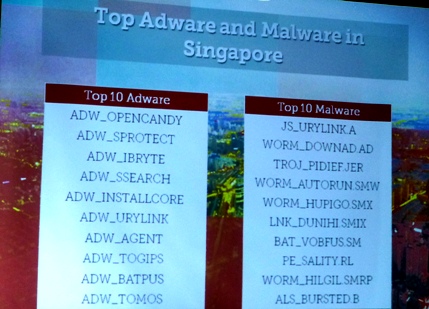
Siah highlighted that common malware like WORM_DOWNAD.AD, codenamed 'Conficker', are still making it to the top 10 in Singapore, implying that Singapore users are not updating their systems regularly, or using an operating system that is no longer supported by Microsoft, such as Windows XP. 

A vulnerability termed CVE-2012-0158 is a favourite means of attack, followed by CVE-2010-0188. The first was discovered in 2012, and the second in 2010, Siah added, showing that victims have not patched their systems against them since 2012 and 2010 respectively. 

Microsoft Office accounts for 53% of targeted attacks, and another 46% are through Adobe Reader. "We live so much with documents today. If there is an attachment I might just click on it, it could present itself as a legitimate document that talks about my work, or a report about the industry that I'm very interested in," noted Siah. 

While lax user practices help the online cybercriminal community, and well-known malware like Zeus is offered free to the community, it may seem like updating systems regularly will be enough protection; but Siah said such updates depend on bugs to be publicly announced by others, after which 'signatures' can be created to detect them. This leaves a window of opportunity in between the announcement of the bug and the availability of the patch for cybercriminals to target users. 

In addition, known vulnerabilities are just the tip of the iceberg. Existing bugs like Shellshock were only announced after decades, while malware can mutate to the point where they are essentially signatureless. "Traditional cybersecurity defences cannot detect such signatureless threats," Siah warned. "Exploiting a vulnerability will be as easy as creating an app."

It is a global problem, even if targeted attacks used to be associated only with countries like US or Russia, Siah further said. Trend Micro is aware of gangs in Brazil and China, and while the cybercriminals may base their operations in one country, they could be connected by the Internet to anywhere else in the world. 

Siah shared that Trend Micro sensors have found that attacks in APAC range across Taiwan, Japan, Indonesia, mainland China, Malaysia, the Philippines and Bangladesh, with Singapore being a relatively minor target. "If a US company has a Taiwan subsidiary, the attackers could go to the subsidiary and once they have gained control of the Taiwan servers they could then jump internally from country to country till they reach the main HQ," Siah pointed out. 

Users should expect that at least one of their accounts, whether on web services or online portals, will be compromised. The prevalence of social media usage in APAC – with about 970 million active social media users – will make users in the region viable targets. Given the predicted increase of attacks next year, cybercriminals will have more opportunities to steal user credentials. As a result, Trend Micro advises users to be more diligent when it comes to password use and online security.

Click here for the full report.

6 June 2014

Checking out Ronaldo? Think twice

According to research from McAfee, part of Intel Security, cybercriminals are most likely to use popular Portuguese footballer Cristiano Ronaldo's name to lure visitors to web pages designed to infect them with malware. The McAfee “Red Card Club” showcases the top eleven Brazil-bound players whose web pages are considered to be risky for fans to search for online. Following Ronaldo are Argentina’s Lionel Messi, Spain’s Iker Cassillas, Brazil’s Neymar and Algeria’s Karim Ziani.
Source: McAfee
Cybercriminals are likely to leverage consumer interest in the world’s most popular sport to lure victims to websites rigged with malware, malicious code capable of infecting a user’s machine and stealing passwords and personal information. McAfee researchers have used McAfee SiteAdvisor site ratings to determine which sites are risky to search when coupled with footballer names, and have calculated an overall risk percentage for each.
According to the research, fans run the greatest risk when visiting sites offering screensaver downloads and videos showcasing the extraordinary skills of the players. Searching for the latest Cristiano Ronaldo content yields more than a 3.7% chance of landing on a website that has tested positive for online threats, such as spyware, adware, spam, phishing, viruses and other malware.  
Players make the McAfee “Red Card Club” by scoring among the top eleven positions in terms of greatest probability by percentage of web page risk.

Red Card Club” Rank
Player
Country
Risk %
1
Cristiano Ronaldo
Portugal
3.76%
2
Lionel Messi
Argentina
3.72%
3
Iker Casillas
Spain
3.34%
4
Neymar
Brazil
3.14%
5
Karim Ziani
Algeria
3.00%
6
Karim Benzema
France
2.97%
7
Paulinho
Brazil
2.81%
8
Edinson Cavani
Uruguay
2.67%
9
Fernando Torres
Spain
2.65%
10
Eden Hazard
Belgium
2.50%
11
Gerard Piqué
Spain
2.45%

We want to caution consumers through the McAfee “Red Card Club” to not to let their guard down as they join in all the excitement surrounding the World Cup online. Be especially wary of videos promising to show your idol’s skills as you might get more than you bargain for,” said David Freer, Vice President, Consumer – APAC at McAfee. "Cybercriminals will definitely try to capitalise on ‘World Cup fever’, so it’s wise not to be complacent by downloading content that might put you at risk.”
Tips to Stay Protected
To avoid the summertime blues of becoming infected during the Brazil games and beyond, McAfee suggests:

Beware of content that prompts you to download anything before providing you the content. Opt to watch streaming videos or download content from official websites of content providers.
  • “Free downloads” are the highest virus-prone search term. Anyone searching for videos or files to download should be careful to not unleash malware on their computer.
  • Established news sites may not entice you with exclusives for one solid reason: there usually aren’t any. Stick to official news sites that you trust for breaking news. However, trusted sites can also fall prey to hackers. Make sure to use a safe search tool that will notify you of risky sites or links before you visit them. A complimentary version of McAfee's SiteAdvisor software can be downloaded at www.siteadvisor.com.
  • Don’t download videos from suspect sites. The useful news can typically be found on official video sites, and don’t require users to download anything. If a website offers an exclusive video for you to download, don’t.
  • Don’t 'log in' or provide other information: If you receive a message, text or email or visit a third-party website that asks for your information—credit card, email, home address, Facebook login, or other information—for access to an exclusive story, don’t give it out. Such requests are a common tactic for phishing that could lead to identity theft.
  • If you do decide to search for information on a major event or celebrity in the news, make sure your entire household’s devices have protection, such as McAfee LiveSafe which protects all devices including PCs, Macs, tablets and smartphone and it also includes malware detection software; and McAfee Mobile Security to protect your smartphone or tablet from all types of malware.
  • Always use password protection on your phone and other mobile devices. If your phone is lost or stolen, anyone who picks up the device could publish your information online.