Showing posts with label diversity. Show all posts

9 March 2025

Gender diversity benefits businesses

Artwork generated by Google Gemini (Imagen 3) to celebrate International Women's Day.  Outlines of four flowers with white text in the middle on top of a simulated watercolor wash in bright colours.
Concept artwork generated by Google Gemini (Imagen 3) to celebrate International Women's Day.

International Women's Day on March 8 is a global celebration of the social, economic, cultural, and political achievements of women. The day also marks a call to accelerate women's equality. 

New research* released for the day has shown that gender equality remains a key societal issue, with women’s rights under threat due to workplace inequalities and online abuse. The annual study, released by HeForShe, The United Nations Global Solidarity Movement for Gender Equality, and global marketing agency TEAM LEWIS, revealed that public awareness of gender inequality has increased, but geopolitical issues overshadow the issue:

- Over 75% believe companies still need to implement policies for women in the workplace.

- One third of women (32%) have reconsidered their employment due to their company’s in-office policy. Of those, 45% say the reason for reconsidering is inflexibility at work. 

- Only 17% of women received a pay rise in the last year, compared to 24% of men. 

- In leadership, women continue to be under-represented. The percentage of women in senior management roles declined to 53% this year, vs 56% in 2023 and 2024.

"Rights, equality and empowerment remain vital to global prosperity. We cannot afford to sit on the sidelines. Equality is everyone’s responsibility. 2025 is the year for men and boys to stand alongside women and girls to help make change happen.” said Vesna Jaric, Global Head of HeForShe, UN Women.

The benefits of gender diversity were championed by industry observers.

Lim Hsin Yin, VP of Sales for ASEAN, Cohesity, has contributed to the community through mentoring initiatives, including as Chairwoman of the SGTech AI Skills and Training Committee and in industry councils. 

She observed: "International Women’s Day is a moment to celebrate the progress we’ve made in fostering gender diversity and to reflect on the work still ahead. With over 30 years in the tech industry, I have witnessed firsthand the transformative power of diverse perspectives." 

Stephanie Barnett, VP of Presales for the Asia-Pacific and Japan (APJ), Okta said: "On International Women’s Day, when I reflect on what it means to be a woman in tech I feel both inspired by how far things have come, and feel energised and compelled to do so much more. While progress has been made, sectors like presales, security, and identity still reveal a significant gender gap that has persisted for decades and will continue until we radically and aggressively change and solve for the biases that exist across education, recruitment and workforce inequity.

"Mentorship has had a transformative impact on my career. I’ve been fortunate to have mentors, both men and women, who have offered guidance that goes beyond advice, helping me navigate difficult situations and complex challenges. I feel deeply accountable to pay forward the privilege that I have had in having phenomenal cheerleaders sitting in my blind spots helping me course correct, deeply reflect and charge forward with perspective and support.

"Personally, I believe that fostering diversity in an organisation is not just a checkbox activity and it takes work, takes focus, takes commitment and it may lead to discomfort and potential change management that will be initially uncomfortable, but future and long term looking will significantly accelerate revenue and positive business business results."

Said Remus Lim, Senior VP, Asia Pacific & Japan, Cloudera:  "As we celebrate International Women’s Day, this year’s theme, #AccelerateAction, serves as a call to move beyond conversation and drive real, measurable progress. At Cloudera, we know that diversity, equity, and inclusion (DEI) isn’t achieved in a single day—it’s a continuous effort that requires commitment, accountability, and the courage to challenge the status quo.

"Creating a truly inclusive workplace isn’t just about policies or programmes—it’s about recognising the talent, ambition, and potential that too often go unseen. Business leaders have a responsibility to not only open doors but to actively support and uplift those who may have been overlooked by traditional hiring and promotion practices."

"I’ve seen firsthand how potential-based hiring and mentorship can change careers—and lives. During the period when I was mentoring a colleague, I realised the importance of approaching issues from different angles when charting out new communication pathways between my mentee and other members of the leadership team. This allowed her to see her ideas to fruition while the organisation benefits from fresh perspectives across functions and levels," added Lim from Cloudera. 

"When we focus on who someone can become, rather than just what they’ve done in the past, we create pathways for talent that may not have had the same access or opportunities. When we do this, our teams grow stronger, our innovation becomes richer, and our workplaces become places where everyone has the chance to thrive."

Verena Siow, President and MD, SAP Southeast Asia, shared that this year's theme for International Women’s Day, Accelerate Action, deeply resonated with her. "To me, this theme reinforces the notion that we must take urgent and proactive actions to drive gender equity and parity. It also aligns with one of my personal mantras: Accelerate to Innovate. Just as businesses must embrace bold, decisive action to drive meaningful innovation, we must do the same to advance gender equity," she said.

"Change is often perceived as a gradual process. But while it is true that change does not take place overnight, every little step we take in accelerating action unlocks new possibilities. In Southeast Asia, I’ve seen firsthand how equipping women with the right skills, access, and support can create extraordinary outcomes."

"Yet, barriers remain. Systemic biases still slow progress, from unequal access to leadership opportunities to deeply ingrained stereotypes. The World Economic Forum estimates that at the current pace, full gender parity will not be achieved for another 134 years — a timeline we cannot accept." 

"Innovation does not happen by waiting. It happens by taking action, challenging norms, and accelerating change. Just as we push the boundaries of technology, we must do the same for equity, opportunity, and leadership. The reality is clear: diversity drives better decisions, stronger businesses, and more resilient economies. The question is no longer “why” we need to act, but how much quicker we can make change happen," Siow concluded.

"The broader challenge of gender equality remains stark. According to the Global Gender Gap Report 2024, achieving full gender parity will take 134 years—roughly five generations—at the current pace of progress. We cannot afford to wait. Governments, businesses, academia, and industry bodies must work together to ensure gender equality is not just a long-term aspiration but an urgent economic and innovation priority," agreed Jess Ng, Country Head, Singapore and Brunei, Fortinet.   

Siow touched on mentorship and leadership as solutions. To truly accelerate progress, three actions are critical, she said:

- Sponsorship over mentorship. Women need not just mentorship but advocates—leaders who actively open doors, champion careers, and create opportunities.

- Equal access to leadership tracks. High-impact projects and decision-making roles must be accessible to women at all levels, ensuring a stronger pipeline for future leadership.

- A redefinition of leadership. Success is not just about traditional leadership traits like aggressiveness; it’s about diverse perspectives, emotional intelligence, and inclusivity. Organisations that embrace this perform better and retain top talent.

Explore

Download the HeForShe research at https://www.teamlewis.com/heforshe/ 

Hashtags: #IWD2025, #AccelerateAction 

*TEAM LEWIS Foundation surveyed the general population aged 18 and above across a balanced and diverse group of ages, races, and gender. A total of 5,003 respondents were polled across 10 countries, including the US, UK, UAE, Australia, China, France, Germany, Netherlands, Singapore, and Spain. Localised translations were provided where necessary. Data was collected through an online survey consisting of 55 questions and fielded from February 5 to 14, 2025.

16 March 2017

Managing cultural diversity as leaders

London Business School experts have explored ways to eliminate bias and turn human potential into reality.

According to the London Business School, workplace diversity matters. Homogenous teams might feel comfortable, but comfort is not necessarily good for performance compared to enriching teams with people from different backgrounds and with broad perspectives.

Steering a diverse team to success takes skill. Leaders must establish trust in teams so that team members feel they can express their creativity and generate great ideas. Randall S Peterson, Professor of Organisational Behaviour at London Business School, explores how leaders foster ambition and banish fear: “Good leadership looks different around the world. While every team has to achieve certain standards to be successful, culture determines the approach.

"Compared to the West, groups in China are more collectivist, which means there is an emphasis on fitting in over standing out individually. Leading teams here is quite a balancing act: you have to ask questions to get information from people. If you ask too many questions, you appear weak and undermine your own legitimacy. If you ask too (few), you don’t encourage new thinking. The ultimate question here as a leader therefore is: how do I pull people together?”

Leadership is driven by a combination of competence, power and attraction, the London Business School notes, but bridging cultural differences demands emotional intelligence. The key, according to Professor Peterson, is in bringing these components together. Diversity is not easy to manage, but is key to achieving a top-performing and world-class team.

Niro Sivanathan, Associate Professor of Organisational Behaviour at London Business School, said: “Is leading a team of individuals an oxymoron? We believe not. It is possible to satisfy both the need to belong and the need to be unique in an individualistic group by having strong, consistently-held values that help unite a team. To do that, construct a model that says: we’re all individuals, we’re all united.

"When diversity feels uncomfortable, there’s a tendency to ignore the reasons behind our differences. A balance can be achieved by creating a common sense of ‘we’ that allows difference within it.”

And despite the many stigmas often associated with narcissists, Professor Peterson believes that there are times where it may be beneficial to have a narcissist on your team, especially when a major transformation is needed:

“Narcissists have the vision and charisma to create a committed group of followers and can be essential to creating organisational change. Most of us think of what is called the ‘agentic narcissist’: these are people who believe that they are far more competent than others. But what if this person’s outsized confidence is based on being the best helper, the best advice-giver or the best group member? These people are called ‘communal narcissists’.

“We find that communal narcissists are four times more likely to share credit and resources and significantly less likely to cause unhelpful conflict than agentic narcissists, who focus mostly on status self-enhancement. They are 33% more likely to be seen as a leader by other group members and significantly more likely to lead their team to a successful outcome. Like all types of leadership, narcissists have their time and their place. Get it right, and you reap the benefit of visionary leadership. Get that wrong, and suffer the consequences of status conflict and poor performance.”

posted from Bloggeroid

29 January 2016

Mercer sounds alarm over under-representation of women in the workforce globally

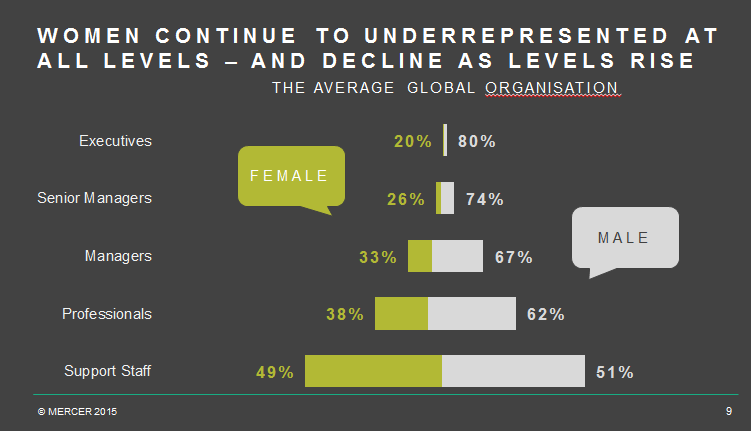
The number of women represented declines into the senior levels.
Source: Mercer When Women Thrive global report.

Women are under-represented in the workforce globally, and if organisations maintain the current rate of progress, female representation will only account for 40% of the professional and managerial ranks in 2025, according to Mercer’s second annual When Women Thrive global report.

Among the key trends revealed in the report is that women’s representation within organisations actually declines as career levels rise – from support staff through the executive level.

“The traditional methods of advancing women aren’t moving the needle, and under-representation of women around the world has become an economic and social travesty,” said Pat Milligan, Mercer’s Global Leader of When Women Thrive. “While leaders have been focusing on women at the top, they’re largely ignoring the female talent pipelines so critical to maintaining progress.

“This is a call-to-action - every organisation has a choice to stay with the status quo or drive their growth, communities and economies through the power of women.”

Mercer’s report finds that although women are 1.5 times more likely than men to be hired at the executive level, they are also leaving organisations from the highest rank at 1.3 times the rate of men, undermining gains at the top.

Asia performs the worst worldwide.
Source: Mercer When Women Thrive global report. Current and projected female representation in 2025 at 2015 attrition rates around the world.

According to the When Women Thrive report, women make up 40% of the average company’s workforce. Globally, they represent 33% of managers, 26% of senior managers, and 20% of executives. In terms of regional rankings, Australia and New Zealand is projected to move from 35% in 2015 to 40% in 2025; and Asia ranks last at 28%, up from just 25% in 2015.

“In 10 years, organisations won’t even be close to gender equality in most regions of the world,” said Milligan. “If CEOs want to drive their growth tomorrow through diversity, they need to take action today.”

The research – the most comprehensive of its kind featuring input from nearly 600 organisations around the world, employing 3.2 million people, including 1.3 million women – identifies a host of key drivers known to improve diversity and inclusion (D&I) efforts.

“It’s not enough to create a band-aid programme,” said Brian Levine, Mercer’s Innovation Leader, Global Workforce Analytics. “Most companies aren’t focused on the complete talent pipeline nor are they focused on the supporting practices and cultural change critical to ensure that women will be successful in their organisations.”

Only 9% of organisations surveyed globally offer women-focused retirement and savings programmes, despite Mercer’s research proving that such efforts lead to greater representation of women.

Other key findings:

Only 57% of organisations claim senior leaders are engaged in diversity and inclusion initiatives

Involvement of men has actually dropped since the first report in 2014, when 49% of organisations said they are engaged in D&I efforts

Just 29% of organisations review performance ratings by gender with Australia/New Zealand ranking first

Four in 10 organisations offer formal pay equity remediation processes, compared to 34% globally, and 25% in Asia. But virtually no improvements have been made since 2014

Nearly a third (28%) of women hold P&L (profit and loss) roles with Asia at No. 2 (27%), and Australia/New Zealand in third place (25%)

Women are perceived to have unique skills needed in today’s market including flexibility and adaptability (39% vs. 20% who say men have those strengths); inclusive team management (43% vs. 20%); and emotional intelligence (24% vs. 5%)

About half of organisations in three key regions – Asia, US/Canada and Latin America – agree that supporting women’s health is important to attract and retain women. Yet only 22% conduct analyses to identify gender-specific health needs in the workforce

In a series of separate studies Mercer has found that clients find that building their leadership pipeline is one of their biggest challenges, and included a lack of plans to develop women in their workforce for leadership as one of the problems in talent management strategies. 

Said Kate Bravery, Mercer’s Growth Markets Leadership & Organizational Performance Practice Leader: “To achieve long term success, a more strategic approach to nurturing the pipeline of leaders is required. This starts by translating core business objectives into a leadership strategy that defines the talent pool, competencies and the tactics required to build leaders from within. It continues with an execution plan that helps businesses identify, develop and accelerate the critical talent moves that will help them achieve real competitive advantage.”

Mercer’s Leadership Practices Study comprises a series of research reports based on surveys conducted from 2012 to 2014 that explore and compare current leadership trends in Asia Pacific, Latin America and the Middle East. Using data gathered from nearly 1,000 companies across the three growth market regions, these studies examine how companies approach leadership strategy, assessment, development and succession planning.found that companies in growth market regions are adopting effective practices for nurturing leadership talent, for example:

· Businesses in Asia-Pacific are investing heavily in training and developing senior level and global leaders at the top of their organisations.

· Firms in the Middle East are doing a good job of using global leadership capability models to help with talent development and creating opportunities for international assignments to which any employee can apply.

However, the studies also identified critical gaps in current planning that potentially limit organisations’ ability to produce the multi-skilled leaders required in modern, rapidly-growing businesses, as well as differences in the leadership competencies that are deemed critical for success by companies in each region.

Key findings included:

· Companies can do more to plan and prepare for the next generation of leaders – fewer than half of those companies responding conduct regular pipeline projections, very few have specific plans for developing key segments of their workforce (e.g. women or grooming local talent) and even fewer have metrics for tracking progress on pipeline management.

· Many businesses are not effectively identifying who is ready for the next move or position within their leadership pipeline – 15% of businesses in Asia Pacific and just 6% in the Middle East report that they have strong, “ready-now” successors in place for critical leadership roles.

· Companies are spending less annually per person on training and developing middle level and frontline leaders than they do on global or senior level leaders. Fewer than 20% of companies in the Middle East are spending US$5,000 or more per person each year to develop their youngest future leaders. In Asia-Pacific, under-investment is even starker, with just 5% of companies achieving this level of spending for individuals at the earliest stage of the pipeline – the next generation of leaders.

· Companies view a leader’s ability to ‘create strategy’ as one of the most critical competencies for leadership success – 64% of companies in Middle East and 36% in Asia Pacific prioritise strategic competencies above other operational, people or personal capabilities.

Highlights for Asia Pacific:

· While leadership development strategies are in place in many organisations, execution remains a significant problem as performance management processes are not effectively identifying who is ready for the next move or position within their leadership pipeline.

· Systems and processes for executing talent management processes are extremely inefficient, still relying on paper-based and email resources.

· Organisations are not focusing leadership development efforts on women as a segment, despite women making up a small percentage of senior management in organisations.

· Companies continue to rely on expatriates, rather than local talent, for top leadership roles, calling into question the effectiveness of leadership development and localization strategies.

· Investment in leadership development is concentrated on top-level leaders, organisations need to also reach deeper and earlier into their leadership pipelines to build talent from within.

· Leaders and managers are not being held accountable for grooming future leadership talent.

· People-related competencies are not among those seen as most critical by organisations for leadership success.

· There is a disconnect between the development methods rated most effective by respondents (“stretch” assignments) and those methods that are most widely used such as classroom training and individual development plans.

Highlights for Middle East

· Half of the companies have defined leadership development strategies in place, although this is more likely in larger organisations.

· Those organisations without a defined leadership development strategy are often reliant on buy/borrow talent strategies.

· The short-term focus of companies jeopardises their ability to build strong leadership pipelines.

· Organisations are missing some critical infrastructure to support leadership development.

· Many companies recognise the lack of attention paid by organisations and top executives to leadership development.

· Companies are relying on traditional methods such as classroom training to develop talent and leadership expertise and these are not proving to be effective in nurturing future leaders.

· Key talent pools are under-represented in leadership positions and often overlooked in talent development programmes, including local staff and women.

Interested?

Access the report summary for When Women Thrive

7 April 2014

Corporate India struggling to find women candidates for jobs

MyParichay, a Facebook-based recruitment platform, says social recruiting is now a necessity, with nine in 10 recruiters believing that a social media based hiring tool will give them a competitive advantage in gender diversity hiring.
Source: MyParichay
According to a pan-India survey conducted by the company, 85% of Indian companies surveyed mentioned that diversity is crucial to fostering innovation in the workplace. Three in four recruiters are struggling to find qualified women candidates to support gender diversity goals set by their leadership, MyParichay said, and attribute the challenge to a lack of specialised hiring tools. 

"Corporate India is looking for ways to tackle the challenges faced in gender diversity hiring," said Ranjan Sinha, Co-founder and Chairman of MyParichay. "This survey validates our thesis that social recruiting has become an essential element of today's corporate recruiting strategy and will continue to play a pivotal role in the future. MyParichay will continue innovate and bring products to market to support the goals of business leaders and HR executives."
 
Some of the key findings from the survey are:

Hiring
  • Nine in 10 recruiters believe a Facebook-based hiring tool will give them a competitive advantage in gender diversity hiring, since most of the users in India are on Facebook. Currently 90 million internet users are active on Facebook.
  • Companies are looking for specialised tools to help them with gender diversity hiring goals.
  • Nine in 10 companies will adopt tools that allow them to target and connect with qualified women professionals.
  • Only two in 10 companies have specialised tools that allow them to promote gender diversity hiring.
Branding
  • Less than half the companies plan and execute brand campaigns to promote gender diversity goals.
  • Four out of 10 companies have employer branding plans to promote gender diversity and hiring.
*Conducted in March 2014, MyParichay's survey polled 100 HR and recruitment professionals across various cities in India. MyParichay's Gender Diversity Hiring survey is a bi-annual survey on gender balance and diversity.