Showing posts with label greeting. Show all posts

28 January 2018

The Chinese new year cheat sheet for the year of the dog

You can't miss the festive feeling in places where Chinese live this time of year. Lucky red and gold objects are on sale everywhere, and distinctive festive music fills the air. Chinese new year begins February 16 in 2018, and auspicious language will be the norm from the first till the 15th day of the lunar new year.

A wish for lots of business.
A wish for lots of business opportunities.
The greetings begin on the first day of Chinese new year. Common ones are 新年快乐 (xin nian kuai le), 'happy new year' and 恭喜发财 (gong xi fa cai), 'congratulations on receiving riches and prosperity'. Riches are fundamental to Chinese culture, and especially so around Chinese new year. 心想事成 (xin xiang shi cheng), 'may your wishes come true', and 福气满满 (fu qi man man), 'prosperity in abundance', will all be well received.

Fortune-related greetings in business settings include:

- 步步高升 (bu bu gao sheng), or 'rising higher with each step taken',

- 财源广进 (cai yuan guang jin), or 'may riches enter in huge volumes', or 财源滚滚 (cai yuan gun gun), 'may riches gush in',

- 工作顺利 (gong zuo shun li), 'may your work go smoothly',

- 鸿运当头 (hong yun dang tou), 'may fortune find you',

- 马到成功 (ma dao cheng gong), 'instant success',

- 年年有餘/年年有馀 (nian nian you yu), 'surpluses every year',

- 平步青云 (ping bu qing yun), 'an easy path to a meteoric rise'

- 升官发财 (sheng guan fa cai) get a promotion and a raise',

- 生意興隆/生意兴隆 (sheng yi xing long), or 'may the business thrive greatly',

- 事业有成 (shi ye you cheng) 'success in what you're working on' , 

- 新年进步 (xin nian jin bu), which means 'making progress in the new year', 

- 一本万利 (yi ben wan li), 'reap much more than you invest'.

Greetings can also involve the animal for the year, such as ___年大吉 (___ nian da ji), 'great fortune in the year of the x', and ___年行大運/___年行大运, 'great luck in the year of the ___' depending on which animal whose year it is. It is the year of the dog in 2018, pig or boar in 2019, and the rat in 2020 - just substitute the underlined character with the appropriate animal.

Chinatown, Singapore features dogs for the new year.
Chinatown in Singapore features dogs in a focal display.
Maxi-Cash in Singapore wishes all an abundance of prosperity in the new year, using the word 旺 to do so.
Maxi-Cash in Singapore wishes all an abundance of prosperity in the new year, using the word 旺 to do so. 

Giordano featured dogs on its Chinese new year collection and had a logo of two dogs behind a gold ingot with 旺财, (wang cai or 'great fortune') on the ingot.
Giordano featured dogs on its Chinese new year collection and had a logo of two dogs behind a gold ingot with 旺财, (wang cai or 'great fortune') on the ingot. 

An advertisement at the Jem Mall. The saying 十全十美 (perfection, literally 10 complete, 10 beautiful) has been converted into a pun, 十犬十美 (10 dogs, 10 beauties).

Brands often relate festive greetings to the animal of the year. For 2018, the year of the dog, the word 旺, which has connotations of abundance and prosperity, is common in festive decor as it sounds similar to the sound a dog makes, 汪. In 2017, the year of the chicken, drinks manufacturer Pokka wished everyone 吉祥如意 (ji xiang ru yi) - all the happiness and prosperity that you hope for, but with a pun on 鸡, which sounds similar, and another on 翔, which sounds like 祥, but means to 'soar' in keeping with the avian theme.

2015 was the year of the goat (or sheep), and there are a few festive greetings that take advantage of how the word for goat, 羊 (yang), is a homonym found in various Chinese idioms. 阳光灿烂 (yang guang can lan) is a wish for bright sunlight or a bright future; 喜气洋洋, converted to 喜气羊羊 (xi qi yang yang) for the year, refers to happiness everywhere; while 羊羊得意, really 洋洋得意 (yang yang de yi), is a wish that the recipient will get whatever he or she wants, in the best way possible.

马到成功 is especially apt in the year of the horse (most recently, 2014), as the character for horse, 马, begins the greeting, but it can be used at any other time as well.

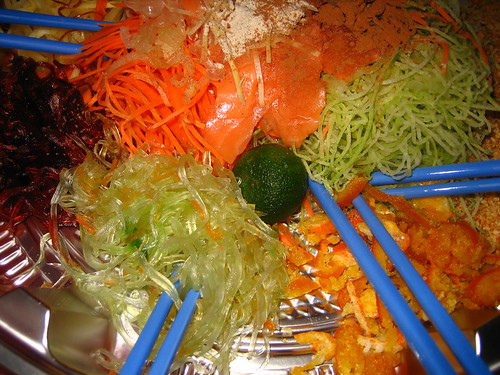
The lohei platter before the lohei starts. Each ingredient has an auspicious meaning, including the raw salmon (abundance) in the middle, and the crackers (money).

These greetings are also recited at traditional Chinese new year banquets in Malaysia and Singapore, during the lohei (撈起) part which precedes the meal proper. Loheis can start weeks before Chinese new year and are available until the 15th day.

A platter of yusheng (鱼生), a raw fish* salad, is first brought to the table after which toppings are ceremoniously added individually, accompanied by auspicious sayings. Specific toppings are associated with specific sayings. The sweet sauce is typically poured while saying 甜甜蜜蜜 (tiantian mimi, a wish that life will be sweet) and the fish or seafood component arranged on the salad while saying 年年有余 because 余, yu or surplus, sounds like 鱼, yu or fish.

Once complete, diners mix (lo) the salad with chopsticks while calling out greetings as wishes for the coming year. The higher the salad is raised (hei), the better the luck for the coming year.

If you can't remember too many greetings, don't worry - a simple 'happy new year' is fine. The whole idea is to start off the year right, and it's traditional to hope for fortune, prosperity and success. Just stay away from anything negative. 万事如意 (wan shi ru yi), 'may all things be as you wish'!

*Various chefs have experimented with different takes on the salad. The raw fish component can be replaced by smoked salmon, sliced abalone or lobster for example, while the salad may be replaced by fruit. Fancier toppings such as gold flakes or caviar have also appeared in recent years.

7 February 2016

Chinese new year greetings for the office and business lohei

Scroll saying 生意興隆/生意兴隆  (sheng yi xing long), or 'may the  business thrive greatly'
Scroll saying 生意興隆/生意兴隆
(sheng yi xing long), or 'may the
business thrive greatly'
You can't miss the festive feeling in mainland China, Taiwan, Hong Kong or Singapore this time of year. Lucky red and gold objects are on sale everywhere, together with representations of the zodiacal animal whose year it is going to be. Chinese new year is on February 8 in 2016, and you'll be greeting or being greeted in auspicious language from the first day on.

The most common greetings you'll hear are 新年快乐 (xin nian kuai le), 'happy new year' and 恭喜发财 (gong xi fa cai), 'congratulations on receiving riches and prosperity'.

Riches are a recurrent theme in Chinese culture, especially around Chinese new year. Fortune-related greetings for businesses include 财源广进 (cai yuan guang jin), or 'may riches enter in huge volumes', and 生意興隆/生意兴隆 (sheng yi xing long), or 'may the business thrive greatly'. 年年有餘/年年有馀 (nian nian you yu), 'surpluses every year', 大吉大利 (da ji da li), 'lots of fortune and profits' as well as 马到成功 (ma dao cheng gong), 'instant success', are spot on both for businesses and individuals.

马 到成功 is especially apt in the year of the horse (most recently, 2014), as the character for horse, 马, begins the greeting, but it can be used at any other time as well. There are lunar new year greetings which mention the specific year, such as x年大吉 (x nian da ji), 'great fortune in the year of the x', and x年行大運/x年行大运, 'great luck in the year of the x'. Just substitute the underlined character with the appropriate animal. 2016 is the year of the monkey, for instance, and 2017 will be the year of the rooster.

Beyond these traditional greetings are some which are more relevant to those working. 新年进步 (xin nian jin bu), which means 'making progress in the new year', 心想事成 (xin xiang shi cheng), 'may your wishes come true', and the simple 工作顺利 (gong zuo shun li), 'may your work go smoothly', will all be well received. 事业有成 (shi ye you cheng) 'success in what you're working on' and 平步青云 (ping bu qing yun), 'an easy path to a meteoric rise' are equally auspicious. Another greeting revolving around 步 (steps) is 步步高升 (bu bu gao sheng), or 'rising higher with each step taken'.

Lo hei
Before the lohei starts.


These greetings are also said at traditional Chinese new year banquets in Malaysia and Singapore, during the lohei (撈起) part which precedes the meal proper. During the lohei, yusheng (鱼生), a raw fish* salad, is prepared. The tradition is to add ingredients for the salad individually, accompanied by auspicious sayings, after which diners mix (lo) the salad with chopsticks while calling out the same greetings as wishes for the coming year. The higher the salad is raised (hei), the better the luck for the coming year.

If you can't remember too many greetings, don't worry - a simple 'x nian kuai le' or 'happy new year in the year of x' is quite appropriate. The whole idea is to start off the year right, and it's traditional to hope for fortune, prosperity and success. 万事如意 (wan shi ru yi), 'may all things be as you wish'!

A version of this post first appeared in a sister blog, WorkSmartSG, which is no longer updated.

*Raw freshwater fish is no longer served in Singapore yushengs as of 2016 because of the danger of group B streptococcus infections. The protein is replaced with raw salmon, abalone or top shell.

20 September 2015

Add your own branding to SPD paper and electronic greeting cards

Source: SPD website.

SPD, an organisation dedicated to working with people with disabilities to develop their potential to the fullest, has a sheltered workshop* that produces both paper and electronic greeting cards for various occasions, including birthdays, Hari Raya, Deepavali, Christmas and Chinese New Year.

Cards can be customised with corporate logos, specific messages, or designed for other occasions.

Interested?

Visit the e-shop to view the full range of cards. Christmas 2015 and Chinese New Year 2016 cards are already available
Enquire at +65 6579 0742

*A sheltered workshop is a work environment for people with disabilities. 

27 January 2015

What to say for Chinese new year

You can't miss the festive feeling in mainland China, Taiwan, Hong Kong or Singapore this time of year. Lucky red and gold objects are on sale everywhere. Chinese new year falls on February 19 in 2015, and you'll be greeting or greeted in auspicious language from the first day till the 15th of the lunar new year. 

The most common greetings you'll hear are 新年快乐 (xin nian kuai le), 'happy new year' and 恭喜发财 (gong xi fa cai), 'congratulations on receiving riches and prosperity'. 

Riches a recurrent theme in Chinese culture, especially around Chinese new year. Fortune-related greetings for businesses include 财源广进  (cai yuan guang jin), or 'may riches enter in huge volumes', and 生意興隆/生意兴隆 (sheng yi xing long), or 'may the business thrive greatly'. 年年有餘/年年有馀 (nian nian you yu), 'surpluses every year', as well as 马到成功 (ma dao cheng gong), 'instant success', are spot on both for businesses and individuals.

马到成功 was especially apt in 2014, the lunar year of the horse, as the character for horse, 马, begins the greeting, but it can be used at any other time as well. There were also a number of puns on 'immediately', 马上 (ma shang), which can also be taken to be 'on the horse'; many shops were selling horse figurines with money and other things on a horse as a wish for immediate fortune.

Advertisement from Kallang Wave
featuring 喜气羊羊 as a greeting.

2015 is the year of the goat (or sheep), and there are a few festive greetings that take advantage of how the word for goat, 羊 (yang), is a homonym found in various Chinese idioms. 阳光灿烂 (yang guang can lan) is a wish for bright sunlight or a bright future; 喜气洋洋, converted to 喜气羊羊 (xi qi yang yang) for the year, refers to happiness everywhere; while 羊羊得意, really 洋洋得意 (yang yang de yi), is a wish that the recipient will get whatever he or she wants, in the best way possible.

There are business-oriented greetings which mention the specific zodiac animal, such as 羊年大吉 (yang nian da ji), 'great fortune in the year of the goat', and 羊年行大运 (yang nian da yun), 'great luck in the year of the goat'. 羊年发财 (yang nian fa cai), 'welcome fortune in the year of the goat' is equally auspicious. Just substitute the underlined character with the appropriate animal for other years. 

Beyond these traditional greetings are some which are more relevant to those working. 新年进步 (xin nian jin bu), which means 'making progress in the new year', 心想事成 (xin xiang shi cheng), 'may your wishes come true', and the simple 工作顺利 (gong zuo shun li), 'may your work go smoothly', will all be well received. 事业有成 (shi ye you cheng) 'success in what you're working on' and 平步青云 (ping bu qing yun), 'an easy path to a meteoric rise' are equally auspicious.

If you can't remember too many greetings, don't worry - a simple 'happy new year' is fine. The whole idea is to start off the year right, and it's traditional to hope for fortune, prosperity and success. Don't mention anything negative, and you'll be fine. 万事如意 (wan shi ru yi), 'may all things be as you wish'!