Showing posts with label #cny. Show all posts

17 February 2015

Facai could be really bad for you

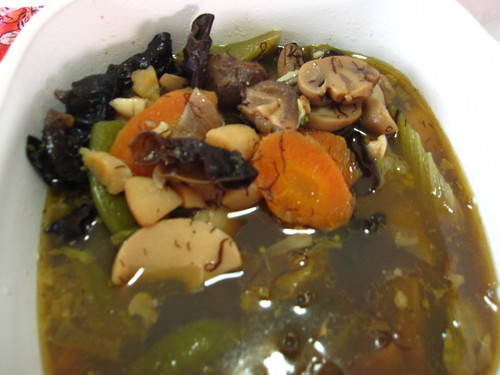
IMG_2152
Facai fungus in a vegetarian dish often seen during Chinese new Year.

Facai, a fungus which looks like hair and which is traditionally eaten during Chinese new year because 'facai' sounds like 'gaining prosperity' (發財), is actually a type of toxic bacteria called nostoc flagelliforme.

Over-harvesting has led to China banning the fungus, and most facai today is actually made from starch. One 2009 study in Amyotrophic Lateral Sclerosis found that few samples of facai on sale were actually genuine nostoc flagelliforme, with the genuine ones containing the toxin beta-N-methylamino-L-alanine (BMAA).

BMAA has been implicated in nerve-related diseases such as motor neuron disease or amyotrophic lateral sclerosis, the disease highlighted by the ice bucket challenge; in Alzheimer’s disease as well as in Parkinson’s disease. A 2013 study in PLOS One explains that the body may mistake BMAA for a very similar amino acid that it uses called serine, leading to abnormalities in nerve tissue.

BMAA has definitely caused brain disorders in mice. A 2011 study in Behavioural Brain Research noted that high doses of BMAA injected into adult rats caused "distinct deficits in spatial learning and memory" but it wreaks most of its damage in developing fetuses. An earlier study by the same researchers published in Toxicological Sciences studied adult rats which had been exposed to BMAA as babies. These rats displayed learning impairments as adults, for example in not associating a punishment as a disincentive.

While there seems to be a case for avoiding facai, or rather the BMAA it contains, BMAA is not only found in facai. It can be found in plants, in water, and likely accumulated in the food chain as live seafood eats materials which contain BMAA and are themselves eaten.

Where does that leave the health-conscious consumer? How much BMAA is too much? The research is still scanty and until we know more about whether we should be avoiding BMAA and how we can do it, we can always err on the side of caution through avoiding foods which are known to contain BMAA.

30 January 2015

POSB expands number of locations where new notes can be collected

Source: POSB eDM.

From February 2 DBS and POSB customers in Singapore can obtain the new notes for Chinese new year in more locations. New notes are considered de rigeur as cash gifts during the new year, placed in red packets (ang pows or lai see) and given to children for luck during the festive period. The heads of some businesses may also distribute such gifts on the first day back to work after the new year holiday.

New notes will be available* at these locations:

1. All SingPost post offices


Exchange amount
Combination
S$500#
S$2 x 100 notes + S$10 x 30 notes (new)
S$1,000
S$10 x 50 notes + S$50 x 10 notes (new)

A DBS or POSB ATM or debit card is required. Post offices can be located here.

2. Pop-up ATMs at Community Clubs (CCs)


Withdrawal amount
Combination
S$100
S$2 x 50 notes (good-as-new)
S$300
S$10 x 30 notes (new)
S$500
S$50 x 10 notes (new)
S$1,000
S$50 x 16 notes + S$10 x 20 notes (new)

The pop-up ATMs will be at:

  1. Bukit Batok CC, 21 Bukit Batok Central, S659959
  2. Chong Pang CC, 21 Yishun Ring Road, S768677
  3. Henderson CC, 500 Bukit Merah View, S159682
  4. Kreta Ayer CC, 28A Kreta Ayer Road, S088995
  5. Kampong Chai Chee CC, 200 Bedok North Ave 1, S469752
  6. Mountbatten CC, 35 Jalan Satu, S399479
  7. Teck Ghee CC, 861 Ang Mo Kio Ave 10, S569734
  8. Toa Payoh West CC, 200 Lorong 2 Toa Payoh, S319642
  9. Yew Tee CC, 20 Choa Chua Kang Street 52 #01-01, S689286
  10. Yuhua CC, 90 Boon Lay Way, S609958
For more information on operating hours, visit www.posb.com.sg/cnynotes

*While stocks last.
#Exchange amount of S$500 is limited to a maximum of three packs per customer.

27 January 2015

What to say for Chinese new year

You can't miss the festive feeling in mainland China, Taiwan, Hong Kong or Singapore this time of year. Lucky red and gold objects are on sale everywhere. Chinese new year falls on February 19 in 2015, and you'll be greeting or greeted in auspicious language from the first day till the 15th of the lunar new year. 

The most common greetings you'll hear are 新年快乐 (xin nian kuai le), 'happy new year' and 恭喜发财 (gong xi fa cai), 'congratulations on receiving riches and prosperity'. 

Riches a recurrent theme in Chinese culture, especially around Chinese new year. Fortune-related greetings for businesses include 财源广进  (cai yuan guang jin), or 'may riches enter in huge volumes', and 生意興隆/生意兴隆 (sheng yi xing long), or 'may the business thrive greatly'. 年年有餘/年年有馀 (nian nian you yu), 'surpluses every year', as well as 马到成功 (ma dao cheng gong), 'instant success', are spot on both for businesses and individuals.

马到成功 was especially apt in 2014, the lunar year of the horse, as the character for horse, 马, begins the greeting, but it can be used at any other time as well. There were also a number of puns on 'immediately', 上 (ma shang), which can also be taken to be 'on the horse'; many shops were selling horse figurines with money and other things on a horse as a wish for immediate fortune.

Advertisement from Kallang Wave
featuring 喜气羊羊 as a greeting.

2015 is the year of the goat (or sheep), and there are a few festive greetings that take advantage of how the word for goat, 羊 (yang), is a homonym found in various Chinese idioms. 阳光灿烂 (yang guang can lan) is a wish for bright sunlight or a bright future; 喜气洋洋, converted to 喜气羊羊 (xi qi yang yang) for the year, refers to happiness everywhere; while 羊羊得意, really 洋洋得意 (yang yang de yi), is a wish that the recipient will get whatever he or she wants, in the best way possible.

There are business-oriented greetings which mention the specific zodiac animal, such as 年大吉 (yang nian da ji), 'great fortune in the year of the goat', and 年行大运 (yang nian da yun), 'great luck in the year of the goat'. 发财 (yang nian fa cai), 'welcome fortune in the year of the goat' is equally auspicious. Just substitute the underlined character with the appropriate animal for other years. 

Beyond these traditional greetings are some which are more relevant to those working. 新年进步 (xin nian jin bu), which means 'making progress in the new year', 心想事成 (xin xiang shi cheng), 'may your wishes come true', and the simple 工作顺利 (gong zuo shun li), 'may your work go smoothly', will all be well received. 事业有成 (shi ye you cheng) 'success in what you're working on' and 平步青云 (ping bu qing yun), 'an easy path to a meteoric rise' are equally auspicious.

If you can't remember too many greetings, don't worry - a simple 'happy new year' is fine. The whole idea is to start off the year right, and it's traditional to hope for fortune, prosperity and success. Don't mention anything negative, and you'll be fine. 万事如意 (wan shi ru yi), 'may all things be as you wish'!

26 January 2015

Shisen Hanten is all ready for the Year of the Goat

Source: Mandarin Orchard Singapore's Chinese new year takeaway order form. 

Shisen Hanten at the Mandarin Orchard Singapore has prepared a wide array of Chinese New Year delicacies and festive goodies from 26 January to 5 March 2015. 

Ten set menus that are themed around good luck have been drawn up this auspicious season, designed to help usher in a year filled with prosperity, fortune, success and wealth. Favourites in the menus include steamed sea perch fillet, and stirfried clam and prawn in XO sauce.

Diners can feast on traditional Cantonese favourites in addition to seasonal treats such as the classic “lo hei,” (yu sheng) for which ingredients must be tossed as high as possible to attain greater heights and fortune for the year. 

Shisen Hanten's take on the lo hei includes salmon and olives. The Prosperity Salmon Yu Sheng topped with Plum Sauce with Olive and Spring Onion Oil boasts a harmony of flavours and offers good luck with every toss. 

Alternatively, the Baby Abalone Fortune Pot is ideal for small groups, and includes 20 treasures, including dried oyster and fish maw, to start the year of the goat off right.

Festive goodies such as Hokkaido pumpkin cake (S$38), golden ingot pineapple tart (eight pieces for S$38.80), and koi fish nian gao (a pair for S$48) provide a prosperous end to meals, and are excellent for gifting, too. Other gifts which can be preordered include honeyed walnuts, steamed rice cake with water chestnut and Shisen Hanten's very own mala sauce.

Helmed by celebrity Chef Chen Kentaro, Shisen Hanten is situated 35 floors above Orchard Road and offers breathtaking views. Reservations can be made by calling +65 6831 6262 or 6831 6266, or through emailing shisenhanten.orchard@meritushotels.com. The service charge is waived for all yu sheng and pen cai takeaway orders.

16 January 2015

Brighten up the office for Chinese New Year with festive flowers

Viva La Fleur will introduce a new range of long-lasting bouquets and table arrangements from 19 January 2015. In keeping with the festive season, red, orange and yellow hues symbolising love, luck and good fortune dominate in this range. 

Part of Viva La Fleur's new range. A combination of deep red roses, hydrangeas and caspia, with brown twigs. View this arrangement on Viva La Fleur's online shop here.

Part of Viva La Fleur's new range. Red roses paired with deep red hydrangeas and pink caspia. View this arrangement on Viva La Fleur's online shop here.

Florals from Viva La Fleur are made up of 100% natural flowers and foliage that do not need watering or sunlight, and which will last for months, bringing the recipient long-lasting love, luck and prosperity.

Read the blog post introducing Viva La Fleur here.

12 January 2015

Corporates can participate in For a Golden Home charity campaign

Design portal and social media platform Cromly.com's For a Golden Home online charity campaign includes a platform which allows organisations to create their own fundraising projects towards the same cause: a better Chinese New Year for the needy elderly in Singapore this year.

Source: Cromly.com. Companies can pledge a project to help raise funds for the charity campaign. Eunice Olsen and Paul Foster are For a Golden Home ambassadors.

The website will go live on 3 February, a Tuesday, in support of the Giving Tuesday movement, and will close two months later in March. Funds raised will be fully channelled towards restoring basic living conditions for the occupants of approximately 30 one-room flats through Project HomeWorks by Habitat for Humanity

Through an invitation to pledge, an organisation can take ownership of its own fundraising project, with its own goals and means to do so. Suggested pledges include pledging corporate fundraising efforts towards a particular target, or pledging a percentage of corporate profits, for a certain period.

Corporate sponsorships are also available, through matching donations dollar-for-dollar to a specific maximum amount, or sponsorship-in-kind of meaningful incentives to encourage donors.

Email alexa@cromly.com for more information about corporate partnerships.

18 January 2014

Chinese new year greetings for business

Chinese new year falls on January 31 in 2014. It's customary to greet Chinese colleagues and business acquaintances with a new year greeting when you first meet or speak to them during the 15 days of the new year.

The most common greetings you'll hear are 新年快乐 (xin nian kuai le), 'happy new year' and 恭喜发财 (gong xi fa cai), 'congratulations on receiving riches and prosperity'. 

Riches a recurrent theme in Chinese culture, especially around Chinese new year. Fortune-related greetings for businesses include 财源广进  (cai yuan guang jin), or 'may riches enter in huge volumes', and 生意興隆/生意兴隆 (sheng yi xing long), or 'may the business thrive greatly'. 年年有餘/年年有馀 (nian nian you yu), 'surpluses every year', as well as 马到成功 (ma dao cheng gong), 'instant success', are spot on both for businesses and individuals.

马到成功 is especially apt in the coming year of the horse, as the character for horse, 马, begins the greeting, but it can be used at any other time as well. There are business-oriented greetings which mention the specific year, such as 年大吉 (ma nian da ji), 'great fortune in the year of the horse', and 年行大運/年行大运, 'great luck in the year of the horse'. Just substitute the underlined character with the appropriate animal of the year.

Beyond these traditional greetings are some which are more relevant to those working. 新年进步 (xin nian jin bu), which means 'making progress in the new year', 心想事成 (xin xiang shi cheng), 'may your wishes come true', and the simple 工作顺利 (gong zuo shun li), 'may your work go smoothly', will all be well received. 事业有成 (shi ye you cheng) 'success in what you're working on' and 平步青云 (ping bu qing yun), 'an easy path to a meteoric rise' are equally auspicious.

If you can't remember too many greetings, don't worry - a simple 'happy new year' is fine. The whole idea is to start off the year right, and it's traditional to hope for fortune, prosperity and success. Don't mention anything worrying, and you'll be fine. 万事如意 (wan shi ru yi), 'may all things be as you wish'!