Showing posts with label lohei. Show all posts

30 December 2025

Lunar New Year cheat sheet for businesses in the year of the Fire Horse, 2026

The horse replaces the snake as the 7th animal* in a 12-year cycle in the Chinese zodiac in 2026. Chinese New Year begins 17 February in 2026, and auspicious language will be the norm from the eve of the 1st till the 15th day of the lunar new year. 

A wish for lots of business.
A wish for lots of business opportunities:
生意兴隆.

Evergreen greetings

Generic auspicious greetings include 新年快乐 (xin nian kuai le), 'happy new year' and the ubiquitous 恭喜发财 (gong xi fa cai), 'congratulations on receiving riches and prosperity'. Riches are synonymous with success in Chinese culture, and especially so around Chinese New Year. 心想事成 (xin xiang shi cheng), 'may your wishes come true', and 福气满满 (fu qi man man), 'prosperity in abundance', will be well received.

Evergreen business greetings

Fortune-related greetings in business settings include:

- 和气生财 (he qi sheng cai), 'wealth arising from harmony',

- 步步高升 (bu bu gao sheng), or 'rising higher with each step taken',

- 财源广进 (cai yuan guang jin), or 'may riches enter in huge volumes', or 财源滚滚 (cai yuan gun gun), 'may riches gush in',

- 东成西就 (dong cheng xi jiu), or 'achievements everywhere, literally from east to west',

- 工作顺利 (gong zuo shun li), 'may your work go smoothly',

- 鸿运当头 (hong yun dang tou), 'may fortune find you',

- 货如轮转 (huo ru lun zhuan), 'may your products sell like hotcakes, as quickly as wheels turn'

- 骏业日新 (jun ye ri xin), 'an excellent business always pays salaries on time', describing a thriving business

- 骏业腾飞 (jun ye teng fei), 'an excellent business soars high', also describing business success

- 马到成功 (ma dao cheng gong), 'instant success' or literally 'succeed when the horse arrives' - particularly popular in the year of the horse as the word for horse (马) features in this saying. 马到功成 (ma dao gong cheng) is a similar saying, meaning 'the work is completed when the horse arrives', or 'the project is completed swiftly' 

- 年年有余 (nian nian you yu), 'surpluses every year'

- 平步青云 (ping bu qing yun), 'an easy path to a meteoric rise'

- 升官发财 (sheng guan fa cai) 'get a promotion and a raise'

- 生意兴隆 (sheng yi xing long), or 'may the business thrive significantly'

- 事业有成 (shi ye you cheng) 'success in business' , 事业发达 (shi ye fa da) 'a thriving business'

- 新年进步 (xin nian jin bu), which means 'making progress in the new year'

- 一本万利 (yi ben wan li), 'reap much more than you invest'

Animal-related greetings

Greetings can also involve the animal for the year, such as filling in the blank accordingly for ___年大吉 (___ nian da ji), 'great fortune in the year of the ___', and ___年行大運/___年行大运, (___ nian xing da yun), 'great luck in the year of the ___ as it progresses', depending on which animal whose year it is. 

It is the year of the horse in 2026, the year of the goat (羊, yang) after that, and then the year of the monkey (猴, hou) thereafter. 

You may also see ___ 来运转 (___ lai yun zhuan), or 'a change of fortunes when the animal arrives'.  Referring to the animal of the year as 福___ (fu ___), or 'the fortune-bringing ___' as well as 金___ (jin____), or the 'golden ____' is common as well as gold is much prized as a precious metal.

Pun-related greetings for the year of the horse

Puns are common in Chinese when many words sound the same, and brands may pun on positive classical Chinese sayings in their festive marketing** as a result. A search online*** has turned up several new year sayings for the horse, which symbolises strength and speed. Cavalry was also a significant part of Chinese defence, leading to military-related language as well:

Besides 马到成功, or 事业马到成功 (shi ye ma dao cheng gong), 'instant success in your affairs', auspicious greetings which mention the horse include:

- 骏马迎春 (jun ma ying chun), 'the excellent horse welcomes spring'

- 駿馬報喜 (jun ma bao xi), 'the excellent horse reports happy news' 

- 骏马奔腾(jùn mǎ bēn téng), 'the excellent horse is galloping', describing something that's developing quickly, or a person who is full of vigour

- 馬躍新程 (mǎ yuè xīn chéng), 'the horse leaps into a new journey', to wish success for a new chapter.

- 龙马精神 (long ma jing shen), 'spirit of the dragon-horse', a description of vigour and a wish for good health

- 一马当先 (yi ma dang xian), 'the warrior horse is the leader'

- 快马加鞭 (kuài mǎ jiā biān), 'to spur a fast horse to speed up', conveying the idea of quick success or rapid progress.  

Some auspicious descriptions involving horses are best paired with a business-related objective:

- 马上_____, (ma shang) is the most common trope for greetings in the year of the horse. While the phrase means 'immediately', it literally is also 'on a horse'. So 马上有钱 (ma shang you qian), would mean 'to get rich instantly', and also 'there's money on the horse'.

- _____如馬蹄生風/马蹄生风 (ru ma ti sheng feng), 'like hoofbeats generating wind', a description of something accelerating. Fill the blank with 生意 (sheng yi) 'doing business' to create 生意如馬蹄生風 (sheng yi ru ma ti sheng feng), a wish that business opportunities grow and develop quickly. An alternative with a similar meaning is 四蹄生风 (si ti sheng feng), 'four hooves generating wind'.

- 千金萬馬 (qian jin wan ma), 'a thousand pieces of gold and 10 thousand horses', a wish for great wealth and unstoppable momentum in the year of the horse.  

- _____万马奔腾 (wan ma ben teng), literally '10,000 horses galloping', typically describes a powerful scene, great momentum, or a grand spectacle. Add a positive prefix, like 好运万马奔腾 (hao yun wan ma ben teng) - this means 'luck rushing in, like the arrival of 10,000 horses'.

- _____不停蹄 (bu ting ti), 'tireless hoofbeats', describing something that is continuous, such as 财源不停蹄 (cai yuan bu ting ti), 'wealth that doesn't stop streaming in'. 

- 騏驥馳騁 (qí jì chí chěng), 'a galloping thoroughbred', by extension an excellent person who is extremely successful. Each of the four characters feature the character for 'horse'.

- 马力十足 (ma li shi zu), '10x the horsepower needed', or 'a horse with 10 legs'; either way, a wish that a business or an individual is well-equipped for the task.

- 匹馬一麾 (pǐ mǎ yī huī), 'commanding one horse', a description of courage and efficiency, basically a leader who is able to achieve great things with a small team.

Here's how brands have been including the horse in their Chinese New Year campaigns: 

Marigold collaborated with Quby and added the festive motto 马上行大运 (ma shang xing da yun), "instant arrival at fortune".


100PLUS went for the classic 马到成功 on its cans.


Cadbury's Chinese New Year campaign has a promo titled Ride into Prosperity.
Cadbury didn't add any Chinese words, but referred to riding and 'prosperity'. The grand prize - gold bars - have horses on them.

A close up of Casa Hana's Chinese New Year pineapple balls featuring 马上有钱 on the labels for Chinese New Year 2026.

Casa Hana's festive cookies use 马上有钱.


Everfresh, a tissue brand, went for 马上有钱花 for Chinese New Year 2026.
Everfresh, a tissue brand, went for 马上有钱花 (ma shang you qian hua), again 'to get rich instantly' but literally 'get money to spend immediately' and 'there's money to spend physically on the horse'. The same character for 'spend' is used for 'flower', which are used to decorate homes for the Lunar New Year. And as it happens, standard Everfresh packaging almost always features a specific flower for a specific type of tissue.
 
 
Old Town and Super, both coffee brands, wish customers 马上发财  in Chinese New Year 2026.
Old Town and Super, both coffee brands, wish customers 马上发财 (ma shang fa cai), another variation of 'get rich instantly'. The word for horse has been given creative treatment and looks like a galloping horse.
 
 
Shachima, has taken the 'ma' of its name to say 玛上有福 in 2026.
This sachima brand, Shachima, has taken the 'ma' of its name to say 玛上有福 (ma shang you fu), a pun on 'instant prosperity' or literally 'prosperity comes instantly on top of the snack'.
 
 
Glico's Chinese New Year 2026 greeting is a direct reference to 一马当先.

Like Cadbury, Glico has gone for a message in English. The copy is a direct reference to 一马当先, 'the galloping horse charges forward'. The Chinese characters can also be read as 'a horse will lead').


A red packet series featuring horse-related auspicious sayings. In this case, the packets are a lucky gold, not red. 马蹄疾驰 (ma ti ji chi) "the hooves gallop", while 步步高升 is apt for galloping horses. Google AI Overviews has surfaced additional auspicious phrases with a similar intent: 
  • 马蹄声声踏富路,财源滚滚来 (ma ti sheng sheng da fu lu, cai yuan gun gun lai)
  • 马蹄踏金路,富贵长春至 (ma ti da jin lu, fu gui chang chun zhi)
  • 马驰万里福满门,福运满满一整年 (ma chi wan li fu man men, fu yun man man yi zen nian)


  • 舞出马力, HUAT 到底 (wu chu ma li, huat dao di) from Ah Huat Coffee refers to the grace and strength of the horse and maximising prosperity. The brand played on its own name, 'Huat' (发 or 'fa' in Mandarin), to wish customers ultimate prosperity at the same time. 


    IKEA brings in the 马力 (horsepower) in 2026.

    IKEA's Chinese New Year campaign in Singapore also refers to the power of the horse: 马力全开,福喜临门 (ma li quan kai, fu xi lin men), literally to 'max out the horsepower to gain prosperity and happiness at your door'. 


    Pagoda puns on a well-known Chinese New Year greeting, 心想事成, 心想志成.
    Pagoda brand sesame oil bottles had a collar that puns on a well-known Chinese New Year greeting, 心想事成, while also alluding to the horse's strength. Pagoda's version for the year of the horse is 心想志成, replacing 'shi' with the rhyming 'zhi' for xin xiang zhi cheng, changing the wish to 'may you succeed in everything you are determined to do'. 志 is sometimes described as 'inner strength'.


    Tiger's year of the horse greeting has a translingual pun.

    Tiger had its year in 2022 but manages to consolidate a reference to itself in addition to the year of the horse. This festive greeting takes the form of spring couplets, which are come in pairs and are read from top to bottom instead of left to right as they traditionally decorate either side of the main entrance of a home. 

    A matching horizontal greeting is often pasted over the top of the doorway. An allusion to the song Who let the dogs out, Tiger's version is 'Hu let the huat out'. 'Hu' or 虎 means 'tiger', so the phrase can also mean 'Tiger is the means to jumpstarting your prosperity'. 

    The left saying, 马舞春风 (ma wu chun feng), 'horse dances in the spring breeze' - introduce the concepts of grace, happiness, and the advent of spring Spring Festival, another name for Chinese New Year. 舞, 'to dance', was also seen in the copy for Ah Huat Coffee. 万事如意, on the right, is a common festive greeting.


    Want Want's festive packaging features 骏马旺业.
    Want Want, whose Chinese name is 旺旺, has created festive packaging featuring 骏马旺业 (jun ma wang ye), 'the excellent horse (the year of the horse) heralds a flourishing business'. Like Ah Huat, the brand can play on its own name every Chinese New Year.

    Good Chen ma ti su or bei tei soh packaging

    These cookies have no festive packaging and aren't traditionally associated with New Year food, but deserve a mention as they just happen to be called 马蹄酥 (ma ti su), 'horse hoof puffs'.


    The lohei (撈起)

    No traditional Chinese New Year banquet in Malaysia and Singapore is complete without a lohei ceremony before the meal proper. Loheis are available weeks before Chinese New Year, and up to the 15th day of the new year.


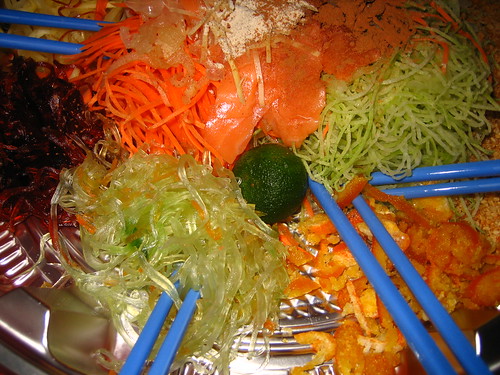
    A lohei platter. Each ingredient has an auspicious meaning, including the raw salmon slices (abundance) at the side, and the sauces in bowls (plum sauce in the foreground for a sweet future, and oil next to it to ensure everything goes smoothly).
    A lohei platter. Each ingredient has an auspicious meaning, including the raw salmon slices (abundance) at the side, and the sauces in bowls (plum sauce in the foreground for a sweet future, and oil next to it to ensure everything goes smoothly).

    A platter of yusheng (鱼生, sometimes called 'yee sang'), a raw fish**** salad, is first brought to the table after which toppings are ceremoniously added individually, accompanied by auspicious wishes that accompany specific ingredients. The sweet sauce is typically added while saying 甜甜蜜蜜 (tiantian mimi, a wish that life will be sweet) and the fish or seafood component arranged on the salad while saying 年年有余 because 余 (yu, 'surplus'), sounds like 鱼 (yu, 'fish').

    Once complete, diners toss (lo) the salad with chopsticks while calling out their wishes for the coming year - just use the ones mentioned above. The higher the salad is raised (hei), the better the luck for the coming year.

    If you can't remember too many greetings, don't worry - a simple 'happy new year' is fine. The whole idea is to start off the year right, and it's traditional to hope for fortune, prosperity and success. Just stay away from anything negative. 万事如意 (wan shi ru yi), 'may all things be as you wish'!


    Poster from the Don Don Donki department store showing what is to be said at each stage of lohei preparation.
    Poster from the Don Don Donki department store shared in the year of the snake showing what is to be said at each stage of lohei preparation.


    Explore

    Fengshui masters typically release forecasts for a new year before Chinese New Year as well. Dato' Joey Yap of The Joey Yap Group and founder of the Mastery Academy of Chinese Metaphysics has released video forecasts for different animal signs in 2026, for example.

    View additional marketing assets with a horse theme at https://www.facebook.com/media/set/?vanity=singaporerecommends&set=a.1449827553820219

    Hashtags: #12Animals, #AnimalZodiac, #ChineseZodiac, #CNY, #CNY2026, #ChineseNewYear, #JoeyYap, #LunarNewYear, #LNY, #SpringFestival, #YearOfTheFireHorse, #YearOfTheFireHorse2026, #YearOfTheHorse, #yearofthehorse2026

    *The sequence, according to legend, came down to which 12 animals arrived first in a race to be included in the zodiac. The animals crossed the finishing line in the sequence of rat, ox or cow, tiger, rabbit, dragon, snake, horse, goat or sheep, monkey, rooster, dog and pig. What everyone also seems to agree on is that the rat took advantage of the ox. It was actually in second place, but jumped off the ox's back to get to the finish line first. The rabbit is also known as the jade rabbit due to a second legend, in which it offered itself as food to a hungry man. The man turned out to be the Jade Emperor in disguise, and as a reward the rabbit became immortal and was sent to the moon to live forever.

    **2015 was the year of the goat (or ram), and there are a few festive greetings that take advantage of how the word for goat, 羊 (yang), is a homonym found in various Chinese idioms. 阳光灿烂 (yang guang can lan) is a wish for bright sunlight or a bright future; 喜气洋洋, converted to 喜气羊羊 (xi qi yang yang) for the year, refers to happiness everywhere; while 羊羊得意, really 洋洋得意 (yang yang de yi), is a wish that the recipient will get whatever he or she wants, in the best way possible.

    In 2017, the year of the chicken (鸡, ji), drinks manufacturer Pokka wished everyone 吉祥如意 (ji xiang ru yi) - all the happiness and prosperity that you hope for, but replacing 吉 with 鸡, and 祥 with 翔 (xiang), which means to 'soar' in keeping with the avian theme.

    For 2018, the year of the dog, the word 旺 (wang), which has connotations of abundance and prosperity, was common in festive decor as it sounds similar to the sound a dog makes, 汪 (wang). 

    2019 featured very few puns on pigs in Singapore, and 2020 was the same as the rat is often depicted negatively in classical Chinese phrases. 2021 continued with this trend with just one phrase, 扭转乾坤 (niu zhuan qian kun) or 'a complete change' used, with the word 扭 replaced with the homonym 牛. The year of the tiger (2022) was the same, with words that sounded like 虎 being replaced. One brand, UFC, changed 五福临门 (wufu linmen), 'may the five fortunes come to your door', to 虎福临门 (hufu linmen) - 'may the fortune of the tiger come to your door', for instance.

    2023, the year of the rabbit, featured many homonym replacements. 钱兔似锦 (qian tu si jin), 'the money rabbit has a future as bright as brocade', is a play on 前程似锦 (qian cheng si jin), 'the future is as bright as brocade'. 兔飞猛进 (tu fei meng jin) sounds exactly like 突飞猛进, 'to progress and grow in leaps and bounds', but would mean 'the rabbit has flown in with great fanfare'. Similarly, 扬眉兔气 (yang mei tu qi) or 'to raise the eyebrows in a rabbit-related atmosphere', makes little sense without the context that the greeting sounds exactly like 扬眉吐气 (yang mei tu qi), 'to feel pride and happiness after completing a difficult task'. 兔显神通 (tu xian shen tong), 'to be superpowered with the rabbit', requires the context that 大显神通 (da xian shen tong) means 'to be superpowered'. 兔然暴富 (tu ran bao fu), 'get rich with the rabbit', is a play on 突然暴富 (tu ran bao fu), 'to suddenly get rich'. The original saying is 一夜暴富 (yi ye bao fu), or 'to get rich overnight'. Last but not least, 大展宏图, sometimes 大展鸿图 (da zhan hong tu) and also reversed as 宏图大展, sometimes 鸿图大展 (hong tu da zhan), meaning 'to unveil or embark on grand plans', can be revised to 大展宏兔 (da zhan hong tu), 'the grand rabbit has been unveiled', or 'to embark on the great year of the rabbit'.

    2024 saw 生意兴龙 (sheng yi xing long), 'a business like a happy dragon', a play on 生意兴隆 (also sheng yi xing long), a 'prosperous business'. 

    The year of the snake, 2025, was exceptionally punny. It boasted 有蛇有得 (you she you de) to get something if the snake is present, a pun derived from 有捨有得 (also you she you de), to get something in return if you give something up first. 喜蛇临门 (xi she lin men), 'the happy snake comes to your door', is derived from 喜事临门 (xi shi lin men), 'happy occasions come to your door'. 蛇拿九穩 (she na jiu wen), 'the snake takes nine reliably', a reference to opportunities, is inspired by 十拿九穩 (shi na jiu wen), 'of 10 taken, nine are stable'. 一蛇二鸟 (yi she er niao), 'one snake, two birds' is of similar meaning, and comes from 一石二鸟 (yi shi er niao), 'one stone takes down two birds'. 蛇蛇如意 (she she ru yi), 'your wishes come true with snakes', can be recognised as formerly 事事如意 (shi shi ru yi), 'everything is as you wish'. 丰衣足蛇 (feng yi zhu she), 'an abundance of clothing and snakes', is a pun based on 丰衣足食 (feng yi zhu shi), 'an abundance of clothing and food'. 蛇灿莲花 (she can lian hua), 'the snake is as glorious as a lotus flower', inspired by 舌灿莲花 (also she can lian hua), 'a tongue as glorious as lotus flowers', sometimes written as 舌粲莲花 (again pronounced as she can lian hua), 'a tongue as charming as lotus flowers'. 画蛇添福 (hua she tian fu), 'draw a snake to add prosperity' an auditory play on the well-known 画蛇添足 (hua she tian zhu), 'draw a snake and add legs to it', literally to add unwanted features to an object.蛇觅隆发 (she mi long fa) 'the snake searches for great growth', with 蛇觅 taken as a homonym for什么 (shen me), 'everything' to create a wish for 'accelerated growth in all things'. 好蛇成双 (hao she cheng shuang), literally 'a good snake will become two', derived from 好事成双 (hao shi cheng shuang), 'may good events double'.

    ***Most of the greetings are the results from a Google AI Overview. Some contributions came from Reddit.


    ****Various chefs have experimented with different takes on the salad. The raw fish component has been replaced (or complemented) by raw sweet shrimp, Wagyu beef slices, smoked salmon, sliced abalone or lobster for example, while the salad may be replaced (or complemented) by fruit. Fancier toppings such as gold flakes or caviar have also appeared in recent years.

    30 December 2024

    Lunar New Year cheat sheet for businesses in the year of the Wood Snake, 2025

    The snake replaces the dragon as the 6th animal* in a 12-year cycle in the Chinese zodiac in 2025. Chinese New Year begins 29 January in 2025, and auspicious language will be the norm from the eve of the 1st till the 15th day of the lunar new year. 

    A wish for lots of business.
    A wish for lots of business opportunities:
    生意兴隆.

    Evergreen greetings

    Generic auspicious greetings include 新年快乐 (xin nian kuai le), 'happy new year' and 恭喜发财 (gong xi fa cai), 'congratulations on receiving riches and prosperity'. Riches are synonymous with success in Chinese culture, and especially so around Chinese New Year. 心想事成 (xin xiang shi cheng), 'may your wishes come true', and 福气满满 (fu qi man man), 'prosperity in abundance', will be well received.

    Evergreen business greetings

    Fortune-related greetings in business settings include:

    - 和气生财 (he qi sheng cai), 'wealth arising from harmony',

    - 步步高升 (bu bu gao sheng), or 'rising higher with each step taken',

    - 财源广进 (cai yuan guang jin), or 'may riches enter in huge volumes', or 财源滚滚 (cai yuan gun gun), 'may riches gush in',

    - 东成西就 (dong cheng xi jiu), or 'achievements everywhere, literally from east to west',

    - 工作顺利 (gong zuo shun li), 'may your work go smoothly',

    - 鸿运当头 (hong yun dang tou), 'may fortune find you',

    - 货如轮转 (huo ru lun zhuan), 'may your products sell like hotcakes, as quickly as wheels turn',

    - 马到成功 (ma dao cheng gong), 'instant success' - particularly popular in the year of the horse as the word for horse (马) features in this saying,

    - 年年有余 (nian nian you yu), 'surpluses every year',

    - 平步青云 (ping bu qing yun), 'an easy path to a meteoric rise',

    - 升官发财 (sheng guan fa cai) 'get a promotion and a raise',

    - 生意兴隆 (sheng yi xing long), or 'may the business thrive significantly',

    - 事业有成 (shi ye you cheng) 'success in business' , 事业发达 (shi ye fa da) 'a thriving business',

    - 新年进步 (xin nian jin bu), which means 'making progress in the new year',

    - 一本万利 (yi ben wan li), 'reap much more than you invest'.

    Animal-related greetings

    Greetings can also involve the animal for the year, such as filling in the blank accordingly for ___年大吉 (___ nian da ji), 'great fortune in the year of the ___', and ___年行大運/___年行大运, (___ nian xing da yun), 'great luck in the year of the ___ as it progresses', depending on which animal whose year it is. 

    It is the year of the snake in 2025, the year of the horse (马, ma), after that, and then the year of the goat (羊, yang), thereafter. You may also see ___ 来运转 (___ lai yun zhuan), or 'a change of fortunes when the animal arrives'. This is particularly meaningful for the year of the snake as the original idiom is 時來運轉 (shi lai yun zhuan), 'the fortune changes with the era', and the word for snake (蛇, she) sounds quite similar to the word for era or time (時, shi).

    Referring to the animal of the year as 福___ (fu ___), or 'the fortune-bringing ___' as well as 金___ (jin____), or the 'golden ____' is common as well.

    Pun-related greetings for the year of the snake

    Puns are common in Chinese when many words sound the same, and brands may pun on positive classical Chinese sayings in their festive marketing** as a result. A search online*** has turned up a number of new year sayings for the snake, many where the word for snake (蛇, she) replaces a word that sounds similar to it.

    - 金蛇衔财 (jin she xian cai), 'the gold snake attracts wealth'.

    - 有蛇有得 (you she you de) to get something if the snake is present, a pun derived from 有捨有得 (also you she you de), to get something in return for giving up something else first.

    - 蛇轉乾坤 (she zhuan qian kun), 'the snake turns over', taken to mean that bad luck becomes good. This was also seen in the year of the ox, and is related in sentiment to 蛇來運轉.

    - 喜蛇临门 (xi she lin men), 'the happy snake comes to your door', derived from 喜事临门 (xi shi lin men), 'happy occasions come to your door'.

     - 蛇拿九穩 (she na jiu wen), 'the snake takes nine reliably', a reference to opportunities. This comes from 十拿九穩 (shi na jiu wen), 'of 10 taken, nine are stable'. 一蛇二鸟 (yi she er niao), 'one snake, two birds' is of similar meaning, and is inspired by 一石二鸟 (yi shi er niao), 'one stone takes down two birds'.

    - 蛇蛇如意 (she she ru yi), 'your wishes come true with snakes', rooted in 事事如意 (shi shi ru yi), 'everything is as you wish'.

    - 丰衣足蛇 (feng yi zhu she), 'an abundance of clothing and snakes', a pun based on 丰衣足食 (feng yi zhu shi), 'an abundance of clothing and food'.

    - 蛇灿莲花 (she can lian hua), 'the snake is as glorious as a lotus flower', inspired by 舌灿莲花 (also she can lian hua), 'a tongue as glorious as lotus flowers' sometimes written as 舌粲莲花 (again pronounced as she can lian hua), 'a tongue as charming as lotus flowers'.

    - 画蛇添福 (hua she tian fu), 'draw a snake to add prosperity', is an auditory play on the well-known 画蛇添足 (hua she tian zhu), 'draw a snake and add legs to it', literally to add unwanted features to an object.

    - 蛇觅隆发 (she mi long fa) 'the snake searches for great growth', with 蛇觅 taken as a homonym for 什么 (shen me), 'everything' to create a wish for 'accelerated growth in all things'.

    - 好蛇成双 (hao she cheng shuang), literally 'a good snake will become two', is based on 好事成双 (hao shi cheng shuang), 'may good events double'. 


    The caption refers to a clever or effective snake (灵蛇, ling she) welcoming fortune and easily getting rid of dirt. 灵蛇 is a pun for 临时 (lin shi), or 'last-minute'.

    Poster with Chinese calligraphy hoping that everything will be smooth and good in the year of the snake.
    Poster with Chinese calligraphy hoping that everything will be smooth and good in the year of the snake. The character for snake has been used to replace the first part of the character pair for 'everything' (什麼, shen me) as it sounds similar.

    The lohei (撈起)

    No traditional Chinese New Year banquet in Malaysia and Singapore is complete without a lohei ceremony before the meal proper. Loheis are available weeks before Chinese New Year, and up to the 15th day of the new year.


    A lohei platter. Each ingredient has an auspicious meaning, including the raw salmon slices (abundance) at the side, and the sauces in bowls (plum sauce in the foreground for a sweet future, and oil next to it to ensure everything goes smoothly).
    A lohei platter. Each ingredient has an auspicious meaning, including the raw salmon slices (abundance) at the side, and the sauces in bowls (plum sauce in the foreground for a sweet future, and oil next to it to ensure everything goes smoothly).

    A platter of yusheng (鱼生), a raw fish**** salad, is first brought to the table after which toppings are ceremoniously added individually, accompanied by auspicious wishes that accompany specific ingredients. The sweet sauce is typically added while saying 甜甜蜜蜜 (tiantian mimi, a wish that life will be sweet) and the fish or seafood component arranged on the salad while saying 年年有余 because 余 (yu, 'surplus'), sounds like 鱼 (yu, 'fish').

    Poster from the Don Don Donki department store showing what is to be said at each stage of lohei preparation.
    Poster from the Don Don Donki department store showing what is to be said at each stage of lohei preparation.

    Once complete, diners toss (lo) the salad with chopsticks while calling out their wishes for the coming year - just use the ones mentioned above. The higher the salad is raised (hei), the better the luck for the coming year.

    If you can't remember too many greetings, don't worry - a simple 'happy new year' is fine. The whole idea is to start off the year right, and it's traditional to hope for fortune, prosperity and success. Just stay away from anything negative. 万事如意 (wan shi ru yi), 'may all things be as you wish'!

    Explore

    Fengshui masters typically release forecasts for a new year before Chinese New Year as well. Dato' Joey Yap of The Joey Yap Group and founder of the Mastery Academy of Chinese Metaphysics has released video forecasts for different animal signs in 2025, for example.

    Hashtags: #CNY, #ChineseNewYear, #JoeyYap, #12Animals, #YearOfTheSnake, #LunarNewYear, #SpringFestival

    *The sequence, according to legend, came down to which 12 animals arrived first in a race to be included in the zodiac. The animals crossed the finishing line in the sequence of rat, ox or cow, tiger, rabbit, dragon, snake, horse, goat or sheep, monkey, rooster, dog and pig. What everyone also seems to agree on is that the rat took advantage of the ox. It was actually in second place, but jumped off the ox's back to get to the finish line first. The rabbit is also known as the jade rabbit due to a second legend, in which it offered itself as food to a hungry man. The man turned out to be the Jade Emperor in disguise, and as a reward the rabbit became immortal and was sent to the moon to live forever.

    **
    马到成功 is especially apt in the year of the horse in 2014, as the character for horse, 马, begins the greeting, but it can be used at any other time as well.

    2015 was the year of the goat (or ram), and there are a few festive greetings that take advantage of how the word for goat, 羊 (yang), is a homonym found in various Chinese idioms. 阳光灿烂 (yang guang can lan) is a wish for bright sunlight or a bright future; 喜气洋洋, converted to 喜气羊羊 (xi qi yang yang) for the year, refers to happiness everywhere; while 羊羊得意, really 洋洋得意 (yang yang de yi), is a wish that the recipient will get whatever he or she wants, in the best way possible.

    In 2017, the year of the chicken (鸡, ji), drinks manufacturer Pokka wished everyone 吉祥如意 (ji xiang ru yi) - all the happiness and prosperity that you hope for, but replacing 吉 with 鸡, and 祥 with 翔 (xiang), which means to 'soar' in keeping with the avian theme.

    For 2018, the year of the dog, the word 旺 (wang), which has connotations of abundance and prosperity, was common in festive decor as it sounds similar to the sound a dog makes, 汪 (wang). 

    2019 featured very few puns on pigs in Singapore, and 2020 was the same as the rat is often depicted negatively in classical Chinese phrases. 2021 continued with this trend with just one phrase, 扭转乾坤 (niu zhuan qian kun) or 'a complete change' used, with the word 扭 replaced with the homonym 牛. The year of the tiger (2022) was the same, with words that sounded like 虎 being replaced. One brand, UFC, changed 五福临门 (wufu linmen), 'may the five fortunes come to your door', to 虎福临门 (hufu linmen) - 'may the fortune of the tiger come to your door', for instance.

    2023, the year of the rabbit, featured many homonym replacements. 钱兔似锦 (qian tu si jin), 'the money rabbit has a future as bright as brocade', is a play on 前程似锦 (qian cheng si jin), 'the future is as bright as brocade'. 兔飞猛进 (tu fei meng jin) sounds exactly like 突飞猛进, 'to progress and grow in leaps and bounds', but would mean 'the rabbit has flown in with great fanfare'. Similarly, 扬眉兔气 (yang mei tu qi) or 'to raise the eyebrows in a rabbit-related atmosphere', makes little sense without the context that the greeting sounds exactly like 扬眉吐气 (yang mei tu qi), 'to feel pride and happiness after completing a difficult task'. 兔显神通 (tu xian shen tong), 'to be superpowered with the rabbit', requires the context that 大显神通 (da xian shen tong) means 'to be superpowered'. 兔然暴富 (tu ran bao fu), 'get rich with the rabbit', is a play on 突然暴富 (tu ran bao fu), 'to suddenly get rich'. The original saying is 一夜暴富 (yi ye bao fu), or 'to get rich overnight'. Last but not least, 大展宏图, sometimes 大展鸿图 (da zhan hong tu) and also reversed as 宏图大展, sometimes 鸿图大展 (hong tu da zhan), meaning 'to unveil or embark on grand plans', can be revised to 大展宏兔 (da zhan hong tu), 'the grand rabbit has been unveiled', or 'to embark on the great year of the rabbit'.

    2024 saw 生意兴龙 (sheng yi xing long), 'a business like a happy dragon', a play on 生意兴隆 (also sheng yi xing long), a 'prosperous business'. 

    ***Some of the snake-related greetings were listed on https://stage.taipei101mall.com.tw/en/article/842 and https://www.harpersbazaar.com/tw/culture/lifestyle/g63222051/2025-cyn-of-snake-greeting/

    ****Various chefs have experimented with different takes on the salad. The raw fish component has been replaced (or complemented) by Wagyu beef slices, smoked salmon, sliced abalone or lobster for example, while the salad may be replaced by fruit. Fancier toppings such as gold flakes or caviar have also appeared in recent years.

    21 January 2019

    Chinese new year cheat sheet for the year of the boar

    You can't miss the festive feeling in places where Chinese live this time of year. Lucky red objects are on sale everywhere, and distinctive festive music fills the air. Chinese new year begins February 5 in 2019, and auspicious language will be the norm from the first till the 15th day of the lunar new year.

    A wish for lots of business.
    A wish for lots of business opportunities.
    The greetings begin on the first day of Chinese new year. Common ones are 新年快乐 (xin nian kuai le), 'happy new year' and 恭喜发财 (gong xi fa cai), 'congratulations on receiving riches and prosperity'. Riches are fundamental to Chinese culture, and especially so around Chinese new year. 心想事成 (xin xiang shi cheng), 'may your wishes come true', and 福气满满 (fu qi man man), 'prosperity in abundance', will all be well received.

    Fortune-related greetings in business settings include:

    - 步步高升 (bu bu gao sheng), or 'rising higher with each step taken',

    - 财源广进 (cai yuan guang jin), or 'may riches enter in huge volumes', or 财源滚滚 (cai yuan gun gun), 'may riches gush in',

    - 东成西就 (dong cheng xi jiu), or 'achievements everywhere, literally from east to west',

    - 工作顺利 (gong zuo shun li), 'may your work go smoothly',

    - 鸿运当头 (hong yun dang tou), 'may fortune find you',
    - 货如轮转 (huo ru lun zhuan), 'may your products sell like hotcakes, as quickly as wheels turn',

    - 马到成功 (ma dao cheng gong), 'instant success',

    - 年年有馀 (nian nian you yu), 'surpluses every year',

    - 平步青云 (ping bu qing yun), 'an easy path to a meteoric rise',

    - 升官发财 (sheng guan fa cai) 'get a promotion and a raise',

    - 生意兴隆 (sheng yi xing long), or 'may the business thrive greatly',

    - 事业有成 (shi ye you cheng) 'success in what you're working on' , 

    - 新年进步 (xin nian jin bu), which means 'making progress in the new year', 

    - 一本万利 (yi ben wan li), 'reap much more than you invest'.

    Greetings can also involve the animal for the year, such as ___年大吉 (___ nian da ji), 'great fortune in the year of the ___', and ___年行大運/___年行大运, 'great luck in the year of the ___' depending on which animal whose year it is. It is the year of the boar in 2019, the rat in 2020 and the ox in 2021 - just substitute the underlined character with the appropriate animal.

    Chinatown in Singapore features pigs in a focal display.
    Chinatown in Singapore features pigs in a focal display.
    Puns on the word for 'pig' were rare, compared to those for other years. This Magiclean ad features a pig as well as a dog with the words "Looking forward to spring and seeing off the dog: may all things be clean".

    Lucky red packets with a pun on 'wishing you', 祝您, converted to 猪您, or 'pig you'.
     
    Brands often relate festive greetings to the animal of the year. For 2018, the year of the dog, the word 旺, which has connotations of abundance and prosperity, is common in festive decor as it sounds similar to the sound a dog makes, 汪. 2019 was particularly unusual for featuring very few puns on pigs in Singapore. Generic new year greetings were common, with the odd pun on other things.

    Lee Kum Kee, for instance, went for a clever pun on its own Mandarin name 李錦記 (Li Jin Ji) instead, turning it into 你紧记 (ni jin ji) or 'you will never forget'.
     
    Lee Kum Kee's ad features the reunion dinner held on the eve of Chinese new year. The heading reads 'the taste of reunion: great flavours that you will never forget'.
     
    In 2017, the year of the chicken, drinks manufacturer Pokka wished everyone 吉祥如意 (ji xiang ru yi) - all the happiness and prosperity that you hope for, but with a pun on 鸡, which sounds similar, and another on 翔, which sounds like 祥, but means to 'soar' in keeping with the avian theme.

    2015 was the year of the goat (or sheep), and there are a few festive greetings that take advantage of how the word for goat, 羊 (yang), is a homonym found in various Chinese idioms. 阳光灿烂 (yang guang can lan) is a wish for bright sunlight or a bright future; 喜气洋洋, converted to 喜气羊羊 (xi qi yang yang) for the year, refers to happiness everywhere; while 羊羊得意, really 洋洋得意 (yang yang de yi), is a wish that the recipient will get whatever he or she wants, in the best way possible.

    马到成功 is especially apt in the year of the horse (most recently, 2014), as the character for horse, 马, begins the greeting, but it can be used at any other time as well.

    The lohei platter before the lohei starts. Each ingredient has an auspicious meaning, including the raw salmon (abundance) in the middle, and the crackers (money).
    The lohei platter before the lohei starts. Each ingredient has an auspicious meaning, including the raw salmon (abundance) in the middle, and the crackers (money).

    Such greetings are recited at traditional Chinese new year banquets in Malaysia and Singapore, during the lohei (撈起) part which precedes the meal proper. Loheis can start weeks before Chinese new year and are available until the 15th day.

    A platter of yusheng (鱼生), a raw fish* salad, is first brought to the table after which toppings are ceremoniously added individually, accompanied by auspicious sayings. Specific toppings are associated with specific sayings. The sweet sauce is typically poured while saying 甜甜蜜蜜 (tiantian mimi, a wish that life will be sweet) and the fish or seafood component arranged on the salad while saying 年年有余 because 余, yu or surplus, sounds like 鱼, yu or fish.

    Once complete, diners mix (lo) the salad with chopsticks while calling out greetings as wishes for the coming year. The higher the salad is raised (hei), the better the luck for the coming year.

    If you can't remember too many greetings, don't worry - a simple 'happy new year' is fine. The whole idea is to start off the year right, and it's traditional to hope for fortune, prosperity and success. Just stay away from anything negative. 万事如意 (wan shi ru yi), 'may all things be as you wish'!

    *Various chefs have experimented with different takes on the salad. The raw fish component can be replaced by smoked salmon, sliced abalone or lobster for example, while the salad may be replaced by fruit. Fancier toppings such as gold flakes or caviar have also appeared in recent years.

    16 December 2016

    Capella Singapore unveils Chinese new year promotions

    Capella Singapore welcomes the Year of the Rooster (beginning January 28, 2017) with an exquisite selection of ultra-luxurious auspicious menus at Cassia, its Cantonese fine-dining restaurant. Guests can also choose to take a break from the city with theresort’s three-night retreat package over this celebratory period.

    Source: Capella Singapore. Capella Singapore's Cassia's Prosperity Lou Hei (百花齐放捞起).
    Source: Capella Singapore. Capella Singapore's Cassia's Prosperity Lou Hei (百花齐放捞起).

    A local tradition for the Lunar New Year, Cassia’s Prosperity Lou Hei (百花齐放捞起), is a
    seasonal favourite. Each ingredient has been handpicked by Cassia’s Executive Chef Lee Hiu
    Ngai. The lohei comprises generous servings of fresh greens, salmon and homemade passion fruit sauce for a citrusy kick. At S$68++ per serving, the dish is designed to be shared between two and four persons.

    Guests dining in pairs can also opt for Cassia’s Signature Lou Hei (凯嘉品味捞起), served with fresh seafood including lobster and sea urchin. Priced at S$38++ per person, this celebratory platter is for a minimum of two diners.

    Companies looking to start off the lunar new year right can take advantage of several traditional Chinese New Year set menus featuring Cassia’s authentic Cantonese offerings. Cassia’s Spring Menu (春回大地), priced at S$79++ per person, includes wok-fried min xin with eggs and vegetables topped with chicken floss, as well as homemade water chestnut cream with osmanthus and glutinous rice dumpling.

    The Abundant Blessing Menu (吉星报喜), priced at S$139++ per person, features dishes such as dried scallops and sea whelk, as well as wok-fried Japanese M9 Wagyu beef with young ginger and pineapple.

    The Double Happiness Menu (如意吉祥), S$169++ per person, and translates to abundance in luck and success for the coming year. The menu includes the braised bird’s nest with sea urchin sauce, the wok-fried lobster medallion with goose Liver, spring onion and ginger, as well as handmade noodles with black truffle and minced Japanese M9 Wagyu beef. 

    The Deluxe Fortune Menu (大展鸿图), priced at S$199++ per person, translates to a bright outlook for the year ahead. The ultimate menu has braised Three-heads Australian abalone with sea cucumber, mushroom, bamboo pith and dried oyster, the premium wok-fried Japanese M9 Wagyu beef with black pepper sauce, and stewed handmade noodles with lobster in superior stock.

    Capella Singapore also presents a special accommodation package starting from S$800++ per night for its Premier Garden Room, including daily breakfast at The Knolls for two persons and set dinner at Cassia for two persons, once per stay. The package is available from 28 January to 4 February 2017. 

    Interested?

    Cassia’s lohei platters will be available in the restaurant from 14 January to 11 February 2017. Abalone is also available upon request as an ingredient in this traditional tossed salad dish.

    Cassia’s Chinese New Year set menus will be available from 28 January to 11 February 2017. View the festive Chinese New Year menus for Capella Singapore in detail

    Read the WorkSmart Asia blog post on what to say at the lohei

    7 February 2016

    Chinese new year greetings for the office and business lohei

    Scroll saying 生意興隆/生意兴隆  (sheng yi xing long), or 'may the  business thrive greatly'
    Scroll saying 生意興隆/生意兴隆
    (sheng yi xing long), or 'may the
    business thrive greatly'
    You can't miss the festive feeling in mainland China, Taiwan, Hong Kong or Singapore this time of year. Lucky red and gold objects are on sale everywhere, together with representations of the zodiacal animal whose year it is going to be. Chinese new year is on February 8 in 2016, and you'll be greeting or being greeted in auspicious language from the first day on.

    The most common greetings you'll hear are 新年快乐 (xin nian kuai le), 'happy new year' and 恭喜发财 (gong xi fa cai), 'congratulations on receiving riches and prosperity'.

    Riches are a recurrent theme in Chinese culture, especially around Chinese new year. Fortune-related greetings for businesses include 财源广进 (cai yuan guang jin), or 'may riches enter in huge volumes', and 生意興隆/生意兴隆 (sheng yi xing long), or 'may the business thrive greatly'. 年年有餘/年年有馀 (nian nian you yu), 'surpluses every year', 大吉大利 (da ji da li), 'lots of fortune and profits' as well as 马到成功 (ma dao cheng gong), 'instant success', are spot on both for businesses and individuals.

    马 到成功 is especially apt in the year of the horse (most recently, 2014), as the character for horse, 马, begins the greeting, but it can be used at any other time as well. There are lunar new year greetings which mention the specific year, such as x年大吉 (x nian da ji), 'great fortune in the year of the x', and x年行大運/x年行大运, 'great luck in the year of the x'. Just substitute the underlined character with the appropriate animal. 2016 is the year of the monkey, for instance, and 2017 will be the year of the rooster.

    Beyond these traditional greetings are some which are more relevant to those working. 新年进步 (xin nian jin bu), which means 'making progress in the new year', 心想事成 (xin xiang shi cheng), 'may your wishes come true', and the simple 工作顺利 (gong zuo shun li), 'may your work go smoothly', will all be well received. 事业有成 (shi ye you cheng) 'success in what you're working on' and 平步青云 (ping bu qing yun), 'an easy path to a meteoric rise' are equally auspicious. Another greeting revolving around 步 (steps) is 步步高升 (bu bu gao sheng), or 'rising higher with each step taken'.

    Lo hei
    Before the lohei starts.


    These greetings are also said at traditional Chinese new year banquets in Malaysia and Singapore, during the lohei (撈起) part which precedes the meal proper. During the lohei, yusheng (鱼生), a raw fish* salad, is prepared. The tradition is to add ingredients for the salad individually, accompanied by auspicious sayings, after which diners mix (lo) the salad with chopsticks while calling out the same greetings as wishes for the coming year. The higher the salad is raised (hei), the better the luck for the coming year.

    If you can't remember too many greetings, don't worry - a simple 'x nian kuai le' or 'happy new year in the year of x' is quite appropriate. The whole idea is to start off the year right, and it's traditional to hope for fortune, prosperity and success. 万事如意 (wan shi ru yi), 'may all things be as you wish'!

    A version of this post first appeared in a sister blog, WorkSmartSG, which is no longer updated.

    *Raw freshwater fish is no longer served in Singapore yushengs as of 2016 because of the danger of group B streptococcus infections. The protein is replaced with raw salmon, abalone or top shell.