Showing posts with label Middle East. Show all posts

23 June 2017

Asian cities reshuffle in Mercer's Cost of Living Survey

· Five Asian cities are in this year’s top 10: Hong Kong (No. 2), Tokyo, Japan (No. 3), Singapore (No. 5), Seoul, Korea (No. 6) and Shanghai, China (No. 8)

· Rankings of most Asian cities changed – currency is the key contributing factor

· All mainland Chinese cities surveyed fell in the ranking except Tianjin (No. 12) which climbed 18 places

· Mumbai, India leaped 25 places this year due to rapid economic growth, inflation and stable currency


Mercer’s annual Cost of Living Survey* has five Asian cities in the list of most expensive locations for working abroad:

To support the growing number of international assignees working in an increased number of locations, organisations are evaluating assignments from a cultural perspective, preparing for regional and lateral moves, and modifying compensation approaches to stay competitive.

According to Mercer’s 2017 Global Talent Trends Study, fair and competitive pay as well as opportunities for promotion are top priorities for employees this year. As a result, multinational organisations are assessing the cost of expatriate packages for their international assignees.

Mercer’s 23rd annual Cost of Living Survey finds that factors like instability of housing markets and inflation for goods and services contribute to the overall cost of doing business in today’s global environment. “Globalisation of the marketplace is well documented with many companies operating in multiple locations around the world and promoting international assignments to enhance the experience of future managers,” said Ilya Bonic, Senior Partner and President of Mercer’s Career business.

“There are numerous personal and organisational advantages for sending employees overseas, whether for long- or short-term assignments, including career development by obtaining global experience, the creation and transfer of skills, and the reallocation of resources.”

Mercer’s 2017 Cost of Living Survey finds Asian and European cities – particularly Hong Kong (2), Tokyo (3), Zurich, Switzerland (4), and Singapore (5) – top the list of most expensive cities for expatriates. The costliest city, driven by cost of goods and security, is however in Africa - Luanda, the capital of Angola. Other Asian cities appearing in the top 10 of Mercer’s costliest cities for expatriates are Seoul (6) and Shanghai (8).

“While historically mobility, talent management, and rewards have been managed independently of one another, organisations are now using a more holistic approach to enhance their mobility strategies. Compensation is important to be competitive and must be determined appropriately based on the cost of living, currency, and location,” said Bonic.

Asia Pacific

Five of the top 10 cities in this year’s ranking are in Asia. Hong Kong (2), which dropped from the top spot, is the most expensive city in Asia as a result of its currency pegged to the US dollar, which drove up the cost of accommodations locally. This global financial centre is followed by Tokyo (3), Singapore (5), Seoul (6), and Shanghai (8).

Mario Ferraro, Global Mobility Leader for Asia, Middle East and Africa (AMEA), Mercer, said, “Although a number of Asian cities remain amongst the world’s most expensive cities, key financial hubs such as Hong Kong and Singapore still continue to attract talent and remain a top choice for relocation. Although this year’s movements were due mainly to currency fluctuations, in particular against the US dollar, we did see cities – such as Mumbai – move up the ranks due to their strengthening economy and growing opportunities.”

Nathalie Constantin-Métral, Principal at Mercer with responsibility for compiling the survey ranking said, “The majority of Chinese cities fell in the ranking due to the weakening of the Chinese yuan against the US dollar. And, the strengthening of the Japanese yen along with the high costs of expatriate consumer goods and a dynamic housing market pushed Japanese cities up in the ranking.”

India’s most expensive city, Mumbai (57), climbed twenty-five places in the ranking due to its rapid economic growth, inflation on the goods and services basket and a stable currency against the US dollar. This most populous city in India is followed by New Delhi (99) and Chennai (135) which rose in the ranking by thirty-one and twenty-three spots, respectively. Bengaluru (166) and Kolkata (184), the least expensive Indian cities, climbed in the ranking as well.

Elsewhere in Asia, Bangkok, Thailand (67) jumped seven places from last year. Jakarta, Indonesia (88) and Hanoi, Vietnam (100) also rose in the ranking, up five and six places, respectively. Karachi, Pakistan (201) and Bishkek, Kyrgyzstan (208) remain the region’s least expensive cities for expatriates.

Australian cities have all experienced further jumps up the global ranking since last year due to the strengthening of the Australian dollar. Sydney (25), Australia’s most expensive city for expatriates, gained 17 places in the ranking along with Melbourne (46) and Perth (50) which went up 25 and 19 spots, respectively.

In the Middle East Dubai, UAE ranked 20th, followed by Abu Dhabi, UAE (23), and Riyadh, KSA (52), all of which climbed in this year’s ranking. Jeddah, KSA (117), Muscat, Oman (92), and Doha, Qatar (81) are among the least expensive cities in the region.

Interested?
Mercer also produces individual cost of living and rental accommodation cost reports for each city surveyed.

Check out Mercer's city rankings

Buy individual Mercer city reports

*Mercer's survey is designed to help multinational companies and governments determine compensation allowances for their expatriate employees. New York is used as the base city and all cities are compared against it. Currency movements are measured against the US dollar. The survey includes over 400 cities across five continents and measures the comparative cost of more than 200 items in each location, including housing, transportation, food, clothing, household goods, and entertainment. The figures for Mercer’s cost of living and rental accommodation costs comparisons are derived from a survey conducted in March 2017. Exchange rates from that time and Mercer’s international basket of goods and services have been used as base measurements.

posted from Bloggeroid

1 April 2017

Digital marketing methods must change in the Middle East during Ramadhan

  Source: Think with Google website. Changes in statistics for Musalsalat, a hub for a Ramadhan TV series, during the month.

Source: Think with Google website. Changes in statistics for Musalsalat, a hub for a Ramadhan TV series, during the month.

Ramadhan requires specific digital marketing optimisation techniques in the Middle East and North Africa, says the Think with Google blog. According to blog authors Vrinda Singh, Google Analytical Consultant, David Lacklen, YouTube Specialist, and Younis Maqousi, Google Analytical Consultant, people access the Internet more often on their mobile devices, watch more YouTube videos, and use search engines more often during the month.

"We also notice that during Ramadhan people are more willing to engage with brands, they watch more ads on YouTube and they share, like and comment more. This heightened engagement behaviour is then sustained for the remainder of the year, so establishing a strong presence in Ramadhan is crucial for long term success," say Singh, Lacklen and Maqousi.

According to Google, average view duration during Ramadhan increases by 11%, users subscribe at 13% more quickly, and commented 57% more during Ramadhan 2016 compared to the rest of the year.
The top six learnings from top Ramadhan ads in 2016, garnered through the inaugural Lantern award, are:

1. Do multi-part stories

2. Think like a service provider, such as a bank or telco

3. Engage people

4. Try different ways to tell the story

5. Consider not using a celebrity

6. Eid is a good focus, too

Timing is important, too. The Ramadhan build-up begins a month before the start. Searches for recipes are 50% higher than the annual average at the start of the month, and cooking videos on Youtube increase in views a month before, spiking at almost 30% higher than average in the first week of Ramadhan. Think with Google says that there is a 44% decrease of viewership between the first and last week of Ramadhan, and 25% more viewership during the month than in other months.

Source: Think with Google page. Spikes in searches for recipes during Ramadhan.

Internet activity is typically up in the hours before the fast is broken, and down thereafter, for example. According to the blog authors, UAE food delivery queries go up 144% between 1pm and 7pm. The busiest search times for restaurant information then comes between 6 PM and 8 PM - just around iftar, but continues until around 2am.

There are more searches around faith and religion, particularly for music and film, but also animated movies, possibly to entertain children, the blog authors said. Other popular searches were for keywords around luxury vehicles, fashion and beauty.

Interested?

Browse the detailed statistics for Ramadhan digital behaviour in Ramadan Insights part 1, about data mining and insight generation

28 October 2016

Sleep better with the Sleep with Six Senses programme

Source: Six Senses. Better sleep with the new Sleep with Six Senses programme.
Six Senses has worked with Sleep Doctor Dr Michael Breus to roll out its enhanced sleep standard, Sleep With Six Senses. Five of the group's resorts already offer the standard, with the remainder to be fully implemented by mid-2017. All resorts opening in the future will have the programme in place from day one.

The sleep experience starts with an online questionnaire that allows a dedicated Sleep Ambassador to prepare the room in advance of the guest arrival. The questionnaire allows Six Senses to understand the relationship that a guest has with sleep and based on this information, each sleep ambassador provides their guests with tools and tips on how to improve the quality of sleep.

Sleep Ambassadors are individuals who have excelled in a training programme created by a passionate group of leaders at Six Senses under the leadership and guidance of Dr Breus. They finetune the guest room prior to arrival to ensure all preferences are noted and prepare the guest bedroom each evening to ensure optimum sleep conditions. They are also on call each day to assist and provide support to guests.

Fundamental to the guest room setup are items that have been carefully selected and tested over a period of 24 months by a team of Six Senses experts. Handmade mattresses by Naturalmat are made from 100% natural materials sourced from sustainable resources and are fully biodegradable. They are complemented by Hanse organic pillows and duvets which feature natural breathing and cooling zones to ensure the perfect temperature during sleep. High quality organic cotton sheets are made by Beaumont & Brown, while towelling and bathrobes are from Madison Collection.

Building upon these quality basics, guests who wish to learn more about improving their quality of sleep can upgrade their sleep experience. The package includes a Sleep Bag, Valley Forge moisture-wicking linens and a Withings Aura Sleep Tracker/App. The results from the sleep app will be reviewed with a Six Senses Integrated Wellness Practitioner during a 30-minute personal consultation. Based on the results, the wellness practitioner may recommend a personalised programme of spa treatments and activities to help improve sleep.

The Sleep Bag contains a selection of specially developed and sourced sleep aids including bamboo fiber pajamas, eye mask, ear plugs, nose strips, nasal neti pot and jasmine sleep spritzer. There is the choice of a bathroom amenity from The Organic Pharmacy and the Six Senses Little Book of Wellness which includes a worry journal section to jot down thoughts that may keep guests up at night. The bag also includes a thumb drive loaded with Six Senses videos providing a wealth of sleep suggestions and professional guidance for better sleep featuring Dr. Breus.

In advance of departure each guest is provided with sleep tips and details on how to purchase any of the products they used during their stay to prolong their quest for a good night’s rest when home.
Interested?

As of November 2016, Sleep With Six Senses is available in Asia Pacific and the Middle East at:

Oman, Six Senses Zighy Bay
Seychelles, Six Senses Zil Pasyon
Thailand, Six Senses Yao Noi
Vietnam, Six Senses Ninh Van Bay

New Six Senses properties that will open soon with Sleep With Six Senses are:

Cambodia, Six Senses Krabey Island, May 2017
Bhutan, Six Senses Bhutan, May 2017
Indonesia, Six Senses Bali, Q317
Fiji, Six Senses Fiji, Q317

The 30-minute personal assessment with a Six Senses Integrated Wellness Practitioner is part of the Sleep With Six Senses package upgrade which is priced at US$165 for one guest, and US$30 per guest per night from the second night onward.

Reservations can be made by visiting online.

21 October 2016

LinkedIn's top skills for 2016 shows cloud, visualisation are hot

The annual LinkedIn Global Top Skills of 2016 list, which shows what skills employers want most from candidates. has unveiled several new trends about the global job market:

Demand for marketers is slowing
While marketing skills like marketing campaign management, search engine optimisation/search engine marketing (SEO/SEM), and channel marketing were in high demand in 2015, things have changed.

Demand for marketing skills is slowing because the supply of people with marketing skills has caught up with employers’ demand for people with marketing skills, says LinkedIn. This year, SEO/SEM dropped five spots from No. 4 to No. 9 and marketing campaign management dropped completely off the list. SEO/SEM is still in the top three for Australia and Singapore nevertheless.

Data and cloud reign supreme
Cloud and distributed computing, No. 1 for the past two years, is the top skill on almost every list — including in India and Singapore, reflecting the complex nature of actually adopting cloud computing. Following closely is the statistical analysis and data mining category, which was No. 2 last year and No. 1 in 2014.

While LinkedIn says that these skills are in high demand because they are at the cutting edge of technology, it is also because both skills are in complex fields, and training and experience is relatively hard to come by.

Show me
Data visualisation has made it to the list for the first time, in No. 8 spot. Basically, people who can organise data so that it looks attractive and is easy for others to understand is now a sought-after skill.

User interface design is the new black
User interface design, design for products that users interact with, has jumped from No. 14 in 2014 to No. 10 last year, and is now No. 5 this year.

These are the top three skills for various countries in Asia Pacific and the Middle East:

Australia
  • Statistical analysis and data mining
  • SEO/SEM marketing
  • Middleware and integration software

China
  • Virtualisation
  • Network and information security
  • Statistical analysis and data mining

India
  • Cloud and distributed computing
  • User interface design
  • Web architecture and development framework

Singapore
  • Cloud and distributed computing
  • SEO/SEM marketing
  • Public policy and international relations

UAE
  • Statistical analysis and data mining
  • Public policy and international relations
  • Algorithm design 

LinkedIn recommends its members to make sure that they list such skills on their LinkedIn profiles. "In addition to showcasing your professional brand, you’ll also show up higher in recruiters’ search results," the company said in a blog post.

Interested?

View the full list of skills wanted by country (Slideshare - The up and down arrows reflect changes in the skill rankings compared to last year’s list)

*LinkedIn grouped similar skill descriptions into several dozen categories. For example, skills like “Android” and “iOS” would fit into the “Mobile Development” category. The company then looked at all of the hiring and recruiting activity that happened on LinkedIn between January 1 and September 1, equaling billions of data points, and identified the skill categories that belonged to members who were more likely to start new jobs and receive interest from recruiters. Skill categories that did not meet a specific threshold for membership were excluded from our analysis. 

posted from Bloggeroid

21 July 2016

Demand for online training in Middle East outstrips supply

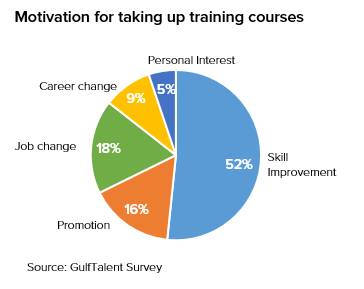
Source: GulfTalent Survey. Piechart showing why people sign up for training.
Professional training courses delivered online are becoming popular across the Middle East, but the supply of suitable courses has failed to keep up with demand, according to research* by recruitment firm GulfTalent, which runs an online recruitment portal for the region.

Based on GulfTalent’s study, one in five professionals looking to take up training is seeking an online course. This represents a rapid transformation, considering that a decade ago online training was virtually non-existent. A further 62% of training seekers prefer classroom-based courses supplemented with an online component. Only 18% now seek the traditional classroom-only format.

The growth of professional online training could be attributed primarily to its lower cost and greater flexibility for participants. Professionals surveyed by GulfTalent reported having to budget on average US$1,000 for a classroom-based training course, compared with just US$500 for an online course. 

Although the demand for online courses is rising rapidly, the supply of courses has not kept up. According to the survey, 14% of those seeking courses with an online element are unable to find a suitable course for their needs, compared with only 6% of those seeking classroom-based courses.
The supply gap is even greater for those seeking online courses delivered in the Arabic language, with 23% of professionals seeking such courses unable to find suitable options in the market.

Traditional classroom-based training providers in the region are being hurt by the popularity of online courses. One of them told GulfTalent researchers, “Online courses have had a big impact on our business because they are so much cheaper. We are planning to offer our own online courses soon.”
In the meantime, with local supply still inadequate, the region’s professionals are resorting to international providers of online training in order to fulfil their learning and development needs.
International online training firms are independently penetrating the Middle East market, including by advertising their courses on career sites such as GulfTalent.
 
The plunge in the oil price and slowdown in regional economic activity seems to have had a mixed impact on the regional training market. Several training providers interviewed by GulfTalent reported a steep drop in demand for training from corporates, as companies look for opportunities to save costs. However, the drive for cost efficiency seems to be pushing many corporates towards greater utilisation of online training, further boosting demand in this area.

In contrast to corporate demand, demand from individuals paying for their own training is rising as more professionals seek training and certifications to improve their career prospects in an uncertain and increasingly competitive job market. According to the survey findings, motivations for taking up training include general skill improvement, which was the biggest factor for 52% of professionals, followed by securing a promotion, getting a new job, or making a complete career change.

GulfTalent’s survey found that the appetite for training was highest among the region’s IT and HR professionals, with roughly one in every two professionals interested in taking some kind of training. Lawyers reported the lowest demand for training, with only one in four planning to take up a course in the next two years.

In terms of subject areas, the survey found the highest demand for training to be for engineering and project management, due to the very high proportion of engineering professionals working in the region, followed by finance. Female professionals in particular went for HR, administration, business management and education.

When it comes to choosing a particular course, professionals surveyed cited the profile and reputation of the training programme as one of the most important factors in their decision. In particular, it was very important for them that they receive a certificate with global recognition. The most popular certificate is SAP's, followed by PMP and ACCA.

In the case of classroom-based training, location was also mentioned as a key factor, with about 75% stating a preference for training courses that are either near their home or close to their place of work. The fact that such proximity is not always available is further contributing to the growth of online courses.

*GulfTalent’s findings were based on a survey of 1,600 professionals in full-time employment, based across nine countries in the Middle East. Surveyed countries included the UAE, Saudi Arabia, Qatar, Kuwait, Oman, Bahrain, Egypt, Lebanon and Jordan. The study also drew on interviews with a number of leading training providers active in the Middle East.

24 June 2016

Viator top travel experiences include choices in Japan, China and Dubai

The team at Viator, a TripAdvisor company and the leading resource for tours and activities worldwide, is highlighting some of the most popular and some of the most interesting travel experiences available on the Viator Tours & Activities App. 

While the majority of the experiences are in the Americas or Europe, Viator’s iOS users liked the Tokyo Robot Cabaret, and Mount Fuji Bullet Train excursions from Tokyo. Android users' top 10 bookings on the app include Dubai's Burj Khalifa At the Top tickets.

For Viator VIP tours, Beijing's Forbidden City with a special viewing of the Treasure Gallery and the Great Wall Ruins at Badaling are popular.

Interested?

The free Viator Tours & Activities App for iOS and Android provides convenient, 24x7 access to the best things to do in any destination with secure booking. The app features over 40,000 travel experiences and attractions in more than 2,000 worldwide destinations and 1 million+ customer reviews and photos, exclusive insider videos, maps, tips and expert recommendations. The app also provides real-time booking and last-minute availability, enhanced checkout including photo-scan for credit cards and instant confirmations, e-vouchers and direct entry ticketing.

24 December 2015

Qatar Duty Free presents new Dolce&Gabbana display at Hamad International Airport

The new Dolce&Gabbana display at Hamad International Airport stars a 4m snow globe in the centre.
Source: Qatar Duty Free. A new Dolce&Gabbana display features a 4m snow globe at Hamad International Airport that will be on display until 14 January 2016.

Qatar Duty Free welcomes the festive season with the installation of a Dolce&Gabbana display featuring a larger-than-life snow globe at Hamad International Airport (HIA). The snow globe, at four m high, is the centrepiece of a display showcasing Dolce&Gabbana’s products, and celebrates the launch of their newest fragrance for men, The One Royal Night. It will be on display until 14 January 2016.

The black and gold display, which is located behind the HIA Lamp Bear sculpture, brings the magic of a winter wonderland to the desert, with a snowman, gifts and the snow globe featuring the Doha skyline. The joint collaboration between Dolce&Gabbana and Qatar Duty Free offers plenty of options for passengers looking to buy a gift.

Qatar Duty Free Senior Vice President Keith Hunter said: “Qatar Duty Free prides itself on offering passengers exclusive fragrances and beauty products, and this is no exception. This partnership not only marks the launch of The One Royal Night at HIA, but is an opportunity for Qatar Duty Free to offer customers the Dolce&Gabbana makeup and Velvet collections. We hope that those travelling from, and through, HIA will enjoy visiting the beautiful display and exploring some thoughtful and personalised gift ideas.”

The One Royal Night for men fragrance is featured together with Velvet niche fragrance collection and D&G makeup.
Source: Qatar Duty Free. The One Royal Night for men is featured together with Velvet niche fragrance collection and D&G makeup.

The One Royal Night for men is an exclusive fragrance within Dolce&Gabbana’s Classic House, The One. The newest fragrance, with an Arabian twist, is an exclusive product from the designers for the Middle East, inspired by the richness, culture and traditions of the region.

The One Royal Night for men is described by Dolce&Gabbana as a blend of opulence and sophistication boasting a woody composition with notes of cardamom, basil, wild pear wood, and spicy nutmeg, followed by a base of cedar, sandalwood, labdanum* and pure amber in its most refined form. Qatar Duty Free will also offer a select number items from the Dolce&Gabbana makeup and niche fragrance collection, Velvet, for the first time at the display.

Dolce&Gabbana makeup available include Classic, Voluptuous and Matte lipsticks, nail polish, Perfect Luminous Liquid Foundation, Perfect Matte Liquid Foundation, Perfect Matte Concealer, eyeliners and mascaras. The Make-Up Essential Palette Beauty Voyage is also available and includes eyeshadows, eyeliner, blush, illuminator, lipstick and lip liner in a stylish compact case.

The Velvet Collection offered will include both 50ml and 150ml bottles of some of Dolce&Gabbana’s most popular niche fragrances such as Velvet Love, Velvet Patchouli, Desert Oud and Tender Oud.

Interested?

For all Dolce&Gabbana products purchased at the display personalised engraving and gift-wrapping will be offered free of charge. 

*Labdanum, also called laudanum, is a resin from shrubs called Cistus ladanifer and Cistus creticus.

10 December 2015

Russell Reynolds sets up direct presence in Dubai

Source: Russell Reynolds
Associates website.
Russell Reynolds Associates has opened an office in Dubai, located at the Dubai International Financial Centre (DIFC). The global assessment, recruitment and succession planning specialist for CEOs, boards of Directors and key roles within the C-suite started doing business in the Middle East in 1975. The firm now has 46 offices in 26 countries spread across Europe, Asia, North and South America and the Middle East.

“Our firm was first in our industry to establish a Middle East Practice, and we remain unique with dedicated consultants based both inside and outside of the region. Our Dubai office is another important step in the global expansion of Russell Reynolds Associates,” says Clarke Murphy, CEO of Russell Reynolds Associates. "Our company continues to expand: the past calendar year was an history high."

The executive search firm's presence in the Arab world will be boosted by the new office, which will be tightly integrated with the firm’s Middle East desk in London. "The Middle East continues to play a key strategic role for many of our clients, most major multinationals and world banks. Our Dubai office complements our clients' growing demands for physical presence in the region," explains Dr Stephan Schönwälder, Managing Director at Russell Reynolds Associates and Area Manager for Dubai. Dr Stephan Schönwälder works with senior members of the London desk Mat Green and Lamees Al-Ashtal. Green coordinates the firm's Middle East practice and conducts assignments for clients in the financial services, oil & gas, mining and natural resources sectors.

Dr Schönwälder joined Russell Reynolds Associates from another search firm, where he led the Middle East Financial Services Practice for four years. He also worked on numerous assignments in the ICT and FMCG industries and served family-owned businesses. Schönwälder was a former Partner with McKinsey & Company, serving as the head of the company’s Middle East Business Technology Practice and as a core member of the region’s Financial Services Practice. He also worked for numerous family conglomerates and government institutions, with a focus on Saudi Arabia and the UAE. 

Schönwälder explains, "The region has considerable potential. Many of the Gulf States are successfully expanding their range of economic activities – moving away from oil toward promising sectors of the future such as tourism and hospitality, financial services and telecommunications. We advise companies and institutions in the region on all talent issues across all industries, with our wide-ranging executive search knowledge and international and local expertise."

22 July 2015

Middle Eastern women reveal they really, really love handbags

Source: Conia. Arab celebrity Aseel Omran is the most recent addition to the Conia brand. The 'Aseel Omran Edition' handbags are designed by Aseel herself and the brand uses her 'AO' initials, which can be seen at the bottom right of this bag. The black velvet stripe topped with a hand-tied bow reflects a love for life. Each bag is created by hand in Conia's studio from the finest Italian Saffiano calf leather, selected for softness, durability and character, and hand-cut to maintain the natural elegance and minimise waste. Saffiano is a textured leather which has a cross-hatched pattern that is finished with a wax treatment, ensuring that the leather is scratch resistant, durable and easy to clean.


Outside of their family, handbags - not diamonds - make Gulf women happiest, says new research surveying Middle Eastern women. According to the research* commissioned by Conia, which offers luxury accessories, more and more women are choosing to purchase luxury clothing, accessories and gadgets to satiate their need for high-quality, well-designed and exclusive products.

Although abayas are considered a crucial wardrobe staple for most Middle Eastern women, many cited that they needed a complementary high-fashion handbag to finish off the look. Shoes were also high on the list, with many admitting to showing off new purchases on social media. Social media is also becoming a source of inspiration, with a high percentage of respondents sharing that they turn to Instagram to source products supported by celebrities, including Kim Kardashian, Paris Hilton and Taylor Swift.

The following items give women pleasure, in descending order of satisfaction:
  1. Handbags
  2. Shoes
  3. Abayas
  4. Jewellery
  5. Indulgent treatments
  6. Lingerie
  7. Oud (perfume)
  8. Gadgets
  9. Headscarves
  10. Flowers
A spokesperson from Conia said: "With fashion awareness growing in the region and women showcasing their extravagant taste, local women both young and old are only content with the finest trendsetting garments and accessories – this couldn't be clearer from the survey results."

The results are a boost for Arab actress Aseel Omran's exclusive Ao line of luxury branded handbags under the Conia umbrella, which were launched in June 2015. Conia says this is the first 'celebrity approved' domestic designer handbag to be made available in the Gulf, with Aseel herself playing a very active role in its design and production. 

Conia specialises in hand-prepared and genuine Italian leather handbags which are made entirely in Italy. To guarantee the highest possible quality of its products, it exclusively uses leather from leading Italian tanneries serving global fashion brands. Transforming raw hides into a material that will last for years takes 30 to 40 days using modern technology and machinery. The styles focus on simplicity, elegance, and quality. 

Interested?


*Ten thousand Middle Eastern women aged 18 to 55 years were surveyed about their shopping habits.

20 July 2015

Dabur Herb'l Sensitive Toothpaste to address tooth demineralisation in Middle East

Source: Dabur International.

Dabur International has launched the Dabur Herb’l Sensitive Toothpaste in the Middle East. The new ‘sensitive’ variant is fortified with natural ingredients such as cinnamon, mint and licorice root along with potassium ions to provide instant and long-lasting relief from tooth sensitivity. 

According to the company, brushing twice a day with Dabur Herb’l Sensitive Toothpaste not only provides instant relief from sensitivity, but also strengthens gums and prevents the formation of plaque, gum inflammation, and tooth decay, ensuring fresh breath.

Abhinav Kumar, Group Product Manager, Dabur International, said: “A study has revealed that tooth sensitivity has emerged as a common oral problem in the Middle East. However, many people are not aware that it is a dental problem and therefore do not undertake measures to treat it. Realising the need for a highly effective ‘sensitive’ toothpaste that can provide relief from the first use, Dabur International has introduced Dabur Herb’l Sensitive Toothpaste in the Middle East. Its natural formula is proven to provide sensitivity protection from the first use by acting against demineralisation."

2 July 2015

New Toyota Camry launched in the Middle East

Source: Toyota Qatar.

Toyota has raised the bar in the mid-size sedan segment with a bold redesign of the Toyota Camry. The new Toyota Camry which is being introduced in the Middle East features new model grades and more dynamic handling.

According to the car’s Chief Engineer Masato Katsumata, the new-look Camry was developed for customers who want a car with more emotional styling and greater driving enjoyment. “We wanted to produce a Camry that appeals to its traditional customers as well as to younger buyers,” he said. "As a result, the latest Camry is the boldest-looking Camry ever. The car is more expressive, more athletic and more confident.”

Takayuki Yoshitsugu, Chief Representative, Middle East and North Africa Representative Office, TOYOTA Motor Corporation, said, “The new Toyota Camry blends an evolution of the car’s values – such as comfort, efficiency, reliability and safety – with a more appealing design and engaging driving experience. With its striking hood lines and statement-making front grille, the car is designed for those who dare to be bold, and combines refinement and performance like never before. I would like to thank our customers in the region for their loyalty and support over the years. The new Camry is our way of repaying their trust by making a truly special vehicle for them.”

Since its debut in 1982, more than 15 million Camrys across six generations have been embraced around the world for their performance, ride quality and high level of quality, durability and reliability (QDR). For the latest upgrade, Toyota designers and engineers re-imagined nearly every exterior surface of the car, with only the roof remaining unchanged. 

An aggressive looking front bumper and grille and pronounced side character lines give the new Camry a sleeker look. The new Toyota Camry offers LED low and high beams, and front turn signal indicators and LED DRLs are integrated. Inside, a center stack with a 4.2" TFT screen makes it easy to access content with an information layout which is simple and easy to understand.

The chassis and body structure are bolstered with additional spot welds, enhancing rigidity for better ride quality. Re-tuned suspension and steering systems along with optimised aerodynamics take the new Toyota Camry’s handling to a new level of responsiveness.

The car features a 2.5 liter four-cylinder engine that produces 181 horsepower and 235 NM of torque, allowing it to deliver outstanding engine performance and quietness. The engine employs Dual Variable Valve Timing with intelligence (Dual VVT-i) which controls valve timing on both the intake and exhaust camshafts for optimal performance and efficiency at all engine speeds. A six-speed automatic transmission enables smooth manual-like shifts and is complemented by an innovative flex-start control that proactively engages the lock-up clutch when starting to enhance fuel economy. The newly developed Electric Power Steering (EPS) on all the new Toyota Camry models is tuned for better on-centre feel, enhanced stability and more direct-feeling steering inputs.

The new Toyota Camry continues Toyota’s approach to safety. Safety features include Enhanced Vehicle Stability Control (VSC), Traction Control (TRAC), Anti-lock Brake System (ABS), Electronic Brake-force Distribution (EBD), and Brake Assist. EBD control utilises the ABS hydraulic control to optimise the distribution of braking force between the front and rear wheels in accordance with driving conditions and vehicle load, for example. In the case of Brake Assist, suddenly and rapidly depressing the brake pedal helps the driver with braking by generating a larger braking force.

The new Camry also employs an advanced collision safety technology designed to not only ensure occupant safety but also to reduce pedestrian injuries. The body construction disperses collision energy through many frame components for effective energy absorption, thereby controlling cabin deformation to ensure survivable space after a collision. The front bumper absorber is concave to reduce intrusion by controlling vehicle under-rides in a frontal collision.

Convenience features include a Rear View Monitor with Guide Lines, a Parking Assist System that alerts the driver when approaching obstacles in blind spots behind, and a Back Sonar System that uses ultrasonic sensors to detect obstacles behind the vehicle and informs the driver of the position and distance between the sensors and the obstacle using a buzzer. The new Camry features six SRS airbags, including driver’s airbag and knee airbag, front passenger airbag, front side airbags and full-length side curtain airbags that help reduce the collision energy imparted to occupants’ heads in the event of a side collision. In addition, it is provided with three-point Emergency Locking Retractor seatbelts for the driver along with three-point Automatic Locking Retractor seatbelts for the front passenger and rear seats.
The new, upscale interior features premium, soft-touch materials throughout the cabin, and advanced instrumentation with intuitive controls helps keep the driver’s eyes safely on the road ahead. Extensive real world testing to finetune cabin noise levels has resulted in the quietest-ever Camry cabin. Genuine leather-trimmed surfaces are found throughout, and trim elements are finished in wood-grain-style accents and satin chrome. A new generation frame construction has been adopted for the front seats to provide enhanced comfort. The front seatback height and the cushion shape have been modified, adding comfort. A power eight-way adjustable driver seat and four-way adjustable front passenger seat are also available. The rear seats split and fold forward for additional space.

A high performance yet compact, lightweight and fuel efficient air conditioning system has been adopted to deliver top class cooling and comfort while being environmentally friendly. The independent left/right temperature controls allow separate temperature zones to be automatically set for the driver and front passenger seats.

A 10-speaker JBL Matrix 5.1-channel surround system provides top class audio performance. The JBL GreenEdge eight-channel amplifier is 66% smaller and lighter and 50% more efficient (low current consumption). Paired with JBL GreenEdge speakers, the technology provides sound output that is twice as powerful using the same amount of current.

The new Toyota Camry is offered in the Middle East in four variants – the GL, GLX, SE and the sporty XSE.
Bold, aggressive and stylishly modern, the new sport model (XSE) comes with a smoked chrome upper grill, piano black lower grill and dark chrome coated headlamps. The XSE grade comes loaded with exclusive features in the form of an automatic air conditioning control panel, seats dressed in Alcantara and genuine leather, a newly designed two-dial Optitron meter, and race-inspired paddle shifters.

The Camry XSE also gets 17" wheels and more sharply tuned suspension and steering along with satin chrome ornamentation. Additional undercover fins provide aerodynamic performance and handling stability. A total of nine exterior colours are available for the XSE grade, namely Super White 2, White Pearl CS, Gray MM, Dark Steel MC, Silver ME, Attitude Black MC, Red MC, Light Yellow MM and Dark Blue MM.

The new Toyota Camry is otherwise available in 10 colours. The two new colours are a metallic dark blue and a light blue shade. There is a choice of four interior colours, ivory, grey, black, and grey & black*.

*Exclusively for the XSE grade

30 June 2015

Canon Middle East launches new cameras for 2015, competition

Canon Middle East's new cameras for 2015 offer all the quality features and technology that you expect in a Canon, plus single tap sharing with NFC and Wi-Fi technology.


In the compact stable are the PowerShot SX530 HS, which has a 50x zoom camera, and the PowerShot SX410 IS, with 40x optical zoom.

The PowerShot SX530 HS features:

• 50x zoom
• Wi-Fi with NFC
• Full HD movie capture
• Creative modes and manual controls

Highlights of the PowerShot SX410 IS include:

• 40x zoom
• Wi-Fi with NFC
• 20 megapixels
• Intelligent IS image stabilisation
• Smart Auto shots

There are also two entry-level DSLRs, the 24.2 megapixel EOS 750D which shoots in Full HD, and the EOS 760D, which offers all the features of the EOS 750D plus the top LCD panel and rear control dial found on Canon's mid-range cameras. 

The EOS 750D and EOS 760D offer:

• 24.2 megapixels 
• Wi-Fi with NFC
• ISO 12,800
• Vari Angle LCD touch screen
• Full HD, Hybrid CMOS AF III

Canon is also running the #COMEANDSEEMYARABIA photo competition. Reveal your city by July 5 for the chance to win a Canon EOS 760D and Canon PIXMA PRO-10S. 

Interested?


*Images from Canon Middle East's eDM.

20 June 2015

Qatar Airways runs Ramadhan specials across Middle East

Source: Qatar Airways website.

Qatar Airways is running Ramadhan promotions across the Middle East. The deadlines range from 25 July for Jodan, all the way to 8 July for Qatar.

In Jordan, passengers' deadline for booking is 25 June to enjoy up to 30% on Economy class and Premium class fares.* Passengers who book* their tickets departing Qatar from now until 8 July 2015 for travel from till 8 July 2015 enjoy up to 25% off on Economy Class and Premium Class fares. Privilege Club members will enjoy redemption discounts of up to 50% on the next flight booked between 15 September and 15 November 2015.*

Most of the booking deadlines are 30 June. For Bahrain, passengers who book tickets from now until 30 June 2015 for travel from 18 June 2015 until 31st October 2015 enjoy special fares on Economy Class and Premium Class fares*. The booking deadline for passengers departing from Iraq is also 30 June but travel is limited till 5 July 2015. Discounts are up to 25% off* on Economy Class. Passengers from departing from Lebanon also have the 30 June deadline, and may enjoy up to 20% off* on Premium class fares for travel until 14 July 2015. If in Oman, book the tickets from now until 30 June 2015 for travel from till 15 December 2015 for special Economy Class and Premium Class fares*.

The Ramadhan offer to Kuwait involves more private travel - an all-First Class experience with just 40 lie-flat all-First Class seats for travel between Kuwait and Jeddah. Privilege Club members earn 100% Bonus Qmiles for travelling from now to 20 July 2015*. The offer is applicable from 22 June 2015. A similar experience is available over Ramadhan between Doha and Jeddah for passengers departing KSA*. Travel has to be booked for between now and 16 July 2015.

The airline has also has announced its Ramadhan timings:

Saturday to Thursday: 8am to 2pm and then 4pm to 10pm
Closed on Fridays

This contrasts with opening hours for the rest of the year, which are:

Saturday to Thursday: 7:30am to 9pm
Closed on Fridays

Interested?

2 June 2015

The best hotels in Asia are in the Maldives, and in the UAE for the Middle East

This year's top Asian hotels according to TripAdvisor are mostly from the Maldives. Out of the top 10, four are resorts in the Maldives, and two from Bali. There are another three from the Maldives in the top 25, making it 28% representation, and a third hotel in Bali. India is also well represented, with four more hotels in the top 25.

Source: TripAdvisor website. The Gili Lankanfushi Maldives.
  1. Gili Lankanfushi Maldives, North Male, Maldives
  2. Shinta Mani Club Siem Reap, Cambodia
  3. Cocoa Island by COMO, South Male, Maldives
  4. Mandarin Oriental Pudong, Shanghai, China
  5. Constance Moofushi, Alifu Atoll, Maldives
  6. The Upper House, Hong Kong, China
  7. Komaneka at Bisma, Bali, Indonesia
  8. The Legian Bali - a GHM Hotel, Bali, Indonesia
  9. The Baros Maldives, North Male, Maldives
  10. Wildflower Hall, Shimla in the Himalayas, Mashobra, India
It should be no surprise then that the top hotel in the world for this year is the Gili Lankanfushi Maldives. The hotel garnered an impressive 967 ratings of 'excellent' out of 1,029 reviews. The Asia Pacific and Middle East hotels in the top 25 global list are:

1. Gili Lankanfushi Maldives, North Male, Maldives
3. Shinta Mani Club Siem Reap, Cambodia 
6. Cocoa Island by COMO, South Male, Maldives 
8. Al Maha, a Luxury Collection Desert Resort & Spa, Murqquab, UAE
13. Jumeirah Al Qasr at Madinat Jumeirah, Dubai, UAE
14. Mandarin Oriental Pudong, Shanghai, China 
15. Constance Moofushi, Alifu Atoll, Maldives 
19. The Upper House, Hong Kong, China
24. Kayakapi Premium Caves - Cappadocia, Urgup, Turkey

For the Middle East, which for TripAdvisor includes Egypt, the top 10 are:
  1. Al Maha, a Luxury Collection Desert Resort & Spa, Murqquab, UAE
  2. Jumeirah Dar Al Masyaf at Madinat Jumeirah, Dubai, UAE
  3. The Royal Savoy Sharm El Sheikh, Egypt
  4. The Raffles Dubai, UAE
  5. Jumeirah Al Qasr at Madinat Jumeirah, Dubai, UAE
  6. Four Seasons Resort Sharm El Sheikh, Egypt
  7. Stella Di Mare Beach Hotel & Spa, Sharm El Sheikh, Egypt
  8. The Oberoi, Sahl Hasheesh, Hurghada, Egypt
  9. Hilton Luxor Resort & Spa, Luxor, Egypt
  10. Grosvenor House, Dubai, UAE
If Egypt - which this blog classes as part of Africa - is taken out of the equation, the top 10 list would be heavily skewed towards the UAE:
  1. Al Maha, a Luxury Collection Desert Resort & Spa, Murqquab, UAE
  2. Jumeirah Dar Al Masyaf at Madinat Jumeirah, Dubai, UAE
  3. The Raffles Dubai, UAE
  4. Jumeirah Al Qasr at Madinat Jumeirah, Dubai, UAE
  5. Grosvenor House, Dubai, UAE
  6. Qasr Al Sarab Desert Resort by Anantara, Hamim, UAE
  7. Staybridge Suites Beirut, Lebanon
  8. Residence&Spa at One&Only Royal Mirage Dubai, UAE
  9. The Oberoi Dubai, UAE
  10. Le Royal Meridien Beach Resort & Spa, Dubai, UAE
Interested?

View TripAdvisor's top 25 hotels around the world
View TripAdvisor's top 25 Asia hotels
View TripAdvisor's top 25 Middle East hotels

30 December 2014

Fujifilm introduces X100T premium compact camera in the Middle East

Fujifilm has announced the X100T premium compact camera, a follow-on from the successful launch of the X100S, in the Middle East. 

Source: Fujifilm. The X100T is available
in black and silver.
“In March 2011, the launch of the X100 opened up a new market for premium compact cameras. A year later, the second generation X100S was released, complete with a newly developed sensor, processer, and an advanced Hybrid Viewfinder," said Yuta Kawamura, Marketing Manager, electronic imaging division, Fujifilm Middle East & Africa.

“Now, the X100T marks the ultimate evolution as the third generation of the X100 Series, reflecting the feedback from our customers for each and every aspect, including image quality, the viewfinder and user experience.” 

Featuring the world’s first Electronic Rangefinder, the US$1,299 
X100T delivers enhanced image quality thanks to advanced colour reproduction technology, and the new Classic Chrome film simulation mode. The X100T’s optical viewfinder ensures real-time parallax correction and serves as the equipment of choice for photographers in search of precision imaging. 

Additionally, reduced display time lag, automatic brightness control, and enhanced Live View settings have been added to the electronic viewfinder providing a more comfortable shooting experience for the users.

The X100T has a 16.3 megapixel sensor and a 23mm F2 lens. Users have the flexibility of deploying a 1/3-stop aperture ring, command dials, as well as customisable function buttons. A 3" LCD screen improves visibility outdoors.

Photographers can capture professional quality videos with the X100T. With a wide range of selection of frame rates – 60, 50, 30, 25 and 24 fps to record Full HD videos, the X100T is the world’s first* camera that can shoot videos using the optical viewfinder, resembling the shooting experience of a film camera.

In addition, the intelligent hybrid autofocus (AF) enables the users to switch between phase detection AF and contrast AF according to the scene, even during video shooting, and enables manual focus while recording a video.

Developed through 80 years of photographic experience, Fujifilm’s latest film simulation mode - Classic Chrome help users to reproduce warm skin tones, bright blue skies and rich green trees that results in vibrant images.

Comparing the usability in terms of other compact cameras available in the Middle East market, the X100T boasts Wi-Fi connectivity, and, hence, can also be controlled remotely via the Fujifilm Camera Remote app. The app, available for all major mobile and tablet platforms, is practically useful when it comes to seamlessly transferring and/or viewing images from the camera to a preferred device. Wi-Fi transfer enables image back up from the camera onto the computer wirelessly without the hassle of using cables.

Several accessories for the camera are available, ranging from hand grips, conversion lenses (wide and tele), to an external stereo microphone.

*As of August 2014 - Fujifilm research.

9 December 2014

Kobo eReader ecosystem now available in GCC

Source: Kobo. The Kobo
Aura H2O eReader.
Kobo and multichannel distributor Lionfish today announced the arrival of Kobo's digital reading platform to the GCC region. Passionate readers can now enjoy Kobo's eBookstore with more than 4.2 million titles, eReaders, and apps for iOS, Android, Microsoft, and BlackBerry platforms. 

Starting today, Kobo will be available in 34 stores, including the Dubai Duty Free Stores, Virgin Megastores* and Xcite**. Kobo eReading devices will also be available for purchase online at Modvito, Souq.com and Jado Pado. Readers will have access to the Kobo eBookstore, featuring 4.2 million titles across 72 languages. From biographies and memoirs to business books, non-fiction to literary fiction, Kobo has something for everyone.

"Digital reading continues to rise across the globe and we're thrilled to be entering GCC countries to offer readers with best in class E Ink eReaders and eBookstore," said Jean-Marc Dupuis, Managing Director of EMEA, Kobo. "The Kobo Touch, Kobo Aura and Kobo Aura H2O offer different capabilities and price points, so there is definitely something for every reader. GCC countries are still in the early adoption stages of reading digitally and we are pleased to lead the transformation of this market."

Lionfish General Trading will be managing all facets of Kobo's presence in the GCC countries including distribution, retail partner relations, marketing and customer care.

The Kobo Touch eReader has an anti-glare 6" Pearl E Ink touchscreen that offers the closest experience to reading print on paper and is easy on the eyes, even in bright sunlight. Available in black, blue and lilac, the Kobo Touch has a battery life of up to one month and has 2 GB of internal memory for the storage of up to 1,000 books, with the option to expand to 32 GB with a micro SD card. The Kobo Touch will be available for AED429.

The new 6" Kobo Aura eReader is a front-lit E Ink eReader that features the first high-resolution, edge-to-edge display available in an E Ink eReader. Kobo's ComfortLight technology offers the most evenly lit display that is adjustable to suit any preference for the best reading experience, day or night. Available in black and pink, the sophisticated design of the eReader delivers the closest experience to print-on-paper with a 212 dpi and Pearl E Ink screen. With pinch-and-zoom capabilities for FLePubs/PDFs, Kobo Aura creates a smooth experience with a low-flash waveform screen to virtually eliminate page refresh and ghosting. With 4GB of storage (up to 3,000 books), expandable up to 32GB with a micro SD card, Kobo Aura has a battery life of up to more than two months. Kobo Aura will be available for AED729.

Kobo Aura H2O is IP67 certified, which means it is waterproof for up to 30 minutes in 1 metre of water with the port cover closed. This enables people to read more, more often, anywhere they like worry-free without damaging their device if accidentally dropped in or splashed with water. Reading on a sun-drenched beach is quite practical due to the device's dustproof design and anti-glare display.

At 265 dpi, the spacious 6.8" touchscreen with upgraded Carta E Ink technology - the first of its kind with these display dimensions - offers the closest experience to print-on-paper. The device's 1GHz processor means page turns are swift, and it comes with 4GB of onboard storage (expandable up to 32GB with a micro SD card). The Kobo Aura H2O will be available for AED999.

* All Virgin Megastores except those in Kuwait
** Only Xcite stores in Kuwait

17 November 2014

Hotdesk and Compass offer temporary workspaces in Asia Pacific

Hotdesk has partnered with Compass Offices to offer casual flexible work and meeting spaces to mobile workers that can be booked by the day, week and month.

According to research by IDC, there will be 1.3 billion mobile workers in the world by 2015, over 838 million of whom will be in Asia Pacific.


"Finding a desk, a chair and an Internet connection while on the road can be difficult, short of setting up in a cafe, which may be good for an hour or two, but is hardly professional or conducive to working from for an entire day or week. Don't even think about running a large meeting from a cafe," said Hotdesk Founder Steve Glaveski

"Hotdesk offers people the opportunity to not only access flexible workspaces on the go across Asia but also network, collaborate, be part of a community and build valuable relationships that can help to accelerate the achievement of professional goals." 

Source: Hotdesk website.
Hotdesk is a marketplace for temporary office space, allowing people who need a desk to get in touch with providers of available space. Glaveski said that the partnership allows Hotdesk customers to book spaces at Compass by the day or week. "Whether in Sydney, Melbourne, Hong Kong, Singapore, Tokyo, Dubai or even Almaty in Kazakhstan, Compass and Hotdesk have you covered," he said.

Hong Kong-based Compass has 29 locations, including in the UAE.

4 November 2014

Tracking global travel trends with Euromonitor

Source: Euromonitor website.
Euromonitor International has released the World Travel Market Global Trends Report 2014, which has predicted future travel trends for the past nine years.

Key trends are for Asia Pacific and the Middle East are:


The Middle East is changing perceptions about the region through design tourism, which promotes design in tourism. The trend is helping to revitalise visitor arrivals and attract creative minds.

Messaging apps are becoming e-commerce platforms in China. WeChat, the second largest global messaging service after WhatsApp, has emerged as a viable sales channel for Chinese travel companies with customer service, bookings and payments.

Online and mobile bookings for India's rail network represent a strong driver for travel and tourism, and are recognised by the new government as a vital component for the country’s overall growth.

In 2013, Euromonitor identified trends such as:


The mobile concierge: travel companies are increasingly using mobile channels to satisfy customers’ needs before, during and after the trip. 

Luxury low-cost carriers (LCCs): Middle Eastern consumers love for luxury has led to LCCs introducing business class-style services.

Business microstays: Hotels are targeting business travellers for stays of 24 hours. 

Download the 2014 report here.

14 August 2014

Hong Kong, Tokyo and Dubai in top 10 for hotel Wi-Fi speeds

Hotelwifitest.com has released rankings for cities by the percentage of hotels with poor Wi-Fi performance. Stockholm was rated highest on satisfaction with hotel Wi-Fi, followed by Hong Kong, and then Amsterdam.

Source: Hotelwifitest.com
The company advises travellers to check the Wi-Fi quality before booking a hotel. The Hotelwifitest website features hotels which have already been tested and also allows visitors to test their upload, download and latency speeds. 

The top three hotels in Singapore, ranked no. 12 for Wi-Fi speeds globally, are the Marina Bay Sands, which offers free Wi-Fi and expected download speeds of 61.5 Mbps, Traders Hotel, which also has free Wi-Fi but at a download speed of 25 Mbps, and V Hotel Lavender, which requires payment for Wi-Fi but offers download speeds of 24.7 Mbps.

Hong Kong, given its no. 2 spot globally, offers faster speeds overall. The top three hotels are the Ovolo with download speeds at 50.5 Mbps, the Pottinger with 34.9 Mbps downloads, and the Ovolo 2 with 30.4 Mbps downloads. All three hotels offer free Wi-Fi.

Rank City           Country              Hotels with poor WiFi (%)
    1    Stockholm      Sweden               4
    2    Hong Kong      Hong Kong            8
    3    Amsterdam      Netherlands          17
    4    Tokyo          Japan                19
    5    Rome           Italy                27
    6    Dubai          United Arab Emirates 29
    7    London         United Kingdom       30
    8    Berlin         Germany              31
    9    San Diego      United States        33
    10   Barcelona      Spain                35
    11   Washington     United States        37
    12   Singapore      Singapore            38
    13   Chicago        United States        38
    14   Vienna         United States        40
    15   Bangkok        Thailand             41
    16   New York       United States        41
    17   Orlando        United States        44
    18   San Francisco  United States        48
    19   Paris          France               53
    20   Las Vegas      United States        57

*A hotel is judged as providing adequate Wi-Fi if it provides an expected download speed of at least 2Mbps. Upload testing, latency testing, and stability feedback have been added to the testing process, and in future all hotels rated as providing adequate Wi-Fi must also feature an upload speed of 1Mbps, latency not exceeding 500ms, and an average stability rating of at least 3 out of 5. The tests did not differentiate between paid and free WiFi.