Showing posts with label chatbot. Show all posts

15 December 2017

SAP Hybris: Majority of Singapore consumers rely on chatbots for Christmas shopping

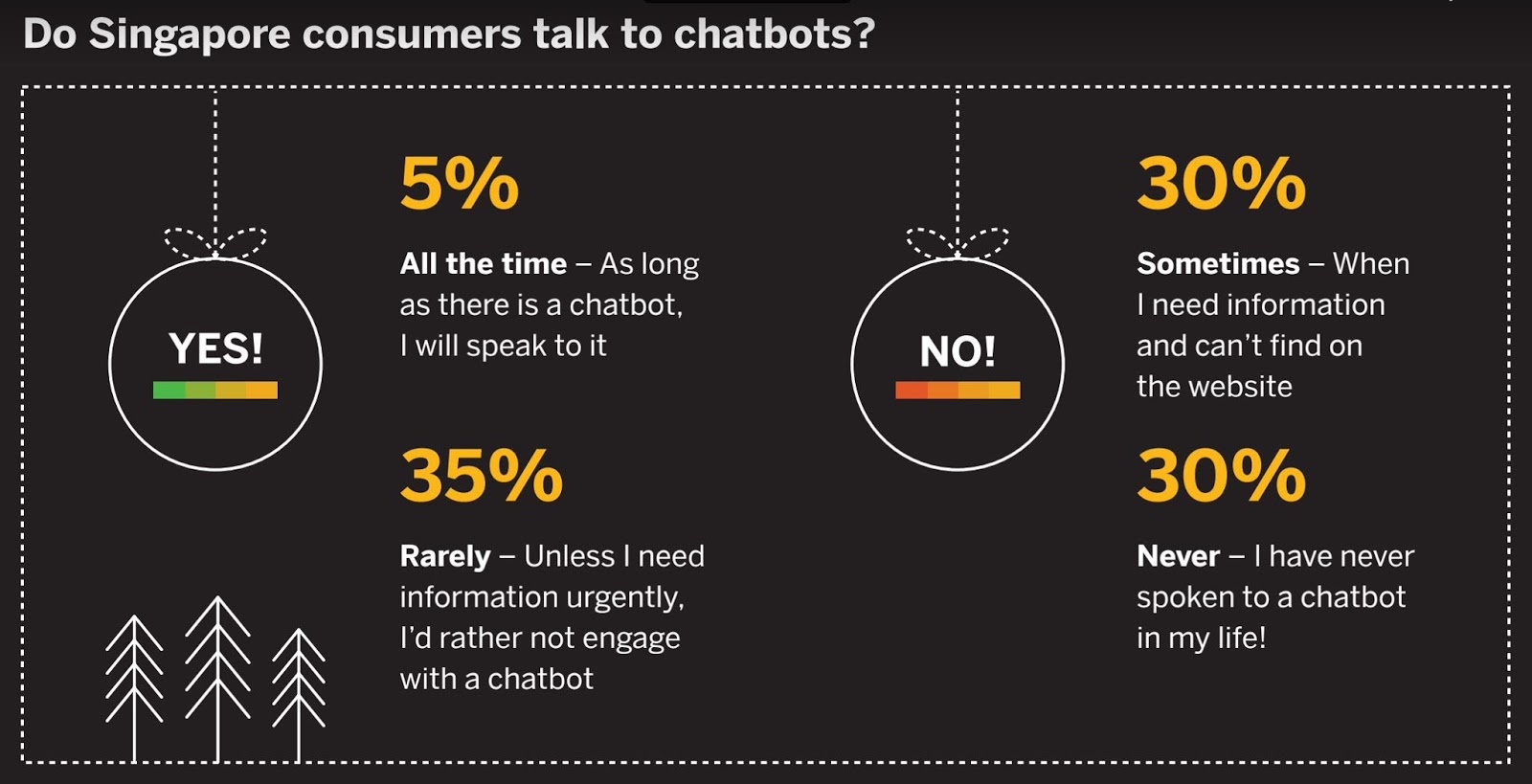
Source: SAP Hybris infographic. More than a third of Singapore consumers interact with chatbots, at least occasionally.
  • Top 3 motivations for Singaporean consumers to engage with chatbots: 
- 48%: "Finds out what I need and want, and makes more personalised recommendations on what to buy"

- 47%: "Helps me compare prices and other products from other brands"

- 38%: "Assures me that my personal information will be kept private and not used for any other purposes"


  • Concerns about chatbots:
- May be misunderstood: 61% feel that chatbots do not understand what they want to say

- Could be unsafe: 35% fear that personal information divulged to chatbots might be leaked


Bot-powered commerce is on a tipping point in Singapore according to the new SAP Hybris* Singapore Christmas Shopper Survey 2017. This Christmas, more than half (53%) of Singaporean shoppers are enlisting the help of chatbots for holiday shopping, the company said. Additionally, the majority of shoppers who asked chatbots for gift recommendations actually acted on the recommendation (74%). 

Despite the success of chatbots, SA Hybris recommends incorporating the human touch as Singaporeans expect assistance from chatbots to be rudimentary. More than 1,000 consumers in Singapore were surveyed on their use of and attitudes towards chatbots, with the results reflecting that while Singaporeans are open towards engaging with chatbots, they still have reservations. 

Nearly six in 10 (58%) view chatbots as useful only for basic information search, anticipating that more complex enquiries will need to be handled by a human being. Others feel that talking to chatbots can be frustrating and they would rather speak to a human being (21%) while close to a fifth expressed an outright dislike for chatbots (17%). 

Source: SAP Hybris infographic. Singaporeans tend to ask chatbots about product or service information and about availability. Promotions and discounts and delivery details are also relatively popular topics.

One of the top concerns that Singaporeans have towards chatbots is that their requests might not be understood (61%). A third (35%) are worried that their personal information might be leaked if they divulge too much to chatbots, and 13% say that chatbots are too creepy if they know too much about them.

Nicholas Kontopoulos, Global VP of Fast Growth Markets for SAP Hybris said, “The customer experience can make or break a brand. In view of this, businesses need to stay attuned to these concerns and optimise the use of chatbots as one component in a wider omnichannel strategy. While chatbots can proactively offer answers for initial queries on pricing, product features, or book and make reservations, they cannot fully replace the value of human interaction when it comes to building customer relationships. Any hint of customer dissatisfaction needs to be solved immediately, by a human services officer.”

To win Singaporeans over, chatbots need to become more understanding and intuitive – almost half of Singaporeans (48%) say that they will engage with chatbots more often if they are able to make more personalised recommendations on what to buy. Other motivating drivers that will encourage shoppers to use chatbots more often is to offer comparison of prices and products from other brands (47%), assure that personal information will be kept private (38%), provide recommendations on similar and complimentary products (34%) or simply becoming more human-like (18%).

“Singaporean shoppers have an appetite for deeper engagement with chatbots, but what the results really tell us is that they want a more personalised e-commerce experience. Today’s consumer have higher expectations and businesses need to keep a close pulse on the ever-evolving customer journey in order to react to not just changing consumer preferences but context at point of purchase or even consideration. To this end, businesses should view chatbots as more than just an answering machine – they are also a valuable mine of data that offer fresh perspectives into the underlying reasons for sales trends and help brands better understand what their customers are looking for. Armed with these insights, they can then take action to cultivate sales and entrench customer loyalty”, added Kontopoulos.

*SAP Hybris is a new brand name launched in January 2016 to represent the SAP solutions for customer engagement and commerce as well as the offerings, employees, and business of acquired company hybris AG, which continues to be the legal entity until integration with SAP is complete.

6 December 2017

Tokio Marine Life Insurance Singapore adds recruitment capabilities to chatbot

Source: TMLS website. The TOMI avatar.
Source: TMLS website.
The TOMI avatar.
Tokio Marine Life Insurance Singapore (TMLS), the only Japanese life insurer in Singapore, today launched a recruitment function in the latest phase of its TOMI  (short for Tokio Marine Insurance) chatbot.

This makes TOMI the first chatbot in Singapore to support an insurer’s recruitment process on top of being the first self-learning AI chatbot in Singapore that makes life insurance more accessible for the public.

Aimed at enhancing the insurer’s engagement with today’s digitally savvy generation in recruitment, TOMI now answers more than 300 questions on how to pursue a career as a financial adviser. It also provides information that is typically not accessible to the public, including required qualifications, training involved and even hiring preferences. The chatbot continues to be accessible at all times through Facebook Messenger.

“Advisers play an important role in supporting Singaporeans in managing their financial planning and insurance coverage. We are always looking for talented individuals who are keen to help people plan the necessary coverage for themselves and their loved ones,” said James Tan, Chief Executive Officer of TMLS.

“TOMI will help us reach out to these potential talents more quickly and easily, through familiar communication channel Facebook Messenger, and encourage them to join us as advisers."

To help users who are uncertain about a career in insurance, TMLS has introduced an interactive quiz on TOMI that briefly evaluates the user’s interests and personality. TOMI also now provides information on upcoming recruitment events, organised multiple times a year, to encourage interested individuals to personally engage with TMLS.

Tokio Marine Life Insurance Singapore is part of Tokio Marine Holdings, which has a presence in over 483 cities across 38 countries.

Details:

TOMI can be accessed via the following methods:

On the Facebook Messenger mobile app, by searching “Tokio Marine Singapore”;

On the Facebook page, by typing “Tokio Marine Singapore” in the search bar and starting a chat via the “Message” button; or

On the Tokio Marine Singapore website, by clicking the TOMI icon on the Tokio Marine Life Insurance page;

On the Facebook Messenger mobile app, by scanning Tokio Marine Singapore profile code - to scan, users can click on their profile picture to access the “Me” page. On this page, users should click on their profile picture again to open the code scanner.

To access TOMI’s recruitment function, users can go to TOMI’s main menu and select the tab “Ask Career”. The function can also be accessed via the “Career” section on the main menu of the TMLS website.

1 October 2017

Learn about the neighbourhoods around Hotel Indigo in new Neighbourhood 15 campaign

Source: Hotel Indigo. Learn about the neighbourhoods around Hotel Indigo in new Neighbourhood 15 campaign.
Source: Hotel Indigo. Learn about the neighbourhoods around Hotel Indigo in
new Neighbourhood 15 campaign.
Hotel Indigo has launched its new Neighbourhood 15 brand campaign, which casts a spotlight on the neighbourhood of each property, defined as the area within a 15-minute radius of the hotel's doorstep. By featuring local neighbourhood stars, the campaign celebrates the inspiring and rich neighbourhood stories that have been integral to each hotel's personality and the intricate relationship the hotel shares with the local community.

As part of the campaign, Hotel Indigo has launched a 2-minute video featuring the new Hotel Indigo Bali Seminyak Beach, the first Hotel Indigo hotel in a resort location. Viewers are also introduced to various neighbours in the Seminyak neighbourhood, including:

Surf School Bali – four minutes out, pros and newbies alike can look forward to an unforgettable surfing experience on Seminyak's pristine beaches as they're led by a seasoned local surfer, Dedik.
Divine Earth – seven minutes out, fuel up on natural good food at this raw vegan restaurant that also boasts its own 30-seat cinema.
Bali Barber – eight minutes out, Bali's original traditional Western barbershop's professional crew promises to deliver on any style needs.
From October, a series of behind-the-scenes videos with the neighbours will feature inspiring commentary on the vibrant local neighbourhood. Insights uncovered from these personal stories and memories complement material on the Hotel Indigo content hub, serving as a repository of information for travellers to create their personal travel itineraries.

From October fans can also participate in a social media competition, which will ask fans to spot various items hidden within the main film in order to win IHG Rewards Club points, which can be redeemed for a number of different travel and merchandise options.

Lara Hernandez, Chief Commercial Officer, IHG, AMEA said: “Our neighbourhood forms the base of each Hotel Indigo DNA. In all our Hotel Indigo locations in this region, we are surrounded by colourful neighbourhoods that are full of vibrant and inspiring stories, and we wanted to really bring these to life with our new campaign. It is also a great platform that allows us the opportunity to contribute positively to the community, by supporting and giving back to our neighbours.”

The three Hotel Indigo hotels in Southeast Asia will also be among the first under the IHG brand to incorporate the use of an online chatbot through the Facebook Messenger mobile application. Dubbed the Hotel Indigo Neighbourhood Host, it will be launched in late 2017 to provide guests with destination specific information and recommendations such as dining suggestions, itinerary planning and places of interest within the neighbourhood, among others, all within 15 minutes form the hotel.

Interested?


Hashtags: #Neighbourhood15, #StaySurprised

18 September 2017

What we really want in chatbots: Amdocs

A study of over 2,500 consumers CEOs and other senior decision makers on artificial intelligence (AI) spending at some of the largest communications and media companies in the region revealed how plans for a rise of the robots for frontline customer interactions could be hampered by wrong investment choices and a lack of human talent. These are part of the findings from a commissioned study conducted by Forrester Consulting on behalf of Amdocs in the Americas, Europe and Asia.

Nearly a third (31%) of consumers in Asia interact with virtual agents at least once a week. While 46% say it is convenient and saves time (46%), 47% also say they had no other option. If offered a choice, 83% would prefer to speak to a human since human agents better understand their needs (81%) and can address multiple questions at once (60%). Bots, say consumers, cannot deal with complex requests (their biggest problem), deliver personalised offers as well as humans (the second-biggest problem) or understand human emotions (the third-biggest problem).

Consumers also have strong views on how they want bots to look like and behave. Forty-eight percent prefer their bot to look like a human, as opposed to 20% who want to see an avatar. While 43% of consumers are neutral, 42% prefer them to be female, rather than male (15%). In order of importance, sounding polite, intelligent and caring were ranked the highest in terms of preferred bot personality traits, followed by being fully customisable and funny. Conversely, sounding serious and authoritative ranked much lower than other attributes, receiving 14% and 12% of the vote respectively.

The research has shown that service providers priorities are not investing in the right areas in terms of their AI investments. Thirty-eight percent of service providers in Asia are prioritising AI investment in increasing information security and privacy and 33% are focusing on speed of response. Yet customers would rather have bots deliver better personalisation and more comprehensive information. Both are lower on service providers’ priority lists at 8% and 4% of respondents saying they are important. 

Thirty-one percent of service providers are also creating avatar images for their bots whereas consumers prefer human-like images. They are also investing in undesirable features - more than half (56%) of service providers are building bots that sound serious and nearly a quarter (24%) are making them sound authoritative. The fact that 39% of consumers experience problems with today’s bot services but do not complain about it means the industry is working in the dark, Amdocs said. 

Eighty-seven percent of service provider AI decision makers in Asia say that 85% of customer interactions will be with software robots in five years’ time. And almost a half of these decision makers (46%) fear they are lagging behind their competitors in the use of AI to improve the customer experience. To catch up, over a half (58%) plan to increase their AI budgets by at least 6% in the next 12 months and 87% intend to expand their AI workforce within the year. 

But this expansion might still not be enough, Amdocs said. Contrary to the common perception that tomorrow’s service provider will be run more by robots than humans, only 4% of service providers see AI as the opportunity to replace a large number of staff. Most decision makers (67%) actually see the lack of human skills to set up and run AI as one of the top two risks to delivering on their AI strategies, just behind technology not being mature enough (79%). A third are seeking external support, predominantly from their existing vendors as opposed to native AI solution providers (25% vs 8%).

“Consumers have a good sense of how bots can serve them, better-developed than perhaps the industry’s. Their level of frustration with today’s bots is striking; a third even say they will take their business elsewhere if the poor service continues,” says Gary Miles, GM, Amdocs. "The good news is consumers actually believe that if anyone can get AI right, the communications and media industry can. And that’s ahead of banks and retailers. So AI could be a winning gambit for service providers as long as they sync up their AI investment priorities with what customers actually want.”

“The research shows, however, that many service providers do not believe they will be able to achieve this on their own,” added Miles. “They are mostly turning to their existing vendors and not to native AI solution providers, probably in order to ensure AI does not become another tech silo that is hard to scale and manage."

The research covered consumers and senior service provider decision makers in Asia, providing a wealth of market-, gender-, age- and role-based information. An equal mix of 2,575 female and male consumers between the ages of 18 to 74 were surveyed, as well as ten service provider executives from the region’s top communications and media service providers, half holding C-level roles.

Interested?

Check out research highlights by video

20 November 2016

Sparkle, the virtual concierge uses AI to understand CapitaLand's customers

Sample conversations with Sparklet on the CapitaStar app. The chatbot on the CAPITASTAR app will assist CapitaLand Mall shoppers on frequently asked questions, and even help book a taxi ride to their preferred mall

Powerupcloud Technologies has partnered Microsoft to develop Sparkle, CapitaLand’s virtual concierge, on IRA.AI, its artificial intelligence (AI) platform.

Through Sparkle, a chatbot aimed at transforming the shopper’s journey, CapitaLand customers can hail rides, book restaurants, and browse retailer offerings by simply chatting to Sparkle on the app for CapitaStar, CapitaLand’s rewards programme for its customers.

“In our journey to innovate with new, cutting-edge technologies that help our customers better engage with their stakeholders, we are happy to develop CapitaLand’s Sparkle which is powered by our IRA.AI engine. Sparkle is a milestone for the team as the bot had to pick up over 2,500 nouns unique to CapitaLand, while ensuring its responses to end-users made sense,” said Siva S, Founder and CEO, Powerupcloud Technologies. “We were able to deliver this highly intuitive solution within three months, and we are certain that Sparkle will help CapitaLand in achieving its goal of transforming the retail journey through conversational commerce.”

Sparkle is able to understand shoppers’ queries and respond accordingly via short message exchanges within the CapitaStar app. In addition, Sparkle is designed to decipher localised linguistic cues while understanding and remembering context. The engine also learns automatically through intelligent feedback scoring algorithms, making conversations smarter along the way.

Unlike most scripted chatbots, Sparkle is able to respond accordingly to shoppers’ queries by gaining context even without their inputs within the app. For example, if a shopper was originally looking for fast food outlets in Bedok Mall and later asked a similar question for another CapitaLand mall, Sparkle is able to recognise this switch and respond accordingly without an additional question prompt. This makes the conversation between the shopper and Sparkle closer to interacting with a human.

“CapitaLand was among the first in the retail industry to embrace online-to-offline and offline-to-online (O2O). With the launch of Sparkle, we are leading the way into the next era of consumerism, defined by convergent offline-and-online (O&O) experiences,” said Lim Ming Yan, President & Group CEO, CapitaLand. “This is a first for an Asian real estate developer, and we invite our customers to join us to co-create Sparkle by interacting with it and making it smarter. This way, Sparkle will be a chatbot trained by customers, for customers.”

Today, Sparkle is able to deliver the following information and services to CapitaLand mall shoppers via CapitaStar app through a chat-like service:
  • Listing of all CapitaLand malls in Singapore
  • Directions to CapitaLand malls
  • Queries on stores within the malls
  • Book Grab rides to users’ preferred CapitaLand malls
  • Make reservations via Chope for any restaurant located in a CapitaLand mall
  • View the latest products of retailers such as Charles & Keith and Capitol Optical

“As everything around us becomes more digitised, we are seeing our customers and partners tap on Microsoft’s intelligent cloud platform to deliver innovative solutions that drive digital transformation in every industry. Particularly, we are seeing forward-looking enterprises apply conversations-as-a-platform, a new shift that applies the understanding of human language to computer and computing, to transform the way they are engaging with their customers,” said Jessica Tan, MD, Microsoft Singapore.

“We are very pleased to have the IRA.AI team of Powerupcloud Technologies and CapitaLand choose Azure as the platform for Sparkle, a showcase piece for how the retail industry can leverage intelligent technologies to reimagine engagement with customers, and in turn create new business models and generate revenue.”

Interested?

The refreshed CapitaStar app is now available for download for iOS and Android users