Showing posts with label green. Show all posts

4 August 2022

Visa Eco Benefits bring sustainability to every transaction

Visa, the digital payments provider, has launched Visa Eco Benefits in Asia Pacific. Eco Benefits is a suite of sustainability-focused solutions that will help Visa cardholders across the region better understand the environmental impact of their day-to-day payments. They can calculate the carbon footprint generated by their Visa transactions, and access options for carbon offsetting or charitable donations from their bank’s website or app.

Banks in Asia Pacific that sign up for Eco Benefits will be able to offer these solutions to their Visa cardholders and meet a growing demand for sustainable financial services. According to a new Visa/YouGov survey*, 66% of consumers in Asia Pacific expect their bank to offer ecofriendly payment solutions. Over half (52%) would switch banks in order to access a product or service that helps them understand the carbon footprint of their spending.

“The majority (78%) of people in Asia Pacific said they are more likely to make more environmentally friendly purchases if they’re able to see their carbon footprint and take steps to change their spending habits,” said Kunal Chatterjee, Country Manager for Singapore and Brunei.

“Our bank and fintech partners across the region can now add these sustainability features to existing Visa cards. Eco Benefits is another way that Visa is expanding our network beyond payment transactions to deliver more insights to our partners and their customers.”

The following solutions are included in Visa Eco Benefits:

Carbon footprint calculator: insights powered by Verrency for cardholders to understand the estimated carbon footprint generated by their purchases

Carbon offsets: cardholders can elect to offset their carbon footprint from a range of specially curated projects in areas such as forestry and clean energy

Charitable contributions: donations to environmental organisations can be triggered when Visa cards are used

Card materials: physical payment cards made from sustainable materials

Personalised education: cardholders can access personalised tips and education on sustainable consumption

“Consumer household expenditure - the products and services we purchase every day - is a major contributor of global greenhouse gas emissions**,” said Jeroen van Son, global CEO of Verrency. “That gives us as consumers a phenomenal opportunity to address climate change by offsetting the carbon footprint of our day-to-day behaviour and start to live a carbon neutral life. Up until now, customers did not have any convenient tools to take decisive action to offset their carbon footprint. Verrency’s Carbon Action Index changes that. From now on, consumers can choose to live a carbon neutral life, just by using their Visa card as they do today.”

Visa Eco Benefits is a continuation of Visa’s global aspiration to be a climate positive company, using its products, services, data, network and brand to drive sustainable commerce and support the transition to a low-carbon economy. In 2021, Visa announced a pledge to reach net-zero emissions by 2040, 10 years ahead of the Paris Climate Agreement goal.

*All figures, unless otherwise stated, are from YouGov Singapore. Total sample size was 14,356 adults across 14 markets. Fieldwork was undertaken between 23 June – 5 July 2022. The survey was carried out online. The figures have been weighted and are representative of all adults (aged 18+) nationally in each of the respective markets. The figures have been weighted and are representative of all adults (aged 18+) nationally in each of the respective markets. The survey was conducted in the following markets: Vietnam, Thailand, Singapore, Philippines, Malaysia, New Zealand, Australia, mainland China, Indonesia, Hong Kong, India, Korea, Japan and Taiwan. 

**Columbia Climate School, How Buying Stuff Drives Climate Change, December 2020.

11 April 2022

Samsonite upcycles pre-loved luggage with sustainable plastic collaboration

Samsonite Singapore has teamed up with Singapore design company STUDIO DAM to upcycle pre-loved luggage following the launch of its 2022 Luggage Trade-In campaign.

Under the terms of the Luggage Trade-In campaign, pre-loved luggage can be traded in at any Samsonite retail store until April 30. For every piece traded, Samsonite Singapore has committed to a S$10 donation to the World Wide Fund For Nature (WWF-Singapore).

The Luggage Trade-In Campaign forms part of Samsonite Singapore’s strategy for environmental responsibility, which focuses on the whole journey – from how Samsonite Singapore’s products are made to how they endure; how the company plays its part in reducing its impact on the planet and how it ensures that its people, partners and communities engage in and benefit from this progress. This sustainable push supports a design agency that champions recycling efforts.

In a bid to support a circular economy, Samsonite Singapore’s tie-up with STUDIO DAM, a firm of sustainable design in Singapore, will see pre-loved luggage upcycled into two-piece sets of coasters which customers can redeem at Samsonite’s ION (#B3-08) and Suntec City outlets (#01-463/466, North Wing). The offer begins in May, with details to be posted on Samsonite’s social networks (Instagram: @samsonite_sg). 

Said Samsonite’s SEA Head of Marketing and Brand Strategy Hazlina Dayangku: “We are pleased to share the news of our partnership with STUDIO DAM in our ongoing efforts to reduce wastage and increase sustainable initiatives within our company. It’s truly encouraging for us that travellers have embraced this campaign and we take this as a positive move forward towards creating a beneficial impact on the way we engage with our sustainable goals.”

Source: Samsonite. STUDIO DAM is working
with Samsonite Singapore to morph used
luggage into brand-new items that stay
true to the brand's sleek identity.

STUDIO DAM is a multidisciplinary design studio which focuses on upcycling waste through its DAM GOOD PLASTIC enterprise into a variety of products including trays, coasters and plant pots. Said Matthijs Rikken, Co-Founder – Creative Director – Maker: “From preloved luggage to 100% upcycled all-purpose trays, this collaboration between Samsonite and DAM GOOD PLASTIC is so meaningful as we witness the company taking steps to create a tangible, 100% up-cycled plastic object made locally in Singapore from their own waste.”

Formerly known as the World Wildlife Fund, WWF-Singapore is an international non-governmental organisation founded in 1961 that works in the field of wilderness preservation and the reduction of human impact on the environment. Samsonite’s donations to WWF-Singapore go towards the environmental group’s No Plastic In Nature Initiative, Plastic ACTion (PACT), a programme that empowers companies to adapt their business models and processes to be more resource-efficient.

25 June 2021

Mandarin Oriental Hotel Group sees nearly 70% cut in annual plastic footprint

The Mandarin Oriental Hotel Group (MOHG) pledge to eliminate all single-use plastic (SUP) across its portfolio of luxury hotels by end-March 2021 has encountered a delay due to slower-than-expected utilisation of existing SUP supplies due to low business levels. The group said the pandemic has led to temporary hotel closures and low occupancies, thereby slowing the depletion of existing stocks of plastic products by up to 12 months in some markets.

Source: MOHG. A We Care package for guests with a city skyline in the background.
Source: MOHG. We Care packages for guests feature reusable fabric masks that are plastic-free.

By the end of Q121, the group has achieved a nearly 70% reduction in its annual plastic footprint. Based on estimated plastic stock depletion timelines and supplier delivery commitments, it is expected that all hotels will eliminate SUP by the end of Q122, avoiding 930 tonnes of plastic waste each year.

SUP is being eliminated across all areas of the hotels, including rooms, spa, transport, restaurants and bars as well as in back-of-house areas not seen by guests, such as offices, colleague areas and kitchens. To help colleagues work through their efforts to eliminate SUP, the most common SUP items were identified across the three main operational departments: F&B, spas and rooms. Of these, six high-impact items accounted for 81% of the annual SUP waste generated:

- Garbage bags (294 tonnes per year)

- Water bottles (7.7 million bottles per year)

- Slippers (816,000 pairs per year)

- Vacuum bags for food (88 tonnes per year)

- Cling film (80 tonnes per year)

- Amenities - shampoo, conditioner and shower gel (4.9 million bottles per year)

The Group continues to focus on eliminating SUP where feasible. For example, We Care packages for guests include reusable fabric facemasks that are plastic-free, but made exceptions for toothbrush bristles and hygiene seals for F&B items such as beverages or candy jars. MOHG is also working with suppliers to reach its goals.

“Although our ambitious timeline to eliminate all single-use plastic from our premises by the end of March 2021 has been deferred by one year, largely as a consequence of the pandemic, we have made massive progress, with a majority of our hotels expected to reach the elimination goal by the end of July this year,” said James Riley, Group Chief Executive.

The Group will issue another progress update in Q421.

23 June 2021

Grab a ride, grab a carbon offset

Grab users will soon be able to reduce their carbon footprint when travelling with Grab through a carbon offset feature integrated within the Grab app.

Source: Grab. Screen on a mobile app explaining the carbon offset feature.
Source: Grab.
Explaining the carbon
offset feature.
In a survey, 82% of Grab users across six Southeast Asian countries said they were concerned about climate change and were taking some actions to reduce their carbon footprint1. Among those who were concerned about climate change but did not take action, 44% said they did not know how, and 31% felt it was too difficult to take action.

Grab’s new carbon offset feature, to be launched in Indonesia, Malaysia and Thailand in July before rolling out to the rest of the region, will let consumers purchase carbon offsets at less than US$0.10 per ride. The amount will go towards reforestation and conservation projects managed by local non-governmental organisations.

In Indonesia, Thailand, and Malaysia, Grab has partnered with EcoMatcher to work with a list of vetted foundations and NGOs to plant trees. Users in these countries will receive a dedicated tree when they have completed a designated number of carbon-neutral rides. The trees will be planted in GrabForGood Forests, dedicated spaces for Grab’s tree-planting initiative under the carbon offset programme.

Through EcoMatcher, Grab users will be able to virtually travel to their trees, name their trees, view photos of their newly-planted trees, and learn more about the farmers who planted their trees. In addition, Grab users in Indonesia, Singapore, Malaysia and Vietnam and the Philippines can also plant a tree through EcoMatcher using their GrabRewards points from the end of June.

“Over the years, we have taken steps to reduce our environmental footprint, such as investing over US$200 million to build up the number of electric vehicles and hybrids in our car rental fleet inSingapore, as well as saving close to 380 million sets of single-use plastic cutlery from being used in 2020. 

"However, there is still a lot of work to be done to get us to a net-zero carbon future. Our new carbon offset feature is another important step in reducing our carbon footprint, while contributing towards environmental conservation projects that uplift local communities,” said Cheryl Goh, Group Head of Marketing and Sustainability, Grab.

The initiative is outlined in Grab's first annual Environment, Social and Governance (ESG) report, which outlines the company’s commitment to create socioeconomic empowerment and safeguard the environment while delivering strong financial performance.

“The health of our business is intrinsically linked to the welfare of our communities and the protection of our environment. In order for our business to grow and succeed in the long run, we must work towards building thriving communities where our partners have sustainable income opportunities, while protecting our environment for generations to come. 

"Our first ESG Report reflects our commitment to build a business with a double bottom line, while ensuring transparency and accountability to our stakeholders,” said Anthony Tan, Group CEO and Co-Founder of Grab.

1 According to a regional survey of 8,910 Grab users conducted in March 2021, across Indonesia, Singapore, Malaysia, Thailand, the Philippines and Vietnam.

24 March 2021

Razer pledges to go recyclable

Box showing a list of Razer's sustainability commitments on the inside cover.
Source: Razer. Razer announces sustainability initiatives.

Having reviewed its products, packaging, and operations, Razer said that it will ensure that all products will be recyclable by 2025.

This includes the disposal and recycling of Razer products by both customers and global distributors. Razer encourages customers to return their old Razer peripherals to any RazerStore worldwide for free-of-charge recycling.

Razer will also implement strict waste disposal procedures across global offices and repair centres, and commits to using recycled or recyclable materials for all products by year 2030. Hardware made by the brand will incorporate PCR plastics and have ecofriendly designs, including FSC-certified, biodegradable packaging.

Details:

Read up on Razer’s Green Products initiative.

Hashtag: #GoGreenWithRazer

21 October 2020

Priceless Planet Coalition expands

Mastercard has welcomed new global coalition partners to the Priceless Planet Coalition, as well as environmental experts to the newly-announced Advisory Committee.

New partners based in the Asia Pacific and Middle East (APME) include: Australia's Archa, Emirates NBD, Expo 2020 Dubai, Frank Green of Australia, UAE-headquartered payments solution provider Network International, and Australian fintech 1derful join existing coalition members from the US and UK. New partners HSBC and Scotiabank have a significant presence in APME, while another new partner, payment solutions provider EedenBull, has Asia-Pacific headquarters in Singapore.

Launched in January 2020, the Priceless Planet Coalition unites the efforts of consumers, financial institutions, merchants and cities to fight climate change through the restoration of 100 million trees over five years – together with climate science and forest restoration experts Conservation International (CI) and World Resources Institute (WRI). Coalition partners in multiple regions are launching campaigns to enlist consumers in environmental action and reforestation efforts with innovative donation technologies.

“Mastercard is committed to building a more inclusive and sustainable digital economy, where people, communities and the planet can thrive. Through the Priceless Planet Coalition, we are empowering our global network of partners and consumers – who share our commitment to being a force for good in the world – to unite in action and create exponential impact for the environment,” said Jorn Lambert, Chief Digital Officer, Mastercard.

“We continue to embed sustainability into the very fabric of our business – including our digital product strategy – as more consumers look to change their behaviour and make mindful spending choices that are better for the planet.”

A new Advisory Committee will support the development of the Priceless Planet Coalition’s work. Committee members will use the latest scientific research and data to ensure that the Priceless Planet Coalition makes the greatest positive impact on both the climate globally and on local communities.

Core to the Priceless Planet Coalition’s mission is empowering and inspiring consumers to take action against climate change. The Priceless Planet Coalition aims to reinforce a restoration model that’s not only focused on planting trees, but on regrowing forests in geographies with the greatest need and most potential for a positive climate, community and biodiversity impact. 

Guided by CI, WRI, and its new Advisory Committee, the Coalition plans to use rigorous science-based best practices to identify three restoration locations for 2021 in Kenya, Brazil and Australia. Beyond these initial projects, the project portfolio will be expanded to include other locations that meet established criteria.

Mastercard continues to develop environmentally-conscious solutions that enable more people to embrace a sustainable lifestyle through their spending choices:

- A collaboration with the Swedish fintech startup and new coalition partner Doconomy enables people to track, understand and take accountability of their environmental footprint through digital tools that set a new standard for purpose-driven payment solutions.

- For people interested in contributing to reforestation projects and other environmental causes, a Mastercard donation platform and soon-to-be-available mobile app enable direct donations to the reforestation partners of the Priceless Planet Coalition and round up everyday purchases.

- Mastercard also offers a widget, a web API that can facilitate banks and merchants to enable cardholder donations in diverse points of the consumer journey.

- Mastercard is also embedding the coalition into loyalty programmes run on behalf of issuers and merchants. For example, the company will enable cardholders to redeem reward points for trees through their gift catalogue and in real time through Mastercard Pay with Rewards.

- To enable issuers to offer cards made from more sustainable materials, Mastercard recently launched the Sustainable Materials Directory, encouraging wider adoption of certified eco-friendly solutions. Mastercard has approved 34 different sustainable card products to date, which have been issued by more than 60 financial institutions.

- Mastercard continues to target the reduction of first-use polyvinyl chloride (PVC) and to research alternative materials for cards, including recyclable, bio-sourced and biodegradable material in collaboration with leading vendors through its leadership of the Greener Payments Partnership (GPP).

Earlier this year, Mastercard was the first in the payments industry to receive approval from the Science Based Targets initiative (SBTi) for an updated emissions target, which aligns to a 1.5-degree Celsius climate trajectory. The company also joined RE100, formalising a commitment to continue using 100% renewable energy across all of its global operations.

Hashtag: #pricelessplanet

31 August 2020

Six Senses joins Global Tourism Plastics Initiative

Six Senses Hotels Resorts Spas has become one of the first signatories of the Global Tourism Plastics Initiative, led by the UN Environment Programme and UN World Tourism Organization, in collaboration with the Ellen MacArthur Foundation.

As a signatory of the Global Tourism Plastics Initiative, Six Senses furthers its commitment to eliminating, innovating and circulating its use of plastics by 2025, although the brand is on its way to being plastic-free in 2022.

According to Six Senses, sustainability is the only choice in a shared world of limited natural resources and fragile ecosystems. "It demands doing what is right rather than what is easy," the company said in a statement.

"This strategy is based on the life cycle assessment of plastics and understanding the impact these products have on the environment from fossil fuel extraction through to disposal. It’s an approach that focuses on upstream suppliers, seeking innovative solutions and promoting a de-plasticised lifestyle by providing more sustainable alternatives," the company said.

Under the Global Tourism Plastics initiative, Six Senses has pledged to:

- Eliminate remaining unnecessary plastic packaging from our rooms and bathrooms by 2022.

- Eliminate all unnecessary plastic packaging from service areas by 2022.

- Introduce more reusable solutions in kitchens to replace unnecessary plastic packaging (cling film and plastic packaging of fresh products) by 2022.

- Introduce reusable solutions in service areas (host shops) to replace single-use packaging by 2022.

- Source naturally compostable packing and other materials where appropriate.

- Work with suppliers to avoid plastic packaging, source plastic-free alternative products, and arrange packaging take-back programs wherever possible.

- Work with other hotels and industry partners to share best practices, supplier recommendations, and other information to help the industry move away from plastic.

- Sort all waste materials, upcycling or composting when possible on site, sending to offsite recycling where available - all with the aim of zero waste to landfill.

Six Senses is already committed to:

- Eliminating all plastics from its operations by the year 2022, with priority on single-use plastics and going beyond that to remove 100% virgin plastic sourcing.

- Zero waste to landfills as a general goal for all Six Senses resorts.

- Continuing its policy of no single-use shampoo and amenity bottles, plastic water bottles and plastic straws.

“The travel industry is growing at a rapid rate on a planet that has limited natural resources. That means all hospitality leaders have a responsibility to stand up and be accountable for making a sustainable difference and achieving measurable results. Our health and wellness ethos is around making our guests feel better inside and out, so it makes sense for our social and environmental policies to make them feel good about their choice of vacation and their impact on the ecosystems around them too,” said Neil Jacobs, CEO, Six Sense Hotels Resorts Spas.

Six Senses Hotels Resorts Spas manages 15 hotels and resorts and 28 spas in 20 countries under the brand names Six Senses, Evason and Six Senses Spas, and has signed a further 27 properties into the development pipeline. Six Senses is part of the IHG (InterContinental Hotels Group) family.

*As of June 2020

The Global Tourism Plastics Initiative is developed by the Sustainable Tourism Programme of the One Planet network, a multi-stakeholder partnership to implement SDG 12 on sustainable consumption and production. The Global Tourism Plastic Initiative acts as the tourism interface of the New Plastics Economy Global Commitment.

Source: Six Senses Hotels Resorts Spas. A plastic-free
table setting with a glass water bottle and two glasses.
The initiative unites more than 450 businesses, governments, and other organisations behind a common vision and targets to address plastic waste and pollution at its source. To realise this vision, tourism companies and destinations commit to eliminate the plastic items they don’t need; innovate so all plastics they do need are designed to be safely reused, recycled, or composted; and circulate everything they use to keep it in the economy and out of the environment.

By taking serious action in a coordinated and determined manner on plastic pollution, the tourism sector can help preserve and protect the places and wildlife that make destinations worth visiting.

1 August 2019

IHG to do away with toiletry miniatures as bathroom amenities

Source: IHG. A shower with sink showing miniatures as amenities.


IHG (InterContinental Hotels Group) is moving from miniature toiletries to bulk-sized bathroom amenities for its entire hotel estate of almost 843,000 guest rooms, with the transition to be completed during 2021. Building on its efforts to reduce plastic waste as part of a broader sustainability agenda, this pledge makes IHG the first global hotel company to commit all brands to removing bathroom miniatures in favour of bulk-size amenities.

Keith Barr, CEO, IHG, commented: “It’s more important than ever that companies challenge themselves to operate responsibly – we know it’s what our guests, owners, colleagues, investors and suppliers rightly expect. Switching to larger-size amenities across more than 5,600 hotels around the world is a big step in the right direction and will allow us to significantly reduce our waste footprint and environmental impact as we make the change.

“We’ve already made great strides in this area, with almost a third of our estate already adopting the change and we’re proud to lead our industry by making this a brand standard for every single IHG hotel. We’re passionate about sustainability and we’ll continue to explore ways to make a positive difference to the environment and our local communities.”

IHG currently has an average of 200 million bathroom miniatures in use across its entire hotel estate every year. As the new brand standard is adopted between now and 2021, the company expects to see a significant reduction in plastic waste. This commitment builds on a number of waste reduction initiatives already in place.


Switching to bulk-size amenities is a tried and tested approach at IHG. Whether for business or leisure, hotel guests increasingly want their stays to be more sustainable without any impact on the quality of their experience. Several IHG brands are already achieving this today, receiving positive guest feedback on the quality of product and the larger volume on offer:

- Six Senses Hotels Resorts Spas offers bathroom products in refillable ceramic dispensers across its entire luxury estate.

- Kimpton Hotels & Restaurants is already moving to larger-size amenities.

- IHG’s voco Hotels, EVEN Hotels and avid hotels brands have all offered bulk-size amenities since launch, working closely with suppliers to offer dispensers and products that retain a quality feel. Created with sustainability in mind, IHG’s voco Hotels brand works with suppliers to provide duvets and pillows that are filled with 100% recycled materials. This equates to 150 plastic bottles per guest room diverted from landfill. There are voco hotels in Australia and the UAE.


In October 2018, IHG announced the removal of single-use plastic straws from its hotels globally by the end of 2019. The new brand standard represents an average of 50 million straws removed from IHG’s hotel estate each year.

Several IHG hotels have partnered with technology company Winnow to automatically track, measure and reduce food waste for more sustainable and efficient restaurant and bar operations. Winnow’s artificial intelligence-enabled technology will help IHG hotels achieve a 30% reduction in food waste.

When the partnership was announced in June 2019, IHG shared that the InterContinental®Fujairah Resort, UAE had been able to reduce food waste by more than 50% in six months. IHG is currently exploring rollout to the Greater China region.

6 March 2019

Anyone can start going plastic-free, anytime

Douglas, second from right, with friends. The enamel mugs
Douglas Yeo, Course Director, DIWA, is passionate about saving the environment. While he is best known for being the diver from Singapore who participated in the Thai cave rescue in 2018 and being nominated for Singaporean of the Year, he is also the person behind a steadily-growing campaign to go plastic-free.

The PlasticFREE initiative, backed by DIWA, is all about pledging to do more to reduce plastic waste. Those who pledge can start small, with our own lives, and share the message with family and friends. 

Yeo talked about going to McDonald's in Singapore, and instead of using the disposable plastic saucers available for ketchup and chilli sauce, just applying the sauces directly onto the food, for example. He suggested that gestures to go plastic-free can be shared on social media, and was delighted that Old Chang Kee at Rex, where we met, was using enamel crockery instead of plastic ones.

The PlasticFREE pledge is Save Our Sea And Earth, for which there is an annual supporting campaign of the same name to clean up the beach in Bintan, Indonesia every year. Yeo has been raising awareness about plastics with Bintan residents, and was heartened to see two large bags of rubbish cleared during the 6th campaign in 2018, as opposed to five or six bags in earlier campaigns.

The 2018 campaign worked with the Tanjong Pinang Kawal Tunas Kindergarten, local fishermen and friends. Yeo realised his message had had an impact when an older child came in 2018 with a younger sibling to participate, telling him that she had been involved in an earlier cleanup and remembered him from then.
Source: Scuba Rangers Singapore Facebook page. A poster for the PlasticFree campaign featuring Yeo.
Explore:

The event page for Save Our Sea And Earth 2018

A Facebook post about the PlasticFREE campaign

23 October 2018

Malaysia announces award winners for Low Carbon Cities Framework Awards 2018

Source: MESTECC. MGTC's CEO, Dr Mohd Azman (centre) with Diamond Recognition recipients.
Source: MESTECC. MGTC's CEO, Dr. Mohd Azman (centre) with Diamond Recognition recipients.

The Low Carbon Cities Framework (LCCF) Awards were presented to 12 local authorities and a university in Malaysia this month.

LCCF is a national low carbon framework for cities which was developed by the Malaysia Ministry of Energy, Science, Technology, Environment and Climate Change (MESTECC), formerly known as the Ministry of Energy, Green Technology and Water Malaysia; and the Malaysian Green Technology Corporation (GreenTech Malaysia) under the Smart Sustainable Cities flagship, to facilitate, guide and assess the development of low carbon cities throughout Malaysia and support its goal of becoming a green nation by 2020.

The LCCF also assists local authorities, developers and universities to achieve low carbon status, providing tools to implement strategies that will reduce their carbon emissions in phases.

Three of the local suthorities received the Diamond Recognition Award at IGEM 2018 in acknowledgement of their efforts in reducing their levels of carbon emission based on their action plans.

At the end of 2017, Majlis Bandaraya Shah Alam (MBSA), Majlis Perbandaran Klang (MPK) and Majlis Perbandaran Seberang Prai (MPSP) successfully reduced a combined 4,268.15 tCO2* in emissions. This was achieved through building energy efficiency, waste recycling, providing low carbon mobility solutions and substantive tree planting in their cities.

Provisional Certificate recipients were recognised for fulfilling the baseline assessment within their working systems. Under the stipulations of the certificate, a comprehensive action plan must be developed and then implemented in the next couple of years.

LCCF is a performance-based system that measures a city’s environmental impact. It looks at the total carbon emissions of a city across four key elements; urban infrastructure, urban environment, urban transportation and buildings.

Realising the importance of measuring performance of cities and townships vis a vis CO2 emission levels of the country, LCCF was established to inspire stakeholders and users to participate in the mitigation of climate change through a real time carbon abatement measure.

For this year’s award recipients at IGEM 2018 are:

LCCF Diamond Recognition

• Majlis Bandaraya Shah Alam (MBSA)

• Majlis Perbandaran Klang (MPK)

• Majlis Perbandaran Seberan Prai (MPSP)

LCCF Provisional Certificate

• Majlis Perbandaran Bentong

• Majlis Perbandaran Kajang

• Majlis Perbandaran Pasir Gudang

• Majlis Perbandaran Ampang Jaya

• Majlis Perbandaran Batu Pahat

• Majlis Perbandaran Langkawi

• Majlis Perbandaran Selayang

• Majlis Bandaraya Pulau Pinang

• Majlis Perbandaran Jasin

• UNIMAS, Sarawak

From 2011 till 2018, five local authorities and two universities received the Diamond Recognition award and 19 local authorities and three universities received the Provisional Certificate. As of October 2018, 28 other local authorities have also begun the process of LCCF by attending training and working out the proper structures at the local authority level.

Private developers of townships and industrial parks such as Selangor Bio Bay, Malaysia Vision Valley and Iskandar Halal Park are also beginning to adopt LCCF and move towards low carbon developments.

LCCF aims to get the 52 local authorities from the major urban areas to begin the journey towards low-carbon cities by 2020. This effort will drive Malaysia’s commitment towards reducing our CO2 emissions intensity of up to 45% by 2030.

The latest IPCC Report has outlined the need for immediate and concrete global action towards reducing CO2 emissions. The time for action is now and through LCCF, Malaysia has a strong foundation to build on to push towards a low carbon nation.

The award presentation was graced by the Honourable Datuk Seri Dr Mohd Azhar Bin Haji Yahaya, Secretary General, MESTECC. Also, present were Asdirhyme Bin Abdul Rasib, Senior Undersecretary for Energy Sector, MESTECC and Dr Mohd Azman Bin Zainul Abidin, CEO, GreenTech Malaysia.

*TCO2 or total CO2 is a measure of carbon dioxide that includes CO2 as we know it as well as CO2 in other forms including bicarbonate (HCO3), carbonate (CO3) and carbonic acid (H2CO3).

22 October 2018

Energy-efficient government buildings to be identified in Malaysia

The Energy Commission of Malaysia's Ministry of Energy, Science, Technology, Environment and Climate Change (MESTECC) has launched National Building Intensity (BEI) Labelling for Government Buildings.

The initiative aims to optimise energy consumption levels in government buildings in Malaysia and encourage owners to make energy use more efficient. The BEI label has a star rating, with five stars for the most efficient buildings.

In phase one, to be introduced by end-2018, involves 100 buildings of ministries, departments and agencies under MESTECC and the Prime Minister's Department. The next phase will run from 2019 for four years and cover 1,900 government buildings such as offices, hospitals, universities, polytechnics and schools; the third phase, from 2023, is to label 3,000 buildings.

19 October 2018

Low Carbon Cities Framework awards handed out at IGEM 2018

The Low Carbon Cities Framework (LCCF) Awards were presented to 12 local authorities and a university in Malaysia this month at International Greentech & Eco Products Exhibition & Conference Malaysia (IGEM). A local authority is a county, city or district public sector organisation in Malaysia.

LCCF is a national low carbon framework for cities which was developed by the Malaysia Ministry of Energy, Science, Technology, Environment and Climate Change (MESTECC), formerly known as the Ministry of Energy, Green Technology and Water Malaysia; and the Malaysian Green Technology Corporation (MGTC) under the Smart Sustainable Cities flagship, to facilitate, guide and assess the development of low carbon cities throughout Malaysia and support its goal of becoming a green nation by 2020.

The LCCF also assists local authorities, developers and universities to achieve low carbon status, providing tools to implement strategies that will reduce their carbon emissions in phases.

Three of the local suthorities received the Diamond Recognition Award at IGEM 2018 in acknowledgement of their efforts in reducing their levels of carbon emission based on their action plans.

At the end of 2017, Majlis Bandaraya Shah Alam (MBSA), Majlis Perbandaran Klang (MPK) and Majlis Perbandaran Seberang Prai (MPSP) successfully reduced a combined 4,268.15 tCO2* in emissions. This was achieved through building energy efficiency, waste recycling, providing low carbon mobility solutions and substantive tree planting in their cities.

Provisional Certificate recipients were recognised for fulfilling the baseline assessment within their working systems. Under the stipulations of the certificate, a comprehensive action plan must be developed and then implemented in the next couple of years.

LCCF is a performance-based system that measures a city’s environmental impact. It looks at the total carbon emissions of a city across four key elements; urban infrastructure, urban environment, urban transportation and buildings.

Realising the importance of measuring performance of cities and townships vis a vis CO2 emission levels of the country, LCCF was established to inspire stakeholders and users to participate in the mitigation of climate change through a real time carbon abatement measure.

For this year’s award recipients at IGEM 2018 are:

Source: MGTC. MGTC's CEO, Dr Mohd Azman Bin Zainul Abidin (centre) with Diamond Recognition recipients. The award presentation was also graced by the Honourable Datuk Seri Dr Mohd Azhar Bin Haji Yahaya, Secretary General, MESTECC. Asdirhyme Bin Abdul Rasib, Senior Undersecretary for Energy Sector, MESTECC was also in attendance.
Source: MGTC. MGTC's CEO, Dr Mohd Azman Bin Zainul Abidin (centre) with Diamond Recognition recipients. The award presentation was also graced by the Honourable Datuk Seri Dr Mohd Azhar Bin Haji Yahaya, Secretary General, MESTECC. Asdirhyme Bin Abdul Rasib, Senior Undersecretary for Energy Sector, MESTECC was also in attendance.

LCCF Diamond Recognition

• Majlis Bandaraya Shah Alam (MBSA)

• Majlis Perbandaran Klang (MPK)

• Majlis Perbandaran Seberan Prai (MPSP)

LCCF Provisional Certificate

• Majlis Perbandaran Bentong

• Majlis Perbandaran Kajang

• Majlis Perbandaran Pasir Gudang

• Majlis Perbandaran Ampang Jaya

• Majlis Perbandaran Batu Pahat

• Majlis Perbandaran Langkawi

• Majlis Perbandaran Selayang

• Majlis Bandaraya Pulau Pinang

• Majlis Perbandaran Jasin

• UNIMAS, Sarawak

From 2011 till 2018, five local authorities and two universities received the Diamond Recognition award and 19 local authorities and three universities received the Provisional Certificate. As of October 2018, 28 other local authorities have also begun the process of LCCF by attending training and working out the proper structures at the local authority level.

Private developers of townships and industrial parks such as Selangor Bio Bay, Malaysia Vision Valley and Iskandar Halal Park are also beginning to adopt LCCF and move towards low carbon developments.

LCCF aims to get the 52 local authorities from the major urban areas to begin the journey towards low-carbon cities by 2020. This effort will drive Malaysia’s commitment towards reducing our CO2 emissions intensity of up to 45% by 2030.

The latest IPCC Report has outlined the need for immediate and concrete global action towards reducing CO2 emissions. The time for action is now and through LCCF, Malaysia has a strong foundation to build on to push towards a low carbon nation.

*TCO2 or total CO2 is a measure of carbon dioxide that includes CO2 as we know it as well as CO2 in other forms including bicarbonate (HCO3), carbonate (CO3) and carbonic acid (H2CO3).

6 September 2018

Singapore Green Building Week gets underway

The DVUCA city management system dashboard features data from Singapore and other cities for quick comparisons of usage of water and power; and can even go micro to show if a person is at their desk.
Singapore Green Building Week has opened its doors, anchored by Build Eco Xpo (BEX) Asia, Southeast Asia’s trade exhibition for the region’s green building market, and Mostra Convegno Expocomfort (MCE) Asia, a regional HVAC-R*, water and energy exhibition.

BEX and MCE Asia, along with the annual International Green Building Conference (IGBC), offer a platform for deliberating the future of green buildings and sustainable development in the region and globally. Over 12,000 international visitors, including green building industry professionals, thought leaders, policy makers and end-users are expected to congregate at the events to discuss and exchange ideas on the innovations that will shape the future of sustainable cities.

With the theme Build Green: Build Smart. Build CommunitiesIGBC 2018 attracts participants from across the entire building and construction value-chain, committed to understanding and putting into action real-world, tangible and leading green building solutions.

A highlight of the showfloor this year is Surbana Jurong’s City of ____. Depicting the possibilities that technology can bring to future cities, the setup brings to life an environment that integrates sustainable, smart and productive technologies to transform how humans interact with their surroundings. The life-sized urban mockup will allow visitors to visualise how spaces associated with living, work and play can be reimagined to bring about an improvement in quality of life.

Walking through the simulated city grid, visitors will witness firsthand the benefits offered by DVUCA’s city management system, which enables better traffic monitoring and optimised energy usage. The exhibit also showcases different technologies such as Thinkphi’s solar powered umbrella.

Advancing its Quality Air for Life message, Panasonic is showcasing the latest integrated air solutions, which combine air-conditioning and ventilation to improve overall indoor air quality.

To improve hygiene and enhance convenience for commercial users, Dyson’s Airblade Wash+Dry combines a tap and hand dryer. The innovation saves space in the washroom while reducing the problem of water dripping on the floor as users move from handwashing to a separate hand drying station.

David Yim, Marketing Manager, AGC Asia Pacific, one of the key exhibitors at BEX 2018, said, “BEX Asia is the ideal platform to nurture interest in green building innovations and an opportunity for us to raise awareness among visitors on technologies that are transforming the built sector. For example, AGC is excited to demonstrate how next-generation electrochromic technology combats glare and solar heat in commercial and residential buildings.”

AGC will continue to showcase its Halio smart-tinting technology that tints uniformly in less than three minutes when exposed to light. Halio looks like conventional glass, but begins tinting within 20 seconds to provide glare protection and block unwanted heat.

In its next edition, BEX and MCE Asia will be complemented by two new flagship events - Innobuild (IB) Asia and Smart Cities & Buildings (SCB) AsiaSCB Asia will focus on digital convergence of solutions and technology into the built environment. The role of technology in transforming the building and construction industry will be further underlined with IB Asia, which will look at how companies can tap on productive technologies, equipment and systems to build more efficiently.

“Clearly, as technology advancements disrupt industries across the world, the built environment sector in Asia will not be spared. Nations are also accelerating their journeys to become smart cities, proving that technology is already playing a crucial role in helping to solve today’s urban challenges and securing a sustainable future for generations to come,” said Michelle Lim, MD, Singapore, Indonesia and Malaysia, Reed Exhibitions.

“These events will be an important accelerator of the industry’s transformation, helping stakeholders keep abreast of change and facilitating their evolution as the industry shifts towards smarter and more sustainable living spaces of tomorrow.”

Details:

Singapore Green Building Week ends 7 September. BEX and MCE are located at Sands Expo & Convention Centre, Level 1.

*Heating, ventilation, air conditioning and refrigeration

5 September 2018

Singapore's Building and Construction Authority champions super low energy buildings

The Singapore Building and Construction Authority (BCA) has launched the Super Low Energy (SLE) Programme to push the envelope of environmental sustainability in Singapore. It includes a suite of initiatives such as the SLE Buildings Technology Roadmap and the SLE Challenge to encourage the adoption and design of cost-efficient SLE buildings. 

The programme was announced by Lawrence Wong, Minister for National Development and Second Minister for Finance, Singapore, who was guest-of-honour at the opening of Singapore Green Building Week (SGBW) 2018

Singapore’s green building journey began in 2005 with the introduction of the BCA Green Mark and the three Green Building Masterplans. Since then Singapore has ‘greened’ more than 3,400 buildings, covering more than 100 million m2 of gross floor area. The business case for green buildings is demonstrated in BCA’s latest Building Energy Benchmarking Report 2018. Commercial buildings have shown 14% lower energy consumption since 2008. This improvement from over 1,000 commercial buildings translates to about 1,000 GWh in energy savings per annum, which is equivalent to about S$200 million savings in a year. 

Hugh Lim, BCA CEO, said: “We have come a long way in our environmental sustainability journey. To kickstart the next wave of our green building movement, BCA is working with the industry professionals to deliver cost-effective super low energy buildings which can achieve a minimum of 60% energy efficiency improvement over the 2005 building codes, when the BCA Green Mark was first introduced. Beyond this, we are embarking on more rigorous research and innovation to further push the frontier for green buildings to achieve up to 80% energy efficiency improvement. 

"By setting such new performance benchmarks, Singapore can play an important role in mitigating climate change and doing our part as a responsible global citizen. We hope more building owners and developers will join us as we work towards the common goal to shape a greener built environment that benefits Singaporeans.”

The SLE Programme is aimed at making SLE buildings the next generation of green buildings. It consists of: 

SLE Challenge 

An SLE Challenge inviting developers to take the lead in developing SLE buildings through good designs and cost-effective technologies. So far, more than 10 developers and building owners have voluntarily pledged their commitment to achieve at least one SLE project in the next five years. 

For instance, the Defence Science and Technology Agency (DSTA) has worked with the Army to achieve a high standard of energy efficiency for building facilities in Kranji Camp and Seletar Camp*, while still meeting operational requirements. For Kranji Camp building, DSTA adopted computational fluid dynamics to simulate wind flow and design the buildings for optimal natural ventilation. 

Solar light pipes are used to channel sunlight into the building interior, while sensors are introduced to automatically lower artificial lighting levels when there is sufficient sunlight, thus conserving energy. Solar panels are installed on the roofs of both buildings to convert sunlight to electricity, generating sufficient energy to meet all their requirements. 

The two Army buildings will save close to 540 MWh of electricity a year – which is equivalent to the annual electricity consumption of about 116 four-room government-issued (HDB) flats. DSTA also introduced the use of mass engineered timber, a sustainable material which also serves as a carbon sink, for the Kranji building, which is a first for Singapore Armed Forces (SAF) facilities. 

Green Mark for SLE

To recognise these SLE projects, BCA has introduced the new Green Mark for SLE. This voluntary certification framework for SLE buildings adds on to the BCA Green Mark scheme, and supports the net zero energy aspiration in tropical and sub-tropical regions. Green Mark for SLE will provide recognition for best-in-class energy efficient buildings in addition to their Green Mark award. For example, a building that achieves both the Green Mark Platinum and Green Mark for SLE would be awarded the Green Mark Platinum (Super Low Energy) accoladeThis encourages building owners to push the boundaries in terms of passive and active strategies, smart energy management, and use of renewable energy to achieve best-in-class building energy performance. Public and private developers have agreed to strive for the Green Mark for SLE in close to 20 projects.

SLE Buildings Technology Roadmap

The SLE Buildings Technology Roadmap to develop cost-effective solutions that push the limits of energy-efficiency ratings. The SLE Buildings Technology Roadmap will also help achieve the target of up to 80% energy efficiency improvement over 2005 levels. Jointly developed in partnership with industry and academia, the roadmap outlines the broad strategies to help the industry design and develop cost-effective SLE buildings. 

An SLE building with 60% energy efficiency improvement is technically feasible with best-in-class technologies today, but more research, development and demonstration (RD&D) is needed to push the boundaries to 80% energy efficiency improvement, and to do so in a cost effective way. 

Keppel Land is one such developer who has committed to pilot various emerging technologies at its BCA Green Mark Platinum-certified development, Keppel Bay Tower, with a view to replicate the implementation of these technologies to rejuvenate its other commercial buildings. In 2017, BCA and Keppel Land launched a Joint Challenge Call for test-bedding of SLE technologies at Keppel Bay Tower. This project is supported by an innovation fund of S$1.28 million from BCA’s Green Buildings Innovation Cluster (GBIC) programme. Keppel Land will demonstrate five technologies within Keppel Bay Tower, namely:

Smart lighting 

The smart lighting system utilises occupancy sensors which will allow seamless transition in lighting levels according to building occupancy. The fully-autonomous system will be implemented in seven levels of the building.

Climate control based on analytics 

Integrated sensors are used to capture occupants’ activities and comfort levels based on which an analytical model will be derived to predict and optimise air-conditioning operations to improve energy efficiency.

Intelligent building control 

The smart building management system, which will be implemented throughout the entire building, uses a simulation model together with available building data for energy optimisation, predictive maintenance and fault detection. This technology employs a high-performance physics-based simulation engine that utilises machine learning and artificial intelligence to improve data analytics and control. This will reduce the downtime and resources required for Keppel Land to maintain and operate the development.

High-efficiency air distribution 

This air handling unit fan, which is about 25% more energy-efficient than best-in-class technology, is expected to run at lower noise levels, resulting in better indoor environment quality for building occupants.

Cooling tower water management 

This system, which will be implemented throughout the building, incorporates a patented solution which dissolves existing scale (buildup of solids/sediment) and prevents further scale formation. It also removes dissolved oxygen for better corrosion control. The system will also automatically disinfect water to prevent algae and bacteria, thereby eliminating the need for chemical treatment. The amount of blow-down water (water that is drained to remove mineral buildup) discharged is hence substantially reduced, resulting in significant water savings.

*Both developments are on track to achieve Zero Energy Building status under the new BCA Green Mark for SLE, as the framework provides pathways to meet either Super Low Energy or Zero Energy Building.

3 April 2018

Reduce waste and help others through the Freegood app

- Freegood app to facilitate giving away and getting goods for free to reduce waste and help others

- Seamless transaction to give and get things for freeSave the environment and foster community spirit

Free Good, a Singapore-based startup founded to inspire good in people through giving, has developed a social app to help give away and request for goods.

Source: Play Store. Screen captures from the Freegood app.

The free Freegood app was created to provide a hassle-free platform for individuals and organisations to give and receive goods for free. Users to request for and list their own items, as well as arrange meetups with other users of the platform. Location-based functionality matches users with similar listings within a community for convenience, and an in-app currency called Tokens allow users to show their appreciation.

Said Free Good co-founder Sidharth Bhasin, "It's a known fact that the world has a waste problem that has been fuelled by commercialism.  People constantly buy things, sell things and throw things. We have countless apps out there that have made it easy for people sell things with an emphasis on 'me' and making money, however there is nothing out there that makes it easy for people to help others by giving away unwanted items - and saving the environment. So, we created Freegood and our mission is to Inspire good in people through giving and that is exactly what our mobile app aims to do."

"Doing good for the environment and helping others at the same time should be made as easy as possible," added Free Good co-founder Yuvi Bhasin. "With Freegood we address both those challenges.  Unique features in the app ensure that users get tokens of appreciation when they successfully give things away. Ultimately it's all about doing good and feeling good."

Details:

Freegood is available for iOS and Android devices.  

29 March 2018

Think of sustainability as a ticket to growth, Singapore SMEs advised

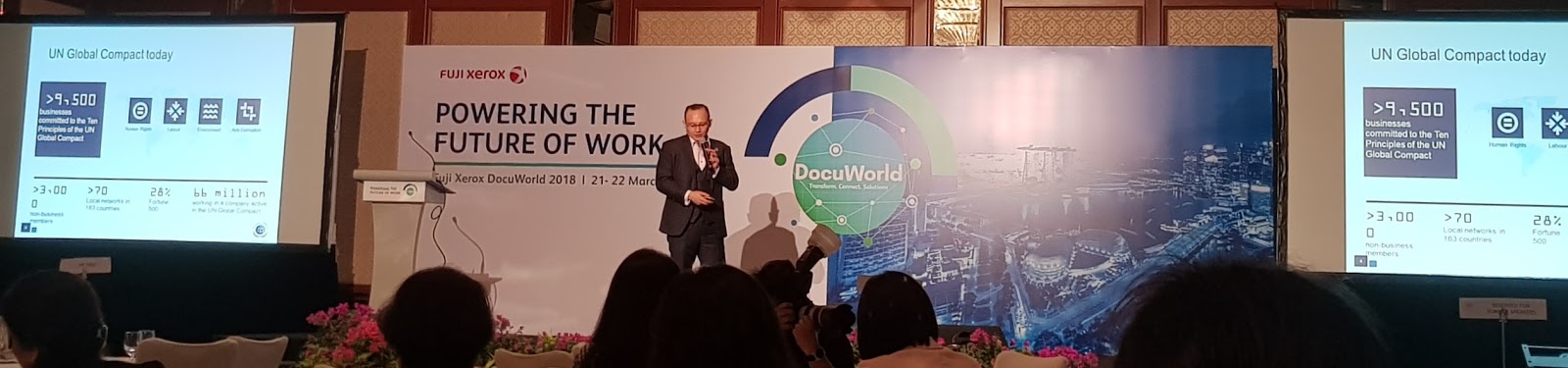
Ang explains why sustainability is important for Singapore SMEs.

Sustainability is a competitive advantage for small and medium sized enterprises (SMEs) as they will then be on the same page as larger companies who are their potential customers.

"It is an opportunity to attract a more sophisticated class of investor," explained Wilson Ang, Executive Director, Global Compact Network Singapore (GCNS) during Fuji Xerox DocuWorld in Singapore. "If you want to be their supplier you must catch up."

GCNS is part of the United Nations Global Compact (UNGC) network, and is tasked with facilitating the progress of companies that are committed to aligning their operations and strategies with UNGC’s 10 universally accepted principles in the areas of human rights, labour, environment and anti-corruption at the country level.

Environmentally-related trends that affect companies in Singapore include an impending carbon tax, announced in February 2018. The tax of S$5 per tonne of greenhouse gas emissions for all facilities producing 25,000 tonnes or more of greenhouse gas emissions in a year from 2019 to 2023 is going to affect businesses downstream, Ang said.

He also noted that green bonds are becoming more popular in Asia. These are loans taken out for green activities, potentially offering business opportunities for SMEs.

The government requires the mandatory reporting of packaging data and packaging waste reduction plans by 2021, Ang added. "It's going to affect your business," he said.

GCNS estimates that there US$12 trillion worth of business opportunities in sustainability globally, US$7 trillion of which are in Asia. According to Ang, there is money to be made in making cities more sustainable, for example in providing more affordable housing, introducing new energy resources, or reducing food wastage.

Financing for such ventures are easily available, he said. The Principles for Responsible Investments platform is one that invests in green ventures, and there is Singapore government support for green bonds. In March 2017, the Monetary Authority of Singapore (MAS) announced that it would introduce a Green Bond Grant scheme to incentivise the issuance of green bonds.

Read the Singapore Sustainable Blueprint (PDF)

Hashtag: #FXD2018