Showing posts with label inclusion. Show all posts

17 July 2019

Singapore ranks third in APAC for fostering women entrepreneurs' growth

Dell Women's Entrepreneur Network - Singapore
Source: Dell. Post-it notes show challenges facing women
in the workplace.
• Singapore is the third top-ranked city in the Asia Pacific region, behind Sydney and Melbourne in Australia for Dell's annual Women Entrepreneur Cities (WE Cities) Index.

• Since 2017, all 50 cities studied have improved on the majority of their indicators year-over-year. Cities in the Asia Pacific region are improving alongside all other cities globally, recording the biggest improvement in the Talent pillar.

• The Index serves as a diagnostic tool to advise policy-makers on how to better support women in business.

At the 10th annual Dell Women Entrepreneur Network (DWEN) Summit in Singapore, Dell announced findings from the 2019 Women Entrepreneur Cities (WE Cities) Index, ranking 50 global cities on their ability to foster growth for women entrepreneurs.

Source: Dell. Infographic showing the Dell Global WE Cities rankings for 2019.

Rankings for Asia Pacific and Middle East cities include:

12. Sydney
13. Melbourne
21. Singapore
23. Hong Kong
26. Taipei, Taiwan
34. Tokyo
37. Dubai, UAE
38. Beijing, mainland China
41. Seoul, Korea
43. Bangalore, India
44. Kuala Lumpur, Malaysia
47. Shanghai, mainland China
48. Istanbul, Turkey
49. Jakarta, Indonesia
50. Delhi, India

All 50 cities have made progress since 2017, Dell noted. However, some cities made bigger strides than others.

“The 2019 Dell WE Cities report is unique from other bodies of research in that it not only ranks 50 global cities on their ability to foster women entrepreneurs, it shows how the cities have improved from their 2017 benchmark,” commented Karen Campbell, Consulting Associate Director, IHS Markit.

“This year we can see some patterns emerging. Ranked cities have collectively made the most improvement in the Capital and Culture pillars, which shows the importance of measuring not just the operating environment but also enabling environment for women entrepreneurs. This data-driven approach shows where women entrepreneurs still face barriers in scaling their business.”

Highlights include:

• Out of a total of 100 possible points, the No. 1-ranked San Francisco Bay Area in the US only scored 63.7. Dell says that this means there is still much work to do to level the field for women – and validates the need for this kind of research and outreach to policymakers to move the needle for female founders.

• Lack of funding, high cost of living, low representation of women in leadership roles and the lack of government-led policies that support women entrepreneurs were among the barriers globally.

• Thirty out of 50 cities improved on more than half of their indicators. The most-improved cities represent nearly every region, which indicates how broad-based the improvements have been around the world.

“When more women work, economies grow. Technology is helping to drive this progress as a genderneutral enabler, and helps create a level playing field,” said Amit Midha, President of Asia Pacific & Japan, Global Digital Cities at Dell Technologies.

“Whilst all cities in the Index have improved, the crucial factor is the consistency of this improvement across the different factors that impact women entrepreneurs’ success. The WE Cities Index helps Dell Technologies get closer to our customers and understand the landscape in each city so we are better able to help women entrepreneurs scale their businesses.”

"We’re very excited about what’s been accomplished and what’s on the table," commented Midha at a media briefing. "Ten years ago, it wasn’t possible. Technology is a great new frontier and we are only at the end of the beginning."

Midha said that the size of a company is not as much of an advantage compared to speed and innovation, calling it "a great time to be a startup and a technology business". "We are solving problems that haven’t been solved before. Startups have a better playing field than ever before," he noted.

He highlighted e-commerce provider Zilingo's story as disruptive. "It's female founded, 50% of the board are female, we’re seeing a lot of green shoots come out, that’s fantastic," he said. "There's never been a better time to be a female founder."

In Asia Pacific (APAC), cities are improving as facilitators of growing businesses for women entrepreneurs alongside all other cities globally. The research suggests that APAC can add a collective annual US$4.5 trillion by 2025 – adding significant growth to growth – if women’s equality is addressed. Similarly, disruptive technologies also have great potential to push the region ahead as many markets are not faced with legacy infrastructure issues.

Four APAC cities are in the top 10 of most-improved for value of funds awarded to businesses with at least 25% women executives. In general, a regional challenge remains in the availability of funding – with contributing factors including lack of policy, and a lack of awareness that funding specifically for women-owned/led businesses is needed.

The research notes that public discussion on women’s issues is slow compared to the rest of the world, and the impact of those discussions emerged with less force. There are some exceptions. Much attention has been on the public discussion of women’s rights in India, owing in part to the power of social media in the country, and in Japan, high-profile women have spoken out against discriminatory working practices.

Regional highlights include:

• More cities in APAC moved down in rankings, than stayed the same or moved up.

• Cities in the APAC region scored the highest improvement in the Talent pillar. The region also improved significantly in the Technology pillar and was the top-improved region for that pillar.

• The median WE Cities score for the APAC region improved by a score of 0.7, compared to 3 in Europe and 0.9 in North America.

• APAC cities mainly fell behind in the pillars for Culture and Markets.

• Globally, Tokyo, Japan ranks second in improvements for women as a percentage of students at top universities, and first for the number of globally top-ranked universities. Tokyo also ranks most improved in number of  globally-recognised, successful women business leaders.

• Globally, Melbourne ranks second-most improved for percentage of the population with a tertiary education, and most improved for both percentage of women with a tertiary education and percentage of the labour force employed in IT.

• APAC is the second-lowest region in terms of board members who are women.

Singapore

Singapore ranks in the top half of the Index and is ahead of other cities in the region, behind only Sydney and Melbourne. The country ranks 2nd in improvements for an economic growth rate forecast of city, region or country over the next five years. While Singapore ranked No. 8 in 2017, and No. 21 in 2019, its decline in rank is not because the city has done poorly, but rather that the competition has made more progress.

Talent and Technology are Singapore’s strongest pillars. Singapore moved from 17th to 11th place in 2019 for Talent and moving from 10th to 6th place in Technology. Singapore’s Talent pillar benefitted from increasing its top school and business school rankings. It also increased its pool of professionals needed to help scale businesses.

Singapore ranks No. 47 globally for Markets as it was hampered by a high cost of living and suffered from a lack of accelerators and relatively few female board members. The 20 by 2020: Gender Diversity on Singapore Boards report was launched in 2018, highlighting that as of June 2017, the overall representation of female directors on boards listed on SGX crossed into the double digits for the first time in history. The report also noted that immedia te action on gender diversity on boards is imperative for Singapore to maintain its positioning as a leading global financial centre in Asia.

For the Capital pillar, Singapore ranked No. 25 globally as venture capital funding to female entrepreneurs increased, but this is still relatively light to other cities. Singaporean women also saw less crowdfunding, fewer female founders and a slight decline in high net worth individuals.

At the No. 28 spot globally on Culture alone, Singapore’s Culture score was relatively low due to fewer female role models or leaders amongst other factors. This said, Singapore is nevertheless more advanced than majority of its neighbours in the region in actively addressing gender parity issues.

“Singapore’s strong base in technology literacy and access to talent position it well to realise its goal in becoming the world’s first Smart Nation,” added Eric Goh, VP and MD, Singapore, Dell Technologies.

“This vision requires the collective effort of the public and private sector, to enable and equip individuals of all genders as agents of change. By highlighting the complex challenges that women entrepreneurs face in Singapore, we hope to be able to drive meaningful conversations and growth as we embark on this nationwide digital transformation journey.”

In a speech at DWEN Grace Fu, Minister for Culture, Community and Youth, Singapore noted that a lot had changed for women in the past 200 years. She highlighted the role of Samsui women in building infrastructure for Singapore in the 1960s and 70s, and said that women make up nearly half of the migrant workforce across ASEAN. Education for women has catalysed "a virtuous cycle that will benefit the economy," she said.

"Women are beginning to drive whole sectors of the economy. We are having our voices heard at all segments of Singapore," she said.

Source: Dell. Fu speaks at the Dell Women's Entrepreneur Network Summit 2019  - Singapore.
Source: Dell. Fu speaks about challenges facing women.

The Singapore government recognises the contribution that women make to the economy and is supporting the expansion of choices and opportunities for them, she said. "We don’t want our women to have to choose between career and family. We want to support them to have both in their lives, and increasingly men [to have the same flexibility in choices] too," she said.

Government initiatives include work-life grants to further develop a workplace that is supportive of flexible work arrangements, and a drive to expand diversity at the board level, Fu shared. The government is also looking at solutions to ease the social pressure on women to leave the workforce early to look after children and their elders.

"We need women around the table to equally cast our eyes on the present and the future, and ask ourselves what can we do to leave behind a great lecacy for ourselves, to create a better place for our daughters and our grand-daughters so that we will, equally, be the trailblazers of tomorrow," she concluded.

The 2017 to 2019 WE Cities Index results highlight the successes and challenges that each city faces, and where cities can learn best practices from one another. These key learnings, if supported by local governments, can add up to big changes for women-owned businesses, globally, said Dell.

Based on the findings and comparison between the 2017-2019 indices, Dell has developed a set of WE Cities Policy Recommendations focused on three areas, including:

• Access to and the development of financial and human capital.

Specifically, this can be supported through:

- Incentives for individuals and organisations to invest in women-owned companies through
venture funds, corporate venture, private equity and social capital.

- Modernisation of existing government certification, grant and loan programs that help women-owned businesses compete to reflect changing investment models.

- Promotion and marketing of existing government programs to encourage broader awareness and
use.

- Continuing to or start to foster small-business lending programmes.

- Creating new sources of capital such as crowdfunding and impact investments.

- Encouraging enterprises and government agencies to increase supplier diversity with a percentage of contracts being awarded to women-owned businesses.

- Considering a shortening of government payment cycles from 90 days to 30 days for small women-owned suppliers.

- Incentivise the adoption of family-friendly policies including access to affordable child care, elder
care and paid family leave policies.

• Private and public sectors role in increasing access to local and global networks and markets.

This could include:

- Supporting trade agreements that further liberalise trade and open new markets for businesses of
all sizes.

- Promoting global and open standards, and reliable mechanisms for cross-border data transfers
and business support services and networks, while providing sufficient protections for privacy and
information security.

- Supporting mentorship efforts through financial support and encouragement of multiplier
platforms such as accelerators, continuing education and training programmes, and facilitated
networking events.

- Encouraging conscious placement of women on boards, in venture partnerships and on executive
teams.

- Promoting positive success stories of female founders and business owners through the media,
conferences and leadership movements.

• How government and business leaders can help women entrepreneurs thrive in the changing face of technology, for example through:

- Streamlining the process of partnering and applying for government resources,

- Emphasising science, technology, engineering and mathematics (STEM) and digital literacy in
education and early training programmes.

- Working with business leaders and educators to encourage technology training programmes to end
unconscious biases in the STEM fields, government, corporations and institutions.

- Enabling access to broadband globally.

- Increasing awareness of options women have to the hardware, software and digital resources they need to scale their companies.
Dell partnered with IHS Markit to launch the research to measure a city’s ability to attract and support high-potential women entrepreneurs. Research for WE Cities began during the 2016 DWEN Research Symposium. The successful pilot of the 2016 index led to the scaling for the 2017 index to include 50 cities and in turn the remeasuring and ranking for 2019.

Building on 10 years of research on women entrepreneurs, Dell partnered with IHS Markit to research and rank 50 cities on five characteristics, including access to Capital, Technology, Talent, Culture and Markets. These pillars were organised into two groups — operating environment and enabling environment.

The criteria includes the impact of local policies, programmes and characteristics in addition to national laws and customs to help improve support for women entrepreneurs and the overall economy.

The overall rating is based on 71 indicators; 45 of which have a gender-based component. Individual indicators were weighted based on four criteria: relevance, quality of underlying data, uniqueness in the index and gender component.

"When we invest in women, we invest in the future; communities prosper, economies thrive and the next generation leads with purpose,” said Karen Quintos, EVP and Chief Customer Officer at Dell Technologies.

“By arming city leaders and policymakers with actionable, data-driven research on the landscape for women entrepreneurs, we can collectively accelerate the success of women-owned businesses by removing financial, cultural and political barriers."

Dell supports and nurtures a community of female entrepreneurs through the Dell Women’s Entrepreneur Network by providing access to technology, networks and capital. The annual DWEN Summit was held in Singapore from July 14-16, 2019.

Hashtag: #DWEN

8 March 2016

It's International Women's Day: can you #MakeWhatsNext?

Source: Microsoft blog. Ada Lovelace was the world's firt computer programmer.
Source: Microsoft blog. Ada Lovelace was the world's first computer programmer.

Microsoft is calling on girls around the world to #MakeWhatsNext in celebration of International Women’s Day, a global celebration of women’s social, economic, cultural and political achievements.

According to the World Economic Forum, the gender gap is not set to close until the year 2133 - a gender gap that is clear in computer science and science, technology, engineering and math education (STEM). And the Asian Development Bank says women in the region are on average 70% less likely than men to be in the labour force, notes Dr Daiana Beitler, Microsoft Philanthropies Lead, Asia, in a blog post

Children are hardly taught about women in science, as a recent Microsoft video shows. The company asked girls to name female inventors – they couldn’t

"On International Women’s Day, we want to put the spotlight on the leading ladies who have helped transform our world with technologies that we now find hard to live without. Their innovations and designs have more than shaped what defines a technology pioneer – they have become beacons for young girls all around the world to learn and draw inspiration from," Dr Beitler said in the blog post, which celebrates 10 women behind key technology breakthroughs.

Microsoft's efforts to encourage girls and women to change the world include the DigiGirlz campaign as well as the MakeWhatsNext hub, which spotlights girls and women who are already making what's next under the Microsoft YouthSpark initiative, and shares details about a Patent Program launched on March 7 that focuses on inviting select female inventors to receive support in patenting their ideas.

Interested?

There are 2016 DigiGirlz Days planned in Sydney, Australia, as well as in Beijing and Shanghai, China.

Hashtag: #MakeWhatsNext

29 January 2016

Mercer sounds alarm over under-representation of women in the workforce globally

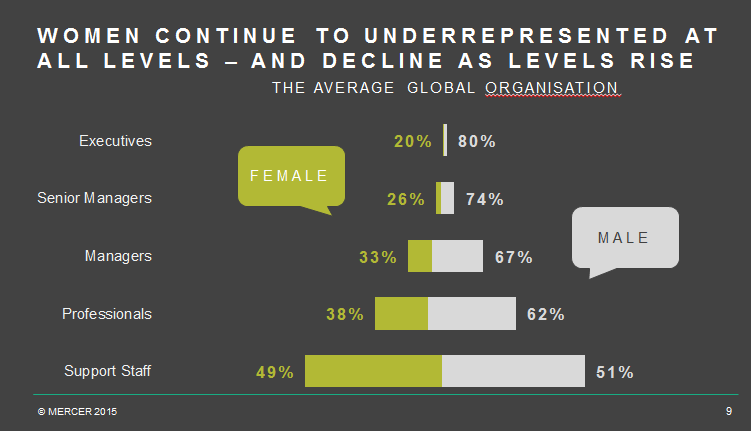
The number of women represented declines into the senior levels.
Source: Mercer When Women Thrive global report.

Women are under-represented in the workforce globally, and if organisations maintain the current rate of progress, female representation will only account for 40% of the professional and managerial ranks in 2025, according to Mercer’s second annual When Women Thrive global report.

Among the key trends revealed in the report is that women’s representation within organisations actually declines as career levels rise – from support staff through the executive level.

“The traditional methods of advancing women aren’t moving the needle, and under-representation of women around the world has become an economic and social travesty,” said Pat Milligan, Mercer’s Global Leader of When Women Thrive. “While leaders have been focusing on women at the top, they’re largely ignoring the female talent pipelines so critical to maintaining progress.

“This is a call-to-action - every organisation has a choice to stay with the status quo or drive their growth, communities and economies through the power of women.”

Mercer’s report finds that although women are 1.5 times more likely than men to be hired at the executive level, they are also leaving organisations from the highest rank at 1.3 times the rate of men, undermining gains at the top.

Asia performs the worst worldwide.
Source: Mercer When Women Thrive global report. Current and projected female representation in 2025 at 2015 attrition rates around the world.

According to the When Women Thrive report, women make up 40% of the average company’s workforce. Globally, they represent 33% of managers, 26% of senior managers, and 20% of executives. In terms of regional rankings, Australia and New Zealand is projected to move from 35% in 2015 to 40% in 2025; and Asia ranks last at 28%, up from just 25% in 2015.

“In 10 years, organisations won’t even be close to gender equality in most regions of the world,” said Milligan. “If CEOs want to drive their growth tomorrow through diversity, they need to take action today.”

The research – the most comprehensive of its kind featuring input from nearly 600 organisations around the world, employing 3.2 million people, including 1.3 million women – identifies a host of key drivers known to improve diversity and inclusion (D&I) efforts.

“It’s not enough to create a band-aid programme,” said Brian Levine, Mercer’s Innovation Leader, Global Workforce Analytics. “Most companies aren’t focused on the complete talent pipeline nor are they focused on the supporting practices and cultural change critical to ensure that women will be successful in their organisations.”

Only 9% of organisations surveyed globally offer women-focused retirement and savings programmes, despite Mercer’s research proving that such efforts lead to greater representation of women.

Other key findings:

Only 57% of organisations claim senior leaders are engaged in diversity and inclusion initiatives

Involvement of men has actually dropped since the first report in 2014, when 49% of organisations said they are engaged in D&I efforts

Just 29% of organisations review performance ratings by gender with Australia/New Zealand ranking first

Four in 10 organisations offer formal pay equity remediation processes, compared to 34% globally, and 25% in Asia. But virtually no improvements have been made since 2014

Nearly a third (28%) of women hold P&L (profit and loss) roles with Asia at No. 2 (27%), and Australia/New Zealand in third place (25%)

Women are perceived to have unique skills needed in today’s market including flexibility and adaptability (39% vs. 20% who say men have those strengths); inclusive team management (43% vs. 20%); and emotional intelligence (24% vs. 5%)

About half of organisations in three key regions – Asia, US/Canada and Latin America – agree that supporting women’s health is important to attract and retain women. Yet only 22% conduct analyses to identify gender-specific health needs in the workforce

In a series of separate studies Mercer has found that clients find that building their leadership pipeline is one of their biggest challenges, and included a lack of plans to develop women in their workforce for leadership as one of the problems in talent management strategies. 

Said Kate Bravery, Mercer’s Growth Markets Leadership & Organizational Performance Practice Leader: “To achieve long term success, a more strategic approach to nurturing the pipeline of leaders is required. This starts by translating core business objectives into a leadership strategy that defines the talent pool, competencies and the tactics required to build leaders from within. It continues with an execution plan that helps businesses identify, develop and accelerate the critical talent moves that will help them achieve real competitive advantage.”

Mercer’s Leadership Practices Study comprises a series of research reports based on surveys conducted from 2012 to 2014 that explore and compare current leadership trends in Asia Pacific, Latin America and the Middle East. Using data gathered from nearly 1,000 companies across the three growth market regions, these studies examine how companies approach leadership strategy, assessment, development and succession planning.found that companies in growth market regions are adopting effective practices for nurturing leadership talent, for example:

· Businesses in Asia-Pacific are investing heavily in training and developing senior level and global leaders at the top of their organisations.

· Firms in the Middle East are doing a good job of using global leadership capability models to help with talent development and creating opportunities for international assignments to which any employee can apply.

However, the studies also identified critical gaps in current planning that potentially limit organisations’ ability to produce the multi-skilled leaders required in modern, rapidly-growing businesses, as well as differences in the leadership competencies that are deemed critical for success by companies in each region.

Key findings included:

· Companies can do more to plan and prepare for the next generation of leaders – fewer than half of those companies responding conduct regular pipeline projections, very few have specific plans for developing key segments of their workforce (e.g. women or grooming local talent) and even fewer have metrics for tracking progress on pipeline management.

· Many businesses are not effectively identifying who is ready for the next move or position within their leadership pipeline – 15% of businesses in Asia Pacific and just 6% in the Middle East report that they have strong, “ready-now” successors in place for critical leadership roles.

· Companies are spending less annually per person on training and developing middle level and frontline leaders than they do on global or senior level leaders. Fewer than 20% of companies in the Middle East are spending US$5,000 or more per person each year to develop their youngest future leaders. In Asia-Pacific, under-investment is even starker, with just 5% of companies achieving this level of spending for individuals at the earliest stage of the pipeline – the next generation of leaders.

· Companies view a leader’s ability to ‘create strategy’ as one of the most critical competencies for leadership success – 64% of companies in Middle East and 36% in Asia Pacific prioritise strategic competencies above other operational, people or personal capabilities.

Highlights for Asia Pacific:

· While leadership development strategies are in place in many organisations, execution remains a significant problem as performance management processes are not effectively identifying who is ready for the next move or position within their leadership pipeline.

· Systems and processes for executing talent management processes are extremely inefficient, still relying on paper-based and email resources.

· Organisations are not focusing leadership development efforts on women as a segment, despite women making up a small percentage of senior management in organisations.

· Companies continue to rely on expatriates, rather than local talent, for top leadership roles, calling into question the effectiveness of leadership development and localization strategies.

· Investment in leadership development is concentrated on top-level leaders, organisations need to also reach deeper and earlier into their leadership pipelines to build talent from within.

· Leaders and managers are not being held accountable for grooming future leadership talent.

· People-related competencies are not among those seen as most critical by organisations for leadership success.

· There is a disconnect between the development methods rated most effective by respondents (“stretch” assignments) and those methods that are most widely used such as classroom training and individual development plans.

Highlights for Middle East

· Half of the companies have defined leadership development strategies in place, although this is more likely in larger organisations.

· Those organisations without a defined leadership development strategy are often reliant on buy/borrow talent strategies.

· The short-term focus of companies jeopardises their ability to build strong leadership pipelines.

· Organisations are missing some critical infrastructure to support leadership development.

· Many companies recognise the lack of attention paid by organisations and top executives to leadership development.

· Companies are relying on traditional methods such as classroom training to develop talent and leadership expertise and these are not proving to be effective in nurturing future leaders.

· Key talent pools are under-represented in leadership positions and often overlooked in talent development programmes, including local staff and women.

Interested?

Access the report summary for When Women Thrive

18 September 2015

Getting people with disabilities off the training treadmill and into real jobs

People with disabilities should not be trained for the sake of training, with no jobs in sight, but placed where they can learn on-the-job. In a speech titled Best Practices of Employers in Supported Employment for Persons with Disabilities, Christy Lynch, Chief Executive Officer, KARE Ireland, an organisation which provides support to people who have an intellectual disability and their families, advocated working with people with disabilities and employers to ensure that there is real empowerment.

Speaking at Towards an Inclusive Workforce 2015, an event jointly organised by SPD, and supported by SG Enable and the Singapore Workforce Development Agency (WDA), Lynch noted that the reality of people with disabilities is that they are disconnected from the labour market and typically do not get the opportunity to go to work. Regular supported employment is attainable, he said.

"The problem is – not was – that lots of people do lots of training and never get to the labour market," he noted, pointing out that many people with disabilities are still stuck in less desirable options of sheltered workshops - a daily programme - and vocational training centres.

While many believe that the severely disabled cannot work, Lynch gave real-life examples of people who have done just that with regular supported employment, with job responsibilities matched to their abilities. "Employers don't hear the success stories," he said.

Supported employment enables individuals with disabilities to be employed in real jobs in regular settings where training and other supports are provided on an ongoing basis, Lynch explained. Kare negotiates with employers on what a disabled person may need to learn to fulfil the requirements of the job, and assigns a job coach to work with the person to ensure that he or she can do the job to the standard that the employer requires.

There may be physical adaptations required for the workplace, and the disabled person may need to learn social skills appropriate for the corporate culture, Lynch noted. Many people may fit the job requirements, but need help on the logistics, such as how to get to the workplace, he added.

Misconceptions with the practice are that employers may think disabled people are a source of cheap labour, or that they create a token job that would not have existed otherwise, Lynch cautioned. "It's about real wages and benefits," he said.

Another misconception is that the support for supported employment stops once the disabled person has been successfully placed in the job. Problems can crop up years later, requiring the support organisation to step in again, Lynch said.

"No two people are the same so no support package is the same," he said. "You have to tailor this to the individual."

The fifth Towards an Inclusive Workforce 2015 was held in conjunction with the 2015 Microsoft YouthSpark Scholarship Award Ceremony, which offers financial support to students with disabilities studying in IT-related disciplines. Over 100 participants comprising employers and representatives from institutes of higher learning attended the event at the NTUC Business Centre.

“People with disabilities have work potential. When given the opportunity, job accommodation and support, they too can contribute to the economic growth of Singapore. We are encouraged by the help of Microsoft Singapore in supporting the IT-related aspirations of students with disabilities, and our partners SG Enable and WDA in advancing the employment of people with disabilities, and hope that inclusive hiring will become second nature, and not initiated as a corporate social responsibility exercise,” said Abhimanyau Pal, Executive Director, SPD.

Interested?

Read the TechTrade Asia blog post about the Microsoft YouthSpark Scholarships for 2015