Showing posts with label skill. Show all posts

2 April 2025

Skilled jobs in Singapore on the rise: Indeed

Higher-skilled jobs related to scientific research and generative AI (gen AI) are growing in demand in Singapore, though the total number of job postings on Indeed declined by 3.7%.

Source: Indeed. Chart. Change in Singapore job postings, percentage change. Scientific research and development job vacancies led the pack over the past three months as of end-February 2025.
Source: Indeed. Change in Singapore job postings, percentage change. Scientific research and development job vacancies led the pack over the past three months as of end-February 2025.

According to Indeed’s latest Hiring Lab Singapore’s job postings are 50% above pre-pandemic levels, with growth mainly seen in higher-skilled roles like scientific research and development, which rose by 35%. Job postings for security and public safety (+31%) and production and manufacturing (+16%) roles also saw some of the highest gains in the past three months.

As of February 2025, job postings related to gen AI have doubled over the past year. Key gen AI-related roles in demand come from data analytics, scientific research, and software development. Indeed said the growth in such roles shows promise for Singapore’s ambitions to become a regional gen AI hub. The share of Singapore job ads referencing gen AI is now 1.2%, which is 4x higher than countries like the US, UK, Canada, and Australia.

Indeed’s data also highlighted that job postings for cleaning and sanitation (-33%), childcare (-19%), and retail (-18%) roles saw the highest decline in terms of job postings. Such jobs are considered those which require fewer skills. The Ministry of Manpower’s Q4 labour report observed a “notable decline” in employment for workers in lower-skilled sectors, such as those in the administrative and support services.

Callam Pickering, APAC Senior Economist at Indeed, commented: “There’s reason to be optimistic about Singapore’s employment outlook despite the month’s mixed results. Higher-skilled roles remain in high demand, with Singapore standing out globally, especially in gen AI and data-related roles. An exciting challenge now is helping workers integrate gen AI capabilities into their skillsets.”

“While more support and service-oriented roles have seen a dip, it’s not necessarily a cause for alarm. With the labour market set to expand, the focus should be on continuous skills development to stay resilient and competitive.”

29 November 2017

Need help with emerging technologies? SGInnovate is working to offer more of it

Source: SGInnovate. From left: Yeo Hwee Lee, Director, Software & Solution Services, IBM Software Group, IBM Asia Pacific; Wendy Wong, Senior VP, Corporate Governance & Communications Office, GIC; Sam Witteveen, Founder, Red Dragon AI; Steve Leonard, Founding CEO, SGInnovate; Yap Jia Qing, Founder, Nurture.ai; Aziza Sheerin, Regional Director, General Assembly (GA); Scott Jones, MD, Six Kins;  and Tan Tin Wee, CEO, NSCC. 

SGInnovate today announced its Deep Tech Nexus Strategy as a direct result of experiences and insights gained in its first year of operation. The Deep Tech Nexus represents SGInnovate’s commitment to add tangible value to the Singapore deep technology (deep tech) startup ecosystem in two key areas – human capital and investment capital.

Deep tech is about building technology-intensive solutions that are based on advanced scientific research, have high barriers of entry and are essentially difficult to replicate. Examples of deep tech would be using artificial intelligence (AI) or robotics to address issues in areas such as healthcare or transportation.

“SGInnovate was formed in 2016 because we believe Singapore can create globally-relevant deep tech products and companies. Singapore has great strengths in academia and scientific research, but we saw a gap in the critical ‘business-building’ capabilities needed to create a viable deep tech company.

“Over the past year, we have met and worked with hundreds of researchers, founders, corporates and investors. Being so immersed in the deep tech founder community has given us a rich understanding of the specific challenges facing these entrepreneurs. Tackling these challenges gives our second year of operation great clarity and focus – and this has led to our Deep Tech Nexus Strategy,” said Steve Leonard, Founding CEO, SGInnovate.

SGInnovate’s focus areas are in transformational technologies that have horizontal applications to many industries, as well as medtech which will impact the healthcare industry. Two such transformational technologies that now – or soon will – affect most industries include AI and Blockchain. For 2018, SGInnovate will be intensifying its efforts around AI, aligning with AI Singapore (AISG)’s mission to bring together Singapore-based research institutions, AI startups and corporates to enhance and expand Singapore's AI capabilities. SGInnovate will focus its efforts on the AI startups.

SGInnovate’s work in the area of human capital will be pursued in three ways:

- Strengthening individual talent capabilities through a range of deep tech-related learning opportunities, delivered by SGInnovate partners. A series of programmes delivered by industry leaders will be undertaken to help people gain knowledge in working with tools at various competency levels in areas such as machine learning, deep learning and data analytics.  The goal is to have 1,500 people participate in these programmes over the next two years.

- Expanding the deep tech talent network through active engagements locally and internationally to build a network of ambitious and capable people who want to build startups. The goal is to bring 2,000 high-potential talent into contact with high-potential deep tech startups based in Singapore by 2018. 

One of the initiatives being driven by SGInnovate in expanding the deep tech talent network is its Apprenticeship Programme, where a curated pool of students in STEM disciplines from local and overseas institutes of higher learning (IHLs) are placed within a select number of Singapore's promising deep tech startups.

- Boosting deep tech communities through a range of deep tech-related networking events, bringing together researchers, entrepreneurs and investors to share experiences on a wide range of topics. SGInnovate says that these events serve as a way to raise the intellectual debate, as well as pursue opportunities to get more people to know more about important future topics. The goal is to have 15,000 participants taking part in over 150 events throughout 2018 across various community meetups.
SGInnovate’s work in the area of investment capital will be pursued by:

- Investing equity in early-stage deep tech startups. The goal is to make direct investments into at least 20 deep tech startups founded in Singapore in 2018, including investments made at the pre-seed, seed and series A stages. SGInnovate will also be managing a portion of the SG Equity fund, and will be co-investing into deep tech startups alongside private-sector venture capitalists (VCs) including Jungle Ventures, NSI Ventures and Vickers Partners.

- Business-building support, such as helping startups in which it has invested in to grow and scale through activities such as customer sales and talent recruiting, connection to business use cases, technical advisory and more.

- Collaborative spaces where deep tech startups, education events and community events can coexist for mutual benefit. All activities will continue to take place at SGInnovate’s locations at 32 Carpenter Street, which has more than 16,000 sq ft of space, and BASH (which stands for Build Amazing Start-ups Here) at 79 Ayer Rajah Crescent with more than 25,000 sq ft. 

To better serve demand under the Deep Tech Nexus Strategy, BASH will be undergoing renovation works and will be operational again in Q118. Some key features of the revitalised BASH will include more enclosed rooms to allow early-stage companies to have privacy, expanded training areas to house more education programmes in areas relating to AI, and access to AI-tuned computing resources. In addition, there will be a new area dedicated to the companies formed under the Entrepreneur First (EF) Singapore programme. 
  
As part of the Deep Tech Nexus Strategy, SGInnovate has partnered with likeminded industry players and global brands including General Assembly (GA), GIC, IBM, National Supercomputing Centre (NSCC) Singapore, Nurture.ai, NVIDIA, Red Dragon AI and SingularityNET – all of which will play instrumental roles in strengthening the deep tech startup ecosystem in Singapore.

Training more people on AI

SGInnovate will work with NSCC to organise training in AI and high performance computing (HPC). SGInnovate will also be working with Red Dragon AI to organise advanced AI training sessions. Using industry-standard frameworks such as TensorFlow, Keras and PyTorch, students will learn how deep learning is applied to different practical applications including computer vision, natural language and time series information. They will then be applying those skills to make real world AI products and services. At least 100 students will participate in the advanced training sessions over the next year. 

“It’s good to see SGInnovate taking a lead in nurturing AI and the deep tech community in Singapore. Their unique position of being independent from the government and educational institutions has allowed them to see what startups really need and respond quickly. Teaching the Deep Learning Developer Course has allowed us to see that there is a wealth of talent in Singapore that just needs real world training to unlock the ability to make AI products and services," said Sam Witteveen, Founder, Red Dragon AI. 

GA, which offers training and assessments in web development, data science, and digital marketing among other topics, is working with SGInnovate to organise workshops and courses in Python, machine learning and data science, to equip trainees with fundamental programming skills and principles before moving on to more advanced deep learning concepts. 

“Skill sets in data analytics and machine learning are sought after by both startups and large organisations alike,” shared General Assembly’s Regional Director, Aziza Sheerin. "It is critical that Singapore builds talent capabilities in these areas to remain competitive. SGInnovate is launching an exciting initiative focusing on deep learning, and General Assembly looks forward to collaborating with them on workshops and courses to train 250 individuals in Python, machine learning, and data science in 2018.” 

Partnering with NVIDIA Deep Learning Institute (DLI), SGInnovate will be conducting DLI workshops and offering hands-on training for developers, data scientists, and researchers looking to solve the world’s most challenging problems with deep learning. "Deep learning is growing at an accelerated pace and we are delighted to partner SGInnovate in driving AI in Singapore. We hope to help build the talent pool by training 1,000 developers within the next two years,” said Raymond Teh, VP of APAC sales and marketing, NVIDIA. 

SGInnovate is working with IBM on strengthening both talent and communities. The two entities are organising AI training courses for undergraduate students from IT-related academic programmes such as computer science and software engineering. The AI career path aims to prepare an estimated 50 students in applying AI in real life. 
Helping AI communities grow

Together with SGInnovate, SingularityNET, a decentralised, open marketplace for exchanging AI services, will co-host meetups and provide speakers and technical experts in the areas of Blockchain, smart contracts, AI and robotics to drive discussions and inspire new ideas. In 2018, the target is to reach out to a community of over 2,000 people.

SGInnovate and IBM are also engaging with the AI and deep tech-ecosystem through co-curated and/or co-branded industry events. These events would focus on industry trends, case studies, real-world applications, etc. of AI and deep technologies, including (but not limited to) Blockchain, robotics, machine learning, and medtech. There is a target of 10-12 events in 2018.

Red Dragon AI's co-founders Witteveen and Dr Martin Andrews started the TensorFlow and Deep Learning Meetup group, which has in under a year become Singapore’s biggest active data science community. Google selected both co-founders as only two of fifteen Google Developer Experts for machine learning in the world. With a member count of close to 2,000, Red Dragon AI is looking to organise multiple TensorFlow, PyTorch and deep learning Meetups with SGInnovate in the next year. The target is to reach out to more than 1,000 participants. 

SGInnovate will be working with Nurture.ai, a web-based AI community, to build a strong community of enthusiasts and experts who would be trained in AI. Nurture.ai enables this through organising free study groups using Stanford University's course material on deep neural networks, where participants get to discuss the most cutting-edge AI models covered in the lectures, read the relevant research papers with peers and implement these models as open-source code. 

"With SGInnovate's wide networks in the deep tech space and their portfolio of promising AI startups, the partnership would be a great boost to Nurture.ai's efforts in empowering the AI community in Singapore to implement the most state-of-the-art AI research into well-documented, easily useable code," said Yap Jia Qing, Founder, Nurture.ai. 
Business support

Through the partnership with SingularityNET, startups within the SGInnovate community will get early access to the SingularityNET marketplace, with SingularityNET providing technical guidance to enable them to integrate, monetise and scale their AI technologies.  

“This partnership will create new opportunities for Singapore startups to leverage and cooperate with SingularityNET – and in this way for Singapore to play a leading role in the currently unfolding transition of AI technology to its next stage of development. In the next few years we will see a transition from narrow AI to artificial general intelligence, and from disparate AI tools to a coordinated network of AI functionality. This partnership will help catalyse the involvement of Singapore researchers, developers and companies in this critical transition in AI capability and application,” said Dr Ben Goertzel, Co-Founder & CEO of SingularityNET, and Chief Scientist of Hanson Robotics.

SGInnovate-supported startups and trainees will have access to NSCC's HPC/AI computing resources, which will include those provisioned under the NSCC NVIDIA AI.Platform collaboration (comprising a NVIDIA DGX-1 Volta V100 supercomputer and access to an NVIDIA DGX SATURNV supercomputing platform), as well as NSCC’s existing 1-PetaFLOPS supercomputer, ASPIRE1 (standing for Advanced Supercomputer for Petascale Innovation, Research and Enterprise) that comes with 13 petabytes of high performance storage and global connectivity of up to 100Gbps. 
Furthering AI research

SGInnovate is also a partner to the Global NIPS Paper Implementation Challenge organised by Nurture.ai, which has seen more than 600 applications globally so far and 30+ expert mentors including researchers from the Baidu Silicon Valley AI Lab, Amazon Core Machine Learning Research team, NVIDIA, SAP, Stanford University and several authors of papers accepted at the Conference for Neural Information Processing Systems – the most prestigious AI research conference in the world.  

Source: SGInnovate. The training roadmap for skilling up AI professionals.
Source: SGInnovate. The training roadmap for strengthening individual talent capabilities on AI through a range of deep tech-related learning opportunities.

 SGInnovate is co-curating and/or co-branding industry events, with GIC, one of the world’s largest fund management companies. Targeted areas for the events are related to AI, machine learning, data analytics and the deep tech-ecosystem. These events will focus on promoting thought leadership and community building by bringing in subject matter experts to talk about key industry trends, and real-world applications of AI and deep technologies. 

By the end of 2017, SGInnovate will have completed equity investments in 15 deep tech startups, played a part in generating 400 potential-customer leads for early-stage companies and built a network of more than 1,000 technical individuals interested in joining early-stage tech companies. In addition, as part of its deep tech community building efforts, SGInnovate has created and hosted more than 100 events at its premises attracting a total of 9,000 participants.

Leonard added, “SGInnovate is itself a startup and, to echo DPM Tharman’s point when he launched us last year, we will keep prototyping and pivoting in the coming years. Building deep tech companies takes time. We feel good about the impact we have already made, and are looking forward with confidence to the year ahead.”

Tharman Shanmugaratnam is Deputy Prime Minister (DPM) and Coordinating Minister for Economic and Social Policies in the Singapore Cabinet. He is also Chairman of the Monetary Authority of Singapore (MAS).

SGInnovate's mission is to enable ambitious and capable individuals and teams to imagine, start, build, and scale globally-relevant technologies. It is a private-limited company wholly owned by the Singapore government.

13 July 2017

Here's why the skills you have are going to help you get one of tomorrow's jobs

Legrand shows how LinkedIn is making breakthroughs connecting present-day skillsets with emerging job requirements.

Olivier Legrand, MD, Asia Pacific, LinkedIn, says that many of us may already be partway towards meeting the requirements for the jobs which are most demand in the industry today, only we don't realise it.

In his keynote Job titles are out, skill sets are in during at the Singapore Computer Society's Tech3 Forum, Legrand said that LinkedIn is not just the platform to matchmake job seekers and employers, but also the company that will put members in touch with the right company, the right jobs and the right skills to acquire in order to stay relevant for the future.

Legrand spoke about LinkedIn's drive to offer more value to the approximately 3.3 billion workers and up to 50 million employers globally. against its 500 million members and 7 million active employers today. Some 30,000 schools are currently on the platform as well.

Legrand explained that there is an opportunity to help all stakeholders through analysing the skillsets that each member has and linking those skillsets with the skillsets actually required for new types of jobs. This is a completely different approach to the traditional focus of match-making members and employers by existing job titles. The company has been asking peers to endorse LinkedIn members for various skillsets for some time, and has amassed some 10 billion of these endorsements so far.

"The 10 billion skills endorsements actually shared by our members...allow us to have a unique view to have a skills taxonomy and what kinds of skills are needed to do the jobs," he said.

As an illustration, Legrand pointed to the crying need for data scientists and how few members currently have related job titles today. An analysis of data scientist-related jobs by skillset on LinkedIn reveals a list of skills that existing members may already possess, or possess to a significant degree, he said. Such insights allow employers to reach out to more people by disregarding their existing job titles, for LinkedIn to suggest new skills for the educational industry to offer, and for members to acquire, he said.

LinkedIn will be there every step of the way to empower members to take control of opportunities, he added. "We are investing in algorithms and machine learning to point you in the right direction," he confirmed.

In the case of data scientists, candidates need to have data knowledge, analytical skills and programming capability. There are 84,000 people on LinkedIn with the right job titles, but 576,000 who have at least five of the skillsets that data scientists are known to require. Casting the net further, Legrand said that 10 million individuals on LinkedIn have one or more of the 10 required skills.

"We're able to massively grow the talent pool about eight times through that exercise," he said. "We identified adjacencies in skills that would allow us to potentially invest in reskilling people who already have (what) it takes to be data scientists."

Legrand also shared the skills which are most in demand in Singapore, and noted that they are generally digital-related.

The skillsets most in demand in Singapore.
The skillsets most in demand in Singapore are mostly digital.

Legrand emphasised the importance of lifelong learning in a world where work requirements are continually evolving. "It's a reality," he said. "Your career path is not always a straight line. Stay open-minded, flexible and adaptable. The jobs of tomorrow will be different from those of today."

Legrand profiled Wui Liang Heng, Country Head, Singapore @ BankBazaar International, a fintech company focusing on mobile payments, as a prime example of a person who had undergone a mid-career switch because he believes in the new digital era. Heng made the effort to reach out on LinkedIn to people who were or had been in startups, which eventually led him to where he is today.

Legrand encouraged members in their pursuit of lifelong learning to emulate Heng, researching people on LinkedIn  and contacting them. The platform allows members to see what others are reading, liking and sharing in terms of professional content so that they can reach out in a meaningful way.

Legrand also spoke about best practices for creating a LinkedIn profile, using CEO of PerX Technologies Anna Gong's profile as an example. Some tips include:

- Add a summary with keywords, not buzzwords

- Add a photograph - the profile is is 21x more likely to be viewed by others

- Include your current position - the profile is 18x more likely to be viewed as a result

- List relevant skills – those with five or more skills are 17x more likely to be viewed by others

LinkedIn Asia Pacific has 13 offices in nine markets.

Held annually, the Tech3 Forum features luminary speakers and examines hot topics revolving around technology, talents and trends.

2 July 2017

IBM sounds alarm over skills gap in India

Source: IBM. Cover for the Upskilling India report.
IBM has announced a study conducted by the IBM Institute for Business Value (IBV) in cooperation with the Economist Intelligence Unit to evaluate India's growing skills challenge and proposed recommendations to bridge the gap.

A majority of Indian executives surveyed in the study said that the quality and quantity of skills in the Indian workforce are at least comparable to those of other countries, and many reported them to be superior. However, only 40% indicated new employees in local labour markets have the requisite job skills.

The IBM study, Upskilling India, derives insights from a survey of academics, corporate-recruiters, and emerging education leaders in India. In addition, the study also analysed results of recent surveys of startup entrepreneurs, venture capitalists and corporate executives.

Key findings:
  • Six in 10 (61%) of India's surveyed educators indicate that the higher education system is unable to respond to changing societal needs.
  • Seven in 10 of India's venture capitalists indicated that startups cannot find employees with the right skills.
  • Only 40% of Indian industry executives said new employees recruited in local labour markets have requisite skills.
  • Nearly three quarters (73%) of India's education leaders surveyed say new technologies are disrupting higher education.

"Today's rapidly evolving economic environment makes developing new skills an imperative across job profiles and sectors. At IBM, we believe in providing an environment that fosters new learning and development experiences aided by the power of technology," said DP Singh, VP and Head - HR, IBM India/ South Asia. "We are working with government bodies, academia, corporates, startups and recruitment firms to equip India with a 'job-ready' workforce."

Between 2010 and 2030, India's working population is expected to expand from 750 million to almost 1 billion. Without adequate education and training, such population growth poses increased risk of the emergence of a growing class of the under or unemployed.

The study recommends:

Developing more practical, experience-based education - Rethink higher education curricula by identifying opportunities to infuse experience-based and real-world learning experiences and embracing new teaching technologies and techniques. Higher education institutions should build alliances with industry partners, share learnings and refine strategies.

Embracing technologies that improve educational access, experiences, and outcomes - Assess current capabilities and requirements, experiment with using new technologies and extend capabilities through ecosystem partners.

Build deeper relationships with ecosystem partners - Define and reach consensus with key partners around a common vision for the education ecosystem, with clearly defined commitments from all partners.

Interested?

Read the Upskilling India study

Download the IBM IBV app on an Android or iOS device

20 February 2017

Project leaders who can communicate in high demand in Singapore

JobTech has identified the most sought-after skills by employers in the info-communications technology (ICT) sector in Singapore. The top five technical and soft skills/traits in the ICT sector were identified and ranked based on the number of unique job postings that employers were seeking from 1 October 2016 to 31 December 2016.

Top skills demanded by Singapore ICT sector employers

No
Technical skills
% share of all unique job postings in the ICT sector
Soft skills/ traits
% share of all unique job postings in the ICT sector
1
Project
management
> 10%
Communication/
interpersonal
> 95%
2
C++
> 10%
Analytical/
problem-solving
> 40%
3
C
> 10%
Self-motivated/
proactive
> 20%
4
SQL
> 5%
Leadership
> 20%
5
Java
> 5%
Customer service
> 15%

The data shows high demand for a common set of soft skills/traits within the ICT sector, with communication/interpersonal skills being sought after by more than 95% of all unique job postings in the sector, followed by analytical/problem-solving skills, which make up close to half of the demand. Given that communication/interpersonal skills are required by almost all job postings in the ICT sector, they are probably viewed as a hygiene factor* for employment, Jobtech said.

JobTech also notes that there is great variability in the demand for technical skills within the sector. JobTech has identified at least 20 different types of programming languages that are widely demanded in the ICT sector today, including the four in the top technical skills listed.


*A hygiene factor, or 'dis-satisfiers', first mentioned by Frederick Herzberg in his motivation theory, is something that does not make an employee happier at a workplace, but would cause dissatisfaction if it is missing.  

28 December 2016

CEOs believe soft skills will matter more than hard skills in the future

· CEOs in Asia believe soft skills are more important than hard skills for their business in the future, according to The Economist Corporate Network, The Economist Group’s advisory service for senior executives seeking insight into economic and business trends

· Communication of the skills management strategy, getting the right structures for skills development in place and CEOs’ time constraints are the key challenges

· More than 80% of CEOs believe that megatrends affect their companies. Technological progress is seen as the most important trend

· Climate change (23%) and industry convergence (26%) are the trends that are the most often viewed as a threat by CEOs.


The Economist Corporate Network (ECN) has released a new paper, Skills 4.0: How CEOs shape the future of work in Asia, which reveals that the majority of CEOs believe that megatrends matter, but most of the skills required for their business to respond to global megatrends are new skills that they neither appreciate or use today.

The survey*, based on ECN’s more than 500 clients, was conducted across Asia Pacific in September and October 2016, and examines how business leaders in Asia perceive their own strategic role in shaping the future of work and the types of skills needed.

The report states that skills are an essential resource in the knowledge economy of the 21st century. With the unprecedented economic developments in Asia and the dramatic changes rattling through many industries, companies need to ensure they are ready to embrace the disruptions and fend off potential skills gaps and talent shortages. The driving forces behind these changes are a series of global megatrends, including demographic change, climate change, technological progress, urbanisation, globalisation as well as the digitisation of the economy and the convergence of industries. Some are seen as opportunities and others as threats (Charts 1 and 2).

Source: ECN. Extent that company is affected by megatrends.

Source: ECN. Are megatrends a threat or an opportunity?

“Megatrends matter,” said Florian Kohlbacher, Director of the ECN North Asia and author of the report. “Executives are increasingly gearing up to face the challenge of strategically managing the business responses to these megachanges.”

According to the survey, only a small number of CEOs are confident that their company is completely prepared to deal with these trends.

It has also become obvious that the key skills required in the future are soft skills, including problem solving, co-ordinating with others and people management, with 71.9% of the surveyed CEOs believing that soft skills are more important than hard skills for their business (Charts 5 and 6). Hard skills included computer programming and machinery operations. The key challenges that CEOs face when trying to shape the future of work are: communication of the skills management strategy, getting the right structures in place, and time constraints.

The survey findings also show that 90% of CEOs claim to be personally involved in making sure their company has the right skills, however only 4% said that this was not the case. More involvement is seen as crucial. “CEOs will have to reconsider the priorities to make sure their businesses are staying ahead of the curve. Time constraints are obviously a classic conundrum for executives. But given the rising importance of megatrends, megachanges and skill development, it’s about time that CEOs break these time constraints and become more actively involved in these strategically important decisions,” added Kohlbacher.

Managing the business responses to these trends and developing the organisation’s human capital to equip them with the skills needed in this environment is a key challenge for businesses. The skills required are likely to comprise of both soft and hard skills, including people, technological and business skills. While hard skills can be more easily acquired, and often conveyed through in-house training, soft skills are much more difficult to build.

Interested?

Download the report

*The ECN conducted a survey with over 500 clients and contacts across Asia Pacific in September and October 2016. A total of 149 valid responses were used for data analysis. Focus group meetings with a small number of invited CEOs and HR executives were held in Hong Kong, Shanghai, Singapore and Tokyo to discuss the issues in the local context.

posted from Bloggeroid

21 October 2016

LinkedIn's top skills for 2016 shows cloud, visualisation are hot

The annual LinkedIn Global Top Skills of 2016 list, which shows what skills employers want most from candidates. has unveiled several new trends about the global job market:

Demand for marketers is slowing
While marketing skills like marketing campaign management, search engine optimisation/search engine marketing (SEO/SEM), and channel marketing were in high demand in 2015, things have changed.

Demand for marketing skills is slowing because the supply of people with marketing skills has caught up with employers’ demand for people with marketing skills, says LinkedIn. This year, SEO/SEM dropped five spots from No. 4 to No. 9 and marketing campaign management dropped completely off the list. SEO/SEM is still in the top three for Australia and Singapore nevertheless.

Data and cloud reign supreme
Cloud and distributed computing, No. 1 for the past two years, is the top skill on almost every list — including in India and Singapore, reflecting the complex nature of actually adopting cloud computing. Following closely is the statistical analysis and data mining category, which was No. 2 last year and No. 1 in 2014.

While LinkedIn says that these skills are in high demand because they are at the cutting edge of technology, it is also because both skills are in complex fields, and training and experience is relatively hard to come by.

Show me
Data visualisation has made it to the list for the first time, in No. 8 spot. Basically, people who can organise data so that it looks attractive and is easy for others to understand is now a sought-after skill.

User interface design is the new black
User interface design, design for products that users interact with, has jumped from No. 14 in 2014 to No. 10 last year, and is now No. 5 this year.

These are the top three skills for various countries in Asia Pacific and the Middle East:

Australia
  • Statistical analysis and data mining
  • SEO/SEM marketing
  • Middleware and integration software

China
  • Virtualisation
  • Network and information security
  • Statistical analysis and data mining

India
  • Cloud and distributed computing
  • User interface design
  • Web architecture and development framework

Singapore
  • Cloud and distributed computing
  • SEO/SEM marketing
  • Public policy and international relations

UAE
  • Statistical analysis and data mining
  • Public policy and international relations
  • Algorithm design 

LinkedIn recommends its members to make sure that they list such skills on their LinkedIn profiles. "In addition to showcasing your professional brand, you’ll also show up higher in recruiters’ search results," the company said in a blog post.

Interested?

View the full list of skills wanted by country (Slideshare - The up and down arrows reflect changes in the skill rankings compared to last year’s list)

*LinkedIn grouped similar skill descriptions into several dozen categories. For example, skills like “Android” and “iOS” would fit into the “Mobile Development” category. The company then looked at all of the hiring and recruiting activity that happened on LinkedIn between January 1 and September 1, equaling billions of data points, and identified the skill categories that belonged to members who were more likely to start new jobs and receive interest from recruiters. Skill categories that did not meet a specific threshold for membership were excluded from our analysis. 

posted from Bloggeroid

12 April 2016

Singapore commits to growing talent in infocomm sector

Growth in the ICT sector and Singapore's Smart Nation initiatives are driving increased demand for infocomm professionals, said Dr Yaacob Ibrahim, Singapore Minister for Communications and Information, at the Committee of Supply Debate* in answer to queries by committee members. An additional 30,000 infocomm jobs must be filled by 2020, he said.

"As demand far outstrips current supply, and because the landscape is changing so rapidly, it is difficult to meet company needs for skilled manpower without non-Singaporeans entirely. But we must do our best to support our Singaporeans to be highly skilled so that they can compete with global talent," he said in a speech during the debate.

In addition to ensuring sufficient computing science and IT places in institutes of higher learning (IHLs), Dr Yaacob said that students should have work-ready skills, while current workers in the sector should be able to renew skills easily. "We will focus our efforts in high demand areas such as software development, data analytics, cybersecurity, and network & infrastructure. We will hence set aside S$120 million to support training efforts in developing infocomm manpower capabilities, to address immediate and future manpower needs," he said.

Measures to boost the pipeline in talent include:

The Code@SG movement to develop coding and computational thinking as a national capability.

Ensuring more students from each cohort in the infocomm disciplines enter the sector, by providing them with work experience even prior to graduation. The new Industry Preparation for Pre-Graduates (iPREP) Programme will nurture selected students in a structured internship and mentorship framework so that they can build their portfolios and gain sufficient entry-level skills and experience prior to graduation.

"Over three years, we hope to increase the supply of professionals by 2,400," he said.

The government's co-funding of Company-Led Training (CLT) programmes with industry partners has been particularly successful. According to Dr Yaacob, every single participant in Google’s Squared Data and Analytics Programme, with the Infocomm Development Authority (IDA) as a partner, found a job after the programme. "Hence, we will expand our CLT programmes to help more than a thousand professionals each year, compared to 160 today. Mid-level professionals will now also benefit from the local and oversea s training and attachments to build expertise and competencies  for jobs in demand, especially in emerging areas like cybersecurity and analytics," he said.

Helping  experienced professionals deepen their skills, or convert to new infocomm disciplines. "IDA’s Critical Infocomm Technology Resource Programme (CITREP) helps approximately 3,000 mid-level professionals take up professional short courses and certifications every year. Moving forward, we will expand the CITREP+ programme and also," Dr Yaacob noted.

More accelerated Tech Immersion and Placement programmes, or bootcamps. Last year, IDA partnered with General Assembly to offer bootcamps, providing immersive training for people with no background or industry experience in tech, but who have interest in a tech career. "Participants are taught through industry projects by industry practitioners, receive career support, and have job placements opportunities with potential employers. We will ramp up the capacity for to support more than 1,000 Singaporean trainees over the next three years, especially those with science, technology, engineering and math (STEM) backgrounds," Dr Yaacob elaborated.

Partnerships through the newly-announced TechSkills Accelerator initiative. "The infocomm industry associations – Singapore IT Federation, Singapore Computer Society and the IT Management Association – have already played a huge role in the past, to develop the National Infocomm Competency Framework. These associations will continue to define new competencies, under the TechSkills Accelerator, and support our shift towards greater recognition of skills mastery.," Dr Yaacob said.

Proxor, a Carnegie Mellon University spinoff, will introduce their skills validation platform as part of the TechSkills Accelerator, allowing employers to test potential employees’ skills in solving realistic problems. Funding support will be provided to Singaporeans who use the platform to validate their skills, Dr Yaacob said.

"A new feature of the TechSkills Accelerator is that the partnership will be anchored by major employers in the sector. This is important because employers must also themselves want to develop a strong Singapore core and offer competitive remuneration to recognise skills achievement, and not just paper qualifications," he added, calling the Government Technology Agency, Singtel, Mediacorp,  ST Electronics, Integrated Health Information Systems, DBS and UOB  anchor employers' of TechSkills Accelerator.

Finally, the minister shared that more than 300 SkillsFuture Study Awards will be given out by this time next year to early-to-mid-career Singaporeans to support aspirations in the infocomm media and design sectors. "Recipients will receive a monetary award of S$5,000 which can be used to defray out-of-pocket expenses associated with the course that they will take," he said.

"I encourage more companies to come on board and to put more emphasis in talent development, so that we can together, build a strong Singapore core for infocomm," Dr Yaacob concluded.

Interested?

Read the WorkSmart Asia blog post about the Singapore Budget announcement

Read the TechTrade Asia blog posts about the Singapore government boosting national cybersecurity and content creation

Hashtags: #SGBudget2016, #SmartNation, #YaacobIbrahim

*A Committee of Supply in Singapore consists of the whole Parliament, which will debate to consider the business of supply. It usually sits for seven days or more to deal with the estimates of expenditure for the coming financial year. The Committee considers each ministry’s request for funds and votes on it. In 2016, the debate runs from 6 to 14 April.

29 January 2016

Mercer sounds alarm over under-representation of women in the workforce globally

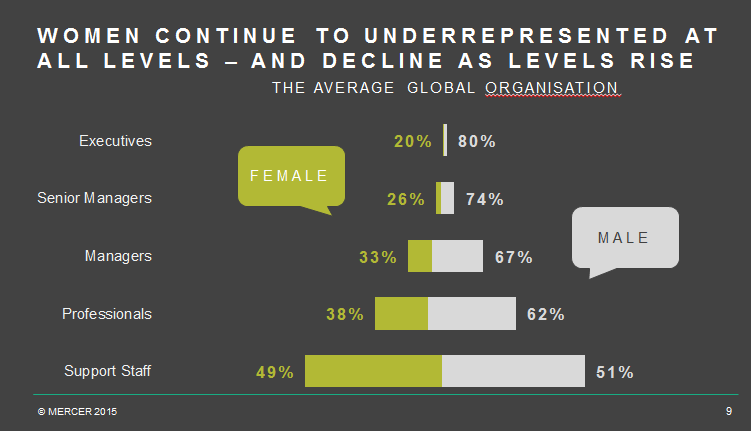
The number of women represented declines into the senior levels.
Source: Mercer When Women Thrive global report.

Women are under-represented in the workforce globally, and if organisations maintain the current rate of progress, female representation will only account for 40% of the professional and managerial ranks in 2025, according to Mercer’s second annual When Women Thrive global report.

Among the key trends revealed in the report is that women’s representation within organisations actually declines as career levels rise – from support staff through the executive level.

“The traditional methods of advancing women aren’t moving the needle, and under-representation of women around the world has become an economic and social travesty,” said Pat Milligan, Mercer’s Global Leader of When Women Thrive. “While leaders have been focusing on women at the top, they’re largely ignoring the female talent pipelines so critical to maintaining progress.

“This is a call-to-action - every organisation has a choice to stay with the status quo or drive their growth, communities and economies through the power of women.”

Mercer’s report finds that although women are 1.5 times more likely than men to be hired at the executive level, they are also leaving organisations from the highest rank at 1.3 times the rate of men, undermining gains at the top.

Asia performs the worst worldwide.
Source: Mercer When Women Thrive global report. Current and projected female representation in 2025 at 2015 attrition rates around the world.

According to the When Women Thrive report, women make up 40% of the average company’s workforce. Globally, they represent 33% of managers, 26% of senior managers, and 20% of executives. In terms of regional rankings, Australia and New Zealand is projected to move from 35% in 2015 to 40% in 2025; and Asia ranks last at 28%, up from just 25% in 2015.

“In 10 years, organisations won’t even be close to gender equality in most regions of the world,” said Milligan. “If CEOs want to drive their growth tomorrow through diversity, they need to take action today.”

The research – the most comprehensive of its kind featuring input from nearly 600 organisations around the world, employing 3.2 million people, including 1.3 million women – identifies a host of key drivers known to improve diversity and inclusion (D&I) efforts.

“It’s not enough to create a band-aid programme,” said Brian Levine, Mercer’s Innovation Leader, Global Workforce Analytics. “Most companies aren’t focused on the complete talent pipeline nor are they focused on the supporting practices and cultural change critical to ensure that women will be successful in their organisations.”

Only 9% of organisations surveyed globally offer women-focused retirement and savings programmes, despite Mercer’s research proving that such efforts lead to greater representation of women.

Other key findings:

Only 57% of organisations claim senior leaders are engaged in diversity and inclusion initiatives

Involvement of men has actually dropped since the first report in 2014, when 49% of organisations said they are engaged in D&I efforts

Just 29% of organisations review performance ratings by gender with Australia/New Zealand ranking first

Four in 10 organisations offer formal pay equity remediation processes, compared to 34% globally, and 25% in Asia. But virtually no improvements have been made since 2014

Nearly a third (28%) of women hold P&L (profit and loss) roles with Asia at No. 2 (27%), and Australia/New Zealand in third place (25%)

Women are perceived to have unique skills needed in today’s market including flexibility and adaptability (39% vs. 20% who say men have those strengths); inclusive team management (43% vs. 20%); and emotional intelligence (24% vs. 5%)

About half of organisations in three key regions – Asia, US/Canada and Latin America – agree that supporting women’s health is important to attract and retain women. Yet only 22% conduct analyses to identify gender-specific health needs in the workforce

In a series of separate studies Mercer has found that clients find that building their leadership pipeline is one of their biggest challenges, and included a lack of plans to develop women in their workforce for leadership as one of the problems in talent management strategies. 

Said Kate Bravery, Mercer’s Growth Markets Leadership & Organizational Performance Practice Leader: “To achieve long term success, a more strategic approach to nurturing the pipeline of leaders is required. This starts by translating core business objectives into a leadership strategy that defines the talent pool, competencies and the tactics required to build leaders from within. It continues with an execution plan that helps businesses identify, develop and accelerate the critical talent moves that will help them achieve real competitive advantage.”

Mercer’s Leadership Practices Study comprises a series of research reports based on surveys conducted from 2012 to 2014 that explore and compare current leadership trends in Asia Pacific, Latin America and the Middle East. Using data gathered from nearly 1,000 companies across the three growth market regions, these studies examine how companies approach leadership strategy, assessment, development and succession planning.found that companies in growth market regions are adopting effective practices for nurturing leadership talent, for example:

· Businesses in Asia-Pacific are investing heavily in training and developing senior level and global leaders at the top of their organisations.

· Firms in the Middle East are doing a good job of using global leadership capability models to help with talent development and creating opportunities for international assignments to which any employee can apply.

However, the studies also identified critical gaps in current planning that potentially limit organisations’ ability to produce the multi-skilled leaders required in modern, rapidly-growing businesses, as well as differences in the leadership competencies that are deemed critical for success by companies in each region.

Key findings included:

· Companies can do more to plan and prepare for the next generation of leaders – fewer than half of those companies responding conduct regular pipeline projections, very few have specific plans for developing key segments of their workforce (e.g. women or grooming local talent) and even fewer have metrics for tracking progress on pipeline management.

· Many businesses are not effectively identifying who is ready for the next move or position within their leadership pipeline – 15% of businesses in Asia Pacific and just 6% in the Middle East report that they have strong, “ready-now” successors in place for critical leadership roles.

· Companies are spending less annually per person on training and developing middle level and frontline leaders than they do on global or senior level leaders. Fewer than 20% of companies in the Middle East are spending US$5,000 or more per person each year to develop their youngest future leaders. In Asia-Pacific, under-investment is even starker, with just 5% of companies achieving this level of spending for individuals at the earliest stage of the pipeline – the next generation of leaders.

· Companies view a leader’s ability to ‘create strategy’ as one of the most critical competencies for leadership success – 64% of companies in Middle East and 36% in Asia Pacific prioritise strategic competencies above other operational, people or personal capabilities.

Highlights for Asia Pacific:

· While leadership development strategies are in place in many organisations, execution remains a significant problem as performance management processes are not effectively identifying who is ready for the next move or position within their leadership pipeline.

· Systems and processes for executing talent management processes are extremely inefficient, still relying on paper-based and email resources.

· Organisations are not focusing leadership development efforts on women as a segment, despite women making up a small percentage of senior management in organisations.

· Companies continue to rely on expatriates, rather than local talent, for top leadership roles, calling into question the effectiveness of leadership development and localization strategies.

· Investment in leadership development is concentrated on top-level leaders, organisations need to also reach deeper and earlier into their leadership pipelines to build talent from within.

· Leaders and managers are not being held accountable for grooming future leadership talent.

· People-related competencies are not among those seen as most critical by organisations for leadership success.

· There is a disconnect between the development methods rated most effective by respondents (“stretch” assignments) and those methods that are most widely used such as classroom training and individual development plans.

Highlights for Middle East

· Half of the companies have defined leadership development strategies in place, although this is more likely in larger organisations.

· Those organisations without a defined leadership development strategy are often reliant on buy/borrow talent strategies.

· The short-term focus of companies jeopardises their ability to build strong leadership pipelines.

· Organisations are missing some critical infrastructure to support leadership development.

· Many companies recognise the lack of attention paid by organisations and top executives to leadership development.

· Companies are relying on traditional methods such as classroom training to develop talent and leadership expertise and these are not proving to be effective in nurturing future leaders.

· Key talent pools are under-represented in leadership positions and often overlooked in talent development programmes, including local staff and women.

Interested?

Access the report summary for When Women Thrive

22 June 2015

Good people are still hard to find: ManpowerGroup

Source: ManpowerGroup infographic.

Globally, the top five talents that rarest are skilled trade positions (especially chefs, bakers, butchers, mechanics and electricians), sales representatives, engineers (mechanical, electrical and civil), technicians and drivers (particularly of heavy vehicles), says the US-based workforce expert ManpowerGroup.

In Singapore, the picture is quite different. With the exception of engineers which are also in the top five positions that are toughest to fill, the others are: accounting and finance talent, sales representatives, secretaries (including receptionists and administrative assistants), and marketing, public relations and communications specialists.

The findings are part of ManpowerGroup's annual Talent Shortage Survey (TSS), for which 41,700 hiring managers in 42 countries and territories were surveyed. Linda Teo, ManpowerGroup Singapore’s Country Manager says that of the 234 respondents in Singapore, 40% said that these are the positions hardest to fill. She attributed the shortage to “widespread restructuring that is sending tremors across sectors, with shocks being added from a tightening labour market”.

"At the same time, employers do not seem to show an urgency to put into place strategies not just to tackle the talent shortage but to stay ahead of the curve to find individuals to meet their business needs,” Teo said.

“Today, merely recruiting and placing candidates will not yield results. Employers need to encourage a learning culture among their employees and to get them to chart their own careers.”

Employers also need to explore untapped talent pools such as youth and older workers, and look to enhancing benefits, she said.

According to the TSS, key reasons for organisations’ difficulty in filling jobs include:
  • Lack of available applicants – 35%
  • Lack of technical competencies (hard skills) – 34%
  • Lack of experience – 22% 
  • Lack of workplace competencies (soft skills) – 17%, and 
  • Looking for more pay than is offered – 13% 
The most likely consequences of a talent shortage are a reduced ability to serve clients (42%) and reduced competitiveness and productivity (42%). In addition, 30% expect an increase in employee turnover and 26% anticipate lower employee engagement and morale.

In Asia Pacific, nearly half of all employers report talent shortages (48%). Apart from Japan, where 83% of employers are facing challenges, lack of talent is also a concern in Hong Kong (65%) and Taiwan (57%). However, talent inadequacies are least likely to be a concern for mainland Chinese employers (24%) given the country’s huge population.

Source: ManpowerGroup infographic.

On the flipside, a global career survey of employees released in April by Right Management, the global career experts within the ManpowerGroup, signal a disconnect between employee aspirations and the performance demands of employers worldwide.

The Global Career Aspiration Survey finds that only one in 10 of employees defines career success as high performance and productivity. Nearly half - 45% - of respondents rank work-life balance as their No.1 career aspiration, and the top definition of workplace success is "enjoyment and happiness".

Teo said: “Understanding employee career motivations and aspirations is key to creating a high performance culture that motivates individuals to do their best work. When people have ongoing career conversations with their managers, they experience effective career development and are more likely to be engaged, motivated and ready to take on new challenges.”

The Global Career Aspiration Survey was commissioned by Right Management in Q4 2014 to better understand career motivations and how perceptions are shifting in the workplace. The survey included results from 1,225 respondents in countries such as Canada, the US, Australia, India and Singapore.

Interested?