Malaysia PM Najib Razak has a vision of capital city Kuala Lumpur as "one of the leading capitals of the world, driving forward Malaysia’s national transformation" with the Bandar Malaysia project.
The biggest development site in Malaysia is envisioned to be a new city centre for Kuala Lumpur, hosting residences as well as businesses. "Rather than just office and residential towers, we want Bandar Malaysia to be a catalyst for fast-track economic development and employment, including the new KL Internet City – the key hub of the world’s first Digital Free Trade Zone. We want to create an iconic development to drive tourism. And we want to create a transport nucleus for Malaysia, with Bandar Malaysia set to host the Kuala Lumpur to Singapore high speed rail, MRT lines, KTM Komuter, Airport Express Rail Link and 12 highways," he said in a statement.
PM Najib announced the appointment of Tan Sri Dr Mohd Irwan Serigar Abdullah, Secretary General of Treasury, as the Chairman of both TRX City and Bandar Malaysia, and added that the Ministry of Finance will retain 100% ownership of Bandar Malaysia.
TRX City and Bandar Malaysia will begin a request for proposal (RFP) process, inviting expressions of interest for the role of master developer of Bandar Malaysia, PM Najib added. "The selection process for the master developer will involve very strict criteria, including a proven track record, speed of delivery, content creation, and the financial capability to deliver a project of this scale. The highest possible value will be sought to ensure that the best deal for the taxpayer is obtained," he said.
Showing posts with label planning. Show all posts
Showing posts with label planning. Show all posts
29 January 2016
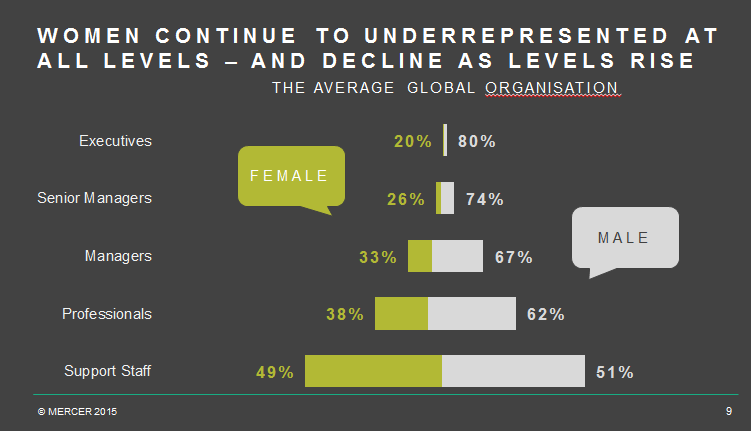
Mercer sounds alarm over under-representation of women in the workforce globally
 |
| Source: Mercer When Women Thrive global report. |
Women are under-represented in the workforce globally, and if organisations maintain the current rate of progress, female representation will only account for 40% of the professional and managerial ranks in 2025, according to Mercer’s second annual When Women Thrive global report.
Among the key trends revealed in the report is that women’s representation within organisations actually declines as career levels rise – from support staff through the executive level.
“The traditional methods of advancing women aren’t moving the needle, and under-representation of women around the world has become an economic and social travesty,” said Pat Milligan, Mercer’s Global Leader of When Women Thrive. “While leaders have been focusing on women at the top, they’re largely ignoring the female talent pipelines so critical to maintaining progress.
“This is a call-to-action - every organisation has a choice to stay with the status quo or drive their growth, communities and economies through the power of women.”
Mercer’s report finds that although women are 1.5 times more likely than men to be hired at the executive level, they are also leaving organisations from the highest rank at 1.3 times the rate of men, undermining gains at the top.
 |
| Source: Mercer When Women Thrive global report. Current and projected female representation in 2025 at 2015 attrition rates around the world. |
According to the When Women Thrive report, women make up 40% of the average company’s workforce. Globally, they represent 33% of managers, 26% of senior managers, and 20% of executives. In terms of regional rankings, Australia and New Zealand is projected to move from 35% in 2015 to 40% in 2025; and Asia ranks last at 28%, up from just 25% in 2015.
“In 10 years, organisations won’t even be close to gender equality in most regions of the world,” said Milligan. “If CEOs want to drive their growth tomorrow through diversity, they need to take action today.”
The research – the most comprehensive of its kind featuring input from nearly 600 organisations around the world, employing 3.2 million people, including 1.3 million women – identifies a host of key drivers known to improve diversity and inclusion (D&I) efforts.
“It’s not enough to create a band-aid programme,” said Brian Levine, Mercer’s Innovation Leader, Global Workforce Analytics. “Most companies aren’t focused on the complete talent pipeline nor are they focused on the supporting practices and cultural change critical to ensure that women will be successful in their organisations.”
Only 9% of organisations surveyed globally offer women-focused retirement and savings programmes, despite Mercer’s research proving that such efforts lead to greater representation of women.
Other key findings:
Only 57% of organisations claim senior leaders are engaged in diversity and inclusion initiatives
Involvement of men has actually dropped since the first report in 2014, when 49% of organisations said they are engaged in D&I efforts
Just 29% of organisations review performance ratings by gender with Australia/New Zealand ranking first
Four in 10 organisations offer formal pay equity remediation processes, compared to 34% globally, and 25% in Asia. But virtually no improvements have been made since 2014
Nearly a third (28%) of women hold P&L (profit and loss) roles with Asia at No. 2 (27%), and Australia/New Zealand in third place (25%)
Women are perceived to have unique skills needed in today’s market including flexibility and adaptability (39% vs. 20% who say men have those strengths); inclusive team management (43% vs. 20%); and emotional intelligence (24% vs. 5%)
About half of organisations in three key regions – Asia, US/Canada and Latin America – agree that supporting women’s health is important to attract and retain women. Yet only 22% conduct analyses to identify gender-specific health needs in the workforce
In a series of separate studies Mercer has found that clients find that building their leadership pipeline is one of their biggest challenges, and included a lack of plans to develop women in their workforce for leadership as one of the problems in talent management strategies.
Said Kate Bravery, Mercer’s Growth Markets Leadership & Organizational Performance Practice Leader: “To achieve long term success, a more strategic approach to nurturing the pipeline of leaders is required. This starts by translating core business objectives into a leadership strategy that defines the talent pool, competencies and the tactics required to build leaders from within. It continues with an execution plan that helps businesses identify, develop and accelerate the critical talent moves that will help them achieve real competitive advantage.”
Mercer’s Leadership Practices Study comprises a series of research reports based on surveys conducted from 2012 to 2014 that explore and compare current leadership trends in Asia Pacific, Latin America and the Middle East. Using data gathered from nearly 1,000 companies across the three growth market regions, these studies examine how companies approach leadership strategy, assessment, development and succession planning.found that companies in growth market regions are adopting effective practices for nurturing leadership talent, for example:
Mercer’s Leadership Practices Study comprises a series of research reports based on surveys conducted from 2012 to 2014 that explore and compare current leadership trends in Asia Pacific, Latin America and the Middle East. Using data gathered from nearly 1,000 companies across the three growth market regions, these studies examine how companies approach leadership strategy, assessment, development and succession planning.found that companies in growth market regions are adopting effective practices for nurturing leadership talent, for example:
· Businesses in Asia-Pacific are investing heavily in training and developing senior level and global leaders at the top of their organisations.
· Firms in the Middle East are doing a good job of using global leadership capability models to help with talent development and creating opportunities for international assignments to which any employee can apply.
However, the studies also identified critical gaps in current planning that potentially limit organisations’ ability to produce the multi-skilled leaders required in modern, rapidly-growing businesses, as well as differences in the leadership competencies that are deemed critical for success by companies in each region.
Key findings included:
· Companies can do more to plan and prepare for the next generation of leaders – fewer than half of those companies responding conduct regular pipeline projections, very few have specific plans for developing key segments of their workforce (e.g. women or grooming local talent) and even fewer have metrics for tracking progress on pipeline management.
· Many businesses are not effectively identifying who is ready for the next move or position within their leadership pipeline – 15% of businesses in Asia Pacific and just 6% in the Middle East report that they have strong, “ready-now” successors in place for critical leadership roles.
· Companies are spending less annually per person on training and developing middle level and frontline leaders than they do on global or senior level leaders. Fewer than 20% of companies in the Middle East are spending US$5,000 or more per person each year to develop their youngest future leaders. In Asia-Pacific, under-investment is even starker, with just 5% of companies achieving this level of spending for individuals at the earliest stage of the pipeline – the next generation of leaders.
· Companies view a leader’s ability to ‘create strategy’ as one of the most critical competencies for leadership success – 64% of companies in Middle East and 36% in Asia Pacific prioritise strategic competencies above other operational, people or personal capabilities.
Highlights for Asia Pacific:
· While leadership development strategies are in place in many organisations, execution remains a significant problem as performance management processes are not effectively identifying who is ready for the next move or position within their leadership pipeline.
· Systems and processes for executing talent management processes are extremely inefficient, still relying on paper-based and email resources.
· Organisations are not focusing leadership development efforts on women as a segment, despite women making up a small percentage of senior management in organisations.
· Companies continue to rely on expatriates, rather than local talent, for top leadership roles, calling into question the effectiveness of leadership development and localization strategies.
· Investment in leadership development is concentrated on top-level leaders, organisations need to also reach deeper and earlier into their leadership pipelines to build talent from within.
· Leaders and managers are not being held accountable for grooming future leadership talent.
· People-related competencies are not among those seen as most critical by organisations for leadership success.
· There is a disconnect between the development methods rated most effective by respondents (“stretch” assignments) and those methods that are most widely used such as classroom training and individual development plans.
Highlights for Middle East
· Half of the companies have defined leadership development strategies in place, although this is more likely in larger organisations.
· Those organisations without a defined leadership development strategy are often reliant on buy/borrow talent strategies.
· The short-term focus of companies jeopardises their ability to build strong leadership pipelines.
· Organisations are missing some critical infrastructure to support leadership development.
· Many companies recognise the lack of attention paid by organisations and top executives to leadership development.
· Companies are relying on traditional methods such as classroom training to develop talent and leadership expertise and these are not proving to be effective in nurturing future leaders.
· Key talent pools are under-represented in leadership positions and often overlooked in talent development programmes, including local staff and women.
Interested?
Access the report summary for When Women Thrive

28 January 2015
Singapore's family-run businesses the least prepared for succession
Family businesses in Singapore are the least prepared of five countries in Southeast Asia for what happens after the current business leader steps down or retires, according to a new report commissioned by the Labuan International Business and Financial Centre (IBFC), a mid-shore international business and finance centre serving the Asia Pacific region.
Just 58% of Singapore family businesses have prepared for succession, states the Building Legacies: Family Business Succession in Southeast Asia report* by the Economist Intelligence Unit. A further third (35%) have established formal wealth management structures such as private foundations while 41% maintain trusts for inter-generational wealth transfer, fewer than their peers in Indonesia, Malaysia, the Philippines and Thailand. |
| Source: Labuan IBFC. |
In contrast, Indonesian family-run businesses reported the largest share of companies with formal succession plans. The survey found that 78% of family businesses in Indonesia have formal succession plans, with 57% saying they have already established private foundations and 53% reporting that they have trusts to manage wealth and succession.

Plumberg highlighted the counterintuitive finding that business families in Singapore, a financial hub for the region, lag in their use of foundations, trusts and external advisors when it comes to succession issues, whereas family-run companies in Indonesia are leaders. "It is representative of the region’s diversity as well as its uneven progress in addressing questions about succession,” he said.
The report, based on a survey of 250 majority family-owned businesses from Indonesia, Malaysia, Singapore, Thailand and the Philippines states that 60% of all listed firms in Southeast Asia are family-run, making their success crucial to national economies. The report also found that customers and investors have more trust in a family-owned business with a succession plan than those without, with 71% of regional family business leaders acknowledging it is easier to attract investment with a succession plan in place.
Saiful Bahari Baharom, Chief Executive Officer of Labuan IBFC, said: “Family-run businesses account for more than 60% of all publicly-listed companies in ASEAN, making them an essential part of the region’s growth. Considering the significance of these businesses to the region, this research has shown that there is an over-reliance on informal structures such as family councils to manage succession issues, which are neither legally binding nor necessarily permanent structures.”
Research highlights include:
The full report is available online here.
*The report is based on a survey and interviews conducted in from July to August 2014. Survey respondents included 250 majority family-owned businesses from Indonesia, Malaysia, the Philippines, Singapore and Thailand. All respondents have senior managerial responsibility at a minimum, and 50% of respondents are board members or C-level executives. Slightly over half (54%) are first-generation businesses. Sixty-two percent of survey respondents are from companies with global annual revenues of US$150 million or less, and 11% make US$1 billion or more.
Saiful Bahari Baharom, Chief Executive Officer of Labuan IBFC, said: “Family-run businesses account for more than 60% of all publicly-listed companies in ASEAN, making them an essential part of the region’s growth. Considering the significance of these businesses to the region, this research has shown that there is an over-reliance on informal structures such as family councils to manage succession issues, which are neither legally binding nor necessarily permanent structures.”
Research highlights include:
- Two-thirds (67%) of respondents said they have a succession plan, while 71% of these two-thirds have had the plan reviewed by their boards.
- Two-thirds (65%) say the family is involved in long-term decisions about the company and 29% are involved in day-to-day operations.
- Ten percent of businesses have measures in place to allow family members to be excluded from management. Businesses in their third generation or later have usually instituted such a measure.
- More than half (55%) of all Southeast Asian business families use informal gatherings or family councils for business governance. "Retaining control is paramount," Plumberg explained.
- Indonesia leads the pack with 74% of respondents reporting that they have a family council, with Thailand a distant second with 56% of respondents reporting the same. Singapore was dead last with 40% of respondents saying that they have a family council.
The full report is available online here.
*The report is based on a survey and interviews conducted in from July to August 2014. Survey respondents included 250 majority family-owned businesses from Indonesia, Malaysia, the Philippines, Singapore and Thailand. All respondents have senior managerial responsibility at a minimum, and 50% of respondents are board members or C-level executives. Slightly over half (54%) are first-generation businesses. Sixty-two percent of survey respondents are from companies with global annual revenues of US$150 million or less, and 11% make US$1 billion or more.
Subscribe to:
Posts (Atom)