|
| Source: Mercer When Women Thrive global report. |
Women are under-represented in the workforce globally, and if organisations maintain the current rate of progress, female representation will only account for 40% of the professional and managerial ranks in 2025, according to
Mercer’s second annual
When Women Thrive global report.
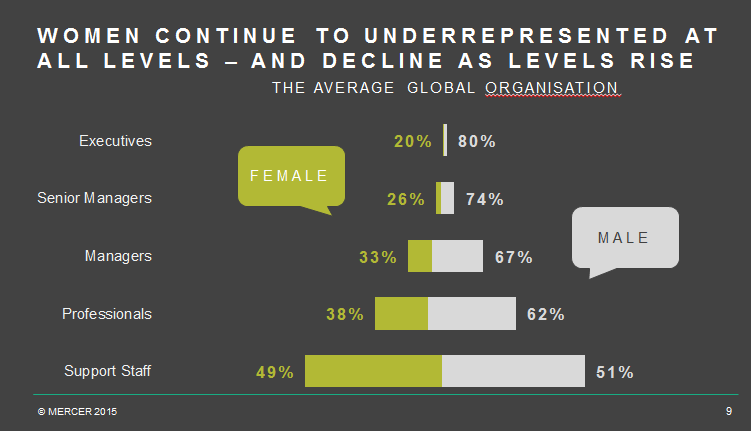
Among the key trends revealed in the report is that women’s representation within organisations actually declines as career levels rise – from support staff through the executive level.
“The traditional methods of advancing women aren’t moving the needle, and under-representation of women around the world has become an economic and social travesty,” said Pat Milligan, Mercer’s Global Leader of
When Women Thrive. “While leaders have been focusing on women at the top, they’re largely ignoring the female talent pipelines so critical to maintaining progress.
“This is a call-to-action - every organisation has a choice to stay with the status quo or drive their growth, communities and economies through the power of women.”
Mercer’s report finds that although women are 1.5 times more likely than men to be hired at the executive level, they are also leaving organisations from the highest rank at 1.3 times the rate of men, undermining gains at the top.
 |
| Source: Mercer When Women Thrive global report. Current and projected female representation in 2025 at 2015 attrition rates around the world. |
According to the
When Women Thrive report, women make up 40% of the average company’s workforce. Globally, they represent 33% of managers, 26% of senior managers, and 20% of executives. In terms of regional rankings, Australia and New Zealand is projected to move from 35% in 2015 to 40% in 2025; and Asia ranks last at 28%, up from just 25% in 2015.
“In 10 years, organisations won’t even be close to gender equality in most regions of the world,” said Milligan. “If CEOs want to drive their growth tomorrow through diversity, they need to take action today.”
The research – the most comprehensive of its kind featuring input from nearly 600 organisations around the world, employing 3.2 million people, including 1.3 million women – identifies a host of key drivers known to improve diversity and inclusion (D&I) efforts.
“It’s not enough to create a band-aid programme,” said Brian Levine, Mercer’s Innovation Leader, Global Workforce Analytics. “Most companies aren’t focused on the complete talent pipeline nor are they focused on the supporting practices and cultural change critical to ensure that women will be successful in their organisations.”
Only 9% of organisations surveyed globally offer women-focused retirement and savings programmes, despite Mercer’s research proving that such efforts lead to greater representation of women.
Other key findings:
Only 57% of organisations claim senior leaders are engaged in diversity and inclusion initiatives
Involvement of men has actually dropped since the first report in 2014, when 49% of organisations said they are engaged in D&I efforts
Just 29% of organisations review performance ratings by gender with Australia/New Zealand ranking first
Four in 10 organisations offer formal pay equity remediation processes, compared to 34% globally, and 25% in Asia. But virtually no improvements have been made since 2014
Nearly a third (28%) of women hold P&L (profit and loss) roles with Asia at No. 2 (27%), and Australia/New Zealand in third place (25%)
Women are perceived to have unique skills needed in today’s market including flexibility and adaptability (39% vs. 20% who say men have those strengths); inclusive team management (43% vs. 20%); and emotional intelligence (24% vs. 5%)
About half of organisations in three key regions – Asia, US/Canada and Latin America – agree that supporting women’s health is important to attract and retain women. Yet only 22% conduct analyses to identify gender-specific health needs in the workforce
In a series of separate studies Mercer has found that clients find that building their leadership pipeline is one of their biggest challenges, and included a lack of plans to develop women in their workforce for leadership as one of the problems in talent management strategies.
Said Kate Bravery, Mercer’s Growth Markets Leadership & Organizational Performance Practice Leader: “To achieve long term success, a more strategic approach to nurturing the pipeline of leaders is required. This starts by translating core business objectives into a leadership strategy that defines the talent pool, competencies and the tactics required to build leaders from within. It continues with an execution plan that helps businesses identify, develop and accelerate the critical talent moves that will help them achieve real competitive advantage.”
Mercer’s Leadership Practices Study comprises a series of research reports based on surveys conducted from 2012 to 2014 that explore and compare current leadership trends in Asia Pacific, Latin America and the Middle East. Using data gathered from nearly 1,000 companies across the three growth market regions, these studies examine how companies approach leadership strategy, assessment, development and succession planning.found that companies in growth market regions are adopting effective practices for nurturing leadership talent, for example:
· Businesses in Asia-Pacific are investing heavily in training and developing senior level and global leaders at the top of their organisations.
· Firms in the Middle East are doing a good job of using global leadership capability models to help with talent development and creating opportunities for international assignments to which any employee can apply.
However, the studies also identified critical gaps in current planning that potentially limit organisations’ ability to produce the multi-skilled leaders required in modern, rapidly-growing businesses, as well as differences in the leadership competencies that are deemed critical for success by companies in each region.
Key findings included:
· Companies can do more to plan and prepare for the next generation of leaders – fewer than half of those companies responding conduct regular pipeline projections, very few have specific plans for developing key segments of their workforce (e.g. women or grooming local talent) and even fewer have metrics for tracking progress on pipeline management.
· Many businesses are not effectively identifying who is ready for the next move or position within their leadership pipeline – 15% of businesses in Asia Pacific and just 6% in the Middle East report that they have strong, “ready-now” successors in place for critical leadership roles.
· Companies are spending less annually per person on training and developing middle level and frontline leaders than they do on global or senior level leaders. Fewer than 20% of companies in the Middle East are spending US$5,000 or more per person each year to develop their youngest future leaders. In Asia-Pacific, under-investment is even starker, with just 5% of companies achieving this level of spending for individuals at the earliest stage of the pipeline – the next generation of leaders.
· Companies view a leader’s ability to ‘create strategy’ as one of the most critical competencies for leadership success – 64% of companies in Middle East and 36% in Asia Pacific prioritise strategic competencies above other operational, people or personal capabilities.
Highlights for Asia Pacific:
· While leadership development strategies are in place in many organisations, execution remains a significant problem as performance management processes are not effectively identifying who is ready for the next move or position within their leadership pipeline.
· Systems and processes for executing talent management processes are extremely inefficient, still relying on paper-based and email resources.
· Organisations are not focusing leadership development efforts on women as a segment, despite women making up a small percentage of senior management in organisations.
· Companies continue to rely on expatriates, rather than local talent, for top leadership roles, calling into question the effectiveness of leadership development and localization strategies.
· Investment in leadership development is concentrated on top-level leaders, organisations need to also reach deeper and earlier into their leadership pipelines to build talent from within.
· Leaders and managers are not being held accountable for grooming future leadership talent.
· People-related competencies are not among those seen as most critical by organisations for leadership success.
· There is a disconnect between the development methods rated most effective by respondents (“stretch” assignments) and those methods that are most widely used such as classroom training and individual development plans.
Highlights for Middle East
· Half of the companies have defined leadership development strategies in place, although this is more likely in larger organisations.
· Those organisations without a defined leadership development strategy are often reliant on buy/borrow talent strategies.
· The short-term focus of companies jeopardises their ability to build strong leadership pipelines.
· Organisations are missing some critical infrastructure to support leadership development.
· Many companies recognise the lack of attention paid by organisations and top executives to leadership development.
· Companies are relying on traditional methods such as classroom training to develop talent and leadership expertise and these are not proving to be effective in nurturing future leaders.
· Key talent pools are under-represented in leadership positions and often overlooked in talent development programmes, including local staff and women.
Interested?
Access the report summary for
When Women Thrive