Showing posts with label review. Show all posts

13 December 2016

Yahoo releases 2016 Year in Review for Singapore

Yahoo, the guide to digital information discovery, has announced its 2016 Year in Review (YIR) for Singapore. The YIR is an annual recap of the top search trends, happenings and events which caught the imagination of Internet users in Singapore, based on users’ daily search habits and an editorial selection of what they read, recommended and shared most on Yahoo in 2016.

The list of Top 10 Singapore Headlines of the year is led by swim superstar Joseph Schooling and his clinching of Singapore’s first Olympic gold medal. Making the list are moments of political significance, such as the changes to the Elected Presidency, as well as the resignation of MP David Ong. The city-state also witnessed its first Zika outbreak, the first bank robbery in 12 years and the world’s first Michelin-starred hawkers stalls.

Viral stories included the Pen-Pineapple-Apple-Pen (PPAP) song in No. 1 place, Singapore Airlines’ photo fail with Joseph Schooling, which comes in at second, and incoming US first lady Melania Trump’s alleged plagiarism of current US first lady Michelle Obama’s rally speech.

Sports dominated the list of Most Popular Searches of 2016, with Euro 2016 and Rio 2016 Summer Olympics taking the spotlight. Also making the list were politicians such as Malaysian Prime Minster Najib Razak, who continued to battle scandal in relation to a state-run fund, and Prime Minister Lee Hsien Loong following his fainting spell during the National Day Rally. Gal Gadot, aka star of the upcoming Wonder Woman movie, also made the list of top searches, and is the only celebrity in the list.

Brexit tops the list of Top 10 Business News Headlines as it created shockwaves across international markets with the UK voting to leave the European Union. Locally, concerns were focused on retrenchment in Singapore, which made headlines several times this year. The worldwide trend of the rise of automation also made the top three, with Singapore becoming the world’s first country to run trials of on-demand driverless taxis.

Lists in the YIR include:

Top 10 Singapore Headlines of 2016
  1. Joseph Schooling and Singapore’s first Olympic gold medal
  2. Elected Presidency changes
  3. Singapore’s slowing economy
  4. Singapore’s Zika outbreak
  5. PM Lee Hsien Loong’s fainting spell and Minister Heng Swee Keat’s stroke
  6. MP David Ong’s resignation and the Bukit Batok by-election
  7. Former President SR Nathan’s death
  8. Standard Chartered bank robbery
  9. Death of two SMRT employees at work
  10. First Michelin-starred hawker
Top 10 Viral Stories of 2016

1. Pen-Pineapple-Apple-Pen song
2. Singapore Airlines photo fail with Joseph Schooling
3. Melania Trump’s speech similarities with Michelle Obama’s
4. Iguana being chased by snakes
5. Mannequin challenge
6. Olympic Games’ most unassuming medal winner
7. Shiny legs optical illusion
8. Killer clown craze
9. US  President-elect Donald Trump’s granddaughter Arabella Kushner recites Chinese poetry
10. High-rise SPCA kitten rescue


Top 10 Singapore Searches of 2016
  • Euro 2016 (football)
  • Rio 2016 (Olympics)
  • Najib Razak
  • Lee Hsien Loong
  • UEFA Champions League (football)
  • Lee Chong Wei (badminton player)
  • All England Badminton
  • Europe’s migrant crisis
  • Gal Gadot
  • Singapore Open (golf)
Top 10 Business News Headlines 2016
  • Brexit
  • Retrenchments in Singapore
  • Rise of automation
  • Samsung Galaxy Note 7 fiasco
  • Singapore bond defaults
  • Banks caught up in 1MDB scandal
  • Panama Papers
  • Finance Minister Heng Swee Keat’s health scare
  • SMRT’s privatisation
  • Chicken rice recipe’s $2 million price tag

*Results are not a representation of a popularity contest or voting; trends are determined by experts on the Yahoo editorial team. To develop the Yahoo Year in Review, editors analyse users' interest patterns on what they searched for, read, recommended and shared. It takes into account a number of factors including absolute volume and growth from previous periods to see which themes and trends bubble to the surface. Individuals and their preferences always remain anonymous. In addition, editors also exercise their editorial judgment to decide which topics had the greatest significance and public resonance in the year.

30 July 2016

IMF gives Singapore economy thumbs up

The Executive Board of the International Monetary Fund (IMF) has concluded its Article IV consultation* with Singapore for 2016, noting that the Singapore economy continues to perform well despite being impacted by a combination of cyclical and structural factors, originating both at home and abroad.

Growth moderated from 3.3% in 2014 to 2% in 2015. It was 2.2% in the first half of 2016. Unemployment has remained low, but net employment generation slowed rapidly in 2015 and headline inflation has stayed below zero since late 2014. In response, macroeconomic policies have become more accommodative, spearheaded by monetary policy easing and an expansionary budget. Financial sector and macroprudential policies have ensured financial stability. On the external front, lower global energy prices contributed to a higher current account surplus in 2015, though the surplus declined in the first quarter of 2016.

Growth is projected to moderate slightly to 1.7% in 2016, as the full impact of the global shocks experienced in 2015 is felt, and is expected to recover to 2.2% in 2017. Economic activity will be supported by accommodative policies, along with low energy prices and the ongoing global recovery. However, near-term risks are skewed to the downside, including from slow global and regional growth and spillovers from renewed global financial volatility. Headline and core inflation are benign, expected to be -0.3% and 0.8% in 2016, respectively, before rising to 1.1% and 1.4% in 2017 on gradually recovering energy and commodity prices. The current account surplus is expected to moderate over the medium term amid rapid population ageing and reforms to boost domestic demand, including through better health care, pensions, and other social insurance arrangements.

Structural policies continue to focus on moving toward an innovation-based economy that relies less on labor and more on productivity growth, especially in the non-traded sector. Policies focus on targeted support to businesses to promote automation, innovation, and internationalisation. The government is also raising investment in infrastructure and other long-term capital projects and rolling out policies to improve access to education and health care, particularly for the elderly.

Executive Directors observed** that Singapore’s highly open economy enjoys strong fundamentals and continues to perform well, and commended the authorities for their skillful management. Directors noted that Singapore’s strong external position and ample fiscal space allows the authorities to adjust policy settings in response to slower growth and external risks stemming from protracted lower growth in advanced and emerging economies and global financial market volatility. Directors considered the authorities’ expansionary fiscal policy stance and further easing of monetary policy in April as appropriate, in view of the weaker‑than‑expected inflation and growth developments. They agreed that the current accommodative fiscal stance is providing welcome support to activity and applauded the authorities’ willingness to act quickly in response to evolving conditions.

However, a number of Directors saw scope for additional fiscal stimulus to boost domestic demand, close the output gap, and provide insurance against elevated downside risks to growth. In this context, a number of Directors underscored that the current fiscal rule has served the country well for many years, while a number of others saw merit in considering aligning it to the business cycle. Turning to monetary policy, Directors considered that current policy settings are appropriate. They agreed that clear monetary communications are desirable, particularly to avoid short‑run instability. While some Directors considered that more frequent elaboration of inflation prospects would be beneficial, a number of other Directors recognised merits in the authorities’ current approach, which has served the country well and should be retained.

Directors observed that Singapore is at the mid‑point of a decade long restructuring to a knowledge‑based economy. They welcomed the authorities’ more targeted approach to supporting automation, innovation and productivity, while expanding social insurance and safety nets. Directors urged the authorities to increase spending on research and development (R&D), promote private sector R&D, and support new, creative firms. They looked forward to the unveiling of initiatives by the Committee on the Future Economy, which was set up to position Singapore for the future and identify areas of growth.

Directors observed that Singapore’s financial cycle has turned and that credit growth to residents has moderated. They noted that macro prudential policies in place made a decisive contribution to containing household indebtedness and should be retained. Directors considered that high levels of corporate debt warrant caution and close monitoring, although risks are mitigated by companies’ high debt‑servicing capacity.

Directors recognised Singapore’s high regulatory and supervisory standards in the financial sector. They noted that banks have remained profitable with low non‑performing loans and large capital and liquidity cushions as they adjust to changes in the direction of capital flows and lower oil prices. Directors welcomed that the regulation and supervision of banks is being further enhanced, and emphasised the need for banks to remain vigilant. They noted the authorities’ continued efforts to align the anti-money laundering and countering financing of terrorism (AML/CFT) framework with international standards, and welcomed recent steps to strengthen its enforcement.

Directors noted the finding that Singapore’s external position is substantially stronger than is consistent with macroeconomic fundamentals and desirable policies, while acknowledging that considerable uncertainty surrounds the assessment. The current account surplus increased further in 2015, as buoyant consumption only partly offset the narrowing of the oil trade deficit. Fiscal expansion should help reduce the external imbalance in the near term. Rapid population ageing and policies to boost domestic demand and enhance inclusion, including better health care, pensions, and other social insurance arrangements, should over time lead to a significant reduction in Singapore’s external imbalance.

*Under Article IV of the IMF's Articles of Agreement, the IMF holds bilateral discussions with members, usually every year. A staff team visits the country, collects economic and financial information, and discusses with officials the country's economic developments and policies. On return to headquarters, the staff prepares a report, which forms the basis for discussion by the Executive Board.

**At the conclusion of the discussion, the Managing Director, as Chairman of the Board, summarizes the views of Executive Directors, and this summary is transmitted to the country's authorities. Read the qualifiers used in summaries.

21 July 2016

UAE dealing well with lower oil prices: IMF

On July 20, 2016, the Executive Board of the International Monetary Fund (IMF) concluded the Article IV consultation* with the UAE.

According to the IMF persistently lower oil prices continue to weigh on economic sentiment and fiscal and external positions, but large buffers built over time have provided ample policy space, limited negative inward spillovers and contained the weakening of investor appetite.

Non-oil economic activity has slowed to 3.7% in 2015, driven by a contraction of public investment in the context of fiscal consolidation, and lower contribution from domestic private demand. Negative effects on overall growth were partially offset by the increase in oil production. Despite the strong fiscal policy response to adjust to lower oil prices, the fiscal balance turned to a deficit of 2.1% of GDP, while the current account surplus declined to 3.3% of GDP. Banks remained well-capitalised and liquid, though pressures on profitability are emerging as asset quality weakens due to the economic slowdown and rising funding costs.

The IMF expects economic activity to moderate further in 2016, before improving over the medium term. Non-hydrocarbon growth is projected to slow to 2.4 % in 2016 due to fiscal consolidation, the stronger dollar, and tighter monetary and financial conditions. Over the medium-term, non-hydrocarbon growth is forecast to increase to above 4% as the dampening effect of fiscal consolidation is offset by improvements in economic sentiment and financial conditions due to oil price rises, a pickup in private investment in the run-up to the Expo 2020, and stronger external demand.

Executive Board Assessment**

Executive Directors welcomed the United Arab Emirates’ resilience to the oil price shock. Directors commended the authorities for their prudent policies, which helped build large fiscal and external buffers and strengthened the economy. Nevertheless, persistent lower oil prices continue to pose challenges. Directors underscored the need for sustained sound macroeconomic policies to reduce fiscal vulnerabilities, safeguard financial stability, and promote long-term growth.

Directors welcomed the authorities’ commitment to pursue fiscal consolidation. For the near term, in light of the ample buffers, they generally considered a gradual adjustment effort to be appropriate in order to minimise the negative impact on growth. However, stronger fiscal consolidation will be needed over the medium term to ensure inter-generational equity.

Directors encouraged the authorities to diversify revenues and rationalise current spending, while further strengthening public financial management. They welcomed the plans to introduce a VAT and increase excise taxes, which could be followed by a corporate income tax. Directors also recommended phasing out remaining energy subsidies, while protecting the vulnerable. Priority should also be given to curb other current spending, while preserving public investment and enhancing its efficiency. Directors noted that developing a consolidated forward-looking medium-term fiscal framework would assist the authorities in setting direction for fiscal policy, and in aligning resource allocation with the UAE 2021 vision. They encouraged the authorities to strengthen the debt management framework to better account for contingent liabilities from government-related entities and public-private partnerships.

Directors noted that the dirham peg to the US dollar remains an appropriate anchor for price and financial stability. They supported continued efforts to enhance the monetary framework, particularly by improving liquidity management. Directors encouraged further steps to develop domestic debt markets and reduce private sector foreign exchange exposure. They also encouraged the authorities to tap into sovereign wealth funds and international capital markets to finance the deficit.

Directors welcomed the ongoing revision of the central bank and banking law and plans to strengthen banking regulation and supervision. They emphasised that the new law should further enhance central bank independence and governance, align the macroprudential institutional framework with best practices, upgrade banking sector regulation and supervision in line with global standards, strengthen safety nets, and improve the resolution framework. Directors encouraged the authorities to implement their plans to phase in the Basel III capital framework, enforce loan concentration limits, strengthen corporate governance, and move toward risk-based supervision. They supported ongoing efforts to strengthen the anti-money laundering and countering financing of terrorism (AML/CFT) framework and address de-risking.

Directors commended the efforts to further diversify the economy away from oil. They encouraged continued action to increase productivity and foster competitiveness. Efforts should continue to improve the business environment, ease restrictions on foreign direct investment (FDI) in the new investment law, and spur competition. In addition, priority should be given to upgrading the quality of education, promoting innovation and entrepreneurship, and facilitating SMEs’ and startups’ access to finance, notably through an approval of the bankruptcy law and further broadening the credit bureau’s coverage.

*Under Article IV of the IMF's Articles of Agreement, the IMF holds bilateral discussions with members, usually every year. A staff team visits the country, collects economic and financial information, and discusses with officials the country's economic developments and policies. On return to headquarters, the staff prepares a report, which forms the basis for discussion by the Executive Board.

**At the conclusion of the discussion, the Managing Director, as Chairman of the Board, summarizes the views of Executive Directors, and this summary is transmitted to the country's authorities. Read the qualifiers used in summaries.

16 July 2016

Japan Food Town offers exclusive dining experiences in Singapore

Japan Food Town banner in Wisma Atria. Just keep going up the escalators to the fourth floor.

Japan Food Town is set to offer authentic Japanese cuisine straight from Japan from 16 July 2016. The food hall, on the 4th level of Isetan Singapore (near Food Republic, basically above Starbucks) at Wisma Atria mall, is the first of a series of Japan Food Towns planned around the world.

  Look upwards to see the washi paper ceiling decor, which is meant to evoke steam rising from a hotpot.
Look upwards to see the washi paper ceiling decor,
which is meant to evoke steam rising 

from a cooking stove.

The 20,075 sq ft space seats roughly 628 guests at any one time. The interior was designed to bring out ‘ma’ (間), a modern Japanese sense of space. Japan Food Town flew in traditional Sakan (左官) craftsmen to create textures that mimic natural materials such as stone and copper from plaster. Prior to Japan Food Town, the Sakan craft could only be found in Japan. Kitchen tools such as plates and bowls arranged in between outlets add to the anticipation for the outstanding food served.

The health-conscious will be interested to learn that Japan Food Town has an official gourmet rice that is a healthier choice, in use by more than half of the tenants. Kinme Mai (金芽米) from the Toyo Rice Corporation has a smooth, creamy texture and a subtle fragrance that complements other foods very nicely.

A special polishing technique ensures that the rice retains most of the healthy components which are often stripped away by traditional techniques, such as fibre, vitamins and minerals. The gold rice germ (kinme) is retained. According to Toyo Rice, Kinme Mai contains roughly 10% fewer calories than an eequivalent amount of white rice. Restaurants offering Kinme Mai will have a sign prominently featured at their entrances.

Sushi table lady at the opening of Japan Food  Town.
Sushi table lady at the opening of Japan Food
Town.
A collaboration with Japan Association of Overseas Promotion for Food & Restaurants (JAOF) means that the outlets can also make use of seasonal produce and unique regional specialities, as well as the freshest ingredients brought in directly from Japan, daily, via the Logistics Hub in Okinawa, Japan.

All tenants are taking advantage of the logistics services, sometimes on a daily basis,  to import more than half of ingredients they require. Diners can thus enjoy Kinme Mai as well as Matsusaka beef (松阪牛), and Kindai (近畿) maguro (bluefin tuna) to Singapore. The bulk procurement slashes shipping expenses by roughly 50%, enabling Japan Food Town to keep its menus at an affordable range.

Japan Food Town features a nice selection of casual dining outlets offering quality Japanese cuisine at affordable prices. Each restaurant has been hand-picked based on its strong reputation and rich heritage, and is exclusive to the food hall. Almost all of the brands are new to Singapore. The tenants include:

Hokkaido Izakaya

Hokkaido island’s unique geographical location, in the north of Japan, means access to the best of both sea and land. Hokkaido Izakaya has been certified by the Hokkaido City Council to promote Hokkaido produce in Singapore.

According to the Japan National Tourist Organisation, Hokkaido's fresh fish and seafood offerings include crab, scallops, sea urchins, salmon roe, salmon, herring, flounder, cod, arabesque greenlings, squid, octopus, shrimp, abalone, surf clams and kelp that are considered among the best in their categories. The crab is particularly recommended when in season, while the  is exceptional. The uni (海胆, sea urchins) feed on the kelp, giving them a unique flavour. Hokkaido Izakaya sources seafood from Yakumo town, oysters from Akkeshi town, vegetables and cheeses from Furano city, and beef from Kamishihoro city.

Signboard, Hokkaido Izakaya.

An exquisite selection of Hokkaido specialties.

For the preview Hokkaido Izakaya served Wagyu (和牛) beef, scallop, salmon sushi wrapped in a leaf, salmon roe, a seashell, and vegetable puree with uni. The food styling was exquisite, and the food flavourful with a wide range of textures and flavours that complemented each other.

Hokkaido Izakaya has another outlet in Tanjong Pagar that opened in December 2015. It is part of the PJ Partners Group which also owns Salt Grill & Bar.

Inaniwa Yosuke

Inaniwa Yosuke is known as Sato Yosuke in Japan. Created in 1860, Sato Yosuke’s Inaniwa udon is an unchanging 150-year old handmade tradition from the town of Akita. The udon takes three days to make using water, salt and flour. Unlike the thick udon that we are used to, Inaniwa udon is an addictive silky, chewy ("Q") and slender noodle, more like a soba in appearance. Sato Yosuke’s original outlet is based in Chuo, Tokyo. This was one of my favourites.

Prepacked udon is available.
Chilled Inaniwa udon in a soy based broth. This is meant to be eaten with a touch of wasabi. They also had the udon a sesame broth for sampling.

Here's the menu:

The Inaniwa Yosuke udon menu.

Bonta Bonta

Entrance to Bonta Bonta.
Bonta Bonta’s onigiri (rice balls) are made with rice specially selected by a rice sommelier, and processed to the highest standards to qualify as Kinme Mai – low-calorie brown rice with high nutritional values. Though considered brown rice, the rice is actually white. The original shop is in Toshima, Tokyo.

For the media preview Bonta Bonta served chicken and eel on rice.

Yomoda Soba

The Yomoda Soba stand draws long queues daily in Tokyo. Favoured by locals and celebrities alike, Yomoda boasts fresh, quality soba made on-site. The hot spicy soy milk chicken soba (S$22) is recommended.

Yomoda Soba's diners eat al fresco style.

Part of the menu, soba, and a tempura ebi on top.
The al dente soba was unusual for me. A must-try experience.

The soba was al dente ("Q"), unlike the usual soba found in Singapore, and quite a pleasant experience. The tasting portion was complemented by a perfect tempura ebi (エビ, prawn).

This is the menu:

Menu, Yomoda Soba. Hot and cold varieties are available.
A page of the menu, Yomoda Soba. 
Rang Mang Shokudo

Tokyo’s Rang Mang Shokudo presents artisanal fried chicken (唐揚げ or 空揚げ or から揚げ, karaage) which has been marinated in buttermilk for six hours, then fried twice at low heat.

Facade, Rang Mang Shokudo.
An example of an actual set meal that would be served at Rang Mang Shokudo.


For the media preview there were two flavours on offer - ume (plum, on the left) and yuzu pepper karaage. Yuzu (ユズ, 柚子) is a type of citrus fruit. The chicken was very moist and juicy, with the sauce/topping adding an interesting twist to the finish.

These are parts of the menu:

Menu, Rang Mang Shokudo.
Partial menu, Rang Mang Shokudo.
Sushi Takewaka

Takewaka’s first shop started about 28 years ago in the famous Tsukiji, the biggest wholesale fish and seafood market in the world. Due to its close proximity to Tsukiji, Takewaka has managed to maintain many years of experience and relationships with fishermen and wholesalers there to pick the best-quality fish and seafood for Edo-style sushi (江戸前寿司)*. The sushi is prepared by Chef Sushi Takewaka, who comes from Tokyo, and the styling is to swoon for. Edo-style sushi is not necessarily raw nor eaten with soy sauce as is conventional sushi.

Try the kaisendon (海鮮丼, S$24.80), which features a mixture of fresh tuna, salmon, crab, tamago (玉子, egg), scallops and ikura (いくら, salmon roe).
Sample dish presentation, bento style.
Sample sashimi presentation.
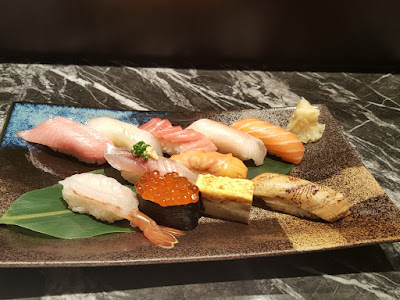
Sample Edo-style sushi selection.

Admittedly nothing to do with the food, but the way even the toothpicks are arranged shows the attention to detail that you can expect at this restaurant.

Sabar

Saba () is the Japanese name for mackerel. Sabar specialises in cuisine starring the fish, which is unusual even in Japan. Sabar at Japan Food Town is the first overseas venture for Sabaya, and its 11th Sabar restaurant, all of which specialise in mackerel as the main ingredient.

There is a lot of symbolism in their restaurant with the number 38 (三十八 which sounds like 'saba' in Chinese), from 38 seats to 38 items on the menu. Lunch is served from 11.38am to 2.38pm. Sabar mainly uses top-quality mackerel from Aomori, though Sabar itself originated from Osaka. Saba is often seen cured or grilled, not raw, but Sabar uses specially-cultivated mackerel which is perfect as sashimi. The premium Ojo (princess) mackerel farmed by the West Japan Railway Company in Tottori prefecture in Japan. Two pieces of Ojo saba sushi costs S$10, while the entire fish served as sashimi costs S$57.

Ojo (princess) saba. 

Saba sushi.
Saba sushi.

This is saba shirako (白子) - milt (sperm from the male mackerel). This Japanese delicacy was absolutely amazing. It looks like tofu and feels much smoother. Extremely creamy and rich.
This is saba shirako (白子) - milt (sperm from the male mackerel). This Japanese delicacy was absolutely amazing. It looks like tofu and feels much smoother. Extremely rich.
And the menu:

Sabar's menu.
Sabar's menu. 
Okada-san expertly skinned and deboned the Ojo mackerel.
Okada-san expertly skinned and deboned the Ojo mackerel in a demonstation of sugata tsukuri (姿造り). a style presenting the whole fish as sashimi, with the head and tail still in place and the sashimi slices in between.

Watch how Sabar Singapore MD Okada-san prepares a mackerel for sashimi sugata tsukuri style (Instagram video)

Tempura Tsukiji Tenka

This is the first restaurant the Tokyo Sushi Academy, Japan’s top traditional culinary academy, is opening in Singapore. It features tempura and donburi by Tokyo Sushi Academy graduates, exclusively for Japan Food Town. Tokyo Sushi Academy has a branch in Singapore which offers courses and team building activities.

Diners can sit at the counter to watch the chef preparing tendon.

The pleasures of eating crisp, light tempura.

The menu offers various tendon (天丼), or tempura placed over rice with a light sauce. The batter for tempura and the way it is fried makes or breaks tempura. I've only ever tasted light, thinly-battered, crunchy tempura at a food court in Oriental City in London, and at Azabu in Brisbane. And as of yesterday, at Japan Food Town.

This is part of the menu plus what a sample dish looks like:

Tenka's menu plus sample dish.

Shabu Shabu Tajimaya

Shabu Shabu Tajimaya is a spinoff from Gyuta, a humble eatery from Hyogo that’s operated on the motto of good quality food with reasonable price since 1997. Their buffet-style shabu shabu (しゃぶしゃぶ) and sukiyaki are very reasonably priced. They have all-you-can-eat 60-minute and 90-minute formats, as well as one more traditional sets with a fixed amount of meat.

Facade, Shabu Shabu Tajimaya.

Just look at the marbling on the beef! It was gone in seconds.
Just look at the marbling on the beef!

  Twin broths on an induction cooker, with the beef cooking in it.
Twin broths on an induction cooker, with the beef cooking in it.

The 'grade 5' beef I tried was absolutely to die for (grade 5 beef is the highest quality possible for Wagyu beef). Boiled in water, the paper-thin meat cooked quickly and literally melted in the mouth in a burst of flavour,  We were provided with a ponzu style sauce as a dip which went very well with the beef.

Here're the parts of the menu about the 90-minute meals:

Shabu shabu selections.
Sukiyaki, anyone? 90 minutes' worth.
Sukiyaki, anyone?
Osaka Kitchen

Osaka Kitchen brings teppanyaki using Wagyu beef and okonomiyaki right in front of diners. Yakisoba is also available.

Several restaurants are yet to open. Nabe Seizan, for example, will only be open 17 July. The original Seizan restaurant in Japan is a two-Michelin starred kaiseki (an exquisite multiple-course banquet) restaurant currently helmed by the Tokyo-born chef Haruhiko Yamamoto. Chef Yamamoto strives to bring out the true flavour of each ingredient rather than rely solely on sauces. Nabe Seizan will offer nabe (鍋物, なべ物) cuisine, 'one-pot' dishes. Seizan’s original outlet is located in Mita, Minato in Tokyo.

Yakiniku Heijyoen will be open in August. Yakiniku Heijyoen takes top quality black hair wagyu from all over Japan, then ages it for tenderness and to bring out a deeper concentration of beef taste and flavour. Yakiniku Heijyoen goes by the name Heijyoen in Japan. Its main outlet is in Tokyo, Japan.

Japan Food Town is a joint venture established by Cool Japan Fund, a public-private fund, in collaboration with the JAOF and its corporate supporters at an investment of about S$8.5 million. Makoto Yoshikawa, Managing Director of Japan Food Town Development and Board Member of JAOF, called Japan Food Town a "multi-sensorial expression of the country’s culture and culinary gems brought together under one roof".

In a statement Yoshikawa explained that many Japanese early-stage companies and small and medium-sized enterprises (SMEs) have found it difficult to expand their businesses overseas in countries such as Singapore because of challenges such as ingredient procurement, staffing and lack of the appropriate space. "Through this project, the selected restaurants will be able to clear the toughest hurdles of overseas development and focus on offering consumers in Singapore with the same high level of service and food quality one would expect in Japan,” he said.

“I believe that through offering Singapore a truly authentic Japanese dining experience without those exorbitant prices, customers will appreciate a real sense of Japanese hospitality. We call this Omotenashi (おもてなし), where you will be warmly welcomed and respected,” he said.

Interested?

Japan Food Town is at 435 Orchard Rd, #04-39/54 Wisma Atria Shopping Centre, Singapore 238877
Hours: 11am to 11pm every day
Prices: Starting from S$10
Seating capacity: 628

Learn how to cook Kinmei Mai

Opening celebrations

The opening celebrations on 16 July, to be held at Isetan Wisma Atria Level 2 (street level facing Orchard Road) from 12pm to 6pm, include Japanese cultural performances and free giveaways.

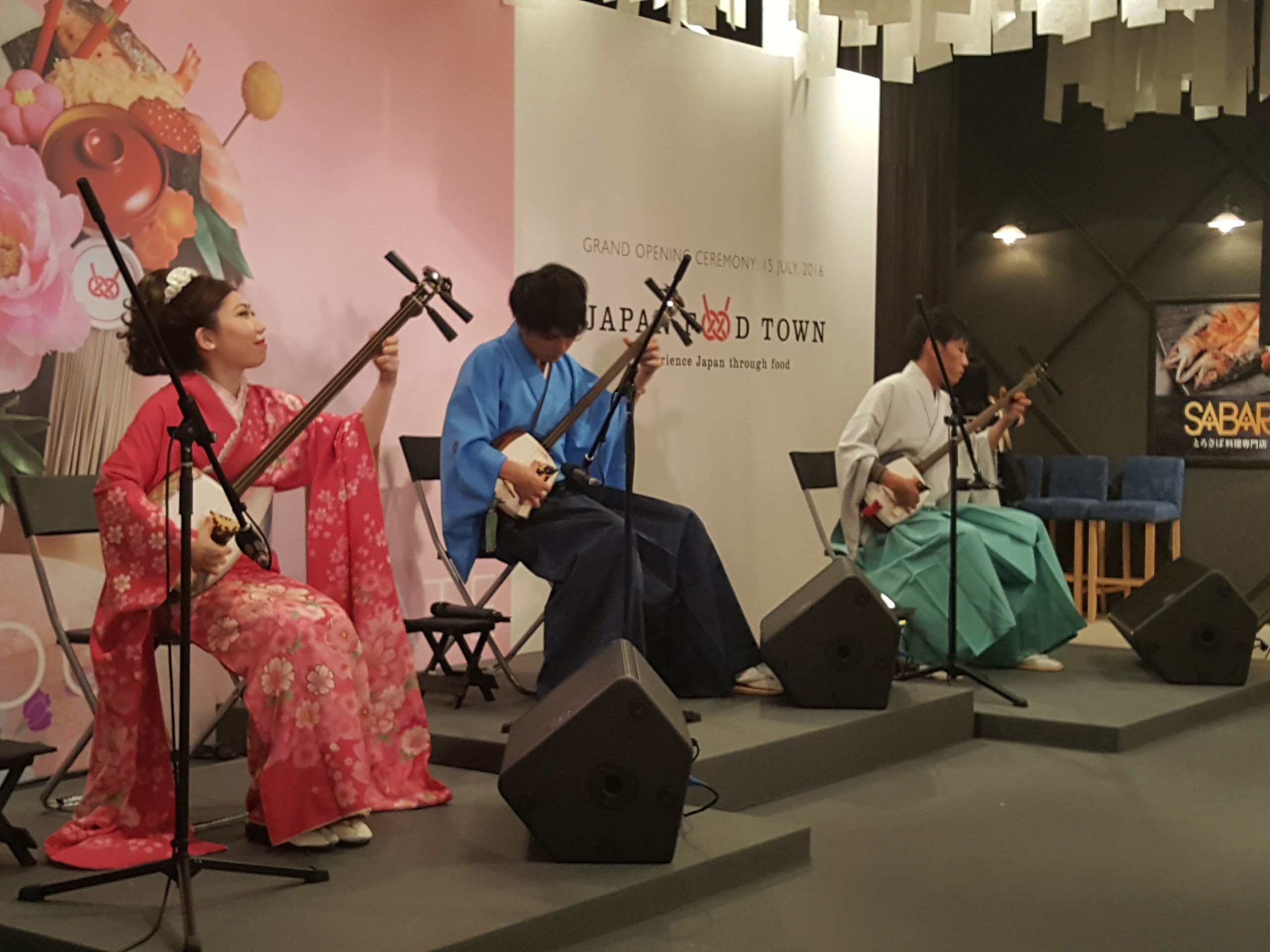
Hayate performed twice during the media preview.

Look for a performance by Hayate, a ten-member shamisen band created by the popular Yoshida Brothers (吉田兄弟), whose first album saw 100,000 copies sold. Hayate aims to create a completely new genre of shamisen music, pushing the limits of the shamisen to the max with rapid, complex yet completely synchronised rhythms that almost appear improvised. Two of the three players at the media preview shared that they had been playing the shamisen for 15 years.

There will also be Taiko drums and a live demonstration of Japanese calligraphy from celebrity calligrapher Tomomi Kunishige (國重友美), who invented the idea of eikanji (英漢字) - kanji composed of strokes that also spell the English word of the same meaning. Kunishige will also be launching her first private exhibition in Singapore.

Watch a snippet of Hayate's spirited performance at the media preview (Instagram video)

*The Sushi Encylopedia explains the history of Edo-style sushi


posted from Bloggeroid

10 December 2015

Facebook lists what captured the world's attention in 2015

Source: Facebook.

Facebook's Year in Review for 2015 has been launched with a dedicated website at yearinreview.fb.com, together with an accompanying video.

The company has identified the US presidential election as the most-discussed topic globally, followed by the November 13 attacks in Paris, the Syrian civil war and refugee crisis, the Nepal earthquakes and the Greek debt crisis.

Game of Thrones was the most interesting TV series, while Star Wars: The Force Awakens is the movie that has captured the most global attention.

Floyd Mayweather, Jr. and Manny Pacquiao were the most talked-about athletes of the year following their highly watched fight in May.

Clash of Kings, a new RTS RPG multiplayer war game developed by ELEX, is Facebook's Game of the Year on both web and mobile with more than 70 million players worldwide.

Facebook: 2015 Year in Review Lists

Topics (Global)
US presidential election
November 13 attacks in Paris
Syrian civil war & Refugee Crisis
Nepal earthquakes
Greek debt crisis
Marriage equality
Fight against ISIS
Charlie Hebdo attack
Baltimore protests
Charleston shooting & flag Debate

India's top topics for 2015.

Australia's top places reflect the popularity of various tourist spots, particularly zoos, which offer more picture-sharing opportunities. Sydney and Melbourne dominate.

Places (Singapore)
Universal Studios Singapore
Gardens by the Bay
Marina Bay Sands
Singapore Botanic Gardens
Marina Bay Singapore
Sentosa Island
Resorts World at Sentosa
Singapore Zoo
Trick Eye Museum Singapore
SEA Aquarium, Marine Life Park

Source: Siam Paragon Development Company. Update 23 December: Mrs Chadatip Chutrakul, CEO of Siam Paragon Development Company said, "This year marks the decade of Siam Paragon's operations. Throughout the past years, Siam Paragon has proved itself to be a project that exudes elegance with high standards and elevates Bangkok to the status of a world-class shopping destination. Siam Paragon has welcomed local shoppers and foreign tourists with no fewer than 250,000 visitors a day. As a result of the fact that Facebook gave the 6th ranking to Siam Paragon as the world's most talked about places and being the only one destination in Asia making the top 10 rankings in 2015; we thank all of you for taking part in Siam Paragon's formidable achievement."

A handful of Asian venues made it to the Top 20 Global Places in Facebook. The Top 20 Global Places and all country-specific Places lists are based on the number of Facebook check-ins at these locations over the course of 2015. Siam Paragon was in 6th place while Gardens By The Bay and Marina Bay Sands and are in the 13th and 14th position respectively.

Entertainers (Global)
Ed Sheeran
Taylor Swift
Kanye West
Nicky Jam
Wiz Khalifa
Drake
Pitbull
Caitlyn Jenner
The Weeknd
Shakira

TV Shows (Global)
Game of Thrones (GoT)
The Walking Dead
The Daily Show
Saturday Night Live
WWE Raw
The Simpsons
19 Kids and Counting
Grey’s Anatomy
Last Week Tonight with John Oliver
Orange is the New Black (OITNB)


Movies (Global)
Star Wars: The Force Awakens
Furious 7
Jurassic World
Avengers: Age of Ultron
American Sniper
Straight Outta Compton
Fifty Shades of Grey
Mad Max: Fury Road
Magic Mike XXL
Pitch Perfect 2 


Athletes (Global)
Floyd Mayweather, Jr.
Manny Pacquiao
Ronda Rousey
Lionel Messi
Cristiano Ronaldo
Tom Brady
Stephen Curry
LeBron James
Serena Williams
Carlos Tevez

New Games (Global)
FIFA 15
Fallout Shelter & Fallout 4
Call of Duty: Black Ops 3
Mortal Kombat X
Batman: Arkham Knight
The Witcher 3: Wild Hunt
Metal Gear Solid V: The Phantom Pain
Dying Light
Star Wars: Battlefront
Halo 5: Guardians 


Interested?

Explore the Year in Review. The Year in Review video captured some special moments in Singapore, which includes Singapore’s 50th birthday and remembering elder statesman Lee Kuan Yew.  
See the Top 20 Places

Editor's note: It should be noted that country lists, offered in local languages, cannot be compared to the English lists. Country lists reflecting what local language speakers think, limiting perspectives to people most likely living in the country, whereas the lists in English could reflect what English speakers around the world think. The list for Taiwan, for example, is in traditional Chinese, which is only used in Taiwan, Hong Kong and Macau.

*Methodology

All Year in Review lists (except for New Sticker Packs and Places) were measured by how frequently a topic was mentioned in Facebook posts made between January 1 and December 1, 2015. To put these lists together, Facebook posts were analysed in an aggregated, anonymised way, and then ranked to create a snapshot of the year on Facebook.
To determine the Top New Sticker Packs, Facebook looked at all sticker packs that launched in 2015 and ranked them by most sticker sends per day averaged across the year. Sticker Pack lists were not included in this blog post.

1 June 2015

Migrating from the Samsung Galaxy S4 to the S6

I just bought a Samsung Galaxy S6 from Singtel as part of contract renewal. I had hoped to hold out till prices fell a bit but I learned about Smart Switch and it sounded great, sooo.. yeah. I have a new phone. I had liked the silver handset on the try-out counter, but apparently that's gold, not silver. I decided to go with black - traditional and no problems with colour recognition.

Warranty registration woes

Next thing up, registering the warranty online. This did not work. The Samsung website kept saying I had an incorrect serial number. This is a common situation for me, but still frustrating. There are only 2 numbers on the bar code sticker that Singtel provided. The IMEI as listed on the receipt, and one other number. Neither number works. So I was going to mail the warranty card, but the card is missing the dealer’s company stamp. I had to go back to the Singtel shop later to get that – more about that later.

MobileSwop or not?

Then I decided not to bring the phone anywhere till I had at least a bumper. Singtel has this offer where you pay a nominal amount a month as insurance. The MobileSwop service is only available to subscribers of getting a new line, or recontracting. It's available 24 hours; if you decide you want to swop your phone (cheaper) or replace it, there are no questions asked. Swops cost S$86 to S$181 depending on the original price of the phone, while replacements cost S$214 to S$532. Depending on the time of the request, you could get the new phone within four hours. The terms of the service are that a subscriber can make two swops or one replacement within 12 months of the delivery date of the last service request; there is an extra charge of S$85.60 per trip for trips on Sundays though. The guys at Singtel said people who subscribe take it up for a maximum of six months as the value of the phone depreciates thereafter. I thought it was a clever offer but said no. 

I shattered the screen of my iPhone 5, even with the bumper on, about three months in, two years ago – before they had this offer. I’ve since seen many people living with cracked screens because it costs so much to replace one. The thing is, my Samsung Galaxy S4 has lasted me roughly two years, and I have dropped it several times. So I might just have been really unlucky with the iPhone, and really lucky with the Galaxy, but to my mind the Samsung Galaxy phones are hardier and I probably wouldn’t need the  insurance. But I would need some protection.


Bumper shopping woes

There are several stores along the same corridor at Jurong Point which sell phone cases: Challenger, Gadget World, and Digital Style among them. The Samsung store is at one corner with the Singtel shop opposite it. I went to each one and there just aren’t many S6 covers on sale compared to the iPhone 6 and iPhone 6S. Admittedly the S6 is much newer but I had hoped for much more variety for cases. There were very few pink ones, and I settled on a Spigen in mint (it’s almost S$20 cheaper at Gadget World compared to the Samsung store, by the way). It's quite pretty, with a non-slip texture and feels solid enough to protect the phone, it's just that it's not pink. The nice cashier actually offered to put on the casing for me when I asked how it is used, but I didn’t have the phone with me.

Migrating takes time

Now I remember moving from the iPhone 4 to the iPhone 5 very fondly. When I keyed in my Apple ID, the brand new iPhone 5 simply asked me if I wanted to restore everything from my most recent backup, and that was it. I got my apps, my WhatsApp chats, and everything else off iTunes. I don’t recall how I migrated from the iPhone 5 to the Galaxy S4, but however difficult it was, I discovered how much better it is to swipe your finger along the keyboard instead of typing, and nothing on iOS mattered any more.

So when I saw that Samsung has an app called Smart Switch, I thought it would be the same type of migration. Smart Switch is a wonderful app. You download it on your old phone and on your new phone; choose a list of what you would like to migrate, then press ‘send’ on the old phone, and ‘receive’ on the new phone. Everything you select ends up on the new phone without a hitch. I got my contacts, all 27* of them, my SMS history, calendar, even my alarms, all activated exactly as before. 

The problem is that the apps don’t come over as well. Smart Switch will tell you which ones to download, which is very helpful, but you still need to download and configure each one before your new phone starts looking familiar again. This is assuming you were up to date with apps on your old phone; if you were not, then the updated app on the new phone can still look quite alien.

What, WhatsApp?

Of course I had been expecting all my WhatsApp conversations from the old phone to miraculously appear on the new phone. This did not happen. You start off with a blank slate, plus membership in any of the groups you were in before. According to helpful advice online, you’re supposed to back up the conversations onto your SD card and then insert the SD card in the new phone before you activate WhatsApp. WhatsApp will notice you have this backup and ask if you would like to restore, and voila! 

Of course I didn’t do this before I activated WhatsApp, and the S6 doesn’t have SD card capability. I believe there was a workaround for this, but once you have transferred your SIM card from the old phone to the new phone, you can’t use WhatsApp on the old phone – WhatsApp only allows one device to be used at a time. I can try telling WhatsApp that the old phone is actually where my WhatsApp life resides.. and then email backups to myself.. but at the moment I’m just making do without a WhatsApp history.

Deleting from Dropbox

Another shock was Dropbox. I had received 48 GB of extra space for two years as a Galaxy Gift when I got the S4. I had naively assumed that the subscription would continue if I continued with a new Samsung phone. It doesn’t. This means I have to make sure that my present Dropbox setup – which worked like clockwork, backing up the pictures taken on the S4 to Dropbox and making them available on my laptop – will still work even when that 48 GB expires, and that I find a new home for any extra files as soon as possible. To be fair, I subsequently discovered that Samsung has arranged a new Galaxy Gift with the S6, this time with Microsoft’s OneDrive – 100 GB for the next two years – but it is still a pain to move from one cloud storage service to another, and of course Google Photos has been launched and it’s unlimited storage for free. Dropbox, incidentally, starts reminding you of the expiry about two months before so that you have ample time to decide what to do. It also generously gives you 3 GB free - which happens to be about 1 GB more than my total usage for the moment.

Stymied by photo backups

When I then downloaded and installed Dropbox on the S6, it asked me if it should back up all photos. I couldn’t say yes. Remember, I had used Smart Switch to transfer all my pictures on the S4, over 3,000 of them, over to the S6. This meant that backing up the S6 pictures to Dropbox would in effect create a second copy of the S4 backup on Dropbox, plus any new pictures taken with the S6, of course. I could have done that and then deleted the files.. but decided to leave things alone, and send the pictures to OneDrive instead. I feel like I’m littering my way through the Internet with the same copies of pictures I might not want, but better safely stored than not at all.

An odd question

And then in the midst of the migration, Singtel sent me an odd SMS that it wanted me to reply 'yes' or 'no' to. Just like when banks verify that you made a big withdrawal or credit card purchase, Singtel wanted to check if I had actually purchased a Galaxy S6. One that I had gone personally to the Singtel shop to buy, and shown my ID to get since it was tied to a contract renewal. Maybe they think there are a lot of people wandering around impersonating others? Someone from Singtel did get in touch on Twitter to say that no offence is meant, but I wasn't offended, just disquieted at what possible motivations that can be for such a text message.

SIMplicity, not

So after downloading my previous apps, I finally decided to switch SIMs. I’m used to the sales guys at the shop doing it for me, but this time the ones at the Singtel shop didn’t (OK, I admit I was the last customer of the evening and they were probably tired). They showed me where my SIM was on the old phone and the pin that you use to get the SIM drawer open on the new phone, and sent me home to figure it out by myself. It was not easy. 

There are no instructions printed on the SIM holder on the S4 on what you should do. I didn’t know how to get the SIM card** out of the Galaxy S4. I tried scraping it out, looking for a lever to lift the holder up, and sticking the pin at this pin-sized hole on the SIM card holder (there is a hole there that's the right size..). It took a long while before I decided to try pushing the SIM card in to see if that would make it pop out. 

There are no instructions on the S6, either. You have to push the pin in quite a way and I was wondering the whole time if I was going to break something. When the drawer pops out, it doesn’t come out all the way, and I wasn’t sure at first which way to put in the SIM card. It was only after I’d realised that the entire drawer can be removed that I saw the (very small) outline of the card printed on the drawer, with the notch to one side to guide me.

Why, Wi-Fi??

So now that I have the SIM finally in the S6, the challenges continue. My Singtel Wi-Fi and my Wireless@SGx EAP-SIM connections don’t work. Wireless&SG does connect automatically, but the connectivity doesn't work out for me. When I went back to the Singtel shop to get my warranty card stamped (very quick, I didn’t even have to get a number to join a queue), I asked about the Wi-Fi. The nice Singtel service staff saw how Singtel Wi-Fi would refuse to connect properly. It would appear connected, and then cycle through and try to connect, over and over. He set the configuration manually, and then admitted defeat. I’m to call the customer service hotline at 1688 to ask them about that, because he says it’s not the phone at fault.

I’ve also been tweeting my challenges with trying to get EAP-SIM to work. The instructions are on a PDF that happily downloads each time I refer to the Singtel website. I must have downloaded this file six, seven times by now. The phone never asks me if I want to retrieve the existing file to read it, but does give me the option to replace the one I have already downloaded. There doesn’t seem to be any other way to read it, which is fine on Wi-Fi but not so fine when you have a mobile data limit and your Singtel Wi-Fi doesn’t seem usable (unlimited downloads till July 2015! FWIW when you can’t even get on it). 

Singtel has been very responsive on social media, asking if they can help – considering I didn’t hashtag them or mention them – so I have taken some screenshots to show how my screen doesn’t look anything like their screen and shared those. I've never actually had any follow-up beyond that initial question though.

Pros & cons

Having said that there are many things to love about the S6.
  • Longer battery life. The S6 probably has much fewer apps on it taking up processing power than the S4, but it lasts waaay longer. Batteries do run down more quickly over time too, of course. I actually watched Google's I/O Developer Conference 2015 through a livestream, which was approximately 2 hours worth of video. The battery life percentage went from 100% to 54% during that time.
  • It’s faster, probably for the same reasons. It’s also got more space, seeing as I got the 64GB version and no longer get complaints that apps can’t be updated because there is no space so possibly there is less juggling of memory space.
  • Faster network. I see a little 4G+ icon on the phone sometimes. It seems faster. 4G was already really fast compared to my home broadband with StarHub, which is still at the lowest speed possible (plus it’s a really old cable modem).  
  • The promise of Singtel Wi-Fi. I really like the idea of bundled Wi-Fi. I hope that I actually get to make use of this.
  • Better camera. I don’t take pictures at maximum resolution as I don’t need to print anything, but my snaps look lovely – nice colours, crisp edges and all.
  • Pink theme. I couldn’t get a pink case but Samsung has a cute pink theme, with cartoonish icons and hearts. It’s a big departure from the sleek organic lines that are used in the marketing campaign, but it’s pink so I’m using that for now. I also have a pink theme for SwiftKey – roses appear when I type.
  • Galaxy Gifts. There were a bunch of interesting offers but most of them are for free trials for a few months each, so I didn’t bother to download them. They’re worth quite a bit in total though. I’ve already mentioned the OneDrive offer, and I downloaded Kindle for Samsung as you get a free e-book every month, plus the privilege of buying the other e-books on offer at discounts. There were four e-books to choose from, but none appealed to me.
  • S Health. I didn’t use it on the S4 but later learned that phone apps are often just as accurate as health bands, so I’ve switched it on and it’s interesting to see how many steps I take from day to day.
  • Muting the phone by turning it face down. This feature may actually have been available for some time, but I never thought about using it till now.
  • Swiping the palm across the screen to do a screen capture. Again, this might be an old feature, but has only been activated now because screen captures using the power and the home button didn’t always work well on the S4. It seems to be much more reliable using the buttons on the S6 though, so I haven’t bothered to do a screen capture with the palm-swipe feature.


There are also a few things I dislike.
  • The lock screen has the numbers for the PIN squished into the bottom third of the screen. I haven’t seen any way to make them bigger. The screen also blacks out very quickly, which is a bit disconcerting.
  • The bottom left button, which often used to bring up the menu for the app, now displays a stack of which apps are currently open, with an option to close them all. I don’t really care which ones are open as I would just tap on the app’s icon to bring it up, and now I have to look for the app menu elsewhere. There is no consistency on where you might stash that.
  • It’s a bit wider than I would like. The screen is larger overall which is nice, but it was difficult to use the S4 with one hand before, and impossible with the S6. There is a one-handed mode that can be switched on through Settings, but I haven’t found it yet. It’s not under Display or under Motions & Gestures.
  • It’s heavier. Not appreciably so, but there is a noticeable difference between the S4 and S6 that I am still getting used to.


The list of likes are way longer and more about productivity enhancement than the dislikes, which will probably just need getting used to. So all in all, I still like the Samsung Galaxy series and consider the S6 a definite step up. I am open to using other Android phones and admit that some of the features for other brands have been extremely tempting. So who knows what my next phone will be?

*How did I get through life with only 27 contacts? I didn’t have a choice. I had very little space left on the primary memory, which was probably why the Galaxy S4 hiccupped one day, switched itself off, and when it came back on again, I didn’t have an address book any more. I hadn’t been able to back up my contacts for a long time because an Android update had limited what could be saved onto the SD card, including backups. It wouldn’t allow restoring from the stored backups, either. I did try importing from an old backup on Gmail, but I don’t think Gmail ever synced with the phone. I was very thankful I had a list of some 500 WhatsApp contacts and/or conversations, from which I could reassemble my life.

**There will be people who point out that the SIM sizes are incompatible. The Galaxy S4 uses a larger SIM card than the Galaxy S6. Remember I mentioned my iPhone 5? I’d been using the SIM card in the S4 with an adapter, so I already have a SIM card of the right size. So there.