Showing posts with label PwC. Show all posts

18 October 2022

PwC: Cambodia is ripe for foreign investment

Source: PwC. Aerial view of Phnom Penh.

A new outlook study titled Cambodia’s Infrastructure Market Update and Outlook, jointly produced by PwC Singapore and PwC Cambodia, highlights that Cambodia is poised for growth and remains attractive for foreign investment despite global economic headwinds.

The report aims to provide investors and financiers with insights into the potential for infrastructure investments in Cambodia, focusing on the latest market developments in key infrastructure subsectors. The report also highlights issues around connectivity between its economic nodes, integration with ASEAN and global transportation and economic networks – in ports, logistics, transportation and construction sectors – and outlines the potential pipeline for the players in these subsectors.

The Council for Development of Cambodia has identified six priority development sectors as drivers for future growth:

- Agrifood

- Automotive

- Electronics

- Textile and apparel

- Bike and parts

- Furniture and plywood

For Cambodia to fulfil its investment potential, PwC said that significant investment in infrastructure is required - US$28 B is estimated to be required between 2016 and 2040. Although the economy contracted due to COVID-19, the country is expected to grow at a CAGR of around 6% in the medium term - making Cambodia one of the fastest growing economies in the ASEAN region. Plus points for existing and future players include:

Public-Private Partnership (PPP) Law of 2021

The new Law on Public-Private Partnership is a step in the right direction as the country seeks greater private capital and efficiencies in infrastructure creation. With the enactment of the PPP Law, many bottlenecks in the infrastructure project pipelines could be eased by using incentive mechanisms.

Joint ventures with local players

The ability to find the right local partner is key to help foreign investors navigate various local factors including bureaucracy, business culture, and more. Cambodia has seen good growth in the asset portfolio of local players who have joined hands and diversified into new sectors.

Affordable long-term financing

The ability to raise affordable long-term capital to finance infrastructure projects remains a challenge. The combination of an increasingly competitive financial sector, larger play by multilateral financing institutions, willingness of local players to access capital markets, availability of guarantee products will enable supply to meet the expected growing demand.

Jennifer Tay, Infrastructure Leader, PwC Singapore said: “With significant development plans underway in the neighbourhood and geopolitical shifts potentially altering the capital flows within the ASEAN region, Cambodia is in a good position to capitalise on potential opportunities for sustained growth, further backed by the Royal Government of Cambodia’s commitment to reforms and growth.”

2 September 2020

OTT video and video games are the winners in 2020 entertainment & media landscape

Consumer habits can take a lifetime to learn – but just a lockdown to lose, says PwC. According to the consultancy's Global Entertainment & Media Outlook 2020–2024, the COVID-19 pandemic has accelerated and amplified ongoing shifts in consumers’ behaviour, pulling forward digital disruption and forging industry tipping points that wouldn’t have been reached for many years.

Digitalisation, one of the major forces shaping all industries, has been intensified by safe distancing and mobility restrictions, PwC said. As a result, the entertainment and media (E&M) world in 2020 has become more remote, more virtual, more streamed, more personal and – for now at least – more centred on the home than anyone anticipated at the start of the year.

PwC has forecast that 2020 will see the sharpest fall in global E&M revenue in the 21-year history of this research, with a decline of 5.6% from 2019 – more than US$120 billion in absolute terms. In Singapore, the expected decline is 5% from 2019, valued at approximately US$274 million.

Oliver Wilkinson, Entertainment and Media Leader, PwC Singapore said: "The year 2020 presents a paradox for many Singapore media businesses. There is more consumption of media than ever before, with Singaporeans stuck at home during the circuit breaker. Yet at the same time, there has been a sharp contraction in revenue and profitability for many industry players.”

While the shockwaves from 2020 will continue to ripple through the global economy, the PwC forecast shows the industry’s fundamental growth trajectory remains strong. The projections show that in 2021, global E&M spending will grow by 6.4% (Singapore: 5.3%). Singapore E&M spending is also expected to bounce back to US$5.5 million, reaching 2019 levels. From 2019 to 2024, the outlook forecasts overall revenue growth running at a 2.8% CAGR globally and a 2.5% CAGR in Singapore.

The current pain in E&M is most acute in segments that COVID-19 literally shut down, such as events: live music, cinema and trade shows. Spending on cinemas in Singapore projected to fall by 59% in 2020 and is expected to make a slow recovery. The current forecast shows that by 2024, cinema spend will remain shy of 2019 levels (US$205 million in 2019, US$200 million in 2024). At the same time, the long-running transition in newspapers from print to digital has been fast-forwarded several years, cutting into papers’ print revenues, for example.

The ongoing decline in global newspapers and consumer magazines has accelerated sharply in 2020, with overall revenues in Singapore slumping by 13%. Consumer magazines are suffering the most. That said, digital offers a silver lining: a tipping point for consumer magazines in 2024 will see their global revenue from digital advertising overtake that from print advertising. Other important sectors will struggle to claw back the growth they lost in 2019. For example, out-of-home advertising is expected to decline by 24% in 2020 but will recover in 2022.

With people staying at home, over-the-top (OTT) video has seen global revenue surge by 26% in 2020 with the Singapore numbers climbing ahead at 32%. And it is forecast to keep rising strongly in the coming years, doubling in size from US$234 million in 2019 to US$477 million in 2024. With more people home, the video games segment has also grown quickly in Singapore amidst the crisis. The segment shows 9% growth this year will remain one of the fastest growing segments going forward to 2024.

Source: PwC. Graphic illustrating the Global Entertainment & Media Outlook.

Wilkinson added: "What is consistent with the outlook from prior years is the wide variance of performance between different segments, particularly given the acceleration of digital media adoption at the expense of traditional. It is in this sense that the pandemic has brought the future forward.

“That said, most affected of all have been the live entertainment and cinema segments. Before this crisis, experiences were amongst the better performing parts of the industry, but they have taken a large hit due to the safe distancing and travel restrictions. We still see a good future for such events and live experiences, but it may be some years before they can adapt to this new normal."

PwC’s 21st annual edition of the Global Entertainment & Media Outlook is an online source of global analysis for consumer and advertising spending. With like-for-like, five-year historical and five-year forecast data and commentary for 14 defined industry segments in 53 territories, the Outlook makes it easy to compare and contrast consumer and advertising spending across segments and territories.

Details:

Buy a subscription or a segment of the Global Entertainment & Media Outlook

*As PwC continually updates the online Global Entertainment & Media Outlook data, the data at the time of writing may not align with the data found online. Please refer to the online Global Entertainment & Media Outlook 2020–2024 as the most up-to-date source of consumer and advertising spend data.

8 June 2020

PwC Singapore launches initiatives for digital learning, SMEs

- To help individuals and organisations increase digital acumen and upskill, PwC Singapore is releasing a learning app to the public for free

- PwC also aims to provide support to help small and medium-sized enterprises (SMEs) accelerate their digital adoption with dedicated digital advisory services, solutions and upskilling programmes

- Other initiatives include providing free virtual learning workshops for charities, social entrepreneurs and social service agencies

Source: PwC. Acquire more digital skills with PwC Singapore's free learning app.

In response to calls in Singapore's Fortitude Budget for more support for upskilling, digital adoption, and financial support for vulnerable communities, PwC Singapore has launched several new initiatives to support individuals and organisations through the COVID-19 pandemic. This move is part of PwC Singapore’s commitment to be part of the solution to support groups that have been impacted by COVID-19.

Yeoh Oon Jin, Executive Chairman, PwC Singapore, said: “We want to play our part in solving some of the important problems that people may be facing now. From preparing individuals for the digital future to supporting non-profit organisations that provide meals to vulnerable individuals and families, we hope that the actions that we are taking can help our community tide through the current situation and be ready for the new normal.”

The need for continuous upskilling and reskilling to become part of the “new normal” was highlighted in the Fortitude Budget. In response, PwC Singapore is making their learning app free for all from 8 June 2020. Digital Fitness for the World will allow users to assess their digital acumen, gain access to recommended learning materials to be more digitally-aware and also gain insight on business and economic issues relevant to our evolving environment.

Fang Eu-Lin, Leader of PwC’s Academy in Singapore, said, “The Digital Fitness App was first used by PwC to help upskill our people’s capabilities in a digital and evolving world. We have updated the app so that this can be made available for use by the whole community. We hope individuals will use the app to gain good knowledge and insights on digital topics, and find it a fun way to learn!”

In addition, PwC Singapore aims to help support SMEs to accelerate their digital adoption journeys with dedicated digital advisory services, solutions and upskilling tailored for the unique needs of this segment.

PwC Singapore has also launched complimentary virtual workshops specifically for charities, social entrepreneurs and social service agencies. The firm conducted a series of four virtual workshops - on digital strategy and transformation, data and analytics, digital marketing and social media, and digital trust and cybersecurity – aimed at helping them address the challenges and opportunities of digital disruption in the social and non-profit sectors. This is part of PwC Singapore’s ongoing skills-based volunteering efforts.

Details:


The Digital Fitness for the World app will be available from 8 June 2020 until 31 July 2020.

Download the Digital Fitness for the World app. Gain free access using the promotional code LRNALL.

21 January 2019

ASEAN CEOs cautious in face of economic slowdown

Source: PwC. Cover for the 22nd annual survey of CEOs.

Nearly 30% of business leaders globally believe that global economic growth will decline in the next 12 months, approximately six times the level of 5% last year – a record jump in pessimism. This is one of the key findings of PwC’s 22nd annual survey of over 1,300 CEOs around the world, launched at the World Economic Forum annual meeting in Davos, Switzerland.

CEOs across members of the Association of Southeast Asian Nations (ASEAN) reflected greater pessimism with almost half (46%) believing that global economic growth would decline. On the other hand, one in three CEOs (32%) in ASEAN forecast an improvement in global economic outlook, lower than the global average of 42%.

Yeoh Oon Jin, Executive Chairman, PwC Singapore said, “CEOs’ views of the global economy which generally mirror the major economic outlooks, are adjusting their forecasts downward in 2019. With the rise of trade tension and protectionism it stands to reason that business confidence is waning. This is especially so in ASEAN this year, with ASEAN CEOs showing even greater pessimism than their global counterparts. This is in stark contrast to sentiments over the past few years where we have been seeing greater optimism in Asia."

The unease about global economic growth is lowering CEOs’ confidence about their own companies’ outlook in the short term. Only thirty-five percent of CEOs globally, and 33% in ASEAN, said they are ‘very confident’ in their own organisation’s growth prospects over the next 12 months.

As indicators predict an imminent global economic slowdown, CEOs have turned their focus to navigating the surge in populism in the markets where they operate. Trade conflicts, policy uncertainty, and protectionism have replaced terrorism, climate change, and increasing tax burden in the top ten list of threats to growth globally.

In ASEAN, trade conflicts came out the top threat amongst CEOs at 83%, with geopolitical uncertainty and policy uncertainty following closely behind at 81% and 78% respectively. A majority of CEOs in ASEAN are taking a strong reactive approach to this geopolitical shift, with 29% adjusting supply chain and sourcing strategy, 29% delaying capex and 17% adjusting their growth strategy to different countries.

This year’s survey took a deep dive into data and analytics as well as artificial intelligence (AI).

This year’s survey revisited questions about data adequacy first asked in 2009. It was found that CEOs continue to face issues with their own data capabilities, resulting in a significant information gap that remains 10 years on. Despite billions of dollars of investments made in IT infrastructure over this time period, CEOs report that they are still not receiving comprehensive data needed to make key decisions about the long-term success and durability of their business.

Leaders’ expectations have certainly risen as technology advances, but CEOs are keenly aware that their analysis capabilities have not kept pace with the volume of data which has expanded exponentially over the past decade. When asked why they do not receive comprehensive data, CEOs in ASEAN point to the ‘lack of analytical talent’ (53% in ASEAN, 54% globally), ‘poor data reliability’ (53% in ASEAN, 50% globally), and ‘inability to quantify external information’ (50% in ASEAN, 40% globally) as the primary reasons.

When it comes to closing the skills gap in their organisation, CEOs agree that there is no quick fix. Forty-two percent of business leaders in ASEAN see significant retraining and upskilling as the answer (46% globally), with 22% also citing establishing a strong pipeline directly from education as an option (17% globally).

Yeoh Oon Jin, Executive Chairman, PwC Singapore said, "The lingering skills gap that is so apparent this year points to the importance of bringing together the best of man and machine, in this technological era. While machines are increasingly being used to generate more accurate statistical trends and automate systems, it is becoming clearer that the analytical and reasoning skills of the human are growing in importance and at least for now, irreplaceable. As businesses start integrating more analytics and technology into their day-to-day operations, there is naturally an increased demand for professionals with strong data and digital skills."

Eighty-seven percent of CEOs in ASEAN (85% globally) further agree that AI will dramatically change their business over the next five years and 62% believe AI will displace more jobs than it creates (49% globally).

Despite the bullish view on AI, one in three CEOs (36% ASEAN, 23% globally) currently have ‘no current plans’ to pursue AI, with a further 32% (35% globally) ‘planning to do so’ in the next three years. Twenty-eight percent have taken ‘a very limited approach’ (33% globally) and one in twenty CEOs have implemented AI on a wide scale (4% ASEAN).

Yeoh concludes, “The potential of AI is immense, but in order for us to make this next quantum leap and fulfil the promise of AI, organisations from both the public and private sector must work hand in hand and be committed to deliver on the educational, governance, innovation and commercial considerations."

Explore:


Download the global report

Notes:

- PwC conducted 1,378 interviews with CEOs in 91 countries between September and October 2018. The sample is weighted by national GDP to ensure that CEOs’ views are fairly represented across all major regions. Ten percent of the interviews were conducted by telephone, 73% online, and 10% by post or face-to-face. All quantitative interviews were conducted on a confidential basis. About half (48%) of companies had revenues of US$1 billion or more: 36% of companies had revenues between US$100 million and US$1 billion; 15% of companies had revenues of up to US$100 million; 59% of companies were privately owned.  

- All figures refer to CEOs across ASEAN unless otherwise indicated.
 

- ASEAN member economies surveyed include Cambodia, Indonesia, Malaysia, Philippines, Singapore, Thailand and Vietnam.
 

Get more information on the ASEAN cut

13 May 2018

PwC makes recommendations for the future of ASEAN

Source: PwC Growth Markets Centre The Future of ASEAN - Time to Act web page. ASEAN's timeline since inception, by GDP, from the World Economic Outlook database, IMF, October 2017. 2018 figures are available.

PwC’s Growth Markets Centre has launched its 2018 annual report, The Future of ASEAN – Time to Act, during the official opening of PwC Singapore’s new office premises at Marina One on May 11.

The Future of ASEAN – Time to Act provides a view of the policies that the Association of Southeast Asian Nations (ASEAN) governments ought to consider to ensure the region continues to attract investment and strategies for future growth across seven sectors – automotive, financial services, consumer goods, medical devices, refined fuels, telecommunications and transportation.

2017 marked the 50th anniversary of ASEAN, comprising Brunei, Cambodia, Indonesia, Laos, Malaysia, Myanmar, Philippines, Singapore, Thailand, and Vietnam. ASEAN has not only doubled its membership since inception, but has also successfully weathered both the Asian financial crisis of 1997 and the global economic crisis of 2008–2009 to become the sixth-largest economy globally. 

However, a number of challenges, including a slowdown in short-term economic growth, weak workforce productivity, an ageing population, an over dependence on external trade and major voids in infrastructure and national institutions raise questions about the sustainability of ASEAN’s growth story.

The Future of ASEAN – Time to Act presents a view as to how ASEAN needs to progress from an era of passive growth, and take more proactive measures to continue to attract investments, develop institutions, and evolve its people and technological capabilities. The private sector will also have a major role to play in strengthening the region’s growth prospects over the coming years, but this will require companies not only to provide new products and services, to meet varying consumer preferences, but also to work more closely with governments to develop the right conditions for businesses to prosper.

Going forward, PwC sees growth opportunities for the private sector across a number of industries in ASEAN. However, given the dynamics and challenges of ASEAN, companies will need to adopt innovative strategies to succeed, the consultancy said. Common themes in the strategies include:
Localisation

Transition to more localised sourcing, productions and sales through the development of regional hubs to serve ASEAN consumers. (e.g. automotive and medical devices). 

Digitalisation

Adoption of digital capabilities to improve the production and transportation of goods and services, as well as the communication with consumers and businesses (e.g. financial services, consumer goods and telecommunications).

Partnerships and alliances

Development of partnerships and alliances, particularly cross sector and with industry disruptors (e.g. fintech), as companies try to stay relevant and competitive whilst meeting consumers expectations in a profitable manner (e.g. refined fuels and transportation).

David Wijeratne, Partner and PwC’s Growth Markets Centre Leader says, “ASEAN can be proud of what it has achieved in the past 50 years, but the time of passive growth is over. Global growth needs ASEAN to fulfil its potential and grab hold of its future, now is the time to act.”

PwC’s Growth Markets Centre is a global team which supports companies navigating the ever changing complexities of entering and expanding into and from developing markets. 

Explore:

Download the Future of ASEAN – Time to Act report

PwC's new office in Singapore is on levels nine to 13 at Marina One.

22 January 2018

CEOs are optimistic about the global economy: PwC

Most CEOs are optimistic about the economic environment worldwide, at least in the short term. This is one of the key findings of PwC’s 21st survey* of almost 1,300 CEOs around the world, launched at the World Economic Forum Annual Meeting in Davos, Switzerland.

Fifty-seven percent of business leaders say they believe global economic growth will improve in the next 12 months, almost twice the level of last year (29%) and the largest-ever increase since PwC began asking about global growth in 2012. This trend was seen even among less optimistic countries such as Japan (2018: 38% vs. 2017: 11%).

“In Singapore, we are also seeing more positive business sentiment. However, with the increasingly complex business landscape, Singapore business leaders will need to find a way to leverage the upturn in the global economy and expand internationally,” says Yeoh Oon Jin, Executive Chairman, PwC Singapore.

This optimism in the economy is feeding into CEOs’ confidence about their own companies’ outlook, even if the uptick is not so large. Forty-two percent of CEOs said they are “very confident” in their own organisation’s growth prospects over the next 12 months, up from 38% last year.

Looking at the results by country, it’s a mixed bag. CEOs’ outlook improved in several key markets including in Australia (up 4% to 46%) and China (up 4% to 40%), where the share of CEOs saying they are “very confident” in their own organisation’s 12-month growth prospects rose.

The top three most confident sectors for their own 12-month prospects this year are technology (48% “very confident”), business services (46%) and pharmaceutical and life sciences (46%) – all exceeding the global “very confident” level of 42%.

Strategies for growth remain largely unchanged on last year’s survey – CEOs will rely on organic growth (79%), cost reduction (62%), strategic alliances (49%) and mergers and acquisitions (42%). There was a small increase in interest in partnering with entrepreneurs and startups (33% vs 28% last year).

This year, the US reinforces its lead on China as the top market for growth (46% US vs 33% China, with the US lead over China up 2% compared with 2017). Germany (20%) remains in third place, followed by the UK (15%) in fourth place, while India bumps Japan as the fifth most attractive market in 2018.

“Even with high levels of global growth confidence, business leaders want and need safe harbours for investment to secure short-term growth,” comments Bob Moritz, Global Chairman, PwC. “Access to consumers, skills, finance and a supportive regulatory environment are reinforcing leading markets’ positions, for business leaders to achieve their short-term growth targets.”

Confidence in short-term revenue growth is feeding into jobs growth, with 54% of CEOs planning to increase their headcount in 2018 (2017: 52%). Only 18% of CEOs expect to reduce their headcount.

Healthcare (71%), technology (70%), business services (67%) communications (60%) and hospitality and leisure (59%) are amongst the sectors with the highest demand for new recruits.

On digital skills specifically, over a quarter (28%) of CEOs are extremely concerned about their availability within the country they are based, rising to 51% in China. Key skills availability is also the top concern for CEOs in China (2018: 64% extremely concerned vs. 2017: 52%). Overall, 22% of CEOs are extremely concerned about the availability of key digital skills in the workforce, 27% in their industry and 23% at the leadership level.  

Investments in modern working environments, learning and development programmes and partnering with other providers are the top strategies to help them attract and develop the digital talent they need.

While recent research by PwC showed that workers were optimistic about technology improving their job prospects, CEOs admit that helping employees retrain, and increasing transparency on how automation and artificial intelligence (AI) could impact jobs is becoming a more important issue for them.

Two thirds of CEOs believe they have a responsibility to retrain employees whose roles are replaced by technology, chiefly amongst the engineering and construction (73%), technology (71%) and communications (77%) sectors. Sixty-one percent of CEOs build trust with their workforce by creating transparency, at least to some extent, on how automation and AI impact their employees.

Yeoh said, “Singapore’s workforce of today must recognise that disruption is not just a buzzword and that the way we operate and do business will change drastically. More companies are implementing technologies and adopting systems that pose a real threat to jobs.

“As the Singapore government pushes the workforce to upskill, individuals must also take responsibility for their own continuous learning to stay relevant in this technology-enabled job market.”

While 18% of CEOs expect to reduce their headcount, CEOs estimate that four out of five (80%) of those jobs affected will have been impacted in some way by technology – 52% to some extent and 28% to a large extent.

The digital and automation transition is particularly acute in the financial services sector. Almost a quarter (24%) of banking and capital markets (BCM) and insurance CEOs plan workforce reductions, with 28% of BCM jobs likely to be lost to a large extent due to technology and automation.

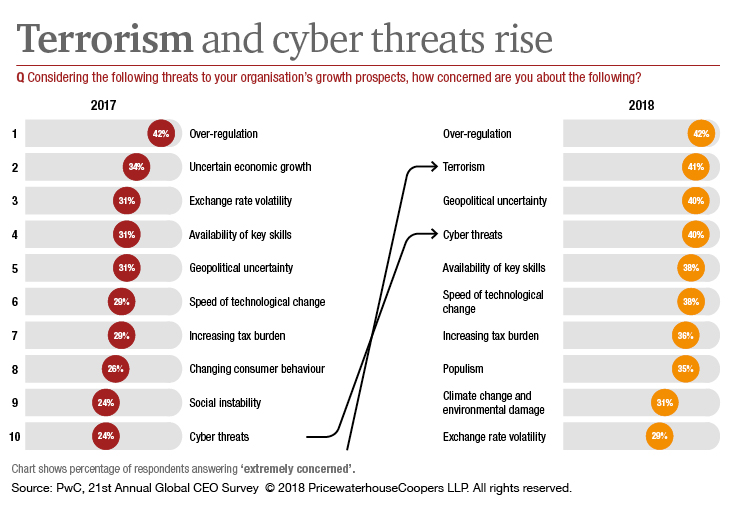
Despite the optimism in the global economy, anxiety is rising on a much broader range of business, social and economic threats. CEOs are ‘extremely concerned’ about geopolitical uncertainty (40%), cyber threats (40%), terrorism (41%), availability of key skills (38%) and populism (35%). These threats outpace familiar concerns about business growth prospects such as exchange rate volatility (29%) and changing consumer behaviour (26%).

Underlining the shift, extreme concern about terrorism doubled (2018: 41% vs 2017: 20%) and terrorism enters the top 10 threats to growth. The threat of over-regulation remains the top concern for CEOs (42% extremely concerned), and over a third (36%) remain concerned about an increasing tax burden.
A year after the Paris Agreement was signed by over 190 nations, which saw countries commit to voluntary action on climate change and low carbon investment, CEOs’ concern about the threat of climate change and environmental damage to growth prospects has now doubled to 31% of CEOs (2017: 15%).

High-profile extreme weather events and the US withdrawal from the Paris Agreement have significantly raised the profile of business action on climate risk, regulation and resilience. In China, over half (54%) of business leaders are extremely concerned about climate change and environmental damage as a threat to business growth, equal with their levels of concern about geopolitical uncertainty and protectionism.

Climate change and environmental damage is reported in the top five threats for businesses in Asia Pacific, and recognised as a top-five threat for the growth prospects of companies in the energy and utilities, engineering and construction, transport and logistics sectors. 

“The higher level of concern is being driven by larger societal and geopolitical shifts rather than the dynamics of business leaders’ own markets,” comments Moritz. “It’s clear their mid- to long-term confidence in revenue growth is tempered by threats the business world is not used to tackling directly itself.” 
Source: PwC microsite. Terrorism and cyber threats are ranked higher in the list of top 10 threats to business growth in 2018.

Echoing the theme of the World Economic Forum this year, CEOs acknowledge that we live in a fractured world. They are divided over whether future economic growth will benefit the many or the few. They see the world moving towards new, multifaceted metrics to measure future prosperity.

Yeoh said: “We can see that CEOs are navigating the fragmentation through the increased concerned for societal threats. This also holds true in Singapore as we enter an era of slower growth, shifting demographics and technological disruption.

“While financial performance is an essential element underpinning any market economy, it cannot be the only measure of success. Broader measures, reflecting targetted outcomes in societal terms, such as quality of life, must also be considered.”

Examining the key challenges to trust for businesses, CEOs admit that delivering results in shorter periods of time (60%) is the main challenge. However, following this, there is a significant shift with the majority reporting higher levels of pressure to hold individual leaders to account (59%), including for misconduct. Over a third report more pressure from employees and customers to take political and social stances (38%) in public.

In the BCM (65%), healthcare (65%) and technology sectors (59%), the profile of leadership accountability was higher than average. High-profile debates on diversity, immigration, social inclusion and pay equity have raised employees’ expectations of leadership to engage in political and social issues, including in China (41%).

Explore:

Download the report

*PwC conducted 1,293 interviews with CEOs in 85 countries between August and November 2017. The sample is weighted by national GDP to ensure that CEOs’ views are fairly represented across all major countries. Eleven percent of the interviews were conducted by telephone, 77% online, and 12% by post or face-to-face. All quantitative interviews were conducted on a confidential basis. Forty percent of companies had revenues of US$1 billion or more: 35% of companies had revenues between US$100 million and US$1 billion; 20% of companies had revenues of up to US$100 million; 56% of companies were privately owned.

16 December 2017

PwC calls on Singapore businesses to improve cash management

Businesses in Singapore need to focus on improving their cash management to mitigate risks, fund their day-to-day operations and finance their growth plans. 

The Singapore Working Capital Study 2017by PwC Singapore and SPRING Singapore has found that over the last three years, businesses in the city state saw an average 2.6% decrease in revenue year-on-year. There has also been a year-on-year increase of 3.5 net working capital (NWC) days** over the past three years, reaching 41.5 NWC days in FY16.

Said Wee Tze Wee, Deals Strategy and Operations Partner, PwC Singapore: “Working capital is akin to the lifeblood of a company. Optimising working capital is crucial as failure to manage it properly can have serious implications on the success of a business – from funding day-to-day operations to its ability to fund growth.”

This year’s results show that 50% of sectors saw their working capital performance deteriorate year-on-year (YoY). This performance was driven by an increase in the time taken to collect cash from sales (days sales outstanding) and an inventory increase (days inventory outstanding), partially offset by an increase in the time to pay creditors (days payables outstanding) that might not be sustainable in the long term.

Very large companies perform best with the highest ratio of working capital to sales at only 8%, followed by small companies at 14% and large companies at 15%***.

Medium-sized companies are the ones struggling the most in managing their working capital with the highest ratio at 18%. Their cost for growth is higher, increasing their difficulty in accessing funding at favourable rates. They find themselves battling for cash while having little negotiating power. Inadequate proficiency in managing a growing business coupled with lagging tools and systems can also add to poor performance, PwC said.

By the nature of their size, very large companies can leverage economies of scale and have easier access to capital at more attractive rates. On the other hand, small companies tend to have less complicated operations, making working capital management more straightforward.

In addition to the cash benefits of funding day-to-day operations, effective working capital management can help businesses improve business performance and revenue growth. Companies that have been able to achieve top quartile working capital performance have outperformed their peers across various key metrics, PwC said.

Some top performers are clearly ahead with higher investment rates, getting paid 40% faster than bottom performers and holding four times less inventory. Top performers are better positioned for growth as they can self-finance part of their investments or secure funds more easily by displaying healthier financial reports.

Leading players ‘stress test’ their working capital process, striving to balance the trade-off between cash, cost and service. They measure compliance with terms, processes and policies with key performance indicators (KPIs) to monitor working capital; and they benefit from top management sponsorship and clear accountability for working capital management.

Based on the findings, PwC says businesses in Singapore need to focus on cash management, specifically working capital, to better position themselves for funding and investments, and to allow them to create greater business value.

Chew Mok Lee, Assistant Chief Executive, Capabilities and Partnership Group, SPRING Singapore said, “Cash flow management has consistently surfaced as a challenge in local small and medium sized enterprises (SMEs) and SMEs do need help in this area. With this joint benchmarking study with PwC Singapore, SMEs can now see how their working capital performance is against their industry peers, tackle shortcomings in their cash collection cycles and find ways to improve their financial health for sustainable growth.”

*The Singapore Working Capital Study 2017 is a joint report by PwC Singapore and SPRING Singapore. The study looked at over 1,000 public and private companies across 15 industries in Singapore, including marine and offshore businesses that were reviewed separately in the sector analysis in the third chapter of the report. 

**Net Working Capital (NWC) days measure the liquidity of a business and how long it takes to convert its working capital into revenue. The longer the cycle is, the longer a business is tying up capital in its working capital without earning a return on it. Therefore, companies strive to reduce their working capital cycle by collecting receivables quicker, improving their inventory management or sometimes stretching their accounts payable. This key performance indicator (KPI) should be considered in the context of the industry that the company operates in.

NWC days is calculated by taking sales (days sales outstanding – DSO) and inventory (days inventory outstanding – DIO), offset by the time to pay creditors (days payables outstanding – DPO).

Calculation of NWC days: NWC days = DSO + DIO - DPO 

***Company sizes refer to companies by revenue, defined as:
Small-sized companies: less than S$10 million
Medium-sized companies: S$10 million to S$100 million
Large-sized companies: more than S$100 million but less than S$500 million
Very large-sized companies: more than S$500 million

4 July 2017

Singapore IPO activity in 2017 to surpass 2016

Singapore’s initial public offerings (IPOs) have raised US$329 million in 1H17 according to figures* by PwC Singapore, published today. The volume of IPO funds raised by the end of 2017 is likely to surpass 2016 levels with professional services leading the way as the sector with the most funds raised.

Two professional services IPOs – HRnetGroup and Shopper360 – have raised a total of US$134 million, ahead of the US$26 million raised in 2016.

Singapore Exchange’s (SGX) traditional strength, real estate industrial trusts (REITs) and business trusts accounted for 33% of Singapore’s IPO proceeds. The expected listing of NetLink Trust of up to US$1.6 billion will likely bring the sector up and build momentum for the rest of 2017, PwC said.

Tham Tuck Seng, Capital Markets Leader at PwC Singapore, said: “Singapore’s 1H17 numbers suggest that, apart from REITs and business trusts, niche sectors in the consumer space and professional services will be the next big growth opportunity for the local exchange. As SGX bolsters efforts in supporting technology startups, we can also expect to see more issuances from technology-driven activities.”

Follow-on (FO) performance in Singapore for 1H17 continues to be dominated by REITs and business trusts, accounting for 82% of total FO funds raised. In today’s rising interest rate environment, the equity market has become a vital fundraising platform to reduce interest costs. For REITs and business trusts, eight out of 10 are deploying the FO funds raised to acquire properties, with two using the funds to repay loans and borrowings.

Rising sectors such as consumer and professional services will continue the uptrend with Singapore’s position as one of the main business and financial services centres in the region. Following the signings of a series of memorandums of understanding with key players in the technology and startup ecosystem, such as A*Star’s EPTL, the Info-communications Media Development Authority of Singapore (IMDA) and PwC’s Venture Hub, PwC says technology and medical technology will also boost this growth.

Healthcare is one of the more well-developed sectors in Singapore with one of the world’s largest healthcare groups, IHH Healthcare, listed in the country. Singapore’s strong reputation as a medical centre of excellence in the region and the attractive market trading valuation for this sector (which sees the price-earnings ratio hovering in the range of 30 to 40 times) make it more attractive for healthcare players to list here. In addition to this, Singapore is expected to remain the choice listing destination for REITs and business trusts with notable interest from Chinese-based real estate players.

With the public consultation for dual class shares ending earlier this year, Singapore could become a more attractive location for listing in Asia. But with the Hong Kong Stock Exchange (HKEx) looking to introduce a third board with dual class shares, this has become a race to see which bourse is faster to the market, PwC notes.

SGX is a choice listing destination for Asian businesses and a springboard for international businesses to access the wider Asian region, PwC said. As markets in the region become more sophisticated, competition will likely get more intense, the company predicted.

Tham concludes: “For Singapore to remain ahead of the curve, we must continue to maintain our existing strengths (e.g. REITs and business trusts) and capitalise on new opportunities (e.g. the rise of new technologies). If we continue in this direction, we are confident Singapore will continue to be relevant for investors and market players in search of future growth.

“With Singapore’s pro-business environment and strong fundamentals – such as transparent regulatory regime, international exchange, and relatively quick time to market – Singapore remains a premier location for capital fundraising.”

*This study was conducted between 1 January and 30 June 2017 for IPOs, and between 1 January and 15 June 2017 for FOs, based on their first trading date. All market data is sourced from the stock markets themselves and has not been independently verified by PricewaterhouseCoopers.

posted from Bloggeroid

7 June 2017

PwC publishes guide on One Belt One Road initiative

Source: PwC. Cover for the Repaving the ancient Silk Routes report.
Source: PwC.
PwC’s Growth Markets Centre has launched Repaving the ancient Silk Routes. The report covers China’s One Belt and One Road (B&R) initiative and guides foreign companies on participating in B&R projects.

B&R was announced by China’s President Xi Jinping in 2013 to rebuild the ancient Silk Route that connects China to Europe via Central Asia in collaboration with foreign companies. According to PwC, B&R has gained significant economic momentum since. Activities are mainly focused along six economic corridors, which cut through more than 65 developing countries, and are expected to be a catalyst for infrastructure development that will have an impact on a population of about 4.4 billion and one third of the global economy. Kept broad and inclusive by the Chinese government, the B&R ecosystem now include railways, airports, and even a maritime route. The initiative goes beyond just geopolitics and embraces the promotion of commercial interests, trade, culture and social integration, PwC said.

Legitimately gaining knowledge through foreign partnerships can help Chinese enterprises further develop expertise while enhancing global credibility in the infrastructure sector. For foreign companies, a collaboration with Chinese enterprises on infrastructure projects located in third party countries can open up access to new markets and pave the way for access to the China market too. Many of these foreign companies also possess international experience in large scale projects in complex developing countries, which can be invaluable when trying to decrease operational risks.

PwC has identified some project risks which are unique to B&R projects, particularly from a geopolitical, funding and operational perspective:

Geopolitical risks. These often span across many territories, due to the exposure to changes in political regimes and bilateral relations.

Funding risks. Besides financing sources from China, companies also need to take into consideration that many growth markets along the B&R routes have a varied ability to pay back the loans they need.

Operational risks. Interested companies ought to remain vigilant in operational planning, even as state-owned enterprises from both China and the host countries are starting to gain international experience. This includes identifying gaps in stakeholder experience and the increased complexity of B&R transnational projects – both of which could result in delays or costs overruns. Although the B&R initiative holds rich promise, the risks are sometimes accentuated and unique.

Potential investors should also choose their B&R projects carefully, PwC added:

Commercial viability assessment. Companies ought to develop a robust business case, which should address market supply and demand forces, and also to what extent companies are reliant on incentives provided.

Maturity of the infrastructure ecosystem. Companies also need to evaluate the maturity and future plans of the surrounding infrastructure. This includes whether there is a strong strategic partnership for policy development, multimodal linkages and supporting facilities.

Portfolio fit. Companies also need to balance the valuation of their experience against the exposure of too much of the same risk in the company’s internal portfolio. For example, a company that already has a project in operation in Kazakhstan might need to decide whether it makes sense to add another at this time.

Success factors include:

Contingency strategies. For B&R projects which typically attract geopolitical attention and straddle multiple territories across a long period of time – it is critical for companies to plan for disruptions in advance. In the course of contract negotiations, any potential unresolved issues should be accounted for in contingency clauses with a clear exit strategy laid out at the outset.

Alignment with local governments: It is also important to build strong and respected relationships with local authorities, because government influence is widened in many B&R countries, where infrastructure development is critical and regulatory systems are still developing.

Trusted local partnerships. Partnerships with companies having prior experience of working with the local government are critical in B&R projects. The right partners will understand the sequence of events, unspoken sensitivities and key actors in the process to facilitate project progress. This is important in many growth markets which B&R projects operate in, where companies need to deal with the fluidity of business.

Risk sharing. A risk-sharing approach will build trust amongst stakeholders, ultimately lowering cost for all stakeholders. Companies can consider ways to share risk, such as waiving the need for performance bonds, carrying the cost of some equipment in their books, or developing a revenue-sharing mechanism.

David Wijeratne, PwC’s Growth Markets Centre Leader, says: “The B&R initiative has already seen many success stories of partnerships that have resulted in mutual benefits, leading to an increase in demand for foreign capabilities and contributions to B&R projects, which reaffirms that there are commercial opportunities across the infrastructure value chain.

“However, companies need to fully understand the potential risks of infrastructure projects, especially those unique to B&R in order to prepare for success. Acknowledging that B&R projects are different, companies can enhance their chances of success by taking proactive actions. This includes establishing contingency plans to manage short term disruptions, while planning for lengthy project lifespans, in addition to building strong and respected relationships with local authorities in order to effectively navigate the political and local bureaucratic scene.

“The B&R initiative is a vast and ambitious undertaking, possibly the largest transcontinental infrastructure programme the world has known – this is really only just beginning.”

Interested?

Download Repaving the ancient Silk Routes


posted from Bloggeroid

28 January 2017

PwC highlights growth opportunities in developing markets

Source: PwC. Cover for the report Winning in Maturing Markets.
Source: PwC. Cover for the report.
PwC’s Growth Markets Centre has recently launched its 2017 annual Winning in maturing markets report, which focuses on understanding growth opportunities in developing markets.

The report analyses growth opportunities across six key sectors – agriculture, health & education, manufacturing, retail, financial services and connectivity (transport & communication) – and highlights essential business capabilities that firms need to grow profitably in these markets.

According to PwC, growth markets should be considered mature and not volatile, and different markets follow distinctive growth paths towards stability and long-term prosperity. Despite recent stagnation in the pace of real GDP growth as a result of domestic and external factors – including domestic and foreign policy actions, falling global commodity prices, speculation around rising interest rates and unfortunate environmental disasters – growth markets will continue to register a rising share in global GDP growth in the next five years, reaching almost 65% by 20211.

To capitalise on existing growth opportunities, organisations need to better understand the shifts governing the market and operational landscape – in particular across these six key sectors, which are essential to achieving balanced economic and human development in the near future:

Agriculture

Sustaining growth in agriculture is of high importance to growth markets, for which the sector is a primary source of livelihood. A large majority of the global agricultural labour force (over 90%) still reside in developing countries2. Growth opportunities in agriculture spread across production, enabling farmers to be more efficient and to deliver higher yield, and consumption – addressing the ever-changing food and drink preferences of consumers.

Health & Education

Pushed by the need to cover large infrastructure and resource gaps, health expenditure is expected to grow by 10.7% annually in growth markets versus 3.7% in developed economies by 2022. The opportunity size for maturing markets is also supposed to touch US$4 trillion in annual spend by 20223 – creating new opportunities for life sciences companies, medical device manufacturers, pharmaceutical companies and delivery service providers.

Digital health is emerging as a growth sector worldwide, garnering US$13 billion in investments over 2014 and 20154. Unsurprisingly, the adoption of technology-driven solutions is expected to increase, with growth markets looking at low cost and less resource-intensive options to bridge existing gaps.

Manufacturing

Growth markets are now responsible for almost 60% of all low and medium technology manufacturing worldwide. Even more noteworthy is the speed at which these markets have grown their share in high-tech manufacturing – accounting for almost 50% of manufacturing value-add globally. The introduction of new production technologies and changing cost dynamics are further expected to influence global manufacturing competitiveness in the coming years.

Retail & consumer goods

Domestic consumption is one of the most important factors in keeping a growth market’s economy moving upward direc. This is driven by the expansion of the middle class, who have a higher propensity to pay for quality and value, therefore boosting opportunities across the sector. This is especially so for discretionary and aspirational products such as clothing, entertainment, leisure and automobiles. Up until 2010, 46% of the world’s middle class lived in growth markets, but by 2020, this will have increased to almost 70% and to nearly 80% by 20305.

Financial services

Expanding access to financial services amongst households will be key to improving the availability of domestic growth capital in growth markets. This can be achieved through technological investments, which are key to improving reach and accessibility to financial services; alternative payments such as non-cash transactions; and the launch of non-traditional sector participants such as e-commerce companies and mobile operators.

Transport & communications

Connectivity is fundamental to growth in any country, but in many growth markets the scale and quality of connectivity infrastructure, across both transport and communication is below what is needed to facilitate and sustain high growth. This presents many opportunities to venture into areas such as improving road connectivity, increasing third-party logistics services, and in furthering mobile and Internet penetration in both urban and rural communities in maturing markets.

The report also discusses capabilities required to navigate through the complex business environment and institutional voids associated with growth markets. Companies will need to develop flexible business models which are more suitable for the local market while developing new capabilities based on operational efficiency, innovation and go-to-market excellence.

David Wijeratne, PwC’s Growth Markets Centre Leader, said, “As we enter 2017, it’s clear that growth markets are on the verge of a new era of leading global growth in which they are projected to enjoy almost two times the absolute growth in GDP as compared to developed markets by 2021, and account for 65% of global growth within the next five years. This will create significant opportunities for private sector players looking to create and deliver value to the billions of people expected to join the middle class in these markets.”

Interested?

Download Winning in maturing markets

1 International Monetary Fund, World Economic Outlook, October 2016.

2 Business Monitor International, 2016.
 

3 World Economic Forum, Health Systems Leapfrogging in Emerging Economies, January 2014.

4 StartUp Health Insights, Digital Health Funding Rankings, 2015, 2016

5 PwC and Switzerland Global Enterprise, Rising Middle Class – Global Outlook and Growth Potential, April 2015.


24 January 2017

PwC launches APAC research centre for asset and wealth management

Source: PwC. PwC is to open an Asset & Wealth Management Asia-Pacific Research Centre in Singapore.

PwC has launched its Asset & Wealth Management (AWM) Asia-Pacific Research Centre, which will be headquartered in Singapore. With the support of the Singapore Economic Development Board, the AWM Asia-Pacific Research Centre aims to build capability in AWM in Singapore and across the region.

As an extension of PwC’s Global Market Research Centre based in Luxembourg, the AWM Asia-Pacific Research Centre will help to address the asset and wealth management industry’s market research needs such as identifying new market opportunities through its dedicated market-entry reports, help asset and wealth managers assess their competitiveness, improve their visibility in the market and monitor key trends.

This will be done through the development of in-depth analytical reports to support players in developing their strategy. It will also provide guidance for new players' market-entry aspirations across the Asia-Pacific region and engage in dialogue with regulators and governments in Asia-Pacific through policy papers.

“We are at the beginning of the Asian decade as global economic power and wealth shifts from west to east. The financial services industry in Asia-Pacific is at the cusp of re-engineering and consolidating. PwC’s AWM Asia-Pacific Research Centre will provide clients and other financial institutions with tools to expand their footprint in this region through the provision of market intelligence and supporting thought leadership,” says Justin Ong, Asia-Pacific Asset and Wealth Management Leader at PwC Singapore.

Barry Benjamin, PwC Global Asset and Wealth Management Leader adds, “The impacts of globalisation, technology advances and changing demographics are leading to dramatic shifts in how people accumulate, manage and distribute their wealth. The Centre will play an integral role in advancing research as well as developing perspectives on these challenges.”

The centre aims to build the analyst and research team to 12 over the next five years.

2 August 2016

PwC Singapore has launched Venture Hub, a one-stop shop to support startups

Source: PwC Singapore. People in a discussion.
Source: PwC Singapore. PwC Singapore has launched Venture Hub, the world's first one-stop shop to help investors and entrepreneurs succeed in the startup and innovation space.

PwC Singapore has launched its Venture Hub, the world’s first one-stop shop targeted at helping investors and entrepreneurs active in the startup and innovation space navigate the complex ecosystem. The team will be based in Singapore and is headed by Patrick Yeo, PwC’s Venture Hub leader.

Said Yeo: “There are many stakeholders in the venture ecosystem ranging from startups, investors, incubators, accelerators to government agencies, each playing an important role. In order to effectively meet the needs of the varied stakeholders with speed, agility and efficiency, we felt that the conventional model of how professional services firms provided advice to such stakeholders had to change.”

“With this one-stop shop model, the stakeholders have a lot more flexibility when they come to us for advice – be it business strategy, global market access, financing, regulatory compliance, etc. It doesn’t matter which area of expertise they need help with – all they have to do is get in touch with anyone from PwC’s Venture Hub and expert advice will be a mere step away. Traditionally, professional services firms like us are known to be costly and rigid, but with PwC’s Venture Hub, we are open to innovative ways of collaboration.”

PwC’s Venture Hub goes beyond catering to the traditional realm of financial technology (fintech) and will look at all disruptive technology in areas such as biomedicaltech, regtech*, wealthtech, and legaltech.

*Regtech is technology that makes regulatory compliance easier.

3 February 2016

PwC Singapore offers recommendations to enhance local economy

PwC Singapore has shared recommendations for the upcoming Singapore Budget 2016 with the Ministry of Finance and Monetary Authority of Singapore.

Source: PwC Singapore. Cover of the proposal.
Source: PwC Singapore.
Chris Woo, Tax Leader, PwC Singapore, said: “In order to sustain Singapore’s future growth and success, it is vital we maintain a leading, vibrant economy amidst greater competition with our regional counterparts. Singapore needs to sharpen its competitive edge by providing a level of certainty to foreign investors and Singapore based multinationals. This must be done while creating more value in Singapore by encouraging entrepreneurship and innovation.

“The government has been actively encouraging entrepreneurship in Singapore, but there is still room to do more. Incentives could be broadened and focused on rewarding growth. Share options and stock award schemes can promote greater owner-entrepreneurial spirit.”

PwC suggests a more liberal tax treatment of expenses for new ventures to spur innovation to encourage businesses to develop innovative capabilities in this rapidly evolving economy. "When introducing this, anti-abuse measures must continue to be taken into consideration,” Woo said.

Another recommendation is enhancement of the Productivity and Innovation Credit (PIC) scheme. "Many small and medium sized enterprises (SMEs) are just starting on their productivity journey. If the PIC grants or incentives are awarded based on productivity gains, this will encourage SMEs to strive to achieve greater productivity,” Woo explained.

A more liberal approach to the administration of research and development (R&D) tax claims is proposed. "One practical way is to streamline the claims, and one which gives taxpayer’s upfront certainty, is to have a pre-approval process with the relevant agencies. An alternative dispute resolution forum could involve evaluation by an independent panel of experts who will rule on the technical merits of the claim,” Woo elaborated.

“The IP hub master plan is a step in the right direction. When sourcing for financing, IP-backed loan programmes need to revisited to allow SMEs to use IP as collateral, leading to more accessible financing,” Woo added.

“Last but not least the safe harbour rule for gains from disposals of equity instruments is expiring in 2017. Making the safe harbour rule a permanent feature of the tax system will provide investors with certainty that their capital gains will not be taxed and help companies plan for the long-term.”

14 December 2015

PwC upbeat about digital entertainment and media, traditional media resilience

Global entertainment and media outlook 2015 to 2019 presented in categories
Source: PwC website.

PwC Middle East has launched Middle East and Africa insights from PwC’s 16th annual edition of the Global Entertainment & Media Outlook 2015-2019* (Outlook) at the Dubai Film Market on December 10, 2015.

According to the Outlook, the rise of mobile Internet is an important opportunity for data-driven advertising. Mobile Internet subscribers in the Middle East and Africa are expected to grow at a CAGR of 21.9% to 2019, and global smartphone connections are forecast to double from 1.92 billion in 2014 to 3.85 billion in 2019 (half the world’s population). PwC forecasts that the global mobile Internet advertising spend will be second only to search spend, surpassing display by 2018, growing at a CAGR of 23.1%.

In the Middle East and Africa, entertainment and media spend will increase from US$38.8 million in 2014 to US$61.1 million in 2019. Consumers now want flexible, on-demand TV and film viewing across platforms, with over the top (OTT)/streaming reaching US$19.2 billion globally by 2019.

In the Middle East, Saudi Arabia is expected to have the highest film market revenue growth (albeit from a low base) at a CAGR of 18.5% from 2014-2019, driven by OTT/streaming and because there is no cinema sector in the country. In the UAE, popular TV and film intellectual property (IP) is going omnichannel. It is being integrated beyond the big screen into leisure attractions, including several upcoming theme parks. The UAE has a relatively large filmed entertainment industry for the region, expected to reach US$141.9 million by 2019.

Philip Shepherd, PwC Middle East’s Entertainment and Media Partner said: “With the availability of all digital resources at our fingertips, consumers will choose the most convenient, flexible and fastest methods to connect digitally.”

Jayant Bhargava, Middle East Digital Media and Entertainment Partner with Strategy& (formerly Booz & Company) said: “Time spent with media and video viewing is at an all-time high. Proliferation of devices and connectivity is driving a culture of media snacking and multitasking. Today, consumers have access to a wide range of content and a multitude choice of how and when to view it. This is driving an explosion in video content and new genres are being introduced by emerging artists world over.”

Globally, worldwide entertainment and media revenues will rise at a CAGR of 5.1% over the coming five years, from US$1.74 trillion in 2014 to US$2.23 trillion in 2019, PwC said.
Global highlights include:
The content experience trumps delivery platforms

PwC notes that consumers disregard distinctions between ‘digital’ and ‘non-digital’, instead exploiting the digital medium in what, when and how they consume. "In making these choices, they’re migrating to offerings that combine relevance and convenience - attractive content, easy discovery, social community - with an inspiring, personalised experience, however it’s delivered," the company noted.

As a result, non-digital media will still contribute well over 80% of global consumer revenues in 2019. Spending on live music ticket sales and cinema box office will rise at a combined global CAGR of 4.7% to 2019, outpacing overall consumer spending at 2.9%. In China, box office revenues will rise at a CAGR of 15.5%.

Marcel Fenez, PwC’s Global leader, entertainment and media, comments: "Digital or non-digital - for consumers it’s all about content experiences. Given the wide variations in consumer preferences, the challenge for entertainment and media companies is to blend data insights and consumer intuition to maximise the value of the experiences they offer. The prize for achieving this is heightened by the fact that the consumer has never been more up for grabs than today."
Advertising growth is primarily digital

Turning to advertising, total global advertising revenues will rise at a CAGR of 4.7% to 2019. Again there will be wide variations by territory, with Indonesia the fastest-growing ad market at a CAGR of 12.9% to 2019. Like consumer revenues, advertising will see digital growth and non-digital resilience: while global digital advertising revenue will rise at a 12.2% CAGR against just 1.2% for non-digital advertising, non-digital will still contribute over 60% of global ad spend in 2019.

The direction is toward digital, however. By 2019, digital advertising as a whole - including digital out-of-home - will account for 38.7% of total global advertising revenue, up from just 16.6% in 2010. Mobile Internet advertising will surge at a 23.1% CAGR to 2019, and video advertising spend globally will rise at a CAGR of 19.5%, supported by a near-doubling of global smartphone connections to 3.85 billion in 2019.

Alongside Internet advertising, digital out-of-home advertising (DOOH) will be another high-growth area, with revenues rising at a 13.2% CAGR. Given the high costs of upgrading OOH to digital formats, the most lucrative markets for DOOH advertising will be major cities. By 2019, Singapore will see DOOH advertising account for 60.4% of total OOH advertising revenue.

Consumers migrate to new media consumption behaviours

Underlying the trends in entertainment and media spending detailed in the Outlook is the migration by consumers worldwide to new ways of consuming content. One of the clearest shifts is in TV and video consumption, with consumers increasingly demanding high-quality original programming in a flexible, on-demand manner across numerous devices - thus enabling ‘binge viewing’ and greater convenience. OTT services offer the best outlet for this type of consumption.

A further shift toward social/casual gaming is underway, spending on which will exceed traditional gaming in nine markets by 2019, including India. While territories with long-established console and PC game markets continue to be dominated by traditional gaming revenue, the global growth of social/casual gaming will create a US$22.52 billion market by the end of the forecast period.

Newspaper consumption is also changing, with consumers increasingly willing to pay for premium content. Online paywalls are now making up for newspapers’ lost print circulation revenues globally, with a wave of subscription offerings boosting newspapers’ digital circulation revenues to nearly US$2.5 billion in 2014. In aggregate, as digital subscription revenues gain momentum globally and print subscriptions continue to shrink, total global newspaper circulation revenue is set to record year-on-year increases - a pattern that began in 2013.
*PwC’s 16th annual update of the Global Entertainment & Media Outlook 2015-2019 (Outlook) provides a single comparable source of five-year forecast and five-year historic consumer and advertiser spending data and commentary, for 13 entertainment and media segments, across 54 countries. Segments covered by the Outlook include TV subscriptions and licence fees, TV advertising, Internet access, radio, Out-of-home advertising, Video games, Filmed entertainment, newspaper publishing, Magazine publishing, Business-to-business, Internet advertising, book publishing and Music. Information may not align with the online version as the data is constantly updated. Refer to the online Outlook as the most up-to-date source of consumer and advertising spend data.

2 December 2015

Japan and Australia to be real estate investment magnets in 2016

Real estate activity in Asia next year will continue trends seen in 2015 - an abundance of capital flowing to core spaces, as well as a flight to safe havens in the region's most developed and liquid markets, according to Emerging Trends in Real Estate Asia Pacific 2016, a real estate forecast jointly published by the Urban Land Institute (ULI) and PwC

Japan and Australia remain the favourite countries for investment and development, with Tokyo, Sydney, Melbourne and Osaka taking four of the top five spots for promising markets in the Asia Pacific region. Ho Chi Minh City, rated fifth, rounds out the list of most favoured markets.

"Asia's real estate markets are the product of almost eight years of easy money from the world's central banks. Although easing in the US may be ending, both Japan and the European Union continue to provide liquidity, while interest rates in many Asian countries are lower than one year ago," said ULI North Asia Chairman Raymond Chow, Executive Director, Hongkong Land in Hong Kong. "This, combined with an allocation of capital from both local and global institutional investors, is resulting in more and more money chasing fewer and fewer real estate assets. This is pushing up prices across most markets and sectors, even as the current industry cycle appears to be winding down. We can expect this to continue throughout 2016, with the most attention being paid to markets perceived as offering certainty in terms of low risk and satisfactory returns."

"As the bull market in Asian real estate enters its seventh year, the positive atmosphere is encouraging investors to sell assets purchased years ago in the wake of the global financial crisis. Our report finds that investors are increasingly opting to take profits and exit from deals made in recent years. Opportunistic returns lie in Japan, where cheap debt and high leverage provide outsized profits, and in China, where developers are in need of capital and liquidity is in short supply. Meanwhile, investors with an eye on a possible peak in the cycle are attracted to the safety of core assets in gateway cities," said KK So, Asia Pacific Real Estate Tax Leader, PwC. 

"In terms of capital flows, investors continue to see increases in capital movements from Asia to real estate markets elsewhere in the world. The main contributor to this trend is China, where institutional, corporate, and private capital is buying mainly in Australia, Japan and the US."

Emerging Trends provides an outlook on Asia Pacific real estate investment and development trends, real estate finance and capital markets, and trends by property sector and metropolitan area. It is based on the opinions of 343 real estate professionals, including investors, developers, property company representatives, lenders, brokers and consultants.

The top five investment markets for 2016 are: 

Tokyo, ranked first for investment and development, ticks all the boxes for investors given its status as Asia's top gateway city, and the market with the greatest depth and liquidity. Despite the continuous heavy activity fuelled by easy credit and low interest rates, some are wary that the market is slowing. While the short-term outlook is favourable, a slowdown, accompanied by price stagnation or declines, could prove problematic for those needing to refinance high loan-to-value loans in the future, the report cautions.
Sydney, ranked second for both investment and development, is a draw for institutional investors seeking core office properties. The shortage of those assets and an influx of new investors competing for the properties, coupled with a depreciated local currency, is resulting in strong property yields. Real estate in Sydney is also benefiting from the transformation of Australia's economy from a commodities-driven to a service sector-driven model. A significant number of office-to-residential conversions and redevelopment projects have drawn investor interest. 

Melbourne, third for investment and development, is perceived as offering a similar environment to Sydney. However, even with double-digit price increases in 2015, properties in the city remain more affordable than those in Sydney, mainly because more land is available for an expansion of the central business district (CBD). 

Osaka, fourth for investment but fifth for development continues to benefit Tokyo's spillover demand. The market's growth "marks the end of a long period of oversupply that plagued the city for years," notes the report.
Ho Chi Minh City - fifth for investment and fourth for development - was in 19th place in 2014. The report attributes its surge in popularity to successful efforts by the government to stabilise the local currency and keep inflation in check, coupled with a revival of real estate lending by banks. In addition, improved market access for foreigners is drawing outside investors, who could significantly boost purchases of both residential and commercial properties.

Across the Asia-Pacific region, the industrial/logistics sector continues to be the most popular property type for investment prospects. "Shortages of modern distribution facilities across almost all markets ensures that demand will continue to grow, especially in China," says the report. It notes that demand is being driven by the need for rapid delivery resulting from the e-commerce boom, buildout in the cold-food chain, and structural changes in regional manufacturing as operations move to emerging markets such as Vietnam.