Showing posts with label menu. Show all posts

30 December 2024

Hong Kong Cuisine 1983 Chinese New Year menu honours Chef Silas Li’s Hakka heritage

Source: Hong Kong Cuisine 1983. A selection of five dishes from A Menu Inspired by Hakka Heritage.
Source: Hong Kong Cuisine 1983. A selection of dishes from A Menu Inspired by Hakka Heritage.

Hong Kong Cuisine 1983 is ushering in the year of the snake with a menu that honours the rich and vibrant culture of the Hakka people. Created by Chef Silas Li, the menu pays tribute to his roots, featuring dishes crafted with fresh, high-quality ingredients and time-honoured techniques.

Hakka cuisine is celebrated for its bold yet balanced flavours and its focus on natural, seasonal ingredients. 

 “The Hakka people have a long culinary tradition of preserving authentic flavours,” Chef Silas Li shared. 

“This menu was designed to celebrate those time-honoured practices while celebrating the essence of Chinese New Year. Every dish tells a story of heritage, family, and the joy of sharing food with loved ones.” 

The menu combines classic Chinese New Year flavours with traditional ingredients like fermented red bean curd, black bean sauce, dried oysters, and mushrooms. These umami-rich components not only elevate the dishes but also carry deep cultural significance, symbolising prosperity, wealth, and harmony. 

Highlights Include: 

- Braised seasonal vegetables with bamboo fungus and elm fungus (HK$480) - A lighter dish that shows off the simplicity and elegance of Hakka cuisine. The bamboo and elm fungi add textural contrast to the seasonal vegetables while celebrating the freshness of the ingredients. 

- Steamed eel with black bean and garlic sauce (HK$1,200) - A harmonious blend of tender eel, fermented black beans, and garlic. Symbolising fortune and strength, this dish is an auspicious choice for the Lunar New Year. (Advance order required.) 

- Deep-fried Wagyu beef cheek with Sichuan spicy sauce (HK$480) - A bold, contemporary offering that combines the richness of tender Wagyu beef cheek with a fiery Sichuan spice blend.

- Beijing-style tiger prawn (HK$238/pc): prawns are a symbol of happiness and celebration.

- Sweet and sour Mandarin fish (HK$1,280): this striking centrepiece balances sweet and tangy flavours, representing harmony and joy. In Chinese culture, the word for fish (鱼, yu) is a homophone for surplus or abundance (余, yu), and therefore symbolises wealth and prosperity.

Serving the fish whole, with the head and tail intact, represents unity and completeness, wishing for a good beginning and end to the year. In Hakka culture, the sweet and sour flavour profile embodies balance and resilience, reflecting the harmony and strength that define the community’s values.

Lohei with fresh salmon (HK$580): lohei (撈起), also known as yusheng (鱼生), is a colourful fish salad enjoyed during Chinese New Year, symbolising prosperity, abundance, and unity. Featuring fresh salmon, shredded vegetables, crispy crackers, and sweet sauces, each ingredient carries auspicious meanings, such as wealth, harmony, and vitality.

Diners gather to toss the salad high with chopsticks while shouting blessings, as the height of the toss is believed to indicate the fortune and success in the year ahead. This vibrant and joyous tradition is a highlight of the festive season, promoting renewal and positivity. (Advance order required.)

The Trio of Festive Cakes

This year, Hong Kong Cuisine 1983 is also presenting a trio of handcrafted puddings that blend tradition with contemporary appeal. Preparation begins days in advance to achieve the perfect texture and balance of flavours for these 100% in-house creations. Presented in elegant, festive boxes adorned with auspicious symbols, these puddings are tokens of prosperity and good fortune.

Chef Silas Li’s dedication shines through in these 100% in-house creations, where preparation begins days in advance to achieve the perfect texture and balance of flavours. Presented in elegant, festive boxes adorned with auspicious symbols, these puddings are more than desserts—they are tokens of prosperity and good fortune, made to share the joy of Chinese New Year with loved ones

- Turnip cake with conpoy and smoked preserved meats (HK$268, early bird HK$218): using premium Hokkaido conpoy, white radish, and high-quality cured meats, this savoury classic is elevated with a subtle smoky aroma. The balance of savoury and sweet notes are designed to evoke nostalgia and highlight traditional New Year flavours. Achieving the perfect texture requires careful preparation - each ingredient must be evenly blended and steamed at precise temperatures for a firm yet tender finish. The most challenging aspect of this pudding is balancing the smokiness of the cured meats with the freshness of the radish to create a harmonious profile.

- Sweet pudding with Okinawa brown sugar (HK$228, early bird HK$198): this glutinous rice cake features imported Okinawa brown sugar, known for its deep caramel-like aroma. Its soft, sticky texture is achieved through the slow blending and steaming of the rice flour and sugar mixture, ensuring a melt-in-your-mouth consistency. Chef Li chose Okinawa brown sugar to add a modern twist to a classic favourite.

- Water chestnut and red bean sweet cake (HK$218, early bird HK$188): this pudding pairs crunchy water chestnut with the rich mouth-feel of red beans, offering textural contrast. The two-layered cake requires delicate handling to achieve its distinctive layers and flavours. Red beans are chosen to represent happiness, and water chestnut for vitality.

Details

A Menu Inspired by Hakka Heritage is available from 3 January to 12 February 2025.

The Trio of Festive Cakes has an early bird promotion till 19 January, 2025. Those who order two or more puddings will receive an extra 10% discount. Pickup is from 21–27 January 2025.

Hong Kong Cuisine 1983

1/F, 2-4 Tsoi Tak Street, Happy Valley

+852 2893 3788/ +852 9029 2093 

Reservations and enquiries can be made at https://www.1983hkc.com or email info@hk-cuisine.com.

20 December 2024

VITIS Wine Bar & Bistro introduces festive lunch menu

VITIS Wine Bar & Bistro has a festive lunch menu available on weekdays till 31 December. 

Start with the VITIS signature small plate of chilled tomato, paired with ocean trout, and edamame and fish consomme. 

Choose between three different mains, consisting of Challans duck, line caught fish or stockyard Wagyu striploin. 

End on a sweet note with a classic dessert, chocolate and cherry. 

The venue can accommodate up to 40 people, with a maximum of 32 in the main restaurant, and up to eight in a private dining room. 

Details 

The lunch costs S$128 per person. 

Call or email to make reservations at:

VITIS Wine Bar and Bistro
7 Fraser St, #01-46/47, DUO Galleria, Singapore 189356

+65 8823 3993
vitis.sg
reservation@vitis.sg

Monday - Friday
Lunch: 12 pm to 2:15 pm (last seating)
Dinner: 5 pm to 10:15 pm (last seating)

Saturday
Dinner: 5 pm to 10:15 pm (last seating)

Closed on Sundays

9 September 2024

New menu at The Beach Grill, The Ritz-Carlton, Bali

The Beach Grill, a beachfront restaurant at The Ritz-Carlton, Bali, has launched new dishes to elevate the beachfront dining experience for guests. 

The Beach Grill is where premium meats, fresh seafood, and local flavours come together. The new menu incorporates fresh, locally-sourced vegetables, herbs, and spices to enhance the flavor and authenticity of each dish. 

The restaurant uses the JOSPER Grill Oven, renowned for imparting a smoky elegance to high-quality meats and premium-grade seafood. All the grilled items will be served with classic or innovative sauces to enhance the dishes.

Menu highlights include scallops and lobster linguine, complementing more traditional offerings like Angus or Wagyu steaks. Vegetarian options include the Bedugul organic mesclun salad and mushroom risotto.

Source: The Beach Grill. Rack of lamb with gravy on the side. Flat lay.
Source: The Beach Grill. Rack of lamb.

The location yields panoramic views of Sawangan Beach and features tables for couples, a lawn, a pavilion area with sofas, cocktails, and a separate bar.

"We are excited to introduce our new menu which reflects our commitment - strive to serve the exceptional quality of our dishes to create an extraordinary dining to our guests. The team which is led by Chef I Gede Angga Suarthama or Chef Angga, Chef De Cuisine of The Beach Grill, has worked tirelessly to source the best ingredients and create amazing dishes that also celebrate local Bali resources," said Chef Raymond Siek, Director of Culinary at The Ritz-Carlton, Bali.  

"The Beach Grill offers a relaxed dining experience where guests can savour fresh, succulent grills and premium seafood while enjoying soft breezes from the Indian Ocean. Our talented culinary team has crafted a sumptuous selection that blends local flavors with innovative techniques," said Go Kondo, GM of The Ritz-Carlton, Bali.

Marriott Bonvoy points can be earned or redeemed at dining outlets of The Ritz-Carlton, Bali. 

Details

 The Beach Grill

  • Jalan Raya Nusa Dua Selatan Lot III
  • Sawangan, Nusa Dua, Bali
  • Indonesia 80361

The Beach Grill opens daily, from 12:00 pm to 10:30 pm for lunch and dinner. 

Make reservations at https://www.thebeachgrillbali.com, or email rc.dpssw.restaurant.reservation@ritzcarlton.com.

8 April 2019

Spice World Hot Pot soups up menu to celebrate 1st birthday

Source: Spice World Hot Pot. Tender milk beef.
Spice World Hot Pot, known for its playful food presentations, fresh and premium ingredients and service, is celebrating their 1st year anniversary at its 200-seater restaurant in Singapore with new dishes.

Bullish Day (牛气冲天, S$36.90 ) is a combination platter of different cuts of sliced beef, tripe and tongue. There are also traditional handmade beef balls (牛肉丸, S$15.90), made fresh every day, and Tender Milk Beef (牛奶嫩牛肉, S$15.90) made with sirloin slices marinated in milk and presented on a plate embellished with a guardian minotaur with clouds coming from its nostrils.


Spice World Hot Pot prides itself in making their food presentation stand out. The Mermaid (美人鱼, S$18.90) is inspired by the popular Premium Barbie Beef Wagyu. This dish features red tilapia slices arranged around a doll to form the shape of a mermaid.

Sustainably-sourced US scallops (秘制带子, S$19.90) marinated in 16 herbs and spices and Australian hairy abalone (秘制毛贝, S$12.90 per piece) are both ideal hotpot additions.


Source: Spice World Hot Pot. The Ying-Yang mala and Bubble Milk Tea combination.

Spice World Hot Pot will also make its milk tea hot pot a permanent addition to the menu. Introduced two months ago as a trial, this dessert creation has become a hit with regulars. Assam or Matcha milk tea is enjoyed with sweet and savoury toppings such as taro, purple sweet potatoes, pumpkin, yam, coconut and fruit jellies, and milk beef. Served with straws, the Ying-Yang mala and Bubble Milk Tea hotpot combination goes for S$39.90.

Details:

Spice World Hot Pot
3B River Valley Road, Clarke Quay, #01-06/07
Singapore 179021


Sunday to Thursday 10:30 am to 4 am
Friday and Saturday 10:30 am to 6 am
Open on public holidays.

Reservations: +65 6265 9777

Promotions at the restaurant include:

- Order as much as you can eat and the total amount spent will be returned to you in the form of a gold VIP membership stored-value card. The amount rebated can be utilised during subsequent visits, with no expiry date. card). This promotion excludes beverages, alcohol and soup bases, and does not apply to takeaway orders.


- Enjoy four out of nine food items at half price when diners follow Spice World Hot Pot’s Facebook (Spice World Hot Pot) and Instagram (@spiceworldsg) accounts.


- For a limited time, the first 200 customers on CHOPE can purchase S$80 vouchers at S$19.99. The promotion is limited to one voucher per customer per table and cannot be used in conjunction with other in store promotions.

Spice World Hot Pot is run by Sichuan Xiang Tian Xia Catering Management Company, a franchisee of Spice World Hot Pot in China. 

Hashtags: #spiceworldsg, #spiceworldhotpot

5 May 2017

The Spring Menu is now available at La Yeon

Source: The Shilla Seoul. La Yeon's chilled pen shell salad with yuzu garlic sauce.

La Yeon, The Shilla Seoul’s three Michelin-starred fine-dining Korean restaurant, that has also made the list of Asia’s 50 Best Restaurants for three consecutive years, has launched a Spring Menu. Showcasing the season’s finest ingredients from the Korean peninsula’s farms and shores, the new menu reflects La Yeon’s ongoing commitment to honor Korea’s culinary history.

The Spring Menu features delicacies such as geoduck, sea bream, king scallops, webfoot octopus, napa cabbage, mulberries and bellflower seeds. Traditional cooking techniques will present the seasonal ingredients, from fermenting and low-temperature ripening to steaming and grilling. These meticulous processes

Wine pairing is available with the new menu, each wine carefully handpicked by La Yeon’s sommelier to enhance the dining experience. The restaurant’s drinks menu will also be refreshed to include two new types of makgeolli (Korean rice wine) and two new types of Cheongju (refined rice wine). Traditional Korean liquors such as a freshly harvested rice and peanut makgeolli are also offered by the glass for pairing with dishes.

Guests can take advantage of the special Taste of La Yeon accommodation package, which is designed for gourmets who enjoy travelling for food. Guests who book the package receive one night's accommodation in a premium suite, a lunch or dinner for two at La Yeon (advance booking required), a Shilla teddy bear, free access to the Executive Lounge and outdoor spa pool, relaxation area, Finnish sauna, gyms, indoor pool and other leisure facilities.

The Shilla Seoul has also reopened Urban Island. With the Urban Island accommodation package, guests have access to the outdoor swimming pool and sunbathing facilities, as well as a spa pool, heated pools, and private cabanas.

Interested?

Book the Urban Island package

8 September 2016

Emirates has a new Japanese menu for first, business class customers

Source: Emirates. A sample dish from the new Japanese menu.

Emirates has unveiled a new Japanese menu for first and business class customers on flights between Dubai and Haneda, Narita, and Kansai airports in Japan. Emirates’ catering team in Dubai created the new dishes in collaboration with a local caterer in Japan, utilising the freshest ingredients possible.

Complementing its gourmet international menu, first class customers on Emirates flights to and from Japan can now experience traditional kaiseki (懐石, a multi-course meal) cuisine while business class customers have the option of a bento box, a full course meal placed in a partitioned box. Emirates is the first Middle Eastern Airline to serve kaiseki-inspired meals on board.

Emirates collaborated with Gate Gourmet Japan to develop and produce the new menu items. Gate Gourmet Japan, which is located in Narita City, Chiba Prefecture, offers a farm-to-table experience. It has established a system to source freshly-picked vegetables from local farms, such as the Hokuso Vegetable Farm, that are all within a 1 km radius from their facility for absolute freshness.

The first class kaiseki cuisine features five courses, including cold appetisers, a hot dish, flavoured rice, pickled vegetables, miso soup, and is finished with a serving of wagashi (和菓子), traditional Japanese sweets typically enjoyed with a cup of green tea. Wagashi sweets are prepared using a variety of ingredients and methods and come in different shapes, sizes and textures.

Emirates explains that kaiseki is traditional Japanese multi-course haute cuisine. Its origins date back centuries ago in the simple meals served at tea ceremonies. Today, kaiseki is enjoyed on special and celebratory occasions and served in specialised restaurants and at ryokans (旅館, Japanese-style inns).

The ingredients are natural, of high quality and change seasonally. Each course is served soon after it is prepared so as to maintain the freshness of the ingredients. The food design and serving style is a reflection of shapes found in nature including forests, mountains, islands, flowers or leaves. The balance between the colour, texture, flavour, consistency, and shape of the food and the aesthetics of the tableware is also carefully considered.

Business class offers a specially-arranged bento box in a high-end Japanese catering style, perfect for eating on board. Bento is the art of arranging one’s lunch in Japan, and has a history of over a thousand years. Although commonly known to be a take-out meal today, bento boxes for celebrations are elaborately prepared. Attention to detail and care is given to taste and presentation. The aesthetics of the box and the texture of the food in each section of the box, demonstrate the kodawari (こだわり) or dedication of the maker and the skill in preparation and artistic presentation.

To create a truly authentic Japanese dining experience on board, Emirates also collaborated with Japanese tableware maker Noritake to develop exclusive tableware designs for the new menus based on the concept of miyabi (), meaning elegance or refinement.

Noritake experts worked closely with the Emirates product and catering teams on the tableware designs, paying attention to the finest details to ensure that the tableware complements the food and enhances its presentation. With tableware that reflects Japanese traditional design, Emirates seeks to further enrich the customer on board experience. Japanese customers will feel at home when they are served the food trays, while non-Japanese customers are able to enjoy an authentic Japanese meal experience.

Emirates flights to and from Japan cater to the needs of Japanese travellers with Japanese-speaking cabin crew on board. The Emirates entertainment system, ice, offers up to 2,500 channels of audio and visual entertainment, including Japanese movies such as If Cats Disappeared From The World, as well as Hollywood blockbusters dubbed in Japanese such as Zootropolis. There are also hundreds of channels of music, audio books and games.

Emirates passengers can enjoy a generous baggage allowance, with 50kg for first class, 40kg for business class and up to 35kg for economy class passengers.

Interested?

Find out what is being served on your Emirates flight

25 July 2016

The Butchers Club Burger serves up National Day fare for Singapore's 51st

Source: The Butchers Club limited edition Little Red Dot Burger.
Source: The Butchers Club Burger's National Day menu will feature a specially created The Little Red Dot Burger.

For two weekends starting from 29 July, The Little Red Dot Burger will be available as part of The Butchers Club Burger Singapore’s National Day Set Menu. This is The Butchers Club Burger’s first National Day celebration in Singapore, and The Little Red Dot Burger is a fitting creation that pays homage to Singapore’s satay ayam (chicken satay).

The Butchers Club Burger’s Singapore-inspired burger features 140g of a grilled juicy chicken patty, with crunchy cucumber strips, freshly shaved red onions, caramelised pineapple is lathered in rich ginger peanut sauce, and served between two sesame buns. The Butchers Club touch was added by upsizing it to the usual Butchers Club Burger portion, and serving it with caramelised pineapple for that extra zest.

The National Day Set Menu (S$28++ for the non-alcoholic version) is a combination of popular local flavours: It will come with The Little Red Dot Burger, a side serving of straight-cut fries seasoned with curry powder and a chocolate, vanilla or strawberry milkshake. This set menu will only be available from 29 July to 10 August 2016.


Interested?

The Butchers Club Burger is at 3A River Valley Road, #01-01 Clarke Quay, Singapore. It is part of the The Butchers Club group, which established itself in Hong Kong for bringing the trend of dry-aged beef from the US and Europe to Asia.


Hashtags: #butchersclubburgersg, #butchersclubburger, #clarkequay, #clarkequaysg

16 July 2016

Japan Food Town offers exclusive dining experiences in Singapore

Japan Food Town banner in Wisma Atria. Just keep going up the escalators to the fourth floor.

Japan Food Town is set to offer authentic Japanese cuisine straight from Japan from 16 July 2016. The food hall, on the 4th level of Isetan Singapore (near Food Republic, basically above Starbucks) at Wisma Atria mall, is the first of a series of Japan Food Towns planned around the world.

  Look upwards to see the washi paper ceiling decor, which is meant to evoke steam rising from a hotpot.
Look upwards to see the washi paper ceiling decor,
which is meant to evoke steam rising 

from a cooking stove.

The 20,075 sq ft space seats roughly 628 guests at any one time. The interior was designed to bring out ‘ma’ (間), a modern Japanese sense of space. Japan Food Town flew in traditional Sakan (左官) craftsmen to create textures that mimic natural materials such as stone and copper from plaster. Prior to Japan Food Town, the Sakan craft could only be found in Japan. Kitchen tools such as plates and bowls arranged in between outlets add to the anticipation for the outstanding food served.

The health-conscious will be interested to learn that Japan Food Town has an official gourmet rice that is a healthier choice, in use by more than half of the tenants. Kinme Mai (金芽米) from the Toyo Rice Corporation has a smooth, creamy texture and a subtle fragrance that complements other foods very nicely.

A special polishing technique ensures that the rice retains most of the healthy components which are often stripped away by traditional techniques, such as fibre, vitamins and minerals. The gold rice germ (kinme) is retained. According to Toyo Rice, Kinme Mai contains roughly 10% fewer calories than an eequivalent amount of white rice. Restaurants offering Kinme Mai will have a sign prominently featured at their entrances.

Sushi table lady at the opening of Japan Food  Town.
Sushi table lady at the opening of Japan Food
Town.
A collaboration with Japan Association of Overseas Promotion for Food & Restaurants (JAOF) means that the outlets can also make use of seasonal produce and unique regional specialities, as well as the freshest ingredients brought in directly from Japan, daily, via the Logistics Hub in Okinawa, Japan.

All tenants are taking advantage of the logistics services, sometimes on a daily basis,  to import more than half of ingredients they require. Diners can thus enjoy Kinme Mai as well as Matsusaka beef (松阪牛), and Kindai (近畿) maguro (bluefin tuna) to Singapore. The bulk procurement slashes shipping expenses by roughly 50%, enabling Japan Food Town to keep its menus at an affordable range.

Japan Food Town features a nice selection of casual dining outlets offering quality Japanese cuisine at affordable prices. Each restaurant has been hand-picked based on its strong reputation and rich heritage, and is exclusive to the food hall. Almost all of the brands are new to Singapore. The tenants include:

Hokkaido Izakaya

Hokkaido island’s unique geographical location, in the north of Japan, means access to the best of both sea and land. Hokkaido Izakaya has been certified by the Hokkaido City Council to promote Hokkaido produce in Singapore.

According to the Japan National Tourist Organisation, Hokkaido's fresh fish and seafood offerings include crab, scallops, sea urchins, salmon roe, salmon, herring, flounder, cod, arabesque greenlings, squid, octopus, shrimp, abalone, surf clams and kelp that are considered among the best in their categories. The crab is particularly recommended when in season, while the  is exceptional. The uni (海胆, sea urchins) feed on the kelp, giving them a unique flavour. Hokkaido Izakaya sources seafood from Yakumo town, oysters from Akkeshi town, vegetables and cheeses from Furano city, and beef from Kamishihoro city.

Signboard, Hokkaido Izakaya.

An exquisite selection of Hokkaido specialties.

For the preview Hokkaido Izakaya served Wagyu (和牛) beef, scallop, salmon sushi wrapped in a leaf, salmon roe, a seashell, and vegetable puree with uni. The food styling was exquisite, and the food flavourful with a wide range of textures and flavours that complemented each other.

Hokkaido Izakaya has another outlet in Tanjong Pagar that opened in December 2015. It is part of the PJ Partners Group which also owns Salt Grill & Bar.

Inaniwa Yosuke

Inaniwa Yosuke is known as Sato Yosuke in Japan. Created in 1860, Sato Yosuke’s Inaniwa udon is an unchanging 150-year old handmade tradition from the town of Akita. The udon takes three days to make using water, salt and flour. Unlike the thick udon that we are used to, Inaniwa udon is an addictive silky, chewy ("Q") and slender noodle, more like a soba in appearance. Sato Yosuke’s original outlet is based in Chuo, Tokyo. This was one of my favourites.

Prepacked udon is available.
Chilled Inaniwa udon in a soy based broth. This is meant to be eaten with a touch of wasabi. They also had the udon a sesame broth for sampling.

Here's the menu:

The Inaniwa Yosuke udon menu.

Bonta Bonta

Entrance to Bonta Bonta.
Bonta Bonta’s onigiri (rice balls) are made with rice specially selected by a rice sommelier, and processed to the highest standards to qualify as Kinme Mai – low-calorie brown rice with high nutritional values. Though considered brown rice, the rice is actually white. The original shop is in Toshima, Tokyo.

For the media preview Bonta Bonta served chicken and eel on rice.

Yomoda Soba

The Yomoda Soba stand draws long queues daily in Tokyo. Favoured by locals and celebrities alike, Yomoda boasts fresh, quality soba made on-site. The hot spicy soy milk chicken soba (S$22) is recommended.

Yomoda Soba's diners eat al fresco style.

Part of the menu, soba, and a tempura ebi on top.
The al dente soba was unusual for me. A must-try experience.

The soba was al dente ("Q"), unlike the usual soba found in Singapore, and quite a pleasant experience. The tasting portion was complemented by a perfect tempura ebi (エビ, prawn).

This is the menu:

Menu, Yomoda Soba. Hot and cold varieties are available.
A page of the menu, Yomoda Soba. 
Rang Mang Shokudo

Tokyo’s Rang Mang Shokudo presents artisanal fried chicken (唐揚げ or 空揚げ or から揚げ, karaage) which has been marinated in buttermilk for six hours, then fried twice at low heat.

Facade, Rang Mang Shokudo.
An example of an actual set meal that would be served at Rang Mang Shokudo.


For the media preview there were two flavours on offer - ume (plum, on the left) and yuzu pepper karaage. Yuzu (ユズ, 柚子) is a type of citrus fruit. The chicken was very moist and juicy, with the sauce/topping adding an interesting twist to the finish.

These are parts of the menu:

Menu, Rang Mang Shokudo.
Partial menu, Rang Mang Shokudo.
Sushi Takewaka

Takewaka’s first shop started about 28 years ago in the famous Tsukiji, the biggest wholesale fish and seafood market in the world. Due to its close proximity to Tsukiji, Takewaka has managed to maintain many years of experience and relationships with fishermen and wholesalers there to pick the best-quality fish and seafood for Edo-style sushi (江戸前寿司)*. The sushi is prepared by Chef Sushi Takewaka, who comes from Tokyo, and the styling is to swoon for. Edo-style sushi is not necessarily raw nor eaten with soy sauce as is conventional sushi.

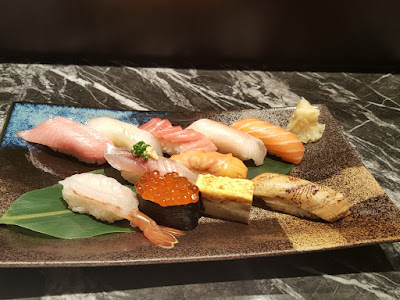
Try the kaisendon (海鮮丼, S$24.80), which features a mixture of fresh tuna, salmon, crab, tamago (玉子, egg), scallops and ikura (いくら, salmon roe).
Sample dish presentation, bento style.
Sample sashimi presentation.
Sample Edo-style sushi selection.

Admittedly nothing to do with the food, but the way even the toothpicks are arranged shows the attention to detail that you can expect at this restaurant.

Sabar

Saba () is the Japanese name for mackerel. Sabar specialises in cuisine starring the fish, which is unusual even in Japan. Sabar at Japan Food Town is the first overseas venture for Sabaya, and its 11th Sabar restaurant, all of which specialise in mackerel as the main ingredient.

There is a lot of symbolism in their restaurant with the number 38 (三十八 which sounds like 'saba' in Chinese), from 38 seats to 38 items on the menu. Lunch is served from 11.38am to 2.38pm. Sabar mainly uses top-quality mackerel from Aomori, though Sabar itself originated from Osaka. Saba is often seen cured or grilled, not raw, but Sabar uses specially-cultivated mackerel which is perfect as sashimi. The premium Ojo (princess) mackerel farmed by the West Japan Railway Company in Tottori prefecture in Japan. Two pieces of Ojo saba sushi costs S$10, while the entire fish served as sashimi costs S$57.

Ojo (princess) saba. 

Saba sushi.
Saba sushi.

This is saba shirako (白子) - milt (sperm from the male mackerel). This Japanese delicacy was absolutely amazing. It looks like tofu and feels much smoother. Extremely creamy and rich.
This is saba shirako (白子) - milt (sperm from the male mackerel). This Japanese delicacy was absolutely amazing. It looks like tofu and feels much smoother. Extremely rich.
And the menu:

Sabar's menu.
Sabar's menu. 
Okada-san expertly skinned and deboned the Ojo mackerel.
Okada-san expertly skinned and deboned the Ojo mackerel in a demonstation of sugata tsukuri (姿造り). a style presenting the whole fish as sashimi, with the head and tail still in place and the sashimi slices in between.

Watch how Sabar Singapore MD Okada-san prepares a mackerel for sashimi sugata tsukuri style (Instagram video)

Tempura Tsukiji Tenka

This is the first restaurant the Tokyo Sushi Academy, Japan’s top traditional culinary academy, is opening in Singapore. It features tempura and donburi by Tokyo Sushi Academy graduates, exclusively for Japan Food Town. Tokyo Sushi Academy has a branch in Singapore which offers courses and team building activities.

Diners can sit at the counter to watch the chef preparing tendon.

The pleasures of eating crisp, light tempura.

The menu offers various tendon (天丼), or tempura placed over rice with a light sauce. The batter for tempura and the way it is fried makes or breaks tempura. I've only ever tasted light, thinly-battered, crunchy tempura at a food court in Oriental City in London, and at Azabu in Brisbane. And as of yesterday, at Japan Food Town.

This is part of the menu plus what a sample dish looks like:

Tenka's menu plus sample dish.

Shabu Shabu Tajimaya

Shabu Shabu Tajimaya is a spinoff from Gyuta, a humble eatery from Hyogo that’s operated on the motto of good quality food with reasonable price since 1997. Their buffet-style shabu shabu (しゃぶしゃぶ) and sukiyaki are very reasonably priced. They have all-you-can-eat 60-minute and 90-minute formats, as well as one more traditional sets with a fixed amount of meat.

Facade, Shabu Shabu Tajimaya.

Just look at the marbling on the beef! It was gone in seconds.
Just look at the marbling on the beef!

  Twin broths on an induction cooker, with the beef cooking in it.
Twin broths on an induction cooker, with the beef cooking in it.

The 'grade 5' beef I tried was absolutely to die for (grade 5 beef is the highest quality possible for Wagyu beef). Boiled in water, the paper-thin meat cooked quickly and literally melted in the mouth in a burst of flavour,  We were provided with a ponzu style sauce as a dip which went very well with the beef.

Here're the parts of the menu about the 90-minute meals:

Shabu shabu selections.
Sukiyaki, anyone? 90 minutes' worth.
Sukiyaki, anyone?
Osaka Kitchen

Osaka Kitchen brings teppanyaki using Wagyu beef and okonomiyaki right in front of diners. Yakisoba is also available.

Several restaurants are yet to open. Nabe Seizan, for example, will only be open 17 July. The original Seizan restaurant in Japan is a two-Michelin starred kaiseki (an exquisite multiple-course banquet) restaurant currently helmed by the Tokyo-born chef Haruhiko Yamamoto. Chef Yamamoto strives to bring out the true flavour of each ingredient rather than rely solely on sauces. Nabe Seizan will offer nabe (鍋物, なべ物) cuisine, 'one-pot' dishes. Seizan’s original outlet is located in Mita, Minato in Tokyo.

Yakiniku Heijyoen will be open in August. Yakiniku Heijyoen takes top quality black hair wagyu from all over Japan, then ages it for tenderness and to bring out a deeper concentration of beef taste and flavour. Yakiniku Heijyoen goes by the name Heijyoen in Japan. Its main outlet is in Tokyo, Japan.

Japan Food Town is a joint venture established by Cool Japan Fund, a public-private fund, in collaboration with the JAOF and its corporate supporters at an investment of about S$8.5 million. Makoto Yoshikawa, Managing Director of Japan Food Town Development and Board Member of JAOF, called Japan Food Town a "multi-sensorial expression of the country’s culture and culinary gems brought together under one roof".

In a statement Yoshikawa explained that many Japanese early-stage companies and small and medium-sized enterprises (SMEs) have found it difficult to expand their businesses overseas in countries such as Singapore because of challenges such as ingredient procurement, staffing and lack of the appropriate space. "Through this project, the selected restaurants will be able to clear the toughest hurdles of overseas development and focus on offering consumers in Singapore with the same high level of service and food quality one would expect in Japan,” he said.

“I believe that through offering Singapore a truly authentic Japanese dining experience without those exorbitant prices, customers will appreciate a real sense of Japanese hospitality. We call this Omotenashi (おもてなし), where you will be warmly welcomed and respected,” he said.

Interested?

Japan Food Town is at 435 Orchard Rd, #04-39/54 Wisma Atria Shopping Centre, Singapore 238877
Hours: 11am to 11pm every day
Prices: Starting from S$10
Seating capacity: 628

Learn how to cook Kinmei Mai

Opening celebrations

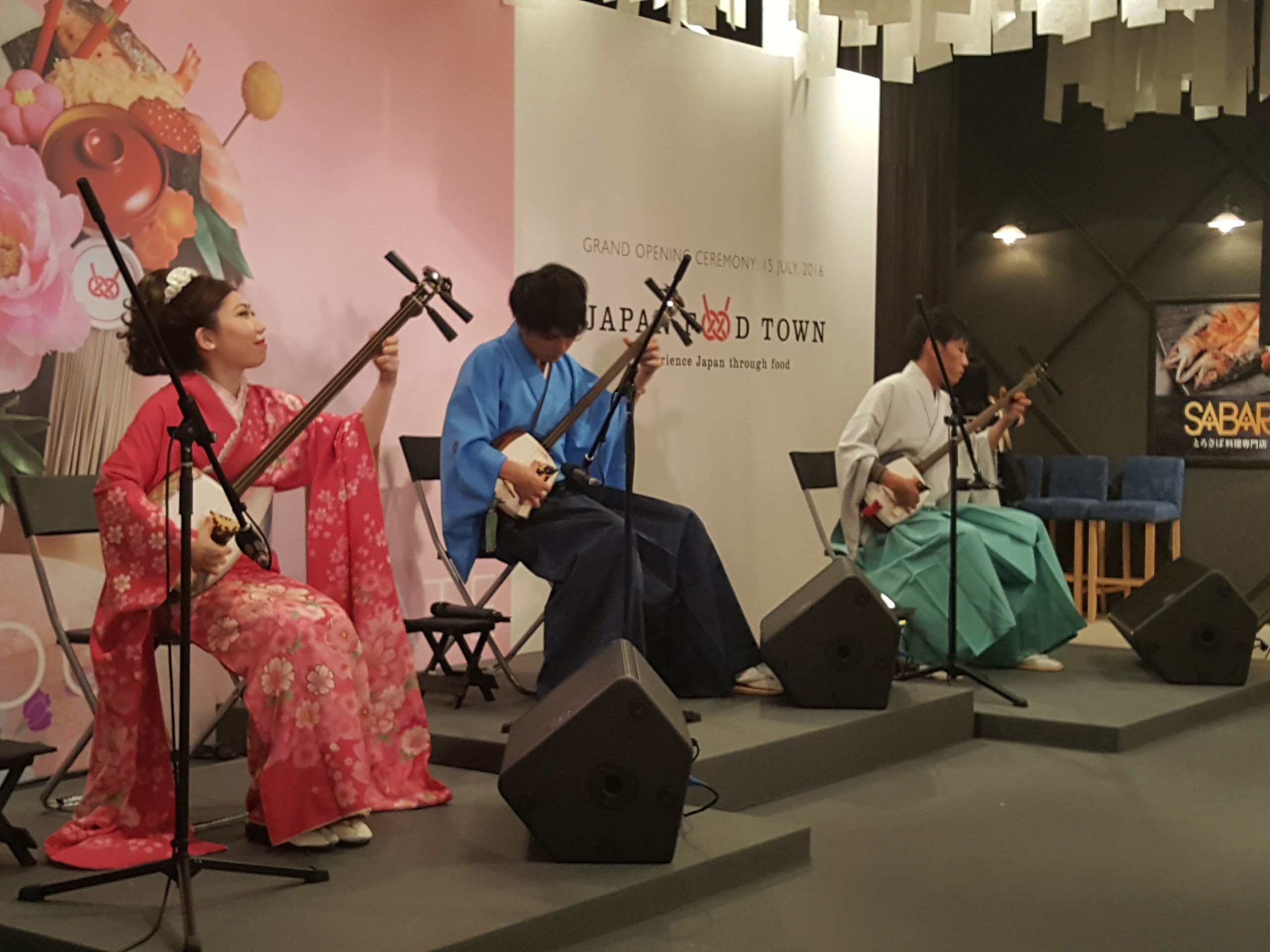
The opening celebrations on 16 July, to be held at Isetan Wisma Atria Level 2 (street level facing Orchard Road) from 12pm to 6pm, include Japanese cultural performances and free giveaways.

Hayate performed twice during the media preview.

Look for a performance by Hayate, a ten-member shamisen band created by the popular Yoshida Brothers (吉田兄弟), whose first album saw 100,000 copies sold. Hayate aims to create a completely new genre of shamisen music, pushing the limits of the shamisen to the max with rapid, complex yet completely synchronised rhythms that almost appear improvised. Two of the three players at the media preview shared that they had been playing the shamisen for 15 years.

There will also be Taiko drums and a live demonstration of Japanese calligraphy from celebrity calligrapher Tomomi Kunishige (國重友美), who invented the idea of eikanji (英漢字) - kanji composed of strokes that also spell the English word of the same meaning. Kunishige will also be launching her first private exhibition in Singapore.

Watch a snippet of Hayate's spirited performance at the media preview (Instagram video)

*The Sushi Encylopedia explains the history of Edo-style sushi


posted from Bloggeroid

15 July 2016

Pan Pacific Singapore crafts Mid-Autumn Reunion menu, introduces two new mooncake flavours this year

Source: Pan Pacific Singapore. The seven mooncakes from Hai Tien Lo.

Hai Tien Lo (海天楼), the Cantonese restaurant at Pan Pacific Singapore is celebrating this Mid-Autumn Festival with a special menu and seven handcrafted mooncakes presented by Executive Chef Lai Tong Ping (黎东平).

Source: Pan Pacific Singapore. The new Green Tea Paste
with Single Yolk baked mooncake.
There are two new flavours this year: the subtly scented Green Tea Paste with Single Yolk (单黄绿茶蓉月饼), a baked mooncake featuring a blend of jade-hued tea paste and a salted egg yolk enveloped within golden-brown pastry. Also debuting this year is the Black Sesame with Single Yolk (单黄黑芝麻月饼) baked mooncake, a blend of rich black sesame paste and fine textured salted egg yolk.

Durian lovers can expect the return of Hai Tien Lo’s signature Mao Shan Wang Durian Snowskin Mooncake (冰皮飘香猫山王榴莲月饼). Each mooncake offers a generous serving of creamy Mao Shan Wang durian puree in fine snowskin.

Those who prefer classic treats can indulge in the Traditional White Lotus Seed Paste with Single or Double Yolk (单黄白莲蓉月饼/双黄白莲蓉月饼), and White Lotus Seed Paste with Macadamia Nuts (夏果纯白莲月饼) mooncakes. For a healthier alternative with a nutty texture, the Vegetarian Mixed Nuts mooncake (五仁素月饼) makes the perfect treat. Featuring a nutritious combination of mainly walnuts, almond, preserved melon, sesame seeds, melon seeds, olive seeds and macadamia nuts, the vegetarian mooncake replaces the usual lard used in mixed nuts mooncake with vegetable oil. 

Source: Pan Pacific Singapore. The Traditional Four Treasures Mooncakes.

Presented in an elegant box, the Traditional Four Treasures Mooncakes (海天楼四喜烘月饼) selection is ideal as a gift for business associates. The four mooncakes included are the White Lotus Seed Paste with Double Yolk, a Black Sesame with Single Yolk, a Green Tea Paste with Single Yolk, and the Vegetarian Mixed Nuts mooncake.

Source: Pan Pacific Singapore. The  Black Sesame with
Single Yolk baked mooncake.
Apart from traditional mooncakes, guests who would like to dine in at Hai Tien Lo to celebrate the Mid-Autumn Festival can enjoy the opulent six-course Mid-Autumn Reunion Set Menu. Culinary highlights of this prix fixe (fixed price) menu include the crispy sea perch fillet in fermented taro sauce with garden vegetables in sesame sauce, and braised classic whole abalone with beancurd in superior oyster sauce. One complimentary box of Traditional Four Treasures Mooncakes will be gifted with every order of two set menus. 

Prices* for a box of four mooncakes:

Mao Shan Wang Durian Snowskin Mooncake - S$76

Traditional Four Treasures Baked Mooncakes (White Lotus Seed Paste with Double Yolk, Black Sesame with Single Yolk, Green Tea Paste with Single Yolk, Vegetarian Mixed Nuts) - S$72

Vegetarian Mixed Nuts Baked Mooncake - S$72

White Lotus Seed Paste with Double Yolk Baked Mooncake - S$70

White Lotus Seed Paste with Single Yolk Baked Mooncake - S$66

Green Tea Paste with Single Yolk Baked Mooncake - S$66

Black Sesame with Single Yolk Baked Mooncake - S$66

White Lotus Seed Paste with Macadamia Nuts Baked Mooncake - S$62

Mid-Autumn Reunion Set Menu 
  • Appetiser Combination Platter 珍饈三盛合
  • Double-boiled Bamboo Piths with Vegetarian Shark’s Fin and Mushroom 花菇銀針燉竹笙汤 
  • Crispy Sea Perch Fillet in Fermented Taro Sauce with Garden Vegetables in Sesame Sauce 南乳汁脆鲈鱼伴胡麻野菜 
  • Braised Classic Whole Abalone with Beancurd in Superior Oyster Sauce 蠔汁原粒鮑扣豆腐 
  • Stewed Inaniwa Udon with King Prawn in Supreme Stock 大蝦金湯稻庭麵 
  • Chilled Aloe Vera with Sago and Pomelo 柚子蘆薈甘露凍 
Source: Pan Pacific Singapore. The Mao Shan Wang  Durian Snowskin Mooncake.
Source: Pan Pacific Singapore. The Mao Shan Wang
Durian Snowskin Mooncake.
Interested?

Pan Pacific Singapore is at 7 Raffles Boulevard, Singapore 039595 

The mooncakes will be available from 15 August to 15 September 2016 at Pan Pacific Singapore, with pre-orders available from 18 July 2016. Advanced orders placed between 18 July and 14 August 2016 will enjoy an exclusive early bird deal of 25% savings on prepaid orders. 

Call +65 6826 8240 with orders and enquiries, or order online. Key in the early bird promotion code “EARLYBIRD25” at the checkout page to enjoy 25% savings on mooncakes from 18 July to 14 August 2016 if ordering online. Card members of UOB, Citibank, OCBC and Bank of China are entitled to 20% savings for mooncakes from 15 August to 15 September 2016. Simply key in the respective promotion codes UOB20OFF, CITIBANK20OFF, OCBC20OFF, BOC20OFF at the shopping cart page.

Priced** at S$128 per person, the Mid-Autumn Reunion Set Menu is available from 15 August to 15 September 2016 only for dine-in at Hai Tien Lo, at level 3. The menu is served at lunch from 11:30am to 2:30pm, and at dinner from 6:30pm to 10:30pm.

Read the WorkSmart Asia blog post about mooncakes at the Mandarin Orchard

*Prices are subject to 7% GST. 

**Prices are subject to 10% service charge and 7% goods and services tax.