- HP study says Asia-Pacific (APAC) small and medium-sized business (SMB) owners remain optimistic
- Bouncing back will require innovation in work processes, flexible work options and customised products and services
- Indonesia, India, Vietnam, Australia, and Thailand SMBs are the most confident of their ability to be innovative
HP Inc.’s latest study* on SMBs in Asia-Pacific,
Survival to Revival, revealed
that over 50% of SMB owners expect not just to survive but thrive
following the pandemic, and feel that digital transformation will be a
key part of this revival.
Some 60% of respondents see
digital transformation as key with innovation in work processes,
flexible work options and customised products and services identified as
future strategies. However, cost-effective solutions are required given
that cashflow remains top of mind and SMBs are unclear where to look,
or even what suitable solutions are available. This is especially key
where only four in 10 SMBs have a department or person responsible for
innovation.
Specifically:
• Fifty-three percent of SMBs in Asia expect to thrive post-pandemic and 60% see digital transformation key to success
• SMB respondents in Indonesia, India, Vietnam, Australia, and Thailand are the most confident of their company’s ability to be innovative and see digital adoption as a key strategy
Indonesia sees the importance of digital to business success, with 74% of Indonesian respondents ranking it as 'essential' or 'very important' against regional average of 59% (India 75%; Vietnam 60%; Australia 58%; Thailand 75%)
• Japan, South Korea, and Singapore are more conservative about their predictions for the future, possibly based on the global nature of their economies. Japan sees the importance of digital to business success with 34% of Japanese respondents ranking it as 'essential' or 'very important' against regional average of 59%; (South Korea 43%; Singapore 50%)
That said, respondents also identified barriers to success. Forty-five percent cited global instability post-pandemic as a key concern due to the uncertainty and inability to plan for the future. Besides global instability, the top three barriers to success are cash flow (28%), the need for adequate marketing and recruitment.
“SMBs are the lifeblood of every economy in
Asia but the pandemic has hit SMBs hard. As the engines of growth for
Asia economies, it is critical for them to move past survival to revive
their businesses,” said Ng Tian Chong, MD, Greater Asia at HP.
“This
study provides us with the insights to provide practical help for SMBs
so that they have access to an ecosystem of devices, tools and
technology. With these resources, we want to help SMBs unlock innovation
for customer and employee-centric experiences, as well as broadly
upskill talent to rebound from the pandemic and prepare for the future.”
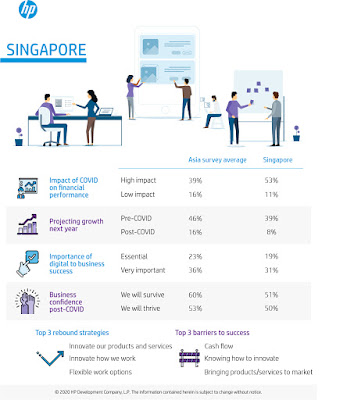 |
Source: HP. Infographic showing the Asian and Singapore figures for the Survival to Revival survey.
|
Completed in June 2020, the study surveyed
SMBs across Australia, India, Indonesia, Japan, South Korea, Singapore,
Thailand, and Vietnam and found:
• SMB owners understand that bouncing back post-pandemic will require them to lean on innovation in how they work, flexible work options and customisation of products and services. The top aspects to help them best bounce back are:
- Workstyle innovations (27%),
- Flexible work options (26%),
- Innovation in products and services (25%),
- Better use of digital tools available (23%) and
- Digitalising processes (19%).
• Companies most confident of bouncing back place high importance on digital adoption
Across
the region, nearly 60% view digital adoption as very important or
essential. Indonesian SMBs are particularly sensitive to this need, with
a full 74% believing it is essential or very important, as are Thai
SMBs, also at 65%.
• Growth projections have been significantly adjusted post-pandemic.
Across
the region, 46% of SMBs were expecting growth prior to the pandemic but
that figure has dropped to just 16%. India and Vietnam are the most
confident about post-pandemic growth and Singapore, Japan and South
Korea are least positive.
• Disruption to productivity is a common experience during COVID.
Only
6% of SMBs recorded higher levels of workplace productivity compared to
the pre-COVID period while 43% recorded lower productivity.
• Skills is an issue.
The
pandemic amplified the lack of digital-first mindsets and skills within
existing SMBs that hamper growth, affecting nearly half (44%) of
respondents.
SMBs are looking for the magic hire, preferring to hire people who can fulfil multiple duties to optimise productivity. In this context, hiring and recruitment is incredibly difficult as the SMB is trying to find someone with a broad range of skills from a narrow pool of candidates. This is particularly an issue in Japan, Thailand and Vietnam where recruitment is one of the top three barriers to success. The education, financial services and healthcare verticals also cite recruitment as one of the top three barriers to success.
• SMBs are unclear on where to look for assistance.
Financial
institutions, especially, rank high (31%); 60% of SMBs consider
government support to be insufficient and/or are unclear on what support
is available; only 19% of respondents turn to IT companies for help.
Underpinning
all of this is a need to identify digital talents who can help SMBs to
transform the business. The majority of SMBs do not dedicate resources
and/or invest in innovation as a discipline; it is more common to ask
customers what they want, or simply mirror what the competition is
offering.
Further:
- Only four in 10 have a team or individual responsible for developing new products and service.
- One in five work with external specialists or consultants to foster innovation.
-
One in five SMBs have customised offerings, looked for new sales and
supply-chain channels, or introduced new lines of business.
Indonesia
(59%) and Thailand (51%) stand out for having the highest percentage of
SMBs dedicating resources to innovation. Unsurprisingly, SMBs in
Indonesia and Thailand are also the most confident about business
performance post-COVID.
Over half (54%) of SMBs see the pandemic as an opportunity to reformulate their business despite less bullish growth, with only 16% expecting growth post-COVID in 2021. To bounce back quickly from the pandemic, SMBs expect to increase usage of online meeting and digital tools and to migrate more processes to digital. Resources that can provide practical help on how to leverage digital technology to unlock innovation are a priority for rebounding from the pandemic most effectively, they said.
In response, HP is introducing integrated services-based print solutions, including an
HP Roam for Business bundle, to make it easy to print on the go. Another solution for SMBs is the enhanced
HP SecurePrint, a flexible, cloud-native solution that releases documents only to authorised users.
To
support SMBs in adapting to new agile working environments, HP has
introduced a suite of integrated services-based print solutions. HP is
now offering a one-year license for
HP Roam for Business with a
compatible HP LaserJet Pro 400-series bought by 31 October 2020, making
it easy to print on the go from a mobile device and to retrieve the job
in a contactless manner at any
HP Roam-enabled printer within the company network.
In addition, HP has enhanced
HP SecurePrint, which
now supports all network types, including traditional networks behind a
firewall as well as serverless print environments, helping customers
simplify IT infrastructures. To empower workers the
HP Workpath
ecosystem,which enables workers to connect to cloud-based platforms
directly from the multifunction printers (MFP)**, has expanded rapidly
since it launched in November 2019, with 100+ apps available on the
platform and thousands of apps deployed.
To meet the
demands of the SMB worker’s multitask, multiplace workday, HP PCs are
designed to enable them to work anywhere. To ensure SMBs get ease of
mind when working anywhere, HP is offering
Sure Click Pro for free to all HP and non-HP Windows customers till September 30, 2020.
HP Sure Click technology guards against malware, ransomware, and viruses embedded in email attachments or malicious websites.
HP is making it easy for SMBs to get their hands on the latest technology. Through initiatives like
HP For Business in
Thailand, HP has tailored a monthly subscription programme that
includes powerful devices with trusted security and 24x7 technical
support. The programme helps relieve financial pressures on
entrepreneurs in the short term and takes care of their IT management
needs.
Further, the
HP LIFE programme offers
free online self-paced training courses designed to help entrepreneurs
and SMBs acquire new skills to grow their business, such as business
communications, having a success mindset, social media marketing, and
design thinking.
Explore:
Learn more about research highlights.
*The survey
covered 1,600 SMBs which completed the survey between 26 May 2020 and 7
June 2020. The results comprise 200 interviews in Australia, India,
Indonesia, Japan, South Korea, Singapore, Thailand, and Vietnam. Only an
owner, partner, MD, CEO, COO, CFO, or a Director of a business with
fewer than 200 employees qualified for the survey.
Interviews
were split evenly between micro business (<10 employees), small
business (10-49 employees), and medium business (50-199 employees).
Multiple
industries were represented, including retail/wholesale, manufacturing,
professional services, healthcare, education and financial services.
**Multifunction printers do more than just printing. Typically they will also scan and copy documents.