Showing posts with label Alibaba. Show all posts

10 May 2026

Alibaba's Qwen Glasses get more AI oomph

Alibaba has made a major upgrade to its Qwen AI Glasses with the introduction of proactive AI services, expanded everyday-life capabilities, and spatial 3D display capabilities. The update marks a significant step in evolving its AI wearables from a passive assistant into an intuitive, anticipatory companion, the company said.

Moving beyond traditional "ask-and-answer" interactions, the new proactive service system enables Qwen Glasses to understand context and act ahead of user requests. By learning user preferences and behaviour patterns and integrating real-time signals such as time, location, and environmental conditions, the AI delivers timely reminders or executes tasks automatically.

For example, the glasses can analyse weather forecasts, individual schedules, and the current location to proactively suggest bringing an umbrella if rain is expected during the morning commute. The device can track how long it’s been worn and user's postures, reminding them to lift their head and stretch.

The proactive capability also supports a range of everyday functions, including morning news briefings, personalised music playlists, workout route tracking, navigation, and fitness milestone tracking. Together, these features enable the glasses to provide continuous assistance throughout the day.

In addition, several core capabilities of Alibaba’s consumer-facing Qwen App will soon be available on the glasses, including ride-hailing, food delivery, trip planning, review searches, and movie ticket purchases. Users can access these services directly through the glasses, minimising phone dependency a range of work and lifestyle scenarios. 

Notably, the upgraded Qwen Glasses pioneers spatial 3D display in AI glasses, using dual optical engines with binocular stereoscopic imaging technology to deliver high-quality 3D visuals. Unlike conventional smart glasses that project flat 2D overlays, Qwen Glasses renders information with depth, layering, and spatial awareness. This allows navigation prompts, information cards, and other content to appear more naturally within the user’s field of view, enhancing readability and comfort.

Source: Alibaba.  Alibaba debuted the Qwen Glasses at Mobile World Congress (MWC) in Barcelona, accelerating its wearable AI strategy and unifying its AI ecosystem under the flagship Qwen brand.

According to Wellsenn XR, a research firm specialising in the smart glasses industry, Qwen Glasses have captured a 53% market share in China based on cumulative online sales since their official launch.

2 December 2020

Cainiao to work with Ethiopian Airlines for cold chain air freight

Source: Alibaba Group. A row of Alibaba and Ethiopian Airlines executives stand in a row holding a banner marking the launch of a Cainiao partnership with Ethiopian Airlines. A cargo plane with Ethiopian Airlines livery is in the background.
Source: Alibaba Group. Cainiao will send temperature-controlled medicines like COVID-19 vaccines around the world excluding Africa via Dubai with the help of Ethiopian Airlines.

Cainiao Smart Logistics Network, the logistics arms of Alibaba Group Holdings, is partnering Ethiopian Airlines to launch a special cold chain air freight for the transportation of temperature-controlled medicines from Shenzhen Airport, China's first medical cross-border cold chain facility.

Temperature-controlled medicines will be distributed twice a week from Shenzhen to Africa, and to the rest of the world via Dubai and Addis Ababa. This is China's first cross-border medical cold chain route to be operated regularly and is certified to transport temperature-controlled medicines including COVID-19 vaccines.

The end-to-end transportation process requires highly-effective cold chain management. The cold chain cabin is equipped with a temperature control system that monitors the cabin’s temperature in real-time. As the fourth airport in Mainland China that obtained International Air Transport Association (IATA)’s Centre of Excellence for Independent Validators (CEIV) certification for pharmaceutical logistics, Shenzhen Airport is also well-equipped to handle biotechnology products. 

The cargo terminal in Ethiopia is outfitted with compartmentalised cold storage facilities with temperature between -23℃ to 25℃. It occupies an area of 54,000 sq m, with dedicated cool dollies and a pharma team, as well as a real-time temperature monitoring system to ensure a safe and seamless cold chain logistics for handling temperature-sensitive healthcare products.

Cool dollies are containers designed to transport temperature-sensitive items between cargo warehouses and aircraft.

“Cainiao’s global logistics network spans over 200 countries and regions, providing end-to-end integrated logistics services, including digital customs clearance capabilities,” said James Zhao, GM, Cainiao International Supply Chain.

“The launch of the cold chain air freight has further bolstered our global logistics capabilities, and allow us to offer a one-stop solution for the global distribution of medical products such as the COVID-19 vaccines.”

Tewolde GebreMariam, Ethiopian Group CEO said, “Ethiopian Airlines will repeat its remarkable and globally-recognised success in leading the fast delivery of PPEs few months ago with similar delivery speed, professional handling and maintaining the cold chain during the forthcoming global distribution of the COVID-19 vaccine. In anticipation of the COVID-19 vaccine release, we will be at the forefront to further discharge our responsibility in the distribution of the vaccine across the globe.” PPE stands for personal protective equipment.

Cainiao’s launch of the Green Channel initiative this year to fight the pandemic has helped in the distribution of 250 million pieces of PPE, including COVID-19 test kits, to medical suppliers in over 150 countries and regions. In collaboration with its partners, Cainiao has also helped to transport medical relief items for international organisations during the pandemic.

26 May 2020

ICBC term deposits offered via Alipay

The Industrial and Commercial Bank of China (ICBC), the world’s largest bank in terms of assets, is now offering three-year term deposit services via Alipay, the digital lifestyle platform.

Alipay and ICBC have been collaborating since 2005 to offer online payment services to users. In January 2020, ICBC launched a one-year term deposit service via Alipay, enabling customers to purchase one-year term deposits directly through the platform. As of May, the bank has witnessed a sevenfold increase in the scale of the service.

The new three-year term deposit service has an annual interest rate of 3.79% and can be found on the Alipay platform under the name of Anxin Cun (Secure Deposits). The font size of the landing page has also been enlarged to ensure the service is easily accessible to elders.

ICBC is accelerating its digital transformation process to integrate more use cases for its users and provide more comprehensive services. In December 2019, ICBC, Alibaba Group and Ant Financial Services Group sealed a partnership to deepen their cooperation in fintech and financial services. Under the agreement, the three parties will work together more closely and improve the quality of fintech offerings by using smart technologies and product innovation.

3 June 2019

Alibaba Cloud to help companies fast-track China market entry

Alibaba Cloud has launched a China Gateway Program with eight local partners: the Info-communications Media Development Authority (IMDA), Enterprise Singapore, DBS SME Banking, Singapore Chinese Chamber of Commerce & Industry (SCCCI), SMU Academy, SGTech, Action Community for Entrepreneurship (ACE) and TechNode.

Alibaba Cloud, the data intelligence backbone of the Alibaba Group, has held its 2nd Alibaba Cloud APAC Summit in Singapore last week, where it showed how it is squarely in Asia for Asia.

The company unveiled of a China Gateway Program at the event, with the Info-communications Media Development Authority (IMDA), Enterprise Singapore, DBS SME Banking, Singapore Chinese Chamber of Commerce & Industry (SCCCI), SMU Academy, SGTech, Action Community for Entrepreneurship (ACE) and TechNode. The programme supports local businesses of all sizes in their growth beyond Singapore, especially into China.

“As the largest public cloud provider in Asia Pacific and our role as the data intelligence backbone of all business units in the Alibaba ecosystem from e-commerce to payments, logistics and supply chain management means we have the proven expertise and experience to help businesses grow. With the support of our partners here, we are confident of supporting local businesses of all sizes and from all backgrounds to grow beyond Singapore, especially into China’s market.” said Selina Yuan, President of Alibaba Cloud Intelligence International.

Yuan said Alibaba Cloud will help fast-track customers' entry into China on a fully-protected security platform with the sharing of resources, best practices and knowledge of local law and regulations. "Our mission is to make it easy to do business everywhere, especially for small and medium sized enterprises (SMEs)," she said.

Guest of honour Chee Hong Tat, Singapore Senior Minister of State, Ministry of Trade and Industry & Ministry of Education, said in a speech: "While digital technologies can create new opportunities, the successful implementation of new ideas often requires close collaboration with partners. Digital
solution providers offer a diverse suite of solutions from supply chain management to traffic incident response, across various industries, which businesses can take advantage of to strengthen their capabilities and grow our local ecosystem. To this end, I am heartened that Alibaba Cloud is committed to work with Singapore-based MNCs* and SMEs on this effort. Beyond digital transformation, Alibaba Cloud’s China Gateway Program can also be a valuable channel for Singapore SMEs to access China as they think about internationalisation."

"Overseas expansion continues to be a priority for DBS SME customers. However, many lack on-ground market knowledge and understanding of business requirements. To navigate these new markets, it is crucial that they work with the right partners and advisors to give their business a head-start. DBS is honoured to be the banking partner for Alibaba’s Cloud’s China Gateway initiative, and look forward to helping our customers capture new growth opportunities in the Greater China region. Our customers can leverage our global network, on-ground expertise and partners to fast-track their growth plans," said Tan Su Shan, Group Head of Institutional Banking, DBS Bank.

The program leverages the knowhow and experience of Alibaba Cloud, which has powered Alibaba Group’s growth to help local businesses capture and capitalise on growth opportunities in Asia and China. Through the local partners in Singapore and around the region, Alibaba Cloud will provide firms of all sizes with an in-depth immersion programme on doing business in China, connecting them to Chinese companies and consumers via the Alibaba ecosystem.


At the summit, Yan emphasised that Alibaba Cloud is in Asia for Asia, and not in China for China.
At the summit, Yuan emphasised that Alibaba Cloud is in Asia for Asia, and not in China for China. According to Yuan, "Alibaba Cloud is positioned as cloud for data intelligence for the future makers of Asia Pacific".

Alibaba Cloud separately announced a partnership with WeWork, the platform for creators that provides the space, community and services to help people make a life not just a living, and SoftBank Telecom China, the consultancy of enterprise-grade solutions, as part of the China Gateway programme.

The partnership offers a one-stop platform, from cloud-based technology solutions, enterprise services, flexible working space, events to business consulting – for business of all sizes looking to enter China or scale up their presence in the market.

Businesses can benefit from the cloud and data intelligence technologies, cross-border IT infrastructure, as well as enterprise solutions tailored for different sectors offered by Alibaba Cloud, the largest cloud service provider in the Asia Pacific region (APAC). In addition, programme participants can enjoy flexible collaborative space (­private, shared or customised), networking events, as well as accessibility and connections to target customers, business partners and the broader ecosystem from WeWork in China. Professional IT consulting services provided by Softbank Telecom China are also part of the programme benefits, along with go-to-market support, access to local tech communities and other business support from all three partners. The programme aims to empower global companies to create and expand business opportunities into the Chinese market.

“It is a first of its kind opportunity for any businesses focusing on the China market, as they can benefit from the local expertise, vertical-focused experience and innovation from three of the most-visionary companies in the world in one package. Together we are committed to supporting global enterprises to connect with digitally-savvy Chinese customers,” said Lancelot Guo, VP of Alibaba Group and GM of Strategy and Marketing for Alibaba Cloud Intelligence.

“With Alibaba Cloud’s innovative technologies and Alibaba’s ecosystem support, we hope to help tackle some common challenges faced by multinational companies entering or growing in China, enabling them to explore more opportunities in the market and stay competitive.”

“The partnership is significant to WeWork because we ourselves have been through the journey of setting up and scaling our business in China. When we began our journey here in China back in 2016, we had to adopt a very localised approach to navigate in this very unique business environment,” said Christian Lee, Vice Chairman, WeWork Asia.

“We are grateful that we have developed a successful strategy and build the largest workplace platform in China. Leveraging our own experience and our partnership with Alibaba Cloud, we are confident to support and empower companies to enter and scale in China – through our holistic offering of space, community, employee experience, as well as accessibility to meaningful business connections and partnerships with the most innovative companies in China.”

The platform also offers exclusive pricing rates for other offerings from Alibaba Cloud and WeWork. On top of traditional offerings, programme participants can also enjoy other privileges such as exclusive Alibaba Cloud-hosted technology workshops, marketing opportunities with Alibaba Cloud, discounts on products and services including business registration, business travel booking on WeWork Services Store, as well as training and events organised by WeWork, Alibaba Cloud, SoftBank Telecom China and other programme partners to deepen their understanding on the business environment in China.

The summit was also the launchpad for more than 10 new products and features, including a new accelerator programme connecting technology partners with the Alibaba ecosystem. Many of these products and features were only launched in March in China, and were introduced outside of China for the first time in Singapore.

“As the largest public cloud provider in Asia Pacific, Alibaba Cloud is speeding up digital transformation in this region by building a world-class cloud infrastructure and we have also been at the forefront of the rapid development of data intelligence. Today, Alibaba Cloud not only provides infrastructure that underpins the entire Alibaba economy from e-commerce and payment, to logistics and supply chain management, but also ensures inclusiveness, so that our cloud technologies can be accessed by companies of all sizes,” said Yuan.

The new products and features that are available globally for the first time outside of China include an SaaS Accelerator, which enables ecosystem partners, such as enterprises in the e-commerce, lodging, and travel industries, to quickly reach their customers on Alibaba platforms.

The accelerator enables technology partners to easily build and launch software-as-a-service (SaaS) applications and leverage proven business and technology knowhow in the Alibaba Economy. SaaS providers can quickly deploy and test their applications on the cloud, shorten the implementation lifecycle, and accelerate time-to-market. According to Dr Derek Wang, GM of Alibaba Cloud Intelligence in Singapore, apps can be created in just five days. 

In line with its commitment to champion small businesses, Alibaba Cloud also launched an upgraded service support campaign designed for SMEs. SME customers will now be able to benefit from greater access to resources and support from Alibaba Cloud. Key benefits of the enhanced support and service include dedicated one-on-one presale consultations, 24x7 technical support, a doubling of complimentary tech support tickets as well as swifter after-sales support.

Alibaba Cloud has the largest infrastructure footprint in the Asia Pacific region, with 15 availability zones outside mainland China, covering the Hong Kong, Singapore, Australia, Malaysia, Indonesia, India and Japan markets. International headquarters for Alibaba Cloud were set up in Singapore in August 2015, the same month a Singapore cloud data centre was established. There are currently three availability zones in Singapore. It is also the only global cloud provider with local data centres in Indonesia and Malaysia. Its first cloud-based Anti-DDos Scrubbing Center was opened in Malaysia last year as an additional layer of protection for customers.

*Multinational corporations.

4 February 2019

SMU and Alibaba Cloud launch first-of-its-kind upskilling programme outside of China

The Singapore Management University (SMU) and Alibaba Cloud have launched a series of courses today to upskill more than 1,000 working professionals in Singapore.

Formalised at a memorandum of understanding signing ceremony, the SMU-Alibaba Series professional continuing education programme is the first of its kind for Alibaba Cloud outside of China, and will be offered at the SMU Academy, the professional training arm of SMU, from March 2019.

Crafted specifically to empower small and medium sized enterprises (SMEs), the Series aims to equip businesses with the right competencies and capabilities to navigate rapid technological disruptions and fast-evolving consumer behaviour today. The courses will cover the latest trends and digital strategies across a range of industries, including retail, finance, logistics and manufacturing, to bring participants up to speed on the adoption of emerging technologies such as cloud computing, artificial intelligence (AI) and Blockchain within their respective fields.

Leon Chen (left) with Dr Lim Lai Cheng (right) after the signing ceremony.
Chen (left) with Dr Lim (right) after the signing ceremony.


Dr Lim Lai Cheng, Executive Director, SMU Academy, said, “This collaboration leverages Alibaba’s cutting-edge technologies and leading industrial knowledge; as well as SMU’s thought leadership, academic rigour and outreach. I am confident that the courses on offer will benefit many professionals who wish to upgrade their knowledge and skills in emerging tech areas, and companies which are keen to use digital and smart technologies to transform their business models.

“Following the completion of their face-to-face training, we hope to encourage participants to continue learning and sharing through the use of Alibaba’s online platforms. Over time, we hope to build a strong online learning community among Singaporeans and SMEs.”

Dr Lim added that the community will be constantly updated to help members hone their skills. This post-course community is the first of its kind for SMU.

Leveraging its faculty expertise, SMU will also develop cases of successful technological adoption by local companies, which in turn will be used as teaching resources for the SMU-Alibaba Series. In future, SMU and Alibaba Cloud plan to expand the Series to include a mentorship programme to help participating SMEs to implement tech-enabled strategies for their businesses.

Leon Chen, Country Manager, Singapore and Indonesia, Alibaba Cloud, shared that it is a special time to partner with SMU as it is the 20th anniversary for the Alibaba Group, and the 10th anniversary for Alibaba Cloud. He said that Alibaba Cloud set up headquarters in Singapore in 2015 not only to provide infrastructure-as-a-service, but to play as a technology enabler.

"We want to replicate our success in China. We want to bring over our technology, not only infrastructure but in big data, in security, in different vertical solutions," he said. "Singapore is the perfect hub not only for Asia but also the international market."

“As Singapore’s Smart Nation becomes a reality, we will require smart citizens to lead the way. Our partnership with SMU aims to help equip local businesses with the right tools and technology to propel Singapore onward. We hope to provide actionable advice through a blend of success stories and our holistic approach to technology to help create a future-ready Singapore,” he added.

The Series will begin with seven courses from March 2019, all of which will be conducted by Alibaba Cloud scientists who have experience with Singapore:

- Big Data Analytics & its Application in Business/Smart Retail & Marketing, by Long Yin and Yang Kan respectively, which will be based on case studies from Alibaba's own business and that of customers.

- Internet of Things: Technology & Applications, by Chuah Jun Wei

- Smart Finance by Sijukumar Kumaran

- Essentials of Cloud Computing by Gavin Liu

- Smart Manufacturing by Yang Kan, and

- Smart Logistics by Cao Yi, which will leverage lessons from Hema and Cainiao.

Yang said the courses will focus on the latest digital strategies that integrate seamless customer experience from offline to online, transforming business models into smart ones and showing how best practices and digital strategies can enable businesses to compete in new markets while preserving their core business.

Each course features an introduction, case study and workshop segment. "We want attendees to learn from each other, not only from us, so they can create synergies, have brainstorms and create innovative ideas," Yang said.

Upon successful completion, participants will receive a certificate jointly issued by the SMU Academy and Alibaba Cloud.

Courses under the SMU-Alibaba Series will be funded by SkillsFuture Singapore will be offered as part of the SkillsFuture Series of training programmes to drive training in eight priority and emerging skill areas. Seventy percent of the course fee can be offset for Singapore citizens and Singapore permanent residents. Singapore citizens aged 40 and above, and SMEs which send their employees who are Singapore citizens and Singapore permanent residents for the training, can claim a 90% course fee subsidy.

Explore:

There are two intakes from 19 to 20 March, and 11 to 12 June. The courses are basic and generally open to working professionals, with some courses suitable for business leaders and senior managers. Recruitment has already begun. Get details of the courses


View pictures of the announcement on Facebook

1 December 2018

Fourth batch of entrepreneurs graduate from eFounders Fellowship initiative

Source: UNCTAD/Alibaba. Ma with the 4th class of  eFounders participants.
Source: UNCTAD/Alibaba. Ma (right, standing) with the 4th
class of eFounders participants.
Thirty-eight Asian entrepreneurs have successfully completed the fourth edition of the eFounders Fellowship, a joint initiative by the United Nations Conference on Trade and Development (UNCTAD) and Alibaba Business School to arming entrepreneurs with the right skills for their businesses and encourage them to share their knowledge with their communities.

The initiative was started to fulfil the pledge made by Jack Ma, founder and Executive Chairman of Alibaba Group, in his capacity as the UNCTAD Special Adviser for Young Entrepreneurs and Small Business. The commitment seeks to empower 1,000 entrepreneurs in developing countries by creating champions for inclusive and sustainable economic development through the digital economy over the next five years.

“This initiative amplifies many of the efforts made by the international community to support digital transformation and innovation for inclusive and sustainable development,” said Arlette Verploegh, UNCTAD eFounders Fellowship Programme Coordinator.

“Investing in youth entrepreneurship can inspire other entrepreneurs in their endeavours and help create awareness about challenges they face and the opportunities the modern economy offers.”
In the fourth batch, entrepreneurs from Bangladesh, India, Myanmar and Singapore joined peers from Cambodia, Indonesia, Malaysia, Pakistan, the Philippines, Thailand, and Vietnam in the programme. Collectively, the participants represent various industries including e-commerce, logistics, fintech, tourism and big data. All participants are founders of promising startups.

The first eFounders Fellowship Singaporean graduate is part of the fourth batch. Victor Liew is the founder of Xfers, a fintech providing compliance, payments, funds disbursal and e-money solutions in Singapore and Indonesia. Parcel Perform's co-founder Dana von der Heide was also part of the cohort. Parcel Perform, a logistics startup, is based in Singapore.

Participants had a chance to understand the entrepreneurship spirit at the core of Alibaba since it was founded, the integrated ecosystem of platforms including Taobao Marketplace, Tmall, Alibaba.com, Cainiao Network, Freshippo (Hema), in addition to relevant industry trends and developments such as New Retail and the impact of e-commerce in rural areas.

To foster more partnerships regionally, the class had interactive sessions where fellows engaged with the lecturers, participants and advisors. Speakers from Alibaba’s senior management team and network were joined by advisors from East Ventures, Gobi Ventures, 500 Startups and the Malaysian Digital Economy Corporation (MDEC). The advisors shared insights and experiences from their local markets and fund raising with the entrepreneurs, including tips on how to grow an entrepreneurial community within their respective digital economies.

The programme gave participants a greater appreciation of Alibaba Group’s support of the digital economy’s growth in China. Entrepreneurs witnessed the kickoff of the 11.11 Global Shopping Festival and experienced the technology, concepts and milestones onsite. Additional field visits and lectures shed more light on the digital transformation that has swept China during the last 20 years.

The entrepreneurs also developed a sense of global and social responsibility by reviewing their business plans against the UN’s Sustainable Development Goals.

“With exposure to the Alibaba ecosystem and our network of partners, and our role in developing the digital economy of China, we hope the entrepreneurs will discover more ways to build a more inclusive and sustainable model for their own businesses while championing the growth of the digital economy in their markets,” said Brian Wong, VP, Alibaba Group, who heads Alibaba’s Global Initiatives programme.

“It is such a privilege to be part of this initiative, especially when the senior leaders and founders, including Jack Ma, spoke to all of us in person,” said Liew. “Their commitment to share their knowledge and wisdom liberally is inspiring, and demonstrates how we can and should be contributing more to the community through our businesses and ideas.”

Following graduation, the 38 Asian candidates have been officially inducted as Fellows of the global eFounders Fellowship network. They join a cohort of 89 entrepreneurs who have graduated over the last three editions.

As part of the commitment by UNCTAD and Alibaba to ensure all Fellows actively apply what they have learned within their communities towards developing an inclusive and sustainable economic model, both organisations will continue to regularly monitor and support the progress of the Fellows every three months.

Advisors from five Asian countries were also inducted into a network overseeing and supporting the development of the latest batch of budding Asian entrepreneurs after graduation. These advisors were involved in the course to better understand the programme and entrepreneurs under their charge.

Explore:

New Retail combines the best of offline and online commerce, with a digital twist. Watch a video about New Retail

11 November 2018

Clothes, cosmetics and baby products pique 11.11 shoppers' interest

Source: Alizila blog. The 2018 11.11 Global Shopping Festival logo picked out in neon.

Alibaba's 2018 11.11 Global Shopping Festival is already breaking 2017 records. Live updates from Alizila have revealed that it took just 1 minute and 25 seconds for the festival to get past total GMV* of US$1 billion.

As of 1.15pm, Tmall Global’s GMV has surpassed the platform’s total GMV of last year’s 11.11. In addition, more than 100 overseas brands have exceeded RMB10 million in GMV. Moony, Ya-Man, Swisse and Chemist Warehouse were some of the first to see these numbers, Alizila's live updates on the festival.

As of 1 am, Alizila shared that the top 10 countries/regions selling to China were:
1. Japan

2. US

3. Korea

4. Australia

5. Germany

6. UK

7. France

8. Spain

9. New Zealand

10. Italy

Cosmetics, toiletries, and food supplements ruled the roost for Chinese customers on 11.11. Baby-related products were also popular. The top 10 imported brands bought by Chinese consumers were: 

1. Swisse, a health and wellness company

2. Kao, which has a number of brands including for beauty, women's paper products and toiletries, as well as cleaning products, and baby diapers

3. Moony, which makes baby products. Moony is a Unicharm brand.

4. Aptamil, a milk powder brand from Danone

5. Dr.Ci:Labo, a Japanese medical skincare brand

6. MartiDerm, known for its nutricosmetics

7. A.H.C, the cosmetic brand from Korea

8. Bio Island, which makes supplements

9. GNC, which sells supplements

10. Move Free, a brand of supplements from Schiff Vitamins

It appears that shopping for winter clothing was a biggie this year for 11.11 customers outside of China, plus party clothes for the season.

The top 10 categories of products exported from China were:

1. Dresses

2. Wool coats

3. Pants

4. Hoodies

5. Wool-knitted sweaters

6. Sweaters

7. T-shirts

8. Down jackets

9. Shirts

10. Low-top shoes

*GMV for the 11.11 Global Shopping Festival is the total value of orders settled through Alipay on Alibaba's China retail marketplaces, Lazada and AliExpress within a 24-hour period on November 11. It is reported on a real-time basis and includes shipping charges paid (where applicable).
All GMV and other figures presented are unaudited and subject to adjustments.

5 November 2018

11 things about 11.11

Alibaba’s 11.11 Global Shopping Festival, to kick off on November 11, is already brimming with pre-launch bells and whistles. Here are 11 things shoppers should know:

Artificial intelligence (AI)-supported multi-language tools

To help global shoppers enjoy the upcoming Festival, Alibaba has developed an AI translation tool that helps remove potential language barriers between sellers and buyers.

The online chat room tool, launched on Lazada last week, supports instant translation between English and Thai, English and Vietnamese, and English and Indonesian. 

AliExpress, Alibaba’s global online retail platform, also offers an AI translation tool that links English speakers with those who speak Chinese, Russian, Spanish, French, Arabic and Turkish. 

AI chatbot

Over 800,000 merchants on Taobao and Tmall will deploy Dian Xiaomi, an AI-powered customer-service chatbot, to handle customer inquiries during the festival.

AI video editing

Alibaba Wood, an AI video-editing tool for brands to generate short videos about their products, will be available to some merchants during the Festival. The editing tool can pull key text and images from the product page to quickly create a 20-second promotional video. 

The visuals are matched to the rhythm and flow of background music, chosen by an algorithm that factors in human emotions to arouse shoppers’ interest. The tool is expected to help small merchants significantly save on the cost of promotions. 

The largest smart warehouse in China
 
Robots at the Cainiao smart robot warehouse.

Alibaba’s logistics unit Cainiao has opened China’s largest smart robot warehouse in Wuxi, Jiangsu Province. Overall, Cainiao’s network has linked 30 million sq m of warehousing around the world, involving more than 3 million logistics personnel.

With 700 automated guided vehicles (AGVs), the new warehouse is located in Cainiao’s first IoT Future Park in Wuxi. The Internet of Things (IoT) technology in the warehouse can automatically direct AGVs to drive, load and unload. 

The system will also plan the best routes for the AGVs so that they avoid collisions and intelligently distribute parcels. This will allow 50% more orders to be fulfilled by the warehouse compared with a traditional facility over the same time period. 

Discounts for 88 vip members

Customers who are Alibaba 88 VIP members.will enjoy a 5% discount on 388 brands on Taobao and Tmall, on top of other special offers during 11.11.

The 5% discount is a new addition to 88 VIP member benefits, which already include a 5% discount on Tmall Supermarket and 88 brands. An 88 VIP member is also automatically entitled to membership across various Alibaba businesses, including video-streaming platform Youku, music-streaming platform Xiami, on-demand delivery service Ele.me and online ticketing portal Taopiaopiao.

Countdown Gala
This year’s gala, to be held November 10 in Shanghai’s Mercedes-Benz Arena, will feature international stars such as singer Coco Lee, Australian model Miranda Kerr, the dance group Kinjaza and circus group Cirque du Soleil. The event will be broadcast live on two leading satellite TV channels – Zhejiang TV and Shanghai TV.

Special offers from Ele.me

In the lead up to 11.11, Ele.me has launched various promotions in partnership with dining brands, including McDonalds, KFC, Starbucks, Wu Fang Zhai, and Haidilao. Consumers can enjoy special half-price discounts or offers for as little as RMB1. This is the first time that the on-demand delivery and local service platform has joined 11.11.

In addition, consumers can also order deliveries on Ele.me for groceries, fruit, flowers, pastries and medicines, with promotion products from several popular brands, including Procter & Gamble, Unilever, Hershey, Budweiser and Nestle, offered at RMB0.01, RMB0.99 and RMB3.

Oranges from Rural Taobao

Source: Alibaba. Rural Taobao will share oranges from its farm of the future with consumers.
Source: Alibaba. Rural Taobao will share oranges from its
farm of the future with consumers.

For the first time, Rural Taobao is bringing oranges from its “future farm” to consumers’ tables. In a remote county in Hubei province, farmers are transforming traditional ways of farming through Alibaba’s technologies. The farm is equipped with integrated irrigation facilities, meteorological sensors and drones.

An electronic map shows real-time crop growth and information about the latest agricultural operations. The farm is expected to harvest 1.5 million kg of oranges in the run-up to 11.11 and shoppers can view details of Rural Taobao’s products on the Taobao app.

Global fun @ Fliggy

Fliggy is bringing promotions from renowned airline partners, hotel brands and travel rewards alliances. Consumers will enjoy a single membership with access to more reward opportunities, new members-only services and discounts.

Marriott International debuted W Hotel’s New Year Pass on Fliggy, allowing customers to enjoy New Year parties at any of the seven W Hotels in Beijing, Shanghai and Xian. It will also offer a privilege package of 24 nights at JW Marriott hotels around the world.

Tmall World brings promotions to overseas

Shoppers have opportunities to enjoy special offers and a number of promotions on Tmall World, a platform that aims to connect overseas Chinese consumers worldwide through Alibaba Group’s Chinese-language social commerce apps Mobile Taobao and Taobao Lite:

· Free-shipping of over 4,000 products to overseas markets including Hong Kong, Taiwan, the US, Canada, Singapore, Malaysia and Australia.

· Taobao and Tmall users can participate in the platforms’ first referral programme available to the overseas markets, whereby they can gain additional shopping vouchers and stand a chance to win prizes worth up to RMB100,000 by referring friends to download and make purchases on the Taobao Lite app.

· Taobao and Tmall are launching a first-of-its-kind extended showcase at NomadX, Singapore’s first “phygital” multi-label concept store at Plaza Singapura, in the run-up to the 11.11 Global Shopping Festival.

· About 2,000 partner merchants have the support of local warehouses for swift return services.

Red packet rain

It’s going to be raining red packets at 100 shopping malls in Beijing, Shanghai, Guangzhou, Shenzhen, Hangzhou, Chengdu, Nanjing, Suzhou, Tianjin, Wuhan, Xian, and Chongqing. Consumers can simply shake their phones to get red packets. Consumers can earn special promotion coupons when they open the red packets in their Taobao mobile apps. The coupons can be used in both online shops and offline smart stores during 11.11.

11 December 2017

Double 12 Global Shopping Festival to woo Alipay users

Source: Alipay Facebook page. Flag advertising the Double 12 Global Shopping Festival.
Source: Alipay Facebook page. Flag advertising the Double 12 Global Shopping Festival.

Alipay, the world’s largest online, mobile payments and lifestyle platform operated by Ant Financial Services Group, today kicked off its 2017 Double 12 Global Shopping Festival in Southeast Asia, including Singapore, Malaysia, Thailand and the Philippines.

Globally, Double 12 will occur in 15 countries and territories spanning across four continents. Over 500 brands and 100,000 merchants are participating worldwide to offer exclusive promotions throughout December to Alipay users.

“With Alipay’s global vision to enable smart lifestyle for consumers, Double 12 Global Shopping Festival is our ‘glocalisation’ strategy to achieve the vision through localised service offerings,” said Cherry Huang, GM, Cross-border Business for South and Southeast Asia, Alipay.

“The South and Southeast Asia region continues to be an attractive travel destination for mainland Chinese travelers. Our extensive merchant network in this region across hospitality, food and beverage (F&B), attractions, and shopping will provide mainland Chinese travellers a cashless experience while they eat, play and entertain. In particular, some of our most attractive Double 12 promotions are available at airports and prime shopping districts, where millions of Chinese travellers frequent.”

Singapore

- Department stores Tangs, Metro and Robinsons along Orchard Road will offer Alipay users discounts of up to 50% on selected products.

- Suntec City: one RMB50 shopping e-coupon and one RMB25 dining e-coupon per Alipay user

- Flying Through Time show admission at Resorts World Sentosa: 40% off when you purchase more than two adult admission tickets

- Jurong Bird Park, Night Safari, River Safari and Singapore Zoo: selected souvenirs and drinks at 50% off

- Wild Wild Wet: 50% off the 2nd ticket purchased

Malaysia

- At Suria KLCC, Alipay users will be able to redeem a RMB20 shopping e-coupon and a RMB10 dining e-coupon collected via their Alipay app. These can be used at selected merchants. Besides that, over 100 merchants in the shopping complex will accept Alipay payments, with many offering 50% discounts to celebrate the shopping festival.
- At the Robinsons department store, mainland Chinese travellers can enjoy deals of up to 50% off selected items, while Eraman duty-free stores at airports will be holding a Swarovski jewelry lucky draw for Alipay users who spend over RMB2,000 via Huabei, a consumer financing service featured within the Alipay app. 

Thailand

- Apartment store Siam Paragon, Siam Discovery, Siam Center, Emporium, Em Quartier and Bluport will offer Alipay users shopping discounts of up to 50% on selected products.

- Fashion brand LaLaMa by NaRaYa and NARA by NaRaYa will offer Alipay users shopping discounts of up to 50%.

- 7-Eleven convenience stores across Thailand offer 50% discounts on selected products to Alipay users.

In addition, Ant Financial’s strategic partners, including Truemoney in Thailand and GCash in the Philippines, will introduce Double 12 for local e-wallet users for the first time. In Thailand for example, more than 10,000 merchants will be participating in 1212 D-day Deals for Truemoney users while 3,000 merchants will offer exclusive discounts on 1212 GCash Day in the Philippines.

Explore:

Watch the event launch in Australia on Alipay's Facebook page

Hashtag: #Alipay1212, #Double12, #ShoppingFestival

2 September 2017

Just smile to pay at this KFC restaurant in China

- A fresh and digitally connected experience for urban professionals

- Brings facial recognition payment solution to consumers for the first time globally

Yum China Holdings has launched a new restaurant concept, KPRO by KFC in Hangzhou, China - home of Alibaba. Designed to offer a fresh, seasonal menu to sophisticated diners, the concept harnesses digital technology to provide a fully immersive dining experience.

"We are excited to launch KPRO – an exciting and fresh new concept for young, tech savvy consumers who are keen to embrace new tastes and innovations," said Joey Wat, President and Chief Operating Officer of Yum China. "Developed to cater to China's burgeoning population of urban professionals, KPRO offers a creative, modern and seasonal menu with a wide range of dishes that are freshly made-to-order. The restaurant is also made for the digitally connected customers and integrates some of the latest technologies from mobile ordering to facial recognition payment."

The KPRO menu features seasonal produce and made-to-order salads, panini and roasted chicken, complemented by freshly squeezed fruit juice, gourmet coffee and premium Cremia ice cream. The store is designed with a "greenhouse" layout and an open kitchen.

A key feature of the new restaurant is the integration of Alipay's new "Smile to Pay" facial recognition payment solution, which enables customers to pay without the need to reach for their wallets. Alipay's payment technology utilises a multistep authentication process, including a facial scan and mobile phone number, to verify the identity of customers and facilitate payment. This is the first commercial application of the facial recognition payment technology globally.

"Yum China has a history of adopting innovative technologies to enhance in-store dining experience and we could think of no better place to pilot this advanced technology. Smile to Pay will bring another level of convenience for customers," said Jidong Chen, Ant Financial's Director of biometric identification technology.

Source: Yum China.   A customer paying using Alipay’s new “Smile to Pay" facial recognition payment solution in KPRO, Hangzhou, China.
Source: Yum China. 
"Elevating the customer experience through new design, flavours and technologies has always been central to our approach at KFC in China," said Johnson Huang, GM, KFC. "We are excited to partner with Alipay to bring the world's first commercial application of the facial recognition payment solution to our customers. With the adoption of the facial recognition payment solution, KPRO customers can experience this ground breaking technology while enjoying fresh and tasty meals prepared in our open kitchen."

In addition to facial recognition payment, KPRO incorporates other technologies to provide customers with a convenient and connected in-restaurant experience. With no traditional ordering counter, customers are able to 'skip the queue' by ordering at digital kiosks or using their mobile phones to scan QR codes and order at their tables. KPRO staff then deliver the freshly prepared food directly to the tables.

8 January 2017

Work as we know it to evolve by 2046

AliResearch, the research arm of Alibaba Group, has shared its take on what our digital future will look like. At the second Vision 2046 summit in Beijing, China, the company shared its Digital Economy 2.0 report, which predicts:

The end of corporations

By the year 2020, the majority of commerce will be conducted on digital platforms, which provides consumers and merchants the infrastructure of commerce, such as data, trade, payment, logistics and etc. In the process it will give rise to the world’s first digital platform with transaction volumes that exceed US$1 trillion.

No more eight-hour employment

By 2036, around half of the workforce will be made up of self-employed and freelance workers, putting an end to the eight-hour work days. 

Centralised commerce goes extinct

By 2046, 80% of global trade will be conducted by small businesses or individuals, as the platform model for economic development will enable them to create and trade globally and freely.

Alibaba Group works to empower small and medium sized enterprises (SMEs) and individuals with the ability to transform and upgrade their businesses for the future. The company anticipates the birth of a new retail industry driven by the integration of online, offline, logistics and data across a single value chain. Alibaba is also a keen advocate for the establishment of an Electronic World Trade Platform (eWTP) which encourages nations to implement free and fair trade for their SME constituents.

A report by Boston Consulting Group (BCG), also released at the summit, predicts that by 2035, China’s eGDP, a monetised measurement of the digital economy, will grow to around US$16 trillion with a penetration rate of around 48% of the wider economy, compared to US$1.4 trillion and a penetration rate of 13% in 2015. The digital economy will create some 415 million jobs, with Alibaba’s ecosystem contributing over 100 million of the job opportunities.

In the era of what it calls 'New Retail', BCG foresees that low-skill, repetitive tasks in offline stores will be replaced by high-tech equipment like touch screens, mobile apps or robots, while omnichannel sales talent will be highly valued by online and offline enterprises. Meanwhile, a 'New Manufacturing' industry will arise in which worker efficiency is greatly enhanced by the increasing use of robotics. The BCG report predicts a large number of new jobs will be created as intelligent manufacturing in China booms.

Source: AliResearch. China Foresight Forum, a new thinktank comprising 10 founding institutions including AliResearch, has been established to focus on research about the future economy.
Source: AliResearch. China Foresight Forum, a new thinktank comprising 10 founding institutions including AliResearch, has been established to focus on research about the future economy. 

"2046 may seem like a distant future but what AliResearch is initiating today, in collaboration with our peers, is nonetheless meaningful. We are in the midst of a great transformation that requires us to imagine beyond industry boundaries, geographic borders and the limitation of time. The insights emerging from our discussions today will ensure that we foresee and are better-prepared for the future and assist us to leverage the necessary platforms to maximise the socioeconomical values of the Digital Economy 2.0,” said Gao Hongbing, Dean of AliResearch and VP of Alibaba Group.

China Foresight Forum, a new thinktank initiated by 10 founding institutions including AliResearch and Chinese Academy of Social Science was established at the event to promote the sharing of learning between different think tanks with a focus on the studies of the future economy.

12 November 2016

Alibaba's 11.11 Global Shopping Festival rakes in over US$17 billion this year

Alibaba Group announced that RMB120.7 billion (US$17.8 billion) in gross merchandise volume* (GMV) was settled through Alipay on Alibaba's China and international retail marketplaces on November 11, 2016. This is an increase of 32% compared to 2015**. Total mobile GMV settled through Alipay was RMB99 billion (US$14.6 billion), accounting for 82% of total GMV.

"This year’s 11.11 is a preview of the future of retail, where entertainment, commerce and interactive engagement intersect seamlessly,” said Daniel Zhang, CEO, Alibaba Group. “From the kickoff of warmup activities to last night’s countdown gala and all the way through the 24-hour global shopping festival itself, we’ve seen unprecedented engagement between consumers and merchants. 11.11 showcased how online and offline retail will be reinvented to offer brand new shopping experiences to our hundreds of millions of mobile, digitally savvy active users.”

Source: Alibaba Group. After the full 24 hours, 11.11 had garnered RMB120.7 billion in GMV.

Key highlights from the 2016 11.11 Global Shopping Festival
 Alibaba Cloud processed 175,000 orders per second at the peak
 Alipay processed more than 1 billion payment transactions in total, and processed 120,000 transactions per second at peak
 The Cainiao Network processed more than 657 million delivery orders placed on Alibaba’s China and international retail marketplaces

This year was Alibaba’s most global 11.11 shopping festival since the inception of the event in 2009, offering Chinese consumers access to brands and products from businesses of all sizes around the world. Highlights from the 2016 Global Shopping Festival include:

 Cross-border transactions were completed with 235 countries and regions
 Over a third (37%) of total buyers purchased from international brands or merchants
 Top countries selling to China by GMV included: Japan, US, South Korea, Australia, and Germany
 Top Japanese brands by GMV included: Uniqlo, Panasonic, Sharp, Sony, and SK-II
 Top Australian and New Zealand brands by GMV included: Jeanswest, UGG, Swisse, Macro, and Blackmores

(Editor's note: this year I made a purchase on 11.11 at AliExpress for the first time, because the discounts for products on 11.11 were clearly going to be lower than buying on any other day. There was no discernable lag in information displayed or in payment processing.)

*Data related to payment transactions and logistic orders are provided by Alipay and Cainiao Network respectively. All GMV, mobile GMV and other figures are unaudited and subject to adjustments. GMV for the 11.11 Global Shopping Festival is the total value of orders settled through Alipay on Alibaba’s China and international retail marketplaces. It is reported on a real-time basis and includes shipping charges paid (where applicable). Transactions related to international brands, defined as brands created outside of mainland China, and user data are limited to Tmall.    

**Alibaba Group's operating results disclosed are denominated in RMB; year-over-year comparisons and growth rates are calculated on the basis of RMB amounts and are not affected by foreign exchange rate fluctuations. 

2 November 2016

Rousing countdown to Alibaba's 2016 11.11 Global Shopping Festival

Source: Alibaba Group. The 2016 11.11 Global Shopping Festival was launched on October 20 in Hong Kong.
From left: Jet Jing, VP of Alibaba Group; Maggie Wu, CFO of Alibaba Group; Daniel Zhang, CEO of Alibaba Group; Joe Tsai, Executive Vice Chairman of Alibaba Group; and Chris Tung, CMO of Alibaba Group.

Alibaba Group has revealed more features and highlights of its 2016 11.11 Global Shopping Festival Countdown Gala. Guests will include basketball player Kobe Bryant and band OneRepublic. There will also be some surprise guests on the night, to be held in Shenzhen on November 10, Alibaba said.

Performers already announced include Katy Perry, who is also the gala’s Global Ambassador, American sitcom 2 Broke Girls star Beth Behrs, and 2010 World Cup Golden Boot-winning footballer Thomas Müller.

This year’s gala reflects Alibaba’s globalisation efforts, as demonstrated in the range of participating brands and merchants, in addition to the lineup of international guests. The festival offers consumers much more than shopping, Alibaba said. In addition to international celebrities, music idols and football stars, the gala will also introduce a wide range of multimedia activities to engage consumers globally.

Chris Tung, CMO, Alibaba Group said, “The gala will be a global carnival, a world-class performance that involves the audience throughout the event with many touchpoints and is like nothing else you would have experienced. Last year was an incredible show and attracted attention from around the world, and this year we are going to surpass this and push the boundaries of entertainment by co-creating programmes with global brands and production studios. So make sure that you are ready and tuned in to get the party started on November 10th!”

As the director of this year’s gala, Los Angeles, US-based TV producer David Hill commented: “I’m excited to have been brought in to be part of something that is so unique. Combining Alibaba’s technology with my experience at other global events we are going to develop a spectacle like no other. This is going to be entertainment that goes beyond expectations and we have a chance to continue to build the legacy of this event. November 10th is eagerly awaited both in China and throughout the world - I’m looking forward to working with the team over the coming days to ensure that people aren’t disappointed.”

Hill has produced live events as varied as several NFL Super Bowls, the 88th Oscars, and American Idol.

This year the gala will redefine interactive entertainment by engaging consumers at an unprecedented level. One example is that viewers will be able to take part in competitions by shaking their smartphones equipped with Taobao or Tmall apps during the event, with big prizes to be won or even the chance to win the celebrities’ clothes right off their backs. Viewers will also have the chance to play the role of director in certain gala segments where they can let the story play out the way they want it to.

In a new element for this year, there will be four one-minute advertising time slots available for free in the categories of consumers, brands, non-profit organisations and 11.11 participants. The winners in each category will be chosen as the most innovative and most inspiring, and will be given the opportunity to have their ad videos played in front of an audience of hundreds of millions.

This year the gala will be held for the first time in the southern Chinese city of Shenzhen at the Shenzhen Universiade Sports Centre. The event will be broadcast live by official media partner Zhejiang Satellite TV. Alibaba’s media assets like Youku Tudou, Tmall TV Box and UC Web will also be conducting live broadcasts of the gala.

Last year the four-hour gala was held in Beijing, at the Water Cube and was watched by around 100 million viewers. TMall generated RMB91.21 billion (around US$14.34 billion) in gross merchandise volume (GMV) on 11.11 last year, surpassing US online shopping volumes on Black Friday and Cyber Monday combined. Over 40,000 merchants and 5,000 global brands from 25 countries participated in the 11.11 Global Shopping Festival last year.

This gala, plus mobile live streaming, virtual reality shopping, interactive games and an eight-hour livestreamed fashion show leading up to November 11 underscore the role that strong entertainment and interactive content will play in engaging all consumers and helping merchants explore new and creative ways to market their brand and products.

The 2016 11.11 Global Shopping Festival was launched on 20 October and promises weeks of marketing promotions, entertainment and new product offerings from around the world, culminating in the world’s busiest and largest shopping day.

At the launch Daniel Zhang, CEO of Alibaba Group said, “11.11 Shopping Festival has become the global retail benchmark over the past seven years, and we have raised the bar again this year to redefine the retail experience for consumers together with our merchants from around the world.

11.11 has evolved far beyond a 24-hour sales event. From today through November 11, consumers will discover, explore, play, watch, comment, share, recommend and shop across our entire ecosystem with our merchants both online and offline. Leveraging our robust infrastructure, global merchants have been empowered with unprecedented capability to seamlessly engage and serve customers through new technology and new environments.”

The 2016 11.11 Global Shopping Festival has four primary focuses which support the global growth strategy of Alibaba and the scale of the event:

Entertainment and interactive engagement
Entertainment and interactive content will play a significant role in engaging all consumers this year which will help merchants explore new and creative ways to market their brand and products.

+The activities included Tmall's eight-hour fashion show in Shanghai, the largest of its kind in China with 50 international brands and 160 models participating. The show was streamed live via the Tmall and Taobao mobile apps, during which viewers can preorder items in real-time as they appear on the catwalk.

“The Tmall Global Fashion Show is a key event that kicks off our 11.11 Global Shopping Festival and one that underscores Tmall’s tremendous growth in the past few years. For big-name fashion brands across the globe, Tmall has become not only a distribution channel, but also a branding powerhouse as well as a global gathering place for lifestyle and fashion trends. We expect the event today to become a lifestyle trendsetter for Chinese consumers and virtually a ‘fashion week at their fingertips,’” said Tung.

Launched in 2008, Tmall is China’s biggest online B2C platform for apparel and accessories, with 80% of market share according to the 2016 Global Trend and Lifestyle Spending Report by CBNData. With access to more than 400 million consumers across the Alibaba platforms and housing more than 50,000 apparel brands, Tmall is set to grow alongside China’s online apparel and accessories industry, which is expected to exceed RMB1 trillion in sales in 2017.

At the Shanghai Oriental Sports Center, style guru Nick Wooster, the image consultant of this year’s show, led a procession of top models including Sui He and Maye Musk, celebrated photographer Tommy Ton and top performers such as Chris Lee on-stage in front of the live and online audience.

Top brands from Burberry to Trussardi, Paul Smith to La Perla showed their latest offerings for the season on the runway while global brands such as Maserati, Guerlain, Rimowa, Vidal Sassoon and New Balance introduced their newest creations using the Tmall platform. Burberry also released a mist of its Mr Burberry cologne to promote the scent's debut on Tmall.

Streaming live on Mobile Taobao, Tmall.com and Youku, the show combined entertainment with a demonstration of Alibaba’s latest technological capability, to help brands engage with consumers in a fun, entertaining and intimate fashion. The live and online audiences could preorder items that were in the show by viewing the products on the Tmall and Taobao apps and tapping the “buy now” button. Orders placed during the eight-hour show and successfully executed on November 11 during the 11.11 Global Shopping Festival will enjoy steep discounts.
    
+Till November 11, more than 600 international brands will be streaming live broadcasts on Tmall to educate and excite targeted consumers about their brand and 11.11 product offerings.

+Alibaba will pilot “Buy+”, the world’s first complete virtual reality (VR) shopping experience, during this year’s 11.11 festival. Shoppers will be virtually transported to select retail stores internationally, and experience the entire shopping process from product selection to payment, all through VR.

+The 11.11 Global Shopping Festival Gala on November 10 will feature a series of interactive activities between brands and consumers to drum up excitement towards the countdown of 11.11.

Online to offline (O2O) initiatives
This year’s 11.11 will showcase Alibaba’s ability to seamlessly integrate data obtained online with offline activities, including marketplace data, logistics, media, and entertainment. Alibaba believes that the future of commerce is not pure e-commerce, but an integrated, holistic online and offline experience. Below are a few examples of the power of O2O during 11.11:

+Alibaba will release a location-based augmented reality (AR) mobile game about two weeks before November 11. Consumers can follow the Tmall Cat mascot on an adventure across the Alibaba online and offline retail ecosystem to earn special promotions and prizes. Participating merchants include Suning, Intime shopping malls, Beijing Joy City shopping mall, Shenzhen Coastal City shopping mall, as well as global brands such as Shanghai Disneyland, KFC and Starbucks.

+Alibaba is working with more than 1 million offline stores across various product categories to present consumers with an integrated online-to-offline experience across products, members and services.

Personalisation through big data
Each user will have a unique and highly-personalised shopping experience for 11.11 this year. Driven by data, everything from product recommendations, search results, newsfeeds, to user-generated content etc., will be specifically tailored to the individual consumer.

+Consumers will enjoy highly relevant products and content that meets their interest and lifestyles.

+Brands and retailers will have the ability to customise their storefronts, product selection and marketing materials targeted at different demographics. 

Buy globally, sell globally
Globalisation is a strategic long-term priority for Alibaba Group, with the 10-year goal of serving 2 billion consumers and supporting 10 million small businesses, brands and retailers globally. The 2016 11.11 Global Shopping Festival will take Alibaba another step forward in its globalisation strategy with its Buy Globally, Sell Globally initiative.

+Buy Globally: Alibaba is the premium gateway to China for international brands and merchants to sell quality international products and services to Chinese consumers.

+Sell Globally: Alibaba is introducing a new pilot programme to help global merchants sell beyond China. The company is in its early phases of expanding its infrastructure, including logistics and payments, in order to allow consumers overseas to purchase international products through Tmall. Hong Kong and Taiwan are the first markets outside mainland China where this will be available.

The 11.11 shopping festival began in 2009 with 27 merchants as an event for Tmall.com merchants and consumers to raise awareness of the value in online shopping. Seven years later, 11.11 has become a global event with participating merchants in the tens of thousands, buyers in the millions, and total sales in the billions.

12 October 2016

Alibaba's Ma says more support for young entrepreneurs, small businesses needed

Alibaba Group Executive Chairman Jack Ma has called on the 34 Asian Cooperation Dialogue (ACD) member states for more policies and infrastructure that support individuals under 30, as well as companies with fewer than 30 employees as they will drive future economic success on a global scale.

“Small is beautiful. Small is powerful,” said Ma in his capacity both as Alibaba Group Executive Chairman and as Special Adviser on youth entrepreneurship and small business to the United Nations Conference on Trade and Development (UNCTAD). The second ACD Summit was held in Bangkok, Thailand on October 9 and 10 with the theme One Asia, Diverse Strengths.

In his address, Ma picked up this theme to talk about the inclusivity and openness of Asia as a region, pointing to how mobile technology in particular had the potential to overcome geographic challenges with regard to trade promotion, financing and job creation. He also emphasised the importance of infusing innovation and imagination into education in Asia. By working together Ma suggested that member countries had the ability to create the next stage of globalisation, one that evolves away from enabling large corporations and on to realising the potential of smaller businesses.

The Asian Cooperation Dialogue (ACD) is an Asian regional cooperation platform initiated by Thailand in 2002 with the aim of connecting the countries in Asia and to build an Asian community based on dialogue and cooperation. The membership has extended to 34 states which represent 60% of the global population.

Ma was one of the first business leaders, and the only business leader from China, to speak at the forum which holds a number of values in common with the Alibaba Group, such as positive thinking, openness and a proactive and results-oriented nature.

9 October 2016

ShopBack explores Singapore's behaviour on Singles Day

ShopBack, which aggregates over 500+ online retailers such as Taobao in various lifestyle categories, has found that 40% of Singapore residents did not know about Singles Day - November 11 - in an online survey*, although they were aware of third-party shopping platforms such as ShopBack.

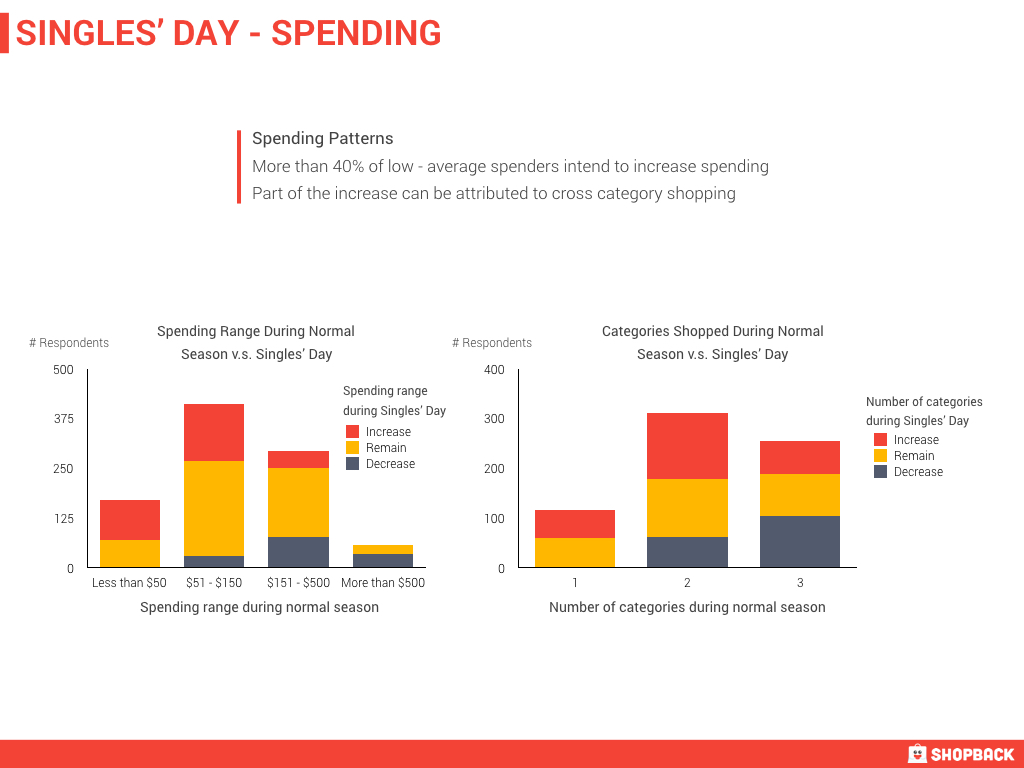
Alibaba, which introduced Singles Day as a focus for e-commerce, generated US$14.3 billion in gross merchandise volume** during the 2015 11.11 Global Shopping Festival. Shopback found that among those who expressed intent of shopping online on Singles' Day, an estimated 60% shared that they will keep to their usual spending bracket of S$51 to S$150. ShopBack commented that the feedback "shows most Singaporeans are self-restrained when it comes to spending, even on a major retail holiday such as Singles' Day which boasts steep discounts and incredible deals".

ShopBack noted that the low prices encourage respondents to explore cross-category purchases. Half of respondents who said they usually focus on one shopping category shared that they will consider purchasing from other categories on Singles’ Day, ShopBack said.

Source: Shopback. Spending patterns for Singles Day.

ShopBack further predicts that the fashion, health & beauty and electronics categories will enjoy more purchases on Singles’ Day, whereas sales in the dining and travel categories might be lower as Singles’ Day deals are perceived to be relatively less enticing.

*An online survey was conducted over the past two weeks and garnered feedback from 2,000 residents in Singapore. The survey results are collated in collaboration with SingSaver.com.sg

**Gross merchandise volume or GMV is the total amount settled through Alipay on Alibaba’s China and international retail marketplaces. All 2015 11.11 GMV and other figures are subject to final auditing following conclusion of the event.

21 June 2016

Chinese passengers can pay for Grab rides in Singapore, Thailand via Alipay

  • Visitors from China can now use Alipay to pay for Grab rides in Singapore and Thailand
  • Grab’s partnership with Alipay further highlights company’s commitment to providing a seamless app experience to customers
Grab, the Southeast Asian ride-hailing company and Ant Financial Services Group, the parent company of China’s largest third-party payment platform Alipay, are providing a cross-border payment solution to Chinese travellers visiting and residing in Singapore and Thailand. Starting today, Alipay users can pay for their taxi and private-hire car rides booked through the Grab app with their Alipay accounts.

Prior to this, Chinese travellers would have had to pay for their rides either by connecting their dual currency credit cards or making a payment via cash. With the Alipay payment option added, all Chinese travellers can pay for their fares in renminbi, without having to worry about currency exchange. Grab and Alipay plan to make the Alipay payment option available in other Southeast Asian markets that Grab currently operates in.

“We are constantly looking at ways to improve our app experience for local and international users. Providing multiple payment options that suit our customers’ preferences is a key focus area for us. Our partnership with Alipay allows Chinese travellers to use Grab to book taxis or private cars for a hassle-free way to get around the city – and they can use a payment method they are familiar with, go cashless and pay in Renminbi,” said Joel Yarbrough, Group Product Manager, Grab.

Sabrina Peng, Vice President of International Business at Ant Financial, said, “By collaborating with partners like Grab, we provide Chinese travellers the kind of convenience they are used to in China – no matter where they are in the world.”

To use Alipay, passengers need only open their Grab app, select GrabPay in the menu bar and add their Alipay account. Grab’s partnership with Alipay underlines the company’s continued commitment to making the Grab app an even more seamless experience for local and international users. Grab passengers can choose to pay with their preferred option, whether cash, credit card or Alipay. Grab is also partnering with local mobile operators to offer mobile wallet solutions.

Alipay has been working with local merchants in 69 overseas markets. As of May 2016, Alipay is accepted in more than 70,000 retail stores outside of China, and tax reimbursement via Alipay is supported in 24 countries and regions, including South Korea, Germany and France.

13 April 2016

Alibaba Cloud launches Create@Alibaba Cloud startup programme

Alibaba Cloud, the cloud computing arm of the Alibaba Group, has launched its first global startup programme, Create@Alibaba Cloud. The initiative was first announced in Singapore, where Alibaba Cloud has international headquarters, and which will act as the regional hub for the programme.

Singapore was chosen as the regional hub for the programme because of the country’s strong links and access to other ASEAN markets, including Thailand, Indonesia and Malaysia. With its close connectivity and reputation as Asia’s most entrepreneurial economy, startups in the programme can easily build connections in Singapore and catapult themselves into neighbouring markets, the company said.

Source: Alibaba Cloud. Yu introduces Create@Alibaba Cloud.
Source: Alibaba Cloud. Yu introduces Create@Alibaba Cloud.
Create@Alibaba Cloud champions startups and maximises their potential through Alibaba’s comprehensive support network and cloud infrastructure services. Yu Sicheng, Vice President of Alibaba Cloud, said: “Our focus has always been to empower our global customers with our cloud expertise to achieve greater global coverage and expansion into international markets. Through our programme, we hope to make our sophisticated networking solutions and big-data intelligence also available to startups and small enterprises to accelerate their business growth. This is Alibaba Cloud’s first global startup program, expanding from previous initiatives in (mainland) China and Hong Kong, and we’re proud to launch it here in Singapore.”

Programme benefits include zero investment in IT infrastructure, professional cloud architect support, and co-branding with Alibaba Cloud for qualified startups.
Programme benefits include zero investment in IT infrastructure, professional cloud architect support, and co-branding with Alibaba Cloud for qualified startups. One of the major benefits of the programme is up to US$10,000 in funding to cover IT costs. Alibaba Cloud can also help with the legal and compliance challenges of entering the China market.

Yu noted that Alibaba Cloud already has startup programmes as well as incubation centres at the Alibaba campus, and is looking to expand the ecosystem and resources to Singapore and globally. Programme partners currently include the Silicon Valley Association of Chinese Entrepreneurs Inc (SVACE), Hanhai Investment, and the Hong Kong Science Park.

As part of the programme, participants will receive funding for investments into IT infrastructure for the first year, technology training for professionals, tailormade IT solutions designed by Alibaba Cloud’s architects and one-on-one post-sales support.

Create@Alibaba Cloud also empowers startups with better access to overseas markets and potential connections. Programme participants will receive support through Alibaba Cloud’s global start-up partners’ network for funding, working spaces, and incubation, as well as the ability to leverage Alibaba’s resources in entering the China market. Participating startups will also be invited to join Alibaba Cloud’s marketing campaigns, both online and offline.

As part of the programme, a series of competitions will be rolled out in key regions including ASEAN markets, Hong Kong, Korea, the Middle East and Europe. These will identify startups with good business potential. Regional winners from the competitions will have the opportunity to pitch their business ideas and conduct live product demos at the annual Alibaba Computing Conference Hangzhou Summit in October 2016. During the programme rollout, cloud workshops, entrepreneurship talks and other activities will be held in these key regions.

Pang Heng Soon, General Manager of Infocomm Investments (IIPL) said: “We are constantly looking at ways to continue building a robust ecosystem for startups in Singapore through initiatives such as the Create@Alibaba Cloud programme. For startups to succeed they will need both technical knowhow and market insights; through a support programme like Alibaba Cloud, entrepreneurs will gain access to cloud capabilities and insights on cross-border expansion to reach their full potential.”

Pang describes the startup ecosystem in Singapore.
Pang said that startups in the software and Internet space in particular have departed in the past decade from the traditional business expansion model of first developing a product and then getting funding. An iterative model of selling a business model, getting the funding and then completing or refining the product is now in place. "They try fast, learn fast, fail fast, and do it again if they fail," he said.

Dr Sun Wenting, Singapore-based CTO of artificial-intelligence based data analytics platform AD+, operates completely on Alibaba Cloud. The startup tried out the services last year and committed to moving fully onto Alibaba Cloud this year, said Dr Sun. The company is also part of the company's startup programme.

Dr Sun explained that her research and development team is located in both Singapore and China. "Alibaba Cloud has cross-border capabilities that can help us collaborate more closely," she said. "We can (also easily) connect with Chinese investors and potential clients."


Dr Sun introduces her company and its flagship AD+ platform, which helps gain sales conversions more easily through the application of artificial intelligence.

A  similar entrepreneurship initiative by Alibaba Cloud in mainland China, established in March 2015, has cooperated with over 40 venture capital and investment funds, supported nearly 10,000 startup projects and  worked closely with over 200 incubators in China. The global initiative is offered "in the same spirit" as the China initiative, but targets local startups, and could be very different in terms of the type of offline events and content, Yu noted.

The regional entrepreneurship support in Singapore dovetails with a recently-launched Singapore data centre and a focus on customer and partner acquisition in this part of the world, Yu added, as Alibaba Cloud moves to replicate its success in China in the rest of the world. "We have a major partnership with a major telco haven't announced yet," he said of partnerships in Singapore. "We're in the process of entering into more partnerships that we're going to announce at the Yunqi Conference in Shenzhen in the next two weeks."

Interested?

Read the TechTrade Asia blog post about the Singapore government's push to strengthen the core of the infocomm sector


posted from Bloggeroid