Showing posts with label shopping. Show all posts

26 July 2020

Adobe: APAC consumer sentiment still positive in mid-2020

Despite COVID-19-induced lockdown restrictions now being lifted in many parts of the world, the extended time spent confined to the home has had a significant impact on consumers’ shopping habits and their interactions with brands, according to research* released by Adobe released on the sidelines of Adobe Experience Makers Live, a virtual event to help brands adapt to the digital world.

According to the research, COVID-19 has impacted consumers’ everyday lives and habits. Nearly seven in 10 consumers (67%) expressed concern about the overall impact of the pandemic. Chief amongst these concerns are personal health (73%), job vulnerability (40%) and the economy (36%). Millennials (72%) typically expressed greater concern compared to Gen Z (58%), Boomers (62%), and Traditionalists (48%).

Simon Dale, MD, Southeast Asia, Adobe commented, “The outbreak of COVID-19 has accelerated a broad shift in APAC consumer behaviours and attitudes that have been in the making for some time. It is clear from the results of the study that brands that are nimble in pivoting to this digital ‘new norm’ will be able to create deep and enduring brand resonance while helping their customers feel truly supported. Marketers will need to pay close attention to their customers and ensure that they adapt their CX strategy to address different groups with relevant messages, more so now than ever.”

While almost all consumers surveyed (95%) are willing to wait out the continued restrictions, only 61% agree with the continued lockdown measures, signalling an eagerness to resume life per normal. Chinese consumers cited the least disagreement with the continued restrictions. Overall, APAC consumers were more willing to wait out restrictions, in contrast to consumer sentiment in Japan and the US.

The survey found a growing social consciousness reflected in the importance consumers placed on staff treatment (77%). Despite this, brands have some way to go - only slightly over half (54%) of consumers agree that brands are doing enough to ensure staff wellbeing. Among the younger generation, attitudes are polarised on this issue - Gen Z typically ascribed less importance while Millennials ascribed more importance to treatment of staff.

Nearly three in four consumers (73%) found it important for brands to mirror the state of the world in their marketing collaterals in response to COVID-19. China (80%) and India (83%) consumers were more likely to agree with this sentiment. Furthermore, there is a general sense that brands have a duty to proactively offer help or provide special offers to customers at this time. This sense of duty among marketers is strongest in China (94%) and India (94%), and weakest in Australia (82%). In the US, close to four fifths (78%) of marketers surveyed say brands have this duty.

Source: Adobe APAC Consumer Survey (June 2020). Results of responses (n = 4,001) to the question "How, if at all, have you changed your shopping for the following?". Shopping frequency and habits have changed. Groceries, media, books, and health products saw an increase or no change in purchase frequency; in contrast, clothes, home improvements, and dining/delivery faced the steepest decline.

Male consumers were more likely to purchase dining/delivery and media, while female consumers shopped less in all categories except groceries and clothes. Media is defined as movies, games and music.

Younger generations and Indian consumers, specifically, cited increased purchasing across all categories, with the exception of dining/delivery for the latter.

Despite COVID-19, seven in 10 consumers reported a preference for purchasing groceries, health/beauty items and home-improvement solutions in person, while around half also opted for home delivery (47%) - usually for food and books - and 17% relied on curbside pickup. In curbside pickups, the shopper does not enter the store, but takes delivery nearby, outside the store.
Across all product categories, younger generations and urban residents preferred home delivery while the older generation preferred in-person shopping, with the exception of media for the latter. Amongst all countries surveyed, Australian consumers were more likely to favour in-person shopping across all product categories. 

Marketers have done a good job at keeping brand sentiment relatively positive during this time. Over half (55%) of consumers found utility in brand-related COVID-19 updates they were sent, with 69% requesting said updates in the future.

Frequency of messaging and ensuring that specific groups of consumers receive messages they need, when they need them was a crucial part of this. Two-thirds of consumers agree that brands are communicating just the right amount, while interestingly, nearly one in five (16%) believe that brands are not communicating enough. Younger consumers were more likely to unsubscribe from emailers, highlighting the importance of taking a personalised approach to keep different groups engaged.

To respond to these nuances in customer preference, the majority of organisations are transforming their long-term strategy in case this period lasts for more than a year (79%), and are also changing their approach to future marketing efforts (82%). In fact, marketers in APAC organisations indicated a greater inclination to make long-term changes compared to their counterparts in the US. Changes include shifting to different marketing channels (75%), changing prioritised audiences (58%) and reallocating resources across different regions (47%).

The intrinsic value of brands directly addressing COVID-19 in external communications is apparent with over seven in 10 (71%) of marketers report having a COVID-19 task force to manage messaging and campaigns. Those in Australia (55%) and Singapore (67%) are less likely to have a task force, whereas those in China (81%) and India (80%) are more likely to have one.

During the lockdown, 58% of consumers increased their online shopping frequency while three quarters (74%) cited an intention to change their future shopping habits. Indian and Singaporean consumers reported the strongest intentions. Unsurprisingly, younger generations were more likely to cite an intention to change future shopping habits while older generations preferred to maintain the status quo.

Chinese and Indian consumers were most likely to report an increase in online shopping, with Indian and Singaporean consumers reporting the strongest intention to change their future shopping habits.

In contrast, under half of marketers in Japan and the US report having specific teams for this. The positive outcome of aligning closely with a COVID-19 task force is that the vast majority of marketers in APAC feel that organisational marketing and communications have been authentic (94%) and have resonated with customers (92%).

Explore:

Download the reports on the Adobe website – Consumer Report | Marketer Report (PDFs).

*Conducted by research firm Advanis for Adobe, the study surveyed 4,001 consumers in selected Asia Pacific countries – Australia, China, India and Singapore and 1,200 marketers across China, India, Singapore and Australia between 1 – 17 June 2020.


APAC stands for Asia Pacific, and CX for customer experience. 


Age bands are defined as: 18 to 29 years old: Gen Z (23%); 30 to 49 years old Millennials (36%); 50 to 64 years old: Boomers (26%); and 65 years+: Traditionalists (15% ).

11 November 2018

Clothes, cosmetics and baby products pique 11.11 shoppers' interest

Source: Alizila blog. The 2018 11.11 Global Shopping Festival logo picked out in neon.

Alibaba's 2018 11.11 Global Shopping Festival is already breaking 2017 records. Live updates from Alizila have revealed that it took just 1 minute and 25 seconds for the festival to get past total GMV* of US$1 billion.

As of 1.15pm, Tmall Global’s GMV has surpassed the platform’s total GMV of last year’s 11.11. In addition, more than 100 overseas brands have exceeded RMB10 million in GMV. Moony, Ya-Man, Swisse and Chemist Warehouse were some of the first to see these numbers, Alizila's live updates on the festival.

As of 1 am, Alizila shared that the top 10 countries/regions selling to China were:
1. Japan

2. US

3. Korea

4. Australia

5. Germany

6. UK

7. France

8. Spain

9. New Zealand

10. Italy

Cosmetics, toiletries, and food supplements ruled the roost for Chinese customers on 11.11. Baby-related products were also popular. The top 10 imported brands bought by Chinese consumers were: 

1. Swisse, a health and wellness company

2. Kao, which has a number of brands including for beauty, women's paper products and toiletries, as well as cleaning products, and baby diapers

3. Moony, which makes baby products. Moony is a Unicharm brand.

4. Aptamil, a milk powder brand from Danone

5. Dr.Ci:Labo, a Japanese medical skincare brand

6. MartiDerm, known for its nutricosmetics

7. A.H.C, the cosmetic brand from Korea

8. Bio Island, which makes supplements

9. GNC, which sells supplements

10. Move Free, a brand of supplements from Schiff Vitamins

It appears that shopping for winter clothing was a biggie this year for 11.11 customers outside of China, plus party clothes for the season.

The top 10 categories of products exported from China were:

1. Dresses

2. Wool coats

3. Pants

4. Hoodies

5. Wool-knitted sweaters

6. Sweaters

7. T-shirts

8. Down jackets

9. Shirts

10. Low-top shoes

*GMV for the 11.11 Global Shopping Festival is the total value of orders settled through Alipay on Alibaba's China retail marketplaces, Lazada and AliExpress within a 24-hour period on November 11. It is reported on a real-time basis and includes shipping charges paid (where applicable).
All GMV and other figures presented are unaudited and subject to adjustments.

15 December 2017

SAP Hybris: Majority of Singapore consumers rely on chatbots for Christmas shopping

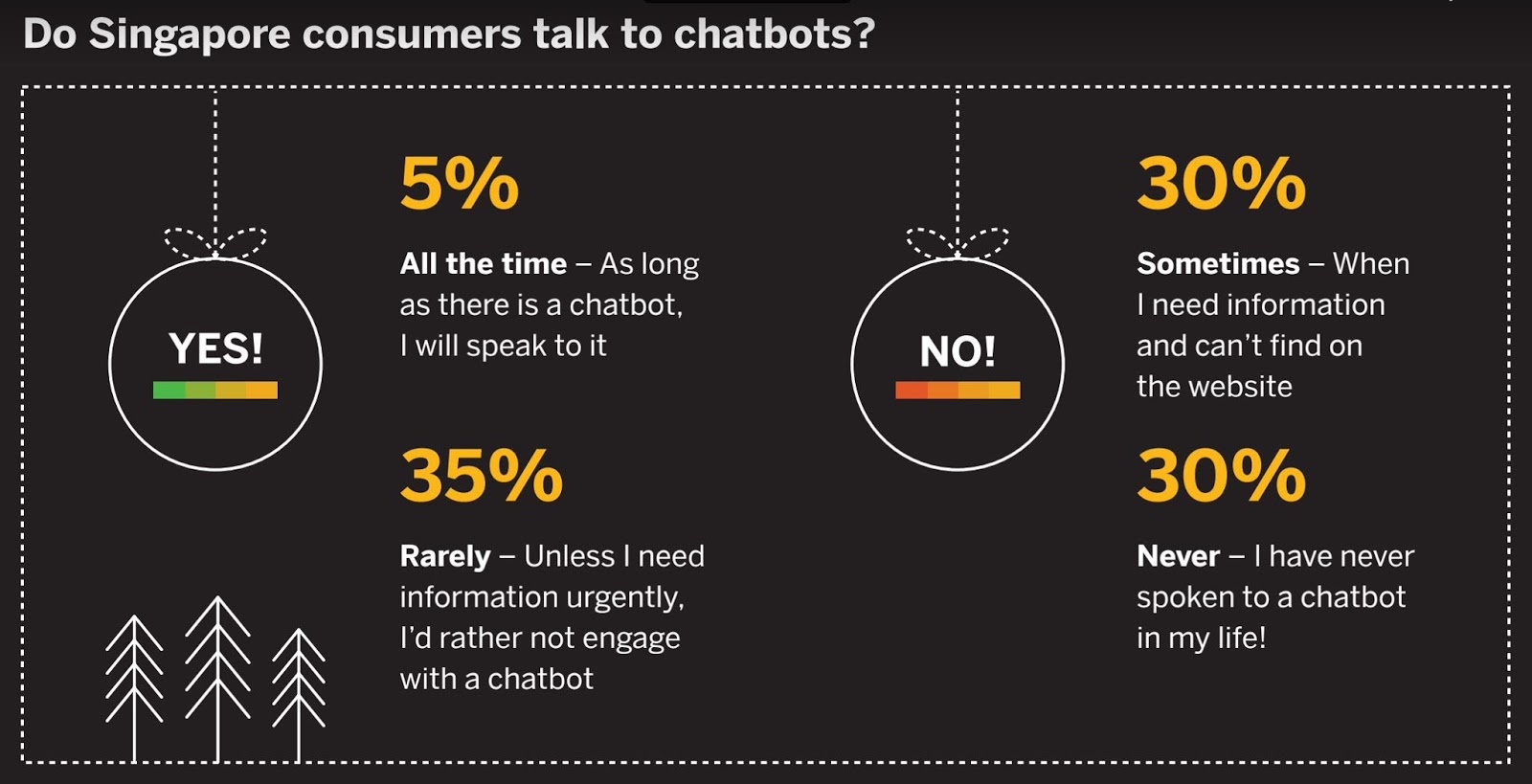
Source: SAP Hybris infographic. More than a third of Singapore consumers interact with chatbots, at least occasionally.
  • Top 3 motivations for Singaporean consumers to engage with chatbots: 
- 48%: "Finds out what I need and want, and makes more personalised recommendations on what to buy"

- 47%: "Helps me compare prices and other products from other brands"

- 38%: "Assures me that my personal information will be kept private and not used for any other purposes"


  • Concerns about chatbots:
- May be misunderstood: 61% feel that chatbots do not understand what they want to say

- Could be unsafe: 35% fear that personal information divulged to chatbots might be leaked


Bot-powered commerce is on a tipping point in Singapore according to the new SAP Hybris* Singapore Christmas Shopper Survey 2017. This Christmas, more than half (53%) of Singaporean shoppers are enlisting the help of chatbots for holiday shopping, the company said. Additionally, the majority of shoppers who asked chatbots for gift recommendations actually acted on the recommendation (74%). 

Despite the success of chatbots, SA Hybris recommends incorporating the human touch as Singaporeans expect assistance from chatbots to be rudimentary. More than 1,000 consumers in Singapore were surveyed on their use of and attitudes towards chatbots, with the results reflecting that while Singaporeans are open towards engaging with chatbots, they still have reservations. 

Nearly six in 10 (58%) view chatbots as useful only for basic information search, anticipating that more complex enquiries will need to be handled by a human being. Others feel that talking to chatbots can be frustrating and they would rather speak to a human being (21%) while close to a fifth expressed an outright dislike for chatbots (17%). 

Source: SAP Hybris infographic. Singaporeans tend to ask chatbots about product or service information and about availability. Promotions and discounts and delivery details are also relatively popular topics.

One of the top concerns that Singaporeans have towards chatbots is that their requests might not be understood (61%). A third (35%) are worried that their personal information might be leaked if they divulge too much to chatbots, and 13% say that chatbots are too creepy if they know too much about them.

Nicholas Kontopoulos, Global VP of Fast Growth Markets for SAP Hybris said, “The customer experience can make or break a brand. In view of this, businesses need to stay attuned to these concerns and optimise the use of chatbots as one component in a wider omnichannel strategy. While chatbots can proactively offer answers for initial queries on pricing, product features, or book and make reservations, they cannot fully replace the value of human interaction when it comes to building customer relationships. Any hint of customer dissatisfaction needs to be solved immediately, by a human services officer.”

To win Singaporeans over, chatbots need to become more understanding and intuitive – almost half of Singaporeans (48%) say that they will engage with chatbots more often if they are able to make more personalised recommendations on what to buy. Other motivating drivers that will encourage shoppers to use chatbots more often is to offer comparison of prices and products from other brands (47%), assure that personal information will be kept private (38%), provide recommendations on similar and complimentary products (34%) or simply becoming more human-like (18%).

“Singaporean shoppers have an appetite for deeper engagement with chatbots, but what the results really tell us is that they want a more personalised e-commerce experience. Today’s consumer have higher expectations and businesses need to keep a close pulse on the ever-evolving customer journey in order to react to not just changing consumer preferences but context at point of purchase or even consideration. To this end, businesses should view chatbots as more than just an answering machine – they are also a valuable mine of data that offer fresh perspectives into the underlying reasons for sales trends and help brands better understand what their customers are looking for. Armed with these insights, they can then take action to cultivate sales and entrench customer loyalty”, added Kontopoulos.

*SAP Hybris is a new brand name launched in January 2016 to represent the SAP solutions for customer engagement and commerce as well as the offerings, employees, and business of acquired company hybris AG, which continues to be the legal entity until integration with SAP is complete.

21 November 2017

Shoppers want more retail tech

Source: Zebra infographic. Nearly two-thirds of Europe and Middle East respondents said customer service affected how much they buy, while nearly a third of Asia Pacific respondents want to pick up their purchases in a physical store.
  • Rising shopper expectations continue to outpace retailer in-store technology investments.
  • Retail customers want a variety of fulfillment options. 
  • More than half of shoppers in Asia Pacific and Europe and the Middle East are interested in Wi-Fi and location-based in-store services such as mobile coupons. 
  • In Asia Pacific, 32% of shoppers would prefer to go to a retail store to pick up items purchased online or through mobile channels.

Zebra Technologies Corporation, the maker of rugged mobile computers, barcode scanners and barcode printers, has released the 10th edition of its Retail Shopper Study, which analyses shopper satisfaction and retail technology adoption trends. Nearly 7,500 shoppers from North America, Latin America, Asia-Pacific, Europe, and the Middle East were interviewed in September 2017.

According to the study, rising shopper expectations continue to outpace retailer in-store technology investments as 53% of Millennial shoppers perceive that they are more connected than store associates - compared to 32% of Gen X shoppers and 15% of Boomer shoppers. The research also revealed that while 44% of surveyed shoppers are still not satisfied with staff availability and customer service, overall shopper satisfaction has significantly improved since the study’s inception a decade ago.

Retail customers said they wanted a variety of fulfillment options. Eight in 10 of those surveyed purchase items in-store and either take them home or ship from store to home. Shoppers are also taking advantage of other fulfillment options, such as buy online, then ship to home (64%), buy online, then pick up in-store (34%) and buy online, then ship to an alternative location (15%). In Asia Pacific, 32% of shoppers would prefer to go to a retail store to pick up items purchased online or through mobile channels. 

The use of tablets in stores is improving the shopper experience. More than half of surveyed shoppers believe technology is improving the shopping experience with 57% specifically citing store associates using tablets.

Out-of-stocks are a retail challenge. When shopping in-store, 70% of shoppers have left without purchasing what they were seeking. However, when it comes to out-of-stock issues, retailers can recover six in 10 incidents with discounts or alternative fulfillment options, such as ship-to-home.
More than half of shoppers in Asia Pacific, as well as in Europe and the Middle East, are interested in Wi-Fi and location-based in-store services such as mobile coupons. 

Ryan Goh, VP and GM, Zebra Technologies, Asia Pacific said, “Technology is accelerating the transformation happening in the retail industry in Asia Pacific. Beyond e-commerce, retailers are increasingly recognising the importance of becoming omnichannel. The rising expectations from customers are also driving the technology investment and deployment in the industry."

Explore:

23 April 2017

Orchard Road's first-ever lifestyle and shopping campaign brings together everything quintessential Orchard Road in 2017

Source: ORBA. Banner, Fiesta On A Great Street, a first-ever Orchard Road promotion for 2017 that brings together dining, staycations, and leisure promotions.

Orchard Road, one of the most recognised shopping streets in Asia, has launched its first-ever lifestyle and shopping campaign, Fiesta On A Great Street, which will run till 21 May 2017. The event is organised by Orchard Road Business Association (ORBA), the place manager for the premium shopping precinct in Singapore, and supported by official card Mastercard. Participating malls include 313@somerset, Forum The Shopping Mall, Takashimaya Shopping Centre/Ngee Ann City, Orchard Central, Paragon, Scotts Square and Wisma Atria.

The celebration of shopping, dining and play-and-stay will involve malls and hotels along Orchard Road. Fiesta On A Great Street features popup lifestyle events, shopping promotions and dining deals, only available along Orchard Road. Visitors to Orchard Road can enjoy dining, beauty, fashion, wellness and hotel staycation deals during the campaign.

“As one of the most famous shopping streets in the region, we constantly strive to ensure that the shopping experience on Orchard Road is a rewarding one too, and this time, together with the support of our stakeholders and official card Mastercard, the promotion programme in Fiesta On A Great Street is designed with a wider range of dining, fashion, beauty, hotels’ staycation deals and more, catering to every discerning shopper of any budget on Orchard Road,” said Steven Goh, Executive Director, ORBA.

Exclusive Mastercard shopping privileges S$30 worth of shopping vouchers for the first shoppers to spend S$300 nett to their Mastercard credit/debit cards at participating malls on Orchard Road. The promotion is limited to the first 200 Mastercard cardholders per week per mall from 21 April to 27 April 2017 and from 28 April to 4 May. The promotion will be offered on a while-stocks-last basis for the next two weeks, from 5 May to 21 May 2017.

Deals in-store for Mastercard cardholders at participating malls along Orchard include wellness treatments such as LPG Endermospa Total Care at S$88 (usual price S$300) at Ngee Ann City. Fashion buy highlights include 50% off Converse apparel and accessories with any purchase of footwear, 10% off regular-priced items from agnès b and more. Discounted high tea buffets, one-for-one buffets and other dining offers will also be available along Orchard Road.

Book Hotel Jen orchardgateway, Hotel Jen Tanglin and Regent Hotel up to 21 May with Mastercard to enjoy late checkout, 15% off weekend rates and even complimentary upgrades.

With the Masterpass by Mastercard X ComfortDelGro Taxis Promotion visitors to Orchard Road can also enjoy S$5 off taxi fares with the promo code ORCHARD when riding with ComfortDelGro via the Taxi Booking App with the fares paid through Mastercard payment to and from seven participating malls: 313@somerset, Forum The Shopping Mall, Orchard Central, Paragon, Scotts Square, Takashimaya Shopping Centre/Ngee Ann City and Wisma Atria. The promotion is valid on Fridays, Saturdays and Sundays and capped at the first 500 eligible rides transacted every Friday to Saturday, up to 21 May.

Stand a chance to win shopping vouchers in the Shop, Dine & Win Draw with every S$50 spent at participating malls. Charge purchases to a Mastercard card and get triple the chance of winning.

Interested?

Other terms and conditions may apply.

Hashtags: #LeaveBoringBehind, #FiestaOnAGreatStreet, #告别沉闷

posted from Bloggeroid

14 April 2017

Criteo breaks down Ramadhan 2016 shopping behaviour in SEA

+Online sales and website traffic start increasing three weeks before Ramadhan in Southeast Asia (SEA)

+E-commerce sales spiked by 110% during the third week of Ramadhan

+Shoppers spend less time browsing and shopping online during sunset

+Mobile continues to be a key driver for discovery and sales with an increase of 126% during Ramadhan


Source: Criteo infographic. Fashion sells best during Ramadhan.

Criteo, the performance marketing technology company, has released seasonal data to help e-commerce businesses better engage consumers during the festive season.

It revealed that online sales and traffic increased in the lead up to and during Ramadhan, but declined during Eid el-Fitr (Hari Raya), the holiday that marks the end of Ramadhan. Based on consumers’ online browsing and buying activity, the three weeks leading up to Ramadhan, and also the third week of Ramadhan represent the biggest opportunity for retailers to engage consumers when they are actively browsing and purchasing items for upcoming celebrations. During this period, there was an average of 67% uplift in online retail sales and 14% uplift in online travel sales.

Criteo’s data also revealed that Ramadhan traditions influence shoppers’ behaviour throughout the day. To engage with shoppers, retailers need to know when they are most active online. During the fasting period between sunrise and sunset, e-commerce transactions were lower at 71%, compared to 76% for the period prior to Ramadhan. However, after breaking fast, there is an increase in e-commerce sales to 29%, from 24% pre-Ramadhan, representing a timely opportunity for retailers to reach out to shoppers.

Understanding how and what shoppers are buying is also crucial. With 37% of onsite retail conversions happening on the mobile app, retailers need to be investing beyond just a mobile-friendly site to an intuitive app. Fashion-related items are the most popular during this period, followed by home and living products and electronics, toys and games.

“Ramadhan is an important festive season in this region. Rapidly rising disposable incomes, a growing appetite for modest fashion, halal products and services mean that retailers need to enlist smart solutions to engage shoppers across all touchpoints and deliver the most impactful content at every point in the customer journey. As shoppers spend time with their friends and families after sundown and on Eid, they are less likely to browse and shop online. Retailers must pick the right time of the week and time of day to increase their digital marketing efforts, so they can achieve an uptick in online transactions,” said Alban Villani, GM, Southeast Asia, Criteo.

Criteo analysed more than 8 million online transactions from 143 retailers based in Indonesia, Malaysia and Singapore. Other key findings from the report include:

+Website traffic and e-commerce sales increased from three weeks before Ramadhan and spiked during weeks three and four, with an increase of 110% and 77% respectively.

+During the start of Eid el-Fitr, there was a decline of 44% in online sales and 20% in website traffic. However, in the week post-Eid, online sales rebounded, increasing 35%.

+During weeks three and four of Ramadan, online mass merchants were the biggest growth driver – with an increase of 87% and 52% respectively.

+The cross-device journey was evident – 46% of shoppers were found to be viewing products across multiple devices, with one in four shoppers switching devices at least three times during their purchasing journey.

“In addition, retailers need to embrace omni-channel marketing – as we continue to see the rise of offline-to-online and online-to-offline (O2O) shopping habits. Our data shows that during the period of Ramadhan, shoppers are browsing in stores and purchasing online, and vice-versa. However, whichever way you look, mobile will still be the foundational building block and key driver in O2O retail. Half of the retail transactions in Southeast Asia are already taking place on mobile,” said Villani.

Ramadhan 2017 will begin around May 25, 2017. The date varies in different countries depending on the sighting of the moon.

Interested?

Download the infographic on Ramadhan 2016

13 April 2017

Mastercard: Asia Pacific shoppers want a secure online experience

While online security remains a vital consideration for the region’s consumers, it has not stopped them from holding back on spending. According to the latest Mastercard Online Shopping Survey, eight in 10 of consumers across Asia Pacific who have shopped online last year intend to make at least one online purchase in the first half of 2017, led by those in emerging markets including mainland China (97.3%), Vietnam (96.2%), India (92.9%), Malaysia (92.8%) and Thailand (87.1%).

Findings from the study indicate that while one in two consumers in Asia Pacific feel secure shopping online, providing secure payment facilities (85.9%) remains the most critical to getting shoppers in the region to make such purchases, along with price (85.5%) and convenience (85.1%). This consideration resonates most strongly in Indonesia (95.3%), followed by the Philippines (92.2%), Taiwan (91.5%) and Malaysia (91.2%).

“The verdict is in - consumers across Asia Pacific want enhanced security and convenience when shopping online. Despite our research showing that the majority of consumers feel safe when shopping online, we cannot stop our relentless focus on developing solutions that address and erase underlying fears about the safety and security of payments across the board,” said Ben Gilbey, Senior VP, Digital Payments & and Labs, Asia Pacific, Mastercard.

“We know the payment experience consumers are looking for, no matter where they choose to shop. As a result, we will not relent on our commitment to work with merchants and key industry players to design, develop and deploy e-commerce experiences that are fast, easy, seamless and safe. Some of these include digital wallets and biometric payments, which are also reimagining and redefining the shopping experience for consumers.”

Detailed findings include:

· In Asia Pacific, nine in 10 consumers have made an online purchase in the three months preceding the survey, led by those in South Korea (96.7%), India (95.8%), Japan (95%), Vietnam (92%) and China (91.8%).

· To drive the growth of e-commerce in the region, more can be done to improve the shopping experience with free or minimal delivery charges (62.9%), assurance that transactions are secure (45.9%) and reduction in friction in transaction processes (44.1%) topping the list of suggested improvements to online shopping by respondents.

· A third of shoppers in Asia Pacific (37.3%) are getting their fashion fix online, with clothing and accessories retailers leading as the most-visited website category. This is followed by online supermarkets (37.3%), and app stores (36.9%).

· Indonesian consumers are the most satisfied with existing opportunities and facilities for online shopping (97.1%) in the region. Consumer satisfaction also rings strongly in India (94.3%) and Malaysia (92.6%).

· When choosing where to shop online, the majority of consumers in Asia Pacific rely on word of mouth recommendations from close family and friends (36.1%), followed by social networking sites (27.4%) and traditional and online media sources (17.5%). Conversely, in Thailand (52.4% vs. 15.1%), Malaysia (39% vs. 24.2%), Philippines (34.1% vs. 33.5%) and Indonesia (32.1% vs. 25.9%), consumers consider social networking sites more influential than word of mouth recommendations.

· The year-end holiday season – with Black Friday, Cyber Monday, Singles’ Day, Christmas Day and Boxing Day sales – is the most popular time of the year for online shopping, with consumers in the region shopping most frequently in December (22.1%), November (17.3%) and October (14%).

Additional findings include:

· More than half of consumers in Asia Pacific (53.9%) feel secure when shopping online. This sentiment is felt especially in India (72.1%), Indonesia (66.4%), China (63.5%), Australia (62.2%) and New Zealand (59.8%). On the other hand, consumers in Vietnam (34%), South Korea (34.6%), Japan (36.6%) and Hong Kong (37.4%) are more wary of online shopping security.

Mastercard recommends that consumers too can play a part in ensuring their own payment safety by following these online shopping tips:

· Shop only on sites with a “lock” icon in the browser’s URL bar – this icon indicates that a site is secure.

· To protect confidential information from prying eyes, refrain from using public, unsecured Wi-Fi to perform financial transactions.

· Track purchases by monitoring account activity online and checking statements. Any suspicious or unfamiliar transactions should be reported to a bank immediately.

· Make sure passwords are strong – at least eight characters and a combination of numbers and letters.

· Do not use the same password with different online shops or to log into email

*The Mastercard Online Shopping Survey was carried out across fourteen markets in Asia Pacific (Australia, mainland China, Hong Kong, India, Indonesia, Japan, Malaysia, New Zealand, Philippines, Singapore, South Korea, Taiwan, Thailand & Vietnam). A total of 8,738 consumers were polled online in November 2016 on questions relating to the online shopping landscape, experience with e-commerce and m-commerce, reasons for shopping online versus brick and mortar stores, safety and security payment concerns, as well as views on ethical shopping, among others.

Interested?

The Mastercard Index suite in Asia Pacific includes the Mastercard Index of Consumer Confidence, as well as the Mastercard Index of Women’s AdvancementMastercard Index of Financial Literacy, and the Mastercard Index of Global Destination Cities. In addition to the indices, Mastercard’s research properties also include a range of consumer surveys including Online ShoppingEthical Spending and a series on consumer purchasing priorities (covering travel, dining & entertainment, education, money management, luxury and general shopping). Find out more about the Online Shopping Survey
posted from Bloggeroid

17 March 2017

Australian consumers happy to use contactless cards to pay

The latest Mastercard Digital Purchasing Survey* reveals that Australian consumers are continuously embracing digital payment technology, with more than four in five (82%) Australians using tap and go (contactless methods) to make payments every week. In fact, over one third of Australians have been annoyed when a store did not offer tap and go, and one in ten even avoid such a store.

Australians are using contactless cards most frequently at supermarkets (54%), general retail stores (22%), and petrol stations (11%).

Garry Duursma, Head of Market Development and Payment Innovation for Mastercard Australia and New Zealand, said, “Overall Australians see tap and go as a convenient and time saving way to pay. The survey findings indicate an increasing demand on retailers to take advantage of more innovative payment methods, with the majority of Australians believing that businesses that offer contactless technology are making it easier for their customers. Almost half of Australians are looking for a better and more enhanced shopping experience.”

Consumers are also becoming more aware of the benefits of contactless in security terms, with contactless card payments offering the same level of protection as chip and pin payments. In fact, Mastercard’s Zero Liability on card payments means that contactless is also safer than carrying cash, which could be lost or stolen. The increase in confidence in the security of contactless as a method of payment is demonstrated in the research findings, which show 64% of Australians are now ‘not very’ concerned about security when using contactless, up from 46% in 2014.

“Australians have largely embraced contactless payments as a part of their everyday lives, indicating that consumers are starting to gain a real understanding and appreciation for the benefits of contactless,” said Duursma. “There are a wealth of innovative payment technologies available to consumers today, and given the positive uptake in Australia, we expect to see more developments in this area, as people continually look for convenience and time saving in their busy lives.”

While tap and go becomes ubiquitous, survey findings indicate that mobile payments remain a growth area in Australia, with only one quarter (26%) of Australian consumers responding that they are aware of having contactless payment options on their mobile phone. Of those that are not aware of having a contactless option on their phone, 36% say that they would consider using it and over half (54%) of all Australians wish they knew more about digital wallet technology – an attitude that represents a positive trend towards adoption.

Globally, Mastercard is shaping the digital future by creating new and secure ways for consumers to pay across all channels and devices – from digital wallets to tokenisation to new solutions in safety and security.

Detailed findings:

Tap and go/contactless
  • More than four in five (82%) Australians are using tap and go/contactless every week.
  • Eighty-four percent of males, 79% of females
  • Eighty-eight percent of Millennials, 83% of Generation X, 72% of Baby Boomers
  • In terms of geographies, 85% come from New South Wales/Australian Capital Territory (NSW/ACT) compared to 74% South Australia (SA) and 72% from Western Australia (WA)
  • This is up from 76% of Australians in December 2015
The benefits of tap and go/contactless continue to be clearly perceived as convenience and time saving.
  • Eight in 10 (81%) of all Australians say that it ‘saves time / quick’ and this increases to 86% among ‘daily’ users (up from 77% December 2015)
  • Eighty percent of all Australians say that it is convenient and easy (up from 75% in December 2015)
  • One third of Australians have been annoyed at some time that a store hasn’t offered tap and go/contactless technology. Nearly half (46%) of Millennials say this compared to 20% of Baby Boomers
  • One in ten (11%) Australians have at some occasion avoided a store that didn’t offer tap and go / contactless. Fifteen percent of Millennials say this compared to 5% of Baby Boomers 
  • Seven in 10 (71%) Australians say that businesses that do offer contactless/tap and go technology are making it easier for their customers (up from 62% in December 2015). A third say that these businesses are ‘modern and innovative’
Almost half (43 %) of Australians are looking for a better and more enhanced shopping experience.
Concern about using contactless transactions at shops and petrol stations continues to recede. The majority (64%) of Australians are now ‘not very concerned’ about security when using tap and go/contactless (compared to 58% in December 2015 and 46% in 2014).

Contactless payments via mobile

One quarter (26%) of Australians are aware of having contactless payment options on their mobile phone.
  • This was reported by 34% of Millennials, 24% of Generation X, 18% of Baby Boomers
  • A third (35%) of people who use tap and go/contactless every day have tap and go on their mobile phone
  • Of those respondents that are aware that they have mobile contactless capability, 28% make use of it weekly and 72% less often
The Mastercard Index suite in Asia Pacific includes the Mastercard Index of Consumer Confidence, as well as the Mastercard Index of Women’s AdvancementMastercard Index of Financial Literacy, and the Mastercard Index of Global Destination Cities. In addition to the indices, Mastercard’s research properties also include a range of consumer surveys including Online ShoppingEthical Spending and a series on consumer purchasing priorities (covering travel, dining & entertainment, education, money management, luxury and general shopping).

*This study was conducted online during December 2016 using a sample of 1,000 Australians aged between 18 and 64 years old across Australia. Age, gender and area quotas were applied to the sample.

15 March 2017

Digital payment methods popular in Australia

The latest Mastercard Digital Purchasing Survey* reveals that Australian consumers are continuously embracing digital payment technology, with more than four in five (82%) Australians using tap and go (contactless methods) to make payments every week. In fact, over one third of Australians have been annoyed when a store did not offer tap and go, and one in ten even avoid such a store.

Australians are using contactless cards most frequently at supermarkets (54%), general retail stores (22%), and petrol stations (11%).

Garry Duursma, Head of Market Development and Payment Innovation for Mastercard Australia and New Zealand, said, “Overall Australians see tap and go as a convenient and time saving way to pay. The survey findings indicate an increasing demand on retailers to take advantage of more innovative payment methods, with the majority of Australians believing that businesses that offer contactless technology are making it easier for their customers. Almost half of Australians are looking for a better and more enhanced shopping experience.”

Consumers are also becoming more aware of the benefits of contactless in security terms, with contactless card payments offering the same level of protection as chip and pin payments. In fact, Mastercard’s Zero Liability on card payments means that contactless is also safer than carrying cash, which could be lost or stolen. The increase in confidence in the security of contactless as a method of payment is demonstrated in the research findings, which show 64% of Australians are now ‘not very’ concerned about security when using contactless, up from 46% in 2014.

“Australians have largely embraced contactless payments as a part of their everyday lives, indicating that consumers are starting to gain a real understanding and appreciation for the benefits of contactless,” said Duursma. “There are a wealth of innovative payment technologies available to consumers today, and given the positive uptake in Australia, we expect to see more developments in this area, as people continually look for convenience and time saving in their busy lives.”

While tap and go becomes ubiquitous, survey findings indicate that mobile payments remain a growth area in Australia, with only one quarter (26%) of Australian consumers responding that they are aware of having contactless payment options on their mobile phone. Of those that are not aware of having a contactless option on their phone, 36% say that they would consider using it and over half (54%) of all Australians wish they knew more about digital wallet technology – an attitude that represents a positive trend towards adoption.

Globally, Mastercard is shaping the digital future by creating new and secure ways for consumers to pay across all channels and devices – from digital wallets to tokenisation to new solutions in safety and security.

Detailed findings:

Tap and go/contactless
  • More than four in five (82%) Australians are using tap and go/contactless every week.
  • Eighty-four percent of males, 79% of females
  • Eighty-eight percent of Millennials, 83% of Generation X, 72% of Baby Boomers
  • In terms of geographies, 85% come from New South Wales/Australian Capital Territory (NSW/ACT) compared to 74% South Australia (SA) and 72% from Western Australia (WA)
  • This is up from 76% of Australians in December 2015
The benefits of tap and go/contactless continue to be clearly perceived as convenience and time saving.
  • Eight in 10 (81%) of all Australians say that it ‘saves time / quick’ and this increases to 86% among ‘daily’ users (up from 77% December 2015)
  • Eighty percent of all Australians say that it is convenient and easy (up from 75% in December 2015)
  • One third of Australians have been annoyed at some time that a store hasn’t offered tap and go/contactless technology. Nearly half (46%) of Millennials say this compared to 20% of Baby Boomers
  • One in ten (11%) Australians have at some occasion avoided a store that didn’t offer tap and go / contactless. Fifteen percent of Millennials say this compared to 5% of Baby Boomers 
  • Seven in 10 (71%) Australians say that businesses that do offer contactless/tap and go technology are making it easier for their customers (up from 62% in December 2015). A third say that these businesses are ‘modern and innovative’
Almost half (43 %) of Australians are looking for a better and more enhanced shopping experience.
Concern about using contactless transactions at shops and petrol stations continues to recede. The majority (64%) of Australians are now ‘not very concerned’ about security when using tap and go/contactless (compared to 58% in December 2015 and 46% in 2014).

Contactless payments via mobile

One quarter (26%) of Australians are aware of having contactless payment options on their mobile phone.
  • This was reported by 34% of Millennials, 24% of Generation X, 18% of Baby Boomers
  • A third (35%) of people who use tap and go/contactless every day have tap and go on their mobile phone
  • Of those respondents that are aware that they have mobile contactless capability, 28% make use of it weekly and 72% less often

*This study was conducted online during December 2016 using a sample of 1,000 Australians aged between 18 and 64 years old across Australia. Age, gender and area quotas were applied to the sample.

8 February 2017

Younger consumers prefer shopping online for clothing

YouGov has discovered that consumers across the Asia Pacific region (APAC) are still shopping for clothing physically in-store, with more than three-quarters of those polled* (79%) saying they have shopped in-store in the past year.

Shopping in-store is particularly prevalent for shoppers in Hong Kong, Australia, and Malaysia, where 88%, 85% and 84% have done so, respectively. Shopping online via a website is the second-most popular method of purchasing apparel; nearly half of respondents in APAC (45%) have used a website to shop for clothing and accessories over the past year. The popularity of e-commerce has surged in mainland China, where three-quarters (75%) of people have bought apparel via a website over the past year. 

Source: YouGov. Respondents in APAC share how they buy clothing.
Respondents in APAC share how they buy clothing.

The most popular reason for online shopping is to save time, say 69% of those who have shopped using websites over the past year and 66% of those who have used apps. Over half of those who shop online also value the price savings, with 58% of those who have shopped through websites and 54% of those who have shopped via apps citing price as an advantage of online shopping.

In contrast, apps are yet to break into the mainstream and have only been used to buy apparel by 15% of those polled in the past year. App usage peaks in Indonesia, China and Singapore where nearly one in five people (19%, 18% and 18% respectively) have purchased apparel through an app in the past year.

Indicators suggest however that shopping trends are set to change. Young people are more than twice as likely to have shopped using a website in the past year and more than six times as likely to have shopped via an app than older generations. Half of those aged 16 to 24 (51%) have shopped using a website over the past year and nearly a fifth (19%) have used an app. In contrast, just a quarter of over 55s (24%) shopped using a website and only 3% have used an app.

Conversely, shopping in-store is most popular with older generations; 90% of over-55s have shopped in-store, compared to 75% of 16 to 24 year olds. This suggests that, as one might expect, younger generations may be more open to shopping with new technologies than older generations. Over three-quarters of those who have shopped in-store (78%) say it is because they like to try out apparel before they buy it; 73% want to check the quality before they buy, and 56% simply enjoy shopping around.

Local markets and street vendors are bucking the trend. They attract 28% of consumers in APAC and are the most popular in Vietnam, the Philippines and Malaysia, where 41%, 38% and 36% of respondents respectively have bought apparel from local markets and street vendors in the past year.
They are more popular with young people than older generations; 35% of 16-24s purchase from markets compared with 23% of over-55s. One possibility, Yougov says, is that young people are strapped for cash and looking for a cheaper alternative to high street and luxury brands.

E- and m-commerce still have a long way to go before they can rival more traditional shopping experiences for convenience as well as for enjoyment. Opinions are divided as to whether new technologies are indeed up to the challenge. While 39% of respondents believe that retailers will close physical stores as online shopping becomes more popular, 36% don’t think they will.

*The company polled 9,037 people across Asia Pacific in December 2016 to investigate apparel shopping habits among the online population. Data was collected from research among YouGov’s panelists and was weighted to be representative of the online population. Sample size: Asia Pacific (n = 9,037; Australia: 1,009; China: 1,003; Hong Kong: 1003; Indonesia: 996; Malaysia: 1,003; Philippines: 1,008; Singapore: 1,004; Thailand: 1,004; Vietnam: 1,007).

29 November 2016

Criteo study uncovers evolving shopping practices in Singapore

· Singapore consumers are using multiple devices in the retail journey

· Brick-and-mortar retailers must respond to the local showrooming phenomenon and invest in multichannel integration

· Improving last-mile fulfilment will help local retailers compete more effectively with international e-commerce players


Criteo, the performance marketing technology company, has found that shopping patterns are changing among consumers in Singapore. Singaporeans now own or have access to an average of 4.72 devices, the research by Edelman Intelligence has found.

Source: Criteo. Profiling the mobile shopper in Singapore.

With three-quarters using these devices to purchase online at least once a month, cross-device usage, ‘showrooming’ and last-mile fulfilment are the three critical areas retailers must address. Showrooming refers to consumers treating a physical store as a showroom, trying on clothing or checking how an item looks and works in real life, before ordering the same item online.

Retailers which can successfully integrate the mobile web, apps and in-app targeting into their business operations and engagement strategies will set the stage for the seamless adoption of newer mobile technologies or add-ons, when required, Criteo said.
The research found:

· Six in 10 Singaporeans consider mobile devices to be their favourite shopping companion, with 95% having used their smartphones or tablets to browse online catalogues in the past month.

· More than half (54%) of consumers indicated that having the option to shop on their mobile devices has caused them to spend more than ever before, with four in five admitting to purchasing online on impulse.

· Travel-related products and apparel are the most popular online purchases, with each shopper purchasing across an average of 5.43 product categories.

· With nearly half of Singaporeans shopping on branded mobile apps at least once a week, and mobile shoppers likely to be heavy social media users in general, retailers must also become familiar with application-based advertising and messaging.

“Singapore is a truly cross-device market, where most consumers – especially Millennials – are using a combination of devices to shop. While a number still rely on PCs to make payments, mobile devices are always by our side as the one consistent factor in all elements of online and offline shopping,” said Alban Villani, Commercial Director, Southeast Asia, Criteo. “This reinforces what we’ve been telling retailers for some time – they can no longer target individuals on just one device. Rather, they will need to embrace technologies that deliver contextual creative experiences and messaging, to respond to individuals’ needs and desires in the moment, wherever they are and however they’re feeling.”

In Singapore, the high incidence of showrooming reinforces the importance of multichannel integration:

· To avoid crowds and queues, almost two-thirds of Singaporeans prefer to shop online during periods like the Great Singapore Sale.

· Half of local consumers also believe online deals during the Great Singapore Sale are better than in-store promotions.

· Even when visiting a physical store, six in 10 local shoppers are browsing similar products online and comparing prices to ensure they get the best deals.

· Seven in 10 (69%) consumers end up purchasing the same product or service online rather than offline.

· Physical stores still have an edge in engaging consumers who desire to touch or trial a product prior to purchase. However, this advantage is eroding as seven in 10 Singaporeans agree that augmented reality also allows them to ‘try’ an item and online players respond by adopting the technology to simulate real-world experiences.

“A few established online players are already using physical pop-up stores with exclusive collections and discounts to create a seamless online-to-offline customer experience. Conversely, physical retailers looking to retain and convert customers must start integrating online channels, especially mobile optimised sites or branded apps, and consider customer relationship management (CRM) data optimisation, to better engage customers before, during and after store visits,” said Villani.

To compete more effectively against international retailers, same-day or next-day order fulfilment should be a big focus for local retailers, who can work with specialised local last-mile delivery service providers.

· Singaporeans shop on both local and international sites. Seventy-eight percent buy from local sites because of delivery considerations – faster or cheaper domestic shipping and easier pickup of a locally-purchased product.

· Six in 10 would rather have their purchases delivered than collect them from a physical store.

“The research findings are pointing us to a future where offline and online shopping are no longer two separate business models. There will just be ‘shopping’ and it will be an integrated experience. If retailers turn to mobile as the chief enabler and successfully deliver such experiences, they will inevitably demand smaller stores as fulfilment gets facilitated directly from warehouses. Be it by offering better connectivity or relooking how retail space is allocated, local malls must also adjust to this new wave of change,” said Villani.

Interested?

Browse the full Criteo-commissioned Edelman Intelligence 2H16 research findings and analysis (PDF)

9 October 2016

ShopBack explores Singapore's behaviour on Singles Day

ShopBack, which aggregates over 500+ online retailers such as Taobao in various lifestyle categories, has found that 40% of Singapore residents did not know about Singles Day - November 11 - in an online survey*, although they were aware of third-party shopping platforms such as ShopBack.

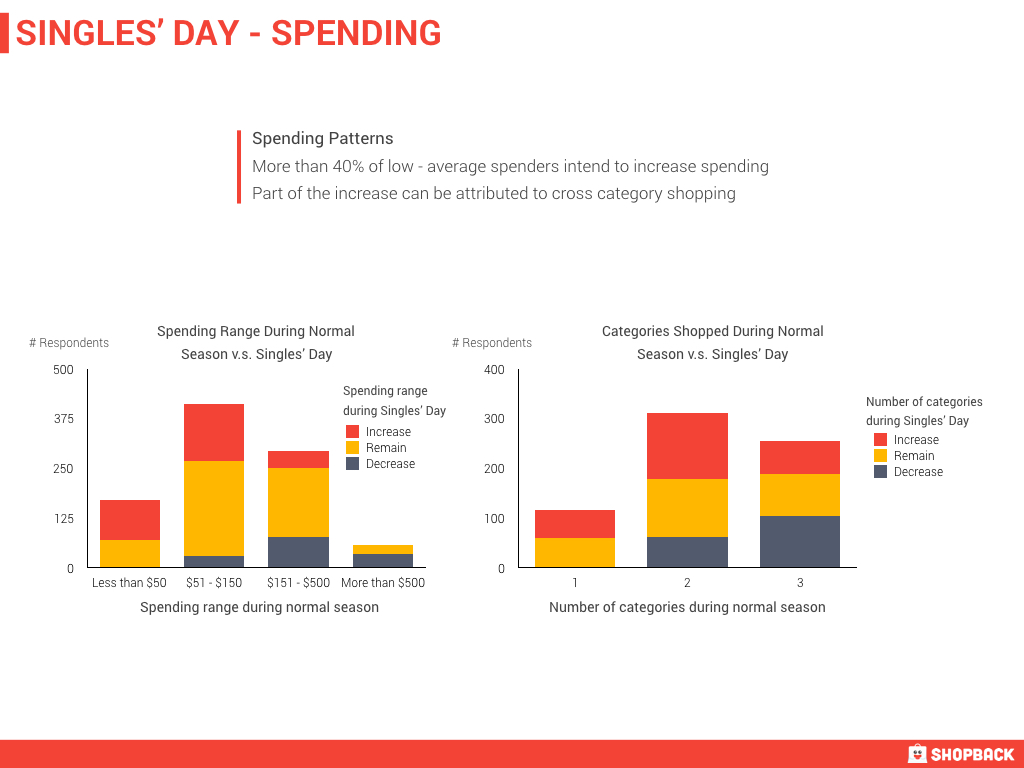
Alibaba, which introduced Singles Day as a focus for e-commerce, generated US$14.3 billion in gross merchandise volume** during the 2015 11.11 Global Shopping Festival. Shopback found that among those who expressed intent of shopping online on Singles' Day, an estimated 60% shared that they will keep to their usual spending bracket of S$51 to S$150. ShopBack commented that the feedback "shows most Singaporeans are self-restrained when it comes to spending, even on a major retail holiday such as Singles' Day which boasts steep discounts and incredible deals".

ShopBack noted that the low prices encourage respondents to explore cross-category purchases. Half of respondents who said they usually focus on one shopping category shared that they will consider purchasing from other categories on Singles’ Day, ShopBack said.

Source: Shopback. Spending patterns for Singles Day.

ShopBack further predicts that the fashion, health & beauty and electronics categories will enjoy more purchases on Singles’ Day, whereas sales in the dining and travel categories might be lower as Singles’ Day deals are perceived to be relatively less enticing.

*An online survey was conducted over the past two weeks and garnered feedback from 2,000 residents in Singapore. The survey results are collated in collaboration with SingSaver.com.sg

**Gross merchandise volume or GMV is the total amount settled through Alipay on Alibaba’s China and international retail marketplaces. All 2015 11.11 GMV and other figures are subject to final auditing following conclusion of the event.

31 August 2016

Shopee introduces 9.9 Mobile Shopping Day this September

Source: Shopee website. The countdown begins 1 September.
Shopee, the mobile-first social marketplace by Garena Interactive Holding, has announced its inaugural 9.9 Mobile Shopping Day, a one-day mobile shopping extravaganza happening on 9 September.

Slated to be the biggest mobile shopping sale in the region, consumers in Singapore can expect 24 hours of non-stop deals and promotions, including discounts of up to 90%, selected picks under S$0.99 and a chance to win Samsung Galaxy phones.

Chris Feng, Chief Executive Officer of Shopee, said, “Among all the markets that we are present in, Singapore has truly proven to be mobile-first, ranking No. 1 globally for smartphone adoption. Shopee 9.9 Mobile Shopping Day signifies the start of a new era for shopping, where everybody is free to shop online anywhere and anytime on mobile, and we’d like to invite everyone to celebrate this day with us.”

Since officially launching across Southeast Asia and Taiwan in December 2015, Shopee has experienced significant growth in all countries. Across all markets, Shopee has over 20 million installs, 250,000 daily orders and an annualised gross merchandise value of US$1.3 billion, making it the fastest-growing marketplace in the region. To date, Shopee Singapore alone has amassed over 1 million installs.

According to a Google study, Singapore has the highest smartphone penetration in the world at 85%*. While e-commerce is expected to grow 13% year on year, expected growth for m-commerce is at 15%**. Based on a report by MasterCard in 2015, 49% of Singaporeans have made a purchase using their mobile phones and this number continues to grow***.

Feng explained, “It is clear that Singapore, much like other countries in the region, is undergoing a mobile transformation. Our mobile-first approach has helped Shopee become one of the leading marketplaces in the region, and we would like to mark September 9 as a milestone to celebrate this.”

He added, “One interesting effect of the mobile revolution is that buyers and sellers are increasingly dealing over live chat. Buyers prefer to chat directly with sellers for multiple reasons, such as to find out more about the products, or seek after-sales support. Shopee has since facilitated 430 million chats across the region, with 30 new chats every second.”

Source: Shopee infographic. Shopee averages 30 chats and four new product listings per second.
Source: Shopee infographic. Shopee averages 30 chats and four new product listings per second. 

Featured deals on 9.9 Mobile Shopping Day include:

● Everything under S$0.99, S$9 and S$19
● Shopee Steals at 90% off

Featured products available on 9.9 Mobile Shopping Day:
Item
Original Price (S$)
Sale Price on 9.9 (S$)
Kat Von D Liquid Lipstick
$32.90
$9.90
SK-II Facial Treatment Cleanser 120ml
$69.00
$9.90
Superga sneakers
$59.90
$37.90
Lancome BB Cushion
$49.90
9.90
Herschel bag
$100
$39.90

Interested?

Shopee 9.9 Mobile Shopping Day will kick off on 1 September with a nine-day countdown featuring deals under $9.99 and daily giveaways. On 9 September, shoppers can enjoy many promotions, including selected products at up to 90% off. Shopee has also enlisted OCBC as a partner for FRANK Credit Card holders to enjoy further discounts.

The app for Shopee Singapore can be downloaded for free on all mobile platforms via Apple App Store and Google Play Store. 

Hashtags: #fashiontrends, #giftforgirls, #freeshipping, #streetstyle, #supportlocal 

*Singapore is No. 1 for smartphone adoption: Google, 2014 figures. As of 2015, Google places Singapore as No. 2 in the world for smartphone adoption, and No. 1 in Asia, with the UAE in No. 1 position.
**Morgan McKinley: The Spending Habits of Southeast Asia eCommerce Consumers, quoting Paypal figures for Q414. 

17 June 2016

Promotions this June at the Palais Renaissance mall

Orchard Road mall Palais Renaissance has always been known to offer its patrons exclusive shopping and dining experiences. As the Great Singapore Sale picks up pace this June, the mall welcomes shoppers for a celebration of gastronomical goodness:

As June marks the start of summer in Japan, Ishinomaki Grill & Sake Bar (#B1-02) has introduced a new Shun no Mikaku (taste of the season) menu available on request.

Source: Palais Renaissance. Nonya dory, P. Bistro.

P. Bistro (#B1-06), a favourite for Asian-inspired Western fare and French classics, offers 20% off food, drinks and desserts after 6pm till the end of June. Well known for its Nonya Dory

Jing Hua Xiao Chi (#B1-04) has a one-for-one offer on selected Chinese snacks only at its Palais Renaissance outlet.

Till 30 June 2016, shoppers who spend a minimum of S$300 at Palais Renaissance will receive a S$10 shopping voucher*. For those making a redemption with at least 1 food and beverage-related receipt, an additional S$10 shopping voucher* will be awarded.

Shops offering promotions include:

DeFRED Jewellers (#01-02), up 50% off storewide*

Maria Grachvogel (#01-07A), 30% off selected pieces till 15 July

Privé Aesthetics (#03-02/03), Calecim Youth-Restore Face therapy at S$244* (including GST, usual price S$406.60)

*Promotions are valid till 30 June unless otherwise stated. Other terms and conditions may apply. Check the Palais Renaissance website for full details.