Showing posts with label vegetarian. Show all posts

3 February 2026

Take up a vegetarian omakase course at Sushi University

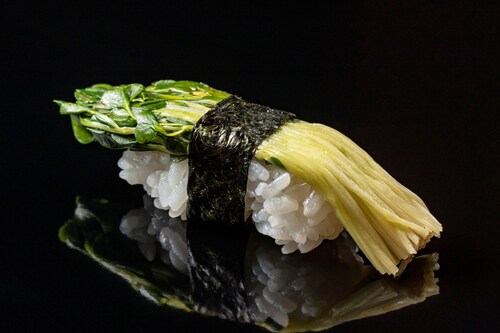
Source: Tabimori. Daikon sprouts sushi.
Source: Tabimori. Daikon sprouts, treated with the same kobujime (昆布締め) technique used for seafood sushi, develop a richer umami profile. In kobujime, the sushi topping is marinated with kelp before serving.

Tokyo-based Tabimori's Sushi University tour has a new vegetarian omakase option. According to the internationally-focused travel company, Japan has seen a surge in international tourism in recent years, but vegetarian and vegan visitors may face limited opportunities to enjoy Japanese sushi.

"Some participants completely avoid fish, while others simply dislike raw seafood. With our growing experience in accommodating such needs, we believe the time is right to offer an authentic, plant-based sushi omakase experience—one that stays true to the spirit of Japanese culinary artistry and hospitality," the company stated.

Historically, Edomae sushi chefs used techniques such as salting, simmering, steaming, marinating, and aging to enhance umami and preserve seafood before refrigeration. Today, these same techniques are applied to vegetables: salting reduces bitterness, gentle heating enhances natural sweetness, marinating in kombu adds depth, and fermentation develops complex flavours. In this way, vegetarian and vegan omakase become more than a fish substitute—they are a refined, nuanced expression of plant-based ingredients, the company pointed out

As part of the Sushi University experience, Tabimori will explain the philosophy behind Japanese culinary traditions, such as the traditional concepts of "five tastes" (五味 or gomi), "five colours" (五色 or goshiki), and "five techniques" (五法 or goho)—the core elements of washoku (和食, Japanese cuisine). 

- Five tastes: sweet, sour, bitter, salty, umami 

- Five colours: white, yellow, red, green, black

- Five techniques: raw, simmered, grilled, fried, steamed

These ideas, developed to balance taste, presentation, and sensory experience, form the heart of Japanese culinary philosophy, Tabimori said. The principles reflect Japan's long-held wisdom—taste harmony, visual beauty, and nutritional balance. 

Sushi University offers an omakase sushi course for vegetarians and vegans (¥16,000) and five other courses for general travellers (¥19,000–¥69,000), all of which include meals and interpreting services. The omakase sushi course for vegetarians and vegans includes hotel pickup services as well as an interpreter. 

Vegetarian and vegan guests will enjoy sushi crafted from the finest seasonal ingredients selected by skilled sushi chefs. Guests can watch the chefs work up close at the counter, and request a custom menu on the spot. 

Explore

Book a sushi course online at https://sushiuniversity.jp/

16 November 2022

Plant-based meat market sees 17% CAGR through to 2027

UnivDatos Markets Insights has forecast that the plant-based meat market will grow at a CAGR of over 17% from 2021-2027. Global plant-based meat sales are expected to reach around US$85 B by 2030, compared to US$5 B in 2018. 

The research firm further expects that plant-based products will account for 10% of global meat consumption within the next five years while conventional meat becomes less popular. UnivDatos Markets Insights said that the supply of conventional meat products would fall by more than 50% by 2040.

COVID-19 created increased awareness about man's impact on the environment, the company said, and has driven government policies on climate change. Consumers stockpiled food during COVID lockdowns, selling 231% more fresh plant-based products in 2020 compared to the same period in 2019. IRI data analysed by The Good Food Institute also registered 454% growth in the sales of plant-based meat over this period.

Soy-based meat is expected to dominate the market during the forecast period due to its protein-rich content. By type, plant-based chicken leads the market followed by plant-based beef. In terms of format, plant-based burger patties dominated the market in 2020 because of their low fat and gluten content, and are expected to maintain their dominance throughout the forecast period.

Although North America dominated the market in 2020, the Asia-Pacific region is expected to witness the highest CAGR growth during the forecast period.

Major players mentioned in the report include:

- Alpha Foods
- Amy's Kitchen
- Beyond Meat
- Hooray Foods
- Impossible Foods
- Maple Leaf Foods
- Morningstar Farms
- Quorn Foods
- The Vegetarian Butcher
- Tofurky

Explore

Buy the report

11 May 2022

Galouti Kabab unveiled by Godrej Tyson Foods

Godrej Tyson Foods, a subsidiary of Godrej Agrovet, has launched Galouti Kabab under its fastest-growing brand – Godrej Yummiez. Godrej Yummiez provides products for vegetarians.

Godrej Yummiez already has a strong presence in the kabab segment with its chicken seekh kabab and Hariyali kabab variants. With the launch of the Galouti kabab, Godrej Yummiez will bring the delicacy from the Royal kitchens of Lucknow to every Indian household. Though kababs are common in Lucknow, Galouti kababs were invented for the Lucknow Nawabs, and are so-called because 'galouti' means 'something that melts in the mouth'.

The ready-to-cook (RTC) food segment took off in India during the pandemic. A study by RedSeer Consulting found that consumer spending on cooking at home during the pandemic saw a 61% rise. RedSeer projected that the segment will grow at 18% CAGR to reach Rs 4,800 crore by 2024. This trend was also predicted by the Godrej Food Trends Report 2021, where one in three top chefs and culinary experts of India felt the RTC segment would gain traction among Indian food lovers. 

Mohit Marwaha, AVP – Yummiez, Godrej Tyson Foods said, "The Indian consumer has been gravitating towards the RTC market in the last few years. Consumers today want to experience fine dining at the convenience of their homes. We have always believed in bringing the tastiest variants to our customers with the highest possible convenience, taste, nutrition and quality.

With the introduction of Galouti Kabab to our portfolio, we are redefining the culinary experience of Indian food lovers and staying true to Godrej Yummiez's credo of Ghar Ka Fast Food*."

Godrej Tyson Foods' meat-based product range comprises nuggets, kababs, tikkas, exotic sausages, and salamis that can be cooked in 3-4 minutes. 

Details:

Godrej Yummiez Galouti Kabab will be available across metro and tier-1 cities in India through leading traditional, modern trade and e-commerce channels. 

*Fast food at home.

16 August 2017

Delcie's offers halal, vegan, sugar-free, gluten-free mooncakes

Delcie's Desserts and Cakes has opened orders for mooncakes in 2017.

Delcie's makes halal-certified vegetarian, vegan, sugarfree and low-sugar mooncakes, as well as gluten-free sugarfree mooncakes which can be reserved on a first-come, first-served basis with full prepayment.

Source: Delcie's website. The spiral flaky sugar-free mooncakes are a best-seller, and contain sugar-free pandan paste.

A new flavour is available this year, a white lotus with salted mung bean mooncake that has no cane sugar.

All mooncakes contain wheat and gluten except for the gluten-free mooncakes. All mooncakes contain peanuts and nut sources, but nut-free mooncakes are also available on a limited basis.

Interested?

View the full list of mooncakes

A box of four mooncakes costs S$108. Early bird discounts end 20 August. Collection is from 20 August to 24 September

Call +65 6282 2951 Tuesdays to Sundays from 11am to 7.30pm to check if nut-free mooncakes are available. These can be picked up in-store at 34 Whampoa West #01-83, Singapore 330034, next to Boon Keng MRT exit B at S$29 each

Email order at delciesdesserts.com to pre-order. Include your personal particulars and preferred date of collection

31 May 2015

Multilingual Veggoagogo app helps vegetarians order when travelling

Source: Veggoagogo page
on the Play Store.
Helsinki-based Agogo Apps has launched Veggoagogo, a 50-language travel translation app for vegetarians that is available on both the iOS and Android platforms. The app is the first of a number of travel translation apps designed to use the same application architecture, Agogo Apps said.

Besides defining what a vegetarian is, Veggoagogo addresses many of the needs that the travelling vegetarian faces on a daily basis, from locating a restaurant that serves vegetarian fare, to choosing suitable items from the menu, down to thanking the chef, waiter, concierge, market-stall holder or friendly local.


The app can be used without Internet connectivity. The user chooses a question from a list, then selects from one of 50 languages available before tapping the translate button and being presented with their translation. The translation screen text has been optimised to be displayed at distance. It can be flicked between night and day modes for ease of reading in all lighting conditions.

Source: Veggoagogo page on the Play Store. Explaining what a vegetarian does not eat, and asking for dishes which have no meat, in Spanish.

Illustrator Cat MacInnnes created a range of animal icons that add to the usability of the app. Users can tap the animal icons atop the translation screen and be presented with full screen versions which can be swiped and used as a visual backup to the translated message. 

Said Paul Dodson, founder of Agogo Apps: "Often when travelling abroad it's hard to get across exactly what a vegetarian will and will not eat. In many countries it's a loosely defined concept where vegetarian dishes may still include fish or seafood. With Veggoagogo we aimed to do two things: one, to define very clearly what a vegetarian won't eat and two, to offer a range of questions that travelling vegetarians face on a daily basis. In version 1 of Veggoagogo, we do this in 50 languages.

"Veggoagogo has been designed with simplicity and usability in mind. The interface is uncluttered and hopefully, aesthetically pleasing. All of our translations have been professionally completed by native language speakers."

Veganagogo, a vegan version of the app is due on the market in June 2015.

Interested?

Download the app on iTunes
Download the app on Google Play