Showing posts with label Turkey. Show all posts

2 June 2018

Oman Air begins new route from Muscat to Istanbul

Oman Air, the national carrier of the sultanate of Oman, has begun a new daily flight from Muscat to the Turkish city of Istanbul. The inaugural flight, WY163, departed Muscat International Airport at 8.10 pm on June 1 after a cake-cutting ceremony at Oman Air’s exclusive First and Business class check-in lounge. 

Source: Oman Air. A Boeing 737-800 in Oman Air livery.
Source: Oman Air. A Boeing 737-800 in Oman Air livery.

The new route will be operated with a Boeing 737-800 and has a flight time of 5 hours and 25 minutes. Flight WY163 will arrive at Istanbul Ataturk International Airport at 12.25 am the next day. The return flight, WY164, will depart Istanbul each day at 1.25 am, arriving in Muscat at 7.25 am.

The new route between Oman and Turkey will strengthen the existing vibrant bilateral relations between the two countries. 

Oman Air is currently undergoing a fleet and network expansion programme which will see the airline operate up to 66 aircraft to 60 destinations by 2022.

8 March 2018

Six Senses Kaplankaya opens May 1

Source: Six Senses Hotels Resorts Spas. The Six Senses Kaplankaya.
Six Senses Kaplankaya, which joined Six Senses Hotels Resorts Spas on May 1, 2017, opens its doors for the new season on May 1, 2018. The property is now in line with Six Senses design, sustainability and wellness standards to create a unique guest experience that addresses all the senses to achieve balance and wellbeing.

The magic touch comes from US-based Clodagh Design. Located across the bay from Bodrum, Six Senses Kaplankaya aims to offer a pioneering approach to wellness while preserving the natural surroundings which are steeped in history and culture.

The resort combines contemporary architecture and tech comforts for its 141 guestrooms, six suites, 66 Ridge Villas and residences. The resort is carved into giant rock formations with green roofed buildings layered down towards the coastline to offer everyone a view across the Aegean Sea.

Kaplankaya is just north of Bodrum on the Turkish Riviera. From Milas-Bodrum International Airport (BJV), guests can complete their arrival journey by car, yacht or helicopter, with the trip taking 50, 30 or 10 minutes respectively. Alternatively, the resort is approximately 105 minutes from Izmir International Airport (ADB) by car.

Details:

Rates start at 350 Euros per night, inclusive of breakfast and VAT.

The high season starts in May and lasts until October, with peak season over June, July and August. Olive harvest visits, olive oil tasting and local dining are offered throughout the season.

30 September 2017

UnionPay to up coverage in Turkey via ZIRAAT BANK and Garanti Bank

Turkey's ZIRAAT BANK has signed an agreement with UnionPay International to accept UnionPay cards at all of its ATMs and POS terminals by the end of the year, so as to further expand the scope of UnionPay cards in Turkey and to improve the experience of UnionPay cardholders visiting Turkey.

UnionPay expects that by the end of this year, the acceptance coverage rate of UnionPay cards at ATMs in Turkey will be increased from the existing 50% to near 70%, and that of POS terminals rising from 80% to near 90%. At present, over 6.3 billion UnionPay cards have been issued globally, making UnionPay the world's largest cardholder group.

Garanti Bank is to issue UnionPay credit cards this year as well, UnionPay said.

9 May 2016

Flynas partners Pegasus Airlines to offer routes from KSA to Turkey

Source: flynas. Aerial view of Turkey.
Saudi Arabian national carrier flynas has launched codeshare flights with Turkish budget carrier Pegasus Airlines as part of efforts to expand its route network in Turkey. The first phase of the codeshare agreement between the two airlines will open up five new destinations for flynas guests travelling to Turkey – Antalya, Ankara, Adana, Hatay and Trabzon – by leveraging on Pegasus Airlines’ extensive network of domestic flights departing from Istanbul’s Sabiha Gökçen International Airport.

“Pegasus Airlines is Turkey’s leading private airline and brings a pedigree of over two decades of being at the forefront of innovation within the Turkish aviation landscape. Connecting with such a reputable domestic partner will allow us to offer a new level of convenience and connectivity to flynas guests travelling from KSA to experience Turkey and its many stunning attractions,” said Bander Al Mohanna, Group CEO of NAS Holding.

“The codeshare agreement with Pegasus Airlines reflects flynas’ continuing commitment to provide new routes and destinations to our guests.”

Pegasus Airlines Chief Commercial Officer Güliz Öztürk said: “As a result of this codeshare agreement all passengers travelling on Flynas’ network can book their flights on Flynas’ website flynas.com and through its sales agents to Trabzon, Ankara, Hatay, Adana and Antalya via Pegasus’ main hub at Istanbul’s Sabiha Gökçen Airport. We are delighted that this agreement that will contribute to the expansion of Pegasus’ regional influence, as well as presenting new opportunities for both airlines.”

20 December 2015

Socialbakers slices dining by Facebook fanbases

Source: Socialbakers website.

The fastest-growing restaurant and cafe Facebook pages in Indonesia include The Duck King, Potato Head Garage, and Kudeta, according to Socialbakers, which tracks and benchmarks social media profiles across major social platforms. The most popular Facebook pages for dining in Indonesia are Excelso Coffee, with nearly 52,000 fans, Kudeta with over 44,500 and The Duck King Group with over 10,500.

Source: Socialbakers website.

In India, Al Kabab Restaurant is the top Facebook page for dining with 62,000+ fans, followed by Thai restaurant Soi7 in second place (47,000+ fans) and the Blue Blazer (nearly 45,000 fans). Al Kabab is the most popular page, followed by Moonshine Cafe and Rollmaal, which serves rolls with a wide range of fillings.

Source: Socialbakers website.

For Turkey, the fastest growing dining-related Facebook pages include KasapDoner, WOW Bodrum Resort and Anjelique. The most popular pages are Melekler Kahvesi with 294,600+ fans, Karakoy Gulluoglu with 78,000 fans and WOW Bodrum Resort with just under 78,000 fans.

Interested?

View the latest Socialbaker statistics for restaurants and cafes in Indonesia, India and in Turkey
Read reviews of Melekler Kahvesi
Read reviews of Rollmaal

17 December 2015

Emirates adds flights to Istanbul Sabiha Gokcen Airport

Emirates has launched daily flights to Istanbul with new flights to a second Istanbul gateway, Sabiha Gökçen Airport, for a total of 18 flights per week. Emirates’ new daily service to Sabiha Gökçen will also offer up to 12 tonnes of cargo per day in each direction.

The new daily flight is operated by an Airbus A330-200 aircraft in a three-class configuration offering 12 seats in First Class, 42 seats in Business Class, and 183 seats in Economy Class. Emirates flight EK119 will depart Dubai at 17:15 and arrive in at Sabiha Gökçen International Airport Istanbul at 20:15 daily. The return flight EK120 will leave Sabiha Gökçen International Airport Istanbul at 22:05, arriving in Dubai at 04:20 the next day. As with all Emirates flights, passengers enjoy baggage allowances of 50kg in first class, 40kg in business class and with 30 kg in economy class.

Istanbul is Emirates’ third international city to benefit from a dual airport operation, following London and Tokyo. In addition to the daily flight to Sabiha Gökçen International Airport Emirates also operates 11 weekly flights to Istanbul Atatürk Airport.

Located on the Asian side of the bi-continental city of Istanbul, Sabiha Gökçen International Airport offers travellers convenient access to the city’s cultural and historical sites. Passengers heading to the European side of Istanbul can take advantage of regular coaches that operate between Sabiha Gokcen and Taksim Square every half hour, taking approximately 45 minutes.

“We have been operating flights to Istanbul for more than 28 years and in that time have seen demand for our services grow exponentially. We are confident that both the passenger and cargo demand (are) strong enough to warrant Emirates operating to both of Istanbul’s airports,” said Adnan Kazim, Emirates Divisional Senior Vice President, Strategic Planning, Revenue Optimisation and Aeropolitical Affairs.

“As well as providing our passengers with greater flexibility in their travel plans to and from Turkey this new flight also signifies the introduction of First Class to our flights to Istanbul. There is high demand for this route and we are already seeing strong booking levels across all cabin classes from across our network.”

Gökhan Buğday, the CEO of Istanbul Sabiha Gokcen Airport said, “With the launch of Emirates new daily flight we now have 51 airlines operating from our rapidly growing airport. This year we expect 28 million passengers to fly through Sabiha Gökçen and Emirates’ launch signifies yet another important and exciting milestone for us.”

The UAE and Turkey enjoy a strong trade relationship that is estimated to reach US$15 billion this year. There are currently more than 500 Turkish companies operating out of the UAE, including a number of Turkish construction companies who have played a key role in the construction of many of the buildings that make up Dubai’s skyline.

6 December 2015

World Heritage Map available for sale

Source: UNESCO website.

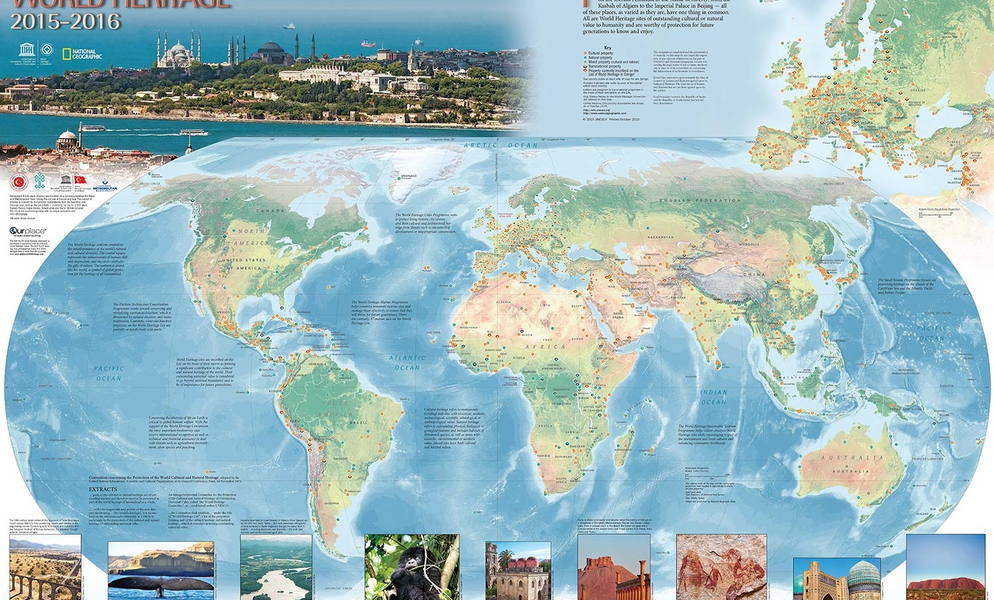
The latest version of the World Heritage map, produced by the UNESCO World Heritage Centre and National Geographic Maps with the generous support of Turkey, can now be ordered from the World Heritage Centre website.

The featured image on the Map presents the Historic Areas of Istanbul in Turkey, the country hosting the next session of the World Heritage Committee in July 2016.

The poster-sized wall map features all 1,031 World Heritage properties and is illustrated with photos with detailed captions. It also presents brief explanations of the World Heritage Convention and its related marine, earthen architecture and other conservation programmes.

Interested?

Make a donation and receive a free World Heritage map
Order your copy in English, French or Spanish
Download previous World Heritage maps

5 July 2015

World Heritage Committee inscribes new world heritage sites

P1350368
The Singapore Botanic Gardens entrance from Botanic Gardens MRT station.

The World Heritage Committee has inscribed the Singapore Botanic Gardens (SBG) as a UNESCO World Heritage Site at the 39th session of the World Heritage Committee (WHC) in Bonn, Germany. The committee noted that the site "demonstrates the evolution of a British tropical colonial botanic garden that has become a modern world-class scientific institution used for both conservation and education", and that it has been an important centre for science, research and plant conservation, notably in connection with the cultivation of rubber plantations, in Southeast Asia since 1875.

According to the SBG, the gardens is the first and only tropical botanic garden on the UNESCO’s World Heritage List. It is the first in Asia and the third botanic gardens inscribed in the world following Orto botanico di Padova in Italy and the Royal Botanic Gardens, Kew, in the UK.

The inscription bid process started in 2010 following a feasibility study commissioned by the then-Ministry of Information, Communications and the Arts, in consultation with experts, academics and other stakeholders. Singapore formally submitted the official Nomination Dossier for the bid in January 2014.

The World Heritage Committee also approved the inscription of the Diyarbakir Fortress and Hevsel Gardens Cultural Landscape in Turkey; China's Tusi SitesSusa and the Cultural Landscape of Maymand, both in Iran; the Baekje Historic Areas in Korea; the Great Burkhan Khaldun Mountain and its surrounding sacred  landscape, in Mongolia; Bethany Beyond the Jordan; and the rock art in Hail in KSA.


Source: UNESCO World Heritage Committee nomination file. Diyarbakır Fortress and Hevsel Gardens Cultural Landscape, Hevsel Gardens and Kırklar Hill, copyright: © Diyarbakır Metropolitan Municipality - Site Management Unit, author: Zeynep Sıla Akıncı.

Turkey
The Diyarbakir Fortress and Hevsel Gardens Cultural Landscape are on an escarpment of the Upper Tigres River Basin. The fortified Turkish city of Diyarbakir and the landscape around has been an important centre since the Hellenistic period, through the Roman, Sassanid, Byzantine, Islamic and Ottoman times to the present. The site encompasses the Amida Moundknown as İçkale (inner castle), the 5.8km-long city walls of Diyarbakir with their numerous towers, gates, buttresses, and 63 inscriptions from different periods, as well as Hevsel Gardens, a green link between the city and the Tigris that supplied the city with food and water.


Source: The Zunyi Huichuan District Party Committee Publicity Department. Snow-Covered Feifeng Pass. 

China
Located in the mountainous areas of southwest China, Tusi (土司) sites encompass remains of several tribal domains whose chiefs were appointed by the central government as ‘Tusi’, hereditary rulers from the 13th to the early 20th century. The Tusi system made the autonomous rule by minorities a reality, and facilitated the development of ethnic diversity, strengthened national unity, ensured borderland security, and promoted the peaceful coexistence of the central government and local minority regimes.

The sites of Laosicheng (老司城) in Yongshun County, Hunan; Tangya (唐崖) in Xianfeng County, Hubei; and Hailongtun Fortress (海龙屯城堡) in Zunyi, Guizhou that make up the site bear testimony to this form of governance, which derived from the civilisation of the Yuan and Ming periods.

Hailongtun fortress was built in 1257 CE. The Tusi arrangement was a collaboration between the central government of the Song dynasty and the Yang family, which built and owned the fortress. The family governed the area for more than 700 years, spanning Tang, Song, Yuan and Ming dynasties, from Yang Rui from the Liao ethnic group in 876 during the Tang dynasty, to Yang Yinglong, the last Tusi of Bozhou (present day Zunyi) and the 29th governor of the Yang family, died in 1600.

Being listed on the World Heritage List will promote studies on the Tusi culture and the history of Bozhou, according to the Office of the Application to World Heritage for Hailongtun, Huichuan District, Zunyi in China. The organisation noted that with Guizhou province's first cultural heritage site, it plans to strengthen the preservation and excavation of historical relics within the territory, and apply for more world cultural heritage listings.

Iran
Susa in southwest Iran, in the lower Zagros Mountains, consists of a group of archaeological mounds on the eastern side of the Shavur River, as well as Ardeshir’s palace, on the opposite bank of the river. Susa contains several layers of superimposed urban settlements in a continuous succession from the late 5th millennium BCE until the 13th century CE*. The site bears exceptional testimony to the Elamite, Persian and Parthian cultural traditions, which have largely disappeared.

Maymand is a self-contained, semi-arid area at the end of a valley at the southern extremity of Iran’s central mountains. The villagers are semi-nomadic agro-pastoralists. They raise their animals on mountain pastures, living in temporary settlements in spring and autumn. During the winter months they live lower down the valley in cave dwellings carved out of the soft rock (kamar), an unusual form of housing in a dry, desert environment.  This cultural landscape is an example of a system that appears to have been more widespread in the past and involves the movement of people rather than animals.

Korea
The Baekje (백제) Historic Areas, in the mountainous midwestern region of the Republic of Korea, comprise eight archaeological sites dating from 475 to 660 AD, including the Gongsanseong fortress and royal tombs at Songsan-ri related to the capital, Ungjin (present day Gongju), the Busosanseong Fortress and Gwanbuk-ri administrative buildings, and the Naseong city wall related to the capital, Sabi (now Buyeo), the royal palace at Wanggung-ri and the Mireuksa Temple in Iksan related to the secondary Sabi capital.

Together, these sites represent the later period of the Baekje Kingdom – one of the three earliest kingdoms on the Korean peninsula (18 BCE to 660 CE) –during which time they were at the crossroads of considerable technological, religious (Buddhist), cultural and artistic exchanges between the ancient East Asian kingdoms in Korea, China and Japan.

Mongolia
The Great Burkhan Khaldun (Бурхан Халдун) Mountain and its surrounding sacred landscape is in northeast Mongolia in the central part of the Khentii mountain chain. Burkhan Khaldun is associated with mountain worship. The site is also believed to be the place of Genghis Khan’s birth and burial.

Jordan
The baptism site “Bethany Beyond the Jordan” (Al-Maghtas, المغطس) is on the east bank of the River Jordan, and consists of two distinct areas: Tell Al-Kharrar (تَل الخرّار), also known as Jabal Mar-Elias (Elijah’s Hill, جبل مار إلياس) and the area of the churches of Saint John the Baptist near the river. The site is believed to be the location where Jesus of Nazareth was baptised by John the Baptist. It features Roman and Byzantine remains.

KSA
Rock art in the Hail (حائل) region of Saudi Arabia includes both Jabel Umm Sinman at Jubbah (جبة) and the Jabal al-Manjor and Raat at Shuwaymis (ال شوويمس). The ancestors of today’s Arab populations have left traces of their passages in petroglyphs and inscriptions on the rock face, covering 10,000 years of history.

Vietnam
The Committee has additionally extended Phong Nha-Ke Bang National Park (Kẻ Bàng) in Vietnam, a natural site inscribed on the World Heritage List in 2003. The extension ensures a more coherent ecosystem while providing additional protection to the catchment areas that are of vital importance for the integrity of limestone landscapes.

The site originally covered 85,754 hectares and now covers a total surface area of 126,236 hectares (a 46% increase). The Park’s landscape is formed by limestone plateaux and tropical forests. It features great geological diversity and offers spectacular phenomena, including a large number of caves and underground rivers.

Other developments during the World Heritage Committee discussions include inscribing a number of World Heritage sites  on the List of World Heritage in Danger due to damage inflicted to the property by armed groups. These include Hatra in Iraq and the Yemeni cities of Sana’a and Shibam.

Iraq
Hatra was a fortified city which grew under the influence of the Parthian Empire and was the capital of the first Arab kingdom. It withstood Roman invasions in 116 and 198 AD thanks to its walls, which are reinforced by towers.

World Heritage Committee members have declared their willingness to help Iraq as soon as the situation on the ground will allow them to do so. The Committee stressed that the danger listing of Hatra was a way to rally the support of the international community for the country’s heritage.

Two other Iraqi sites are also on the World Heritage List in Danger: Ashur (inscribed on the World Heritage List in 2003) and Samara Archaeological City (inscribed on the World Heritage List in 2007).

Yemen
The World Heritage Committee has voiced concerns about the damage to the old city of Sana’a (سناء) due to armed conflict in Yemen. Situated in a mountain valley at an altitude of 2,200 m, Sana’a has been inhabited for more than 2,500 years. Its religious and political heritage can be seen in 103 mosques, 14 hammams and over 6,000 houses, all built before the 11th century. The neighbourhood of al Qasimi and the 12th century al-Mahdi Mosque have been affected.


The Committee also noted that the Old Walled City of Shibam (شِبَام) in Yemen is under potential threat from the armed conflict, which compounds safeguarding and management problems already observed at the site. The Committee decided that adding it to the List of World Heritage in Danger could help reinforce international mobilisation for the safeguarding of the site.


Surrounded by a fortified wall, the 16th-century city of Shibam is one of the oldest and best examples of urban planning based on the principle of vertical construction. 

The 39th session of the World Heritage Committee started on 28 June and will continue till 8 July under the chair of Maria Böhmer, Minister of State at the German Federal Foreign Office and member of the Bundestag. The inscription of sites will continue through 5 July.

*BCE stands for 'before common era', corresponding to BC, and CE for common era, corresponding to AD.

24 April 2015

L'Oréal creates beauty snapshot of Turkey

L'Oréal continues to listen to real people worldwide in its quest for innovation, most recently visiting  the streets of Istanbul asking Turkish men and women what is beauty for them. 

Here's what they found out:
Source: L'Oréal.

19 March 2015

Garuda and Turkish Airlines enter into codeshare agreement

Garuda Indonesia and Turkish Airlines are implementing a codeshare agreement from Jakarta to Istanbul and vice versa. This new agreement is in effect from until October 24 2015.

The updated codeshare flight schedule between Garuda Indonesia and Turkish Airlines is as follows:


Source: Garuda Indonesia. CGK is the airport code for Soekarno–Hatta International Airport in Jakarta, Indonesia, while IST is the airport code for Atatürk International Airport in Istanbul, Turkey. STD refers to the time of departure, and STA to the time of arrival. +1 next to a number indicates that arrival is on the next day.

Enquiries on the codeshare agreement should be directed to +62 8041 807 807 or +6221 2351 9999.

11 August 2014

Cowork at a beach resort, make new connections

Startup events and incubation programmes are typically local or held over short periods. The organisers of Coworking Camp are addressing the need to network farther afield for a longer time with an upcoming six-week programme that allows startups and digital nomads to network and develop business opportunities with likeminded individuals at a comfortable pace.

Source: Coworking Camp website.

“Even though new coworking spaces are opening every day, and there is a flurry of startup events and incubation programmes, it is sometimes difficult to make meaningful connections with other startups from different cities. Coworking Camp is specifically designed to let you meet founders that can help you to grow your network and to help each other to reach the next stage in your business. Plus it provides the opportunity to relax and recharge your batteries for a week or two,” says Matthias Zeitler, the Chief Coworker.

Coworking Camp was conceptualised by Romy Sigl, Owner, Coworking Salzburg, and Matthias Zeitler, Founder and CEO of MarkTheGlobe, a global search engine optimisation (SEO) company.

Many of the event formats used at Coworking Camp were invented at Coworking Salzburg. Sigl organised the first Coworking Camp in El Gouna, Egypt in March 2014. Thirty-nine entrepreneurs, startups and makers attended a week of networking and workshops, and the organisers say the outcome exceeded everyone's expectations, with strong relationships built and long-term collaborations begun.

For Coworking Camp Turkey, Coworking Camp provides a temporary coworking space at off-season rates at a five-star resort in Kemer, Turkey, by the beach. Participants may choose to stay the full six weeks from November 3 to December 15, 2014, or for a minimum of a week.

Source: Majesty Mirage Park Resort website.

Events held at Coworking Camp include speed networking, a Showtime presentation session, and group discussions, with ample time to focus on day-to-day work activities. Optional sightseeing activities are available on the weekends. 

Zeitler noted that Middle Eastern and Asian incubators have said that their Founders find Coworking Camp Turkey of interest as they can meet founders from Europe and also because it is easy for them to get a visa for Turkey. "We already have Middle Eastern and Asian startup registrations from Pakistan, UAE, and the Philippines," he said.

A ticket for three weeks costs €350 and includes a coworking membership, access to all events, and a fixed desk at an open desk area at the Majesty Mirage Park Resort.

Hotel accommodation and the cost of travel need to be paid separately. The organisers estimate that it would cost €400 for a week and €1,500 for six weeks for the all-inclusive hotel accommodation and the flight to the Antalya region in Turkey.